Unit 5 AP Psych
 Studied by 2 people
 Call Kai
 Learn
Learn Practice Test
 Spaced Repetition
 Match
Match Flashcards
 Knowt Play
1/198

Earn XP
Description and Tags
Name | Mastery | Learn | Test | Matching | Spaced | Call with Kai |
|---|
No analytics yet
Send a link to your students to track their progress
199 Terms
Health Psychology
a field that explores how biological, psychological, and social factors influence health and illness.
It examines behaviors, thoughts, and emotions related to health, as well as how individuals and communities can promote well-being and prevent illness.
Physical Health
how behaviors such as diet, physical activity, substance use, and adherence to medical recommendations impact health.
Wellness
Cognitive processes play a crucial role in health behaviors and outcomes. Beliefs, attitudes, and perceptions about health and illness influence decisions regarding healthcare seeking, treatment adherence, and preventive behaviors.
Stress
The physiological and psychological response to challenges or demands that exceed an individual's coping abilities.
Physical Effects of Stress
Hypertension
Headaches
Immune Suppression
Eustress
refers to positive stress that motivates individuals to achieve goals, improve performance, and enhance well-being.
Distress
is negative stress that exceeds an individual's ability to cope effectively, leading to feelings of anxiety, frustration, or overwhelm.
Chronic Stress
a prolonged state of feeling pressured and overwhelmed, where the body's stress response system stays activated, leading to serious mental and physical issues
Stressors
Traumatic Events
Daily hassles
Adverse Childhood Experiences (ACEs)
Traumatic Events
An event or incident that causes you physical, emotional, spiritual, or psychological harm
Daily Hassles
minor stressful events and irritations that occur on a regular basis in an individual's everyday life
Adverse Childhood Experiences (ACEs)
Abuse, neglect, household challenges
General Adaptation Syndrome (GAS)
Aims to explain the body's universal, three-stage (alarm, resistance, and exhaustion) physiological response to any significant stressor someone experiences
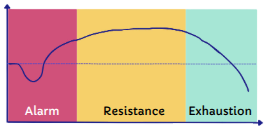
Alarm
occurs as the sympathetic nervous system is suddenly activated.
Resistance
all resources are summoned to meet the challenge. As time passes, with no relief from stress, the body’s reserves begin to dwindle.
exhaustion
With this, the body becomes more vulnerable to illness or even, in extreme cases, collapse and death.
Tend-and-Befriend Theory
Proposes that in response to stress, individuals, especially women, are biologically predisposed to seek social connections and support (befriending) and nurture others (tending).
Tend Example
Bringing food to your sick significant other
Befriend Example
Calling your significant other after they have had a bad day
Problem-Focused Coping
involves actively managing or altering stressful situations through direct actions or problem-solving strategies.
Emotion-Focused Coping
involves regulating emotional responses to stressors, rather than altering the stressors themselves.
This approach aims to manage the emotional distress caused by stressors through strategies like seeking emotional support, distraction, or reframing the situation. (Deep breathing / Meditation / Medication)
Positive Psychology
Focuses on the study of human strengths and well-being, aiming to understand and promote factors that allow individuals and communities to thrive.
It emphasizes positive emotions, character strengths, and constructive experiences to foster optimal functioning and happiness.
Expressing Gratitude
involves recognizing and appreciating the positive aspects of life and the kindness of others.
Signature Strengths
Positive psychology identifies six core virtues that encompass various character strengths.
Cultivating these virtues promotes personal development, resilience, and ethical behavior.
They contribute to a fulfilling and purposeful life, guiding individuals toward actions that align with their core values and enhance societal well-being.
Signature Strength: Courage
Emotional strengths that involve the exercise of will to accomplish goals in the face of opposition.
Bravery, Honesty, Perseverance, Zest
Signature Strength: Humanity
Interpersonal strengths that involve tending and befriending others.
Kindness, social intelligence, love
Signature Strength: Justice
Civic strengths that underlie healthy community life.
Fairness, Leadership, Teamwork
Signature Strength: Temperance
Strengths that protect against excess.
Forgiveness, humility, prudence, self-reg.
Signature Strength: Transcendence
Strengths that forge connections to the larger universe and provide meaning.
Appreciation of beauty & excellence, hope, humor, gratitude, spirituality
Signature Strength: Wisdom
Cognitive strengths that involve acquiring and using knowledge.
Creativity, Curiosity, perspective, judgement, love of learning
Posttraumatic Growth
Positive psychological change experienced as a result of struggling with highly challenging life circumstances.
Finding new meaning, personal strength, and appreciation for life following adversity.
Psychological Disorders
Conditions characterized by abnormal thoughts, feelings, and behaviors. These disorders cause significant distress or impairment in personal, social, occupational, or other important areas of functioning.
Level of Dysfunction
Refers to the extent to which a person's thoughts, feelings, and behaviors interfere with their ability to perform daily activities
Perception of Distress
Involves the subjective experience of emotional or psychological pain. It is a critical factor in identifying psychological disorders, as individuals may seek help when their distress becomes unbearable.
Deviation from Social Norms
Behaviors, thoughts, or feelings that significantly differ from what is considered typical or acceptable within a society or culture.
Dysfunction
Causes interference with life
Distress
Unpleasant & upsetting
Deviance
Different, extreme, unusual
Danger
Poses risk of harm to themselves or others
Positive Consequences of Diagnosing
Access to Treatment & Support
Understanding & Connection
Reducing Self-Blame
Negative Consequences of Diagnosing
Stigma
Self-Limiting Identity
Potential for Misdiagnosis
Negative Social/Employment Outcomes
Diagnostic and Statistical Manual of Mental Disorders (DSM)
A comprehensive classification system published by the American Psychiatric Association (APA) that provides standardized criteria for diagnosing mental disorders. It is widely used by clinicians and researchers in the United States and internationally
offers a common language for diagnosing and understanding psychological disorders, ensuring consistency and reliability in mental health assessments and treatments.
International Classification of Diseases (ICD)
Global health information standard maintained by the World Health Organization (WHO).
includes a section on mental and behavioral disorders, providing diagnostic criteria and codes for mental health conditions.
used internationally, promoting a standardized approach to diagnosing and treating mental disorders across different countries and cultures.
It facilitates global health reporting and research.
Sets forth specific diagnostic criteria for disorders and helps differentiate between disorders
What does the DSM do?
Eclectic Approach
Using a combination of techniques and theories from various therapeutic schools (such as cognitive-behavioral, psychodynamic, and humanistic) to customize treatment for a client's specific needs
Behavioral Perspective
Views psychological disorders as maladaptive behaviors learned through conditioning.
emphasizes observable behaviors rather than internal processes. Disorders are seen as the result of improper learning experiences, where inappropriate behaviors have been reinforced or adaptive behaviors have not been adequately learned
* Classical conditioning, Operant conditioning, Observational learning
Psychodynamic Perspective
views psychological disorders as stemming from unconscious conflicts, childhood experiences, and repressed emotions.
Disorders are believed to arise from unresolved internal conflicts and the influence of unconscious forces on behavior.
Humanistic Perspective
emphasizes personal growth, self-actualization, and the achievement of one's potential.
Psychological disorders are viewed as barriers to personal growth caused by conditions that thwart self-actualization, such as lack of unconditional positive regard or failure to meet basic needs.
Cognitive Perspective
Views psychological disorders as resulting from faulty or distorted thinking patterns. Cognitive distortions, such as overgeneralization or catastrophic thinking, lead to maladaptive behaviors and emotions.
Evolutionary Perspective
Explains psychological disorders in terms of adaptive functions that have become maladaptive in modern environments.
Traits or behaviors that were advantageous for survival and reproduction in ancestral environments may contribute to disorders today due to mismatches with contemporary living conditions.
Sociocultural Perspective
emphasizes the role of societal and cultural influences on psychological disorders.
It considers factors such as social norms, cultural expectations, and socio-economic conditions as significant contributors to the development and expression of disorders.
Biological Perspective
Attributes psychological disorders to biological factors such as genetics, neurochemical imbalances, and brain abnormalities.
Disorders are seen as medical conditions that can be treated with pharmacological and medical interventions.
Biopsychosocial Model
A holistic framework viewing health and illness as an interplay of Biological, Psychological, and Social factors
Biological Factors
Genetic predispositions, neurochemical imbalances, brain abnormalities, and other physiological influences that can affect mental health.
Psychological Factors
Cognitive patterns, emotional responses, personality traits, and coping mechanisms that influence how individuals perceive and respond to stressors.
Social Factors
Environmental influences such as family dynamics, social support, cultural norms, socioeconomic status, and life events that impact mental health.
Diathesis-Stress Model
suggests that psychological disorders develop due to a combination of a predisposition (diathesis) and environmental stressors
diathesis can be genetic, biological, or psychological, and it predisposes an individual to a disorder, but the disorder manifests only when significant stress triggers it.
Diathesis
An underlying vulnerability or predisposition that can be genetic, biological, or psychological in nature.
Neurodevelopmental Disorders
a group of conditions that typically manifest early in development, often before the child enters grade school.
These disorders are characterized by developmental deficits that produce impairments in personal, social, academic, or occupational functioning.
Attention-Deficit / Hyperactivity Disorder (ADHD)
affects executive functions, including planning, organization, and impulse control.
This can lead to academic challenges, difficulties in social relationships, and lower self-esteem.
Inattention
Difficulty with organization and attention to detail
Struggles in or avoids tasks that require sustained mental effort
Quickly loses focus and is easily sidetracked
Hyperactivity and impulsivity
Difficulty or uncomfortability in being still for extended periods of time
Often unable to play or engage in leisure activities quietly
Excessive talking or blurting
Difficulty waiting for turn
ADHD Treatment
Stimulant drugs calm hyperactivity and increase ability to sit and focus. So do behavior therapy and aerobic exercise.
Psych therapies help with the distress
Autism Spectrum Disorder (ASD)
affecting social skills, communication, and behavior, characterized by a wide range of symptoms and support needs
Often associated with significant problems with social communication and social interaction across many different social situations; small numbers of interests and activities.
Deficits in social communication/interaction
Avoidance of eye contact
Difficulty initiating or maintaining back-and-forth conversation
Struggle with interpreting body language or emotional expression
Restricted, repetitive patterns of behavior, interests, or activities
Inflexible adherence to routines; can get upset when this is disrupted
Highly restricted, fixated interests
Sensitivity to sensory input or unusual interest in sensory aspects of the environment
Genetic Factors
Many neurodevelopmental disorders have a genetic basis, with specific genes and genetic mutations identified as contributing to these conditions. Family studies and twin studies provide evidence for the heritability of disorders like ADHD and ASD.
Environmental Factors
Prenatal exposure to toxins, infections, and stress can affect brain development and increase the risk of neurodevelopmental disorders. Postnatal environmental factors, such as exposure to lead and malnutrition, also play a role.
Physiological Factors
Abnormal brain development, including differences in brain structure, function, and connectivity, is a common feature of neurodevelopmental disorders. Neurotransmitter imbalances and atypical neural circuitry have been implicated in conditions like ADHD and ASD.
SCHIZOPHRENIA
A psychotic disorder characterized by disturbances in thinking (cognition), emotional responsiveness, and behavior, with an age of onset typically between the late teens and mid-30s.
Acute
denoting conditions or symptoms of sudden onset, short duration, and often great intensity.
Chronic
denoting conditions or symptoms that persist or progress over a long period of time and are resistant to cure.
Pos Symptoms
inappropriate behaviors that are present
Neg Symptoms
appropriate behaviors that are not present.
DELUSIONS
positive symptoms and may manifest in ways such as delusions of persecution or grandeur.
Delusions of persecution
Belief that one is going to be harmed, harassed, and so forth by an individual, organization, or other group).
Delusions of grandeur
When an individual believes that he or she has exceptional abilities, wealth, or fame).
HALLUCINATIONS
false perceptions, are positive symptoms and may involve one or more of the senses.
They are vivid and clear, with the full force and impact of normal perceptions, and not under voluntary control.
DISORGANIZED THINKING/SPEECH
positive symptom and may manifest as speaking in ways such as speaking in a word salad (stringing together words in nonsensical ways).
Word Salad
When words are thrown together without any logical connection (type of disorganized thinking / speech)
pos
Loose Associations
an individual will jump from one topic to another with little to no connection between the topics
pos
Tangential Speech
When an individual answers a question with answers that are unrelated to the question that was being asked
pos
Catatonic excitement
Categorized by sudden movements, with the individual becoming very active with unusual almost out of control movement
Pos
Catatonic stupor
Periods of little to no movement, where the individual appears unresponsive and immobile.
Neg
Flat Affect
A noticeable lack of emotion expression.
Neg
Alogia
significant reduction in the amount or content of speech
Neg
Possible Causes of Schizophrenia
Genetics
Prenatal virus exposure
Age of father at conception
Dopamine hypothesis
Brain structure
Brain tissue
Thalamus
Brain function
Thalamus
Amygdala
Frontal lobe
Dopamine Hypothesis
proposes that schizophrenia symptoms arise from abnormal dopamine activity
Researchers studying the brains of schizophrenia patients after death found an excess number of dopamine receptors, including a six-fold excess for the dopamine receptor D4.
Depressive disorders
characterized by the presence of sad, empty, or irritable mood along with physical and cognitive changes that affect a person’s ability to function.
Major Depressive Disorder (MDD)
characterized by a persistent and pervasive low mood, along with a range of emotional and physical symptoms.
Sad mood
Loss of pleasure in activities
Feelings of worthlessness Sleeping difficulties
Lack of motivation
Lasting 2+ weeks
Depressed Mood
Persistent feelings of sadness, emptiness, or hopelessness.
Anhedonia
Loss of interest or pleasure in activities once enjoyed.
Cognitive Impairment
Difficulty concentrating, making decisions, or thinking clearly.
Psychomotor Agitation
Restlessness or slowed movements and speech.
Suicidal Ideation
Recurrent thoughts of death, suicidal thoughts, or suicide attempts.
Persistent Depressive Disorder (PDD
a chronic form of depression characterized by a depressed mood lasting for at least two years in adults or one year in children and adolescents.
Chronic depressed mood
Appetite/Weight changes
Sleep disturbaces
Fatigue
Low Self-Esteem
Difficulty concentrating
Causes of depressive disorders
Biological
Neuroticism
Genetic
First-degree family member
Behavioral
learned helplessness
Social
ACEs
Cultural
Gender; Women may also be at risk for depressive disorders in relation to specific reproductive life stages, including in the premenstrual period, postpartum, and in perimenopause.
Cognitive
Maladaptive thoughts
Cognitive triad
Bipolar Disorder
a disorder in which a person alternates between the hopelessness and lethargy of depression and the overexcited state of mania
Bipolar 1
Manic Episodes, may/may not include depressive
Severe mania (7+ days that may require hospitalization)
Often include higher doses of mood stabilizers and intensive therapy
Bipolar 2
Hypomanic and depressive
Less severe manic eps for a few days
More frequent and prolonged depressive ep
focus on managing depression and hypomania; lower med doses
 Note
Note  Flashcards (127)