OVERVIEW OF EPIDEMIOLOGY TO CONCEPT OF DISEASE OCCURRENCE
 Call Kai
 Learn
Learn Practice Test
 Spaced Repetition
 Match
Match Flashcards
 Knowt Play
1/63

Earn XP
Description and Tags
Q4
Name | Mastery | Learn | Test | Matching | Spaced | Call with Kai |
|---|
No analytics yet
Send a link to your students to track their progress
64 Terms
Epidemiology
The study of distribution and determinants of health-related states and events in populations, and the application of this study to control health problems.
Basic Science of Public Health.
Epi
on or upon
Demos
people
Logos
the study
equal distribution
Goal: to ensure ______ of individuals who are sick, and those who should be treated right away.
Determinants
These are the risk factors and causes in understanding the process behind the occurrence of disease.
Frequency
Focuses on the relationship between the number of cases of a particular disease and the size of the population.
Pattern
Occurrence of health-related events by time, place, and person.
Disease
Refers to disorder of structure or function in humans, especially one that produces specific symptoms.
Epidemiologic Triad
It is used as the traditional model for infectious diseases.
It is also known as the Agent, Host, Environment Model.
It was proposed by John Wade Frost in 1928.
It consists of an external agent, a susceptible host, and an environment that brings host and agent together which results in disease through the interaction of the given three dynamic elements.
Agent
Infectious microorganism or pathogens.
It can be a physical, chemical, nutrient, mechanical, or social.
Host
Refers to the human who gets the disease.
Exposure, susceptibility, or response to a causative agent is influenced by risk factors.
It can either be influenced by:
Demographic Characteristics
Biological Characteristics
Socioeconomic Characteristics
Environment
Extrinsic factors that affect the agent and its opportunity for exposure to the host.
It is where the agent and host live.
It nourishes both agent and host.
Factors include:
Physical
Biological
Social
Infectious Disease Model
Involves the occurrence of Opportunistic Infection.
This type of infection affects persons who are immunocompromised greater than those who are healthy.
Causal Pies
It is concerned with the multifactorial nature of causation of particular disease.
It can be used for non-infectious diseases.
Uses pie as a representation of the different contributing factors to the development of a
disease.
It is developed by Kenneth J. Rothman in 1976.
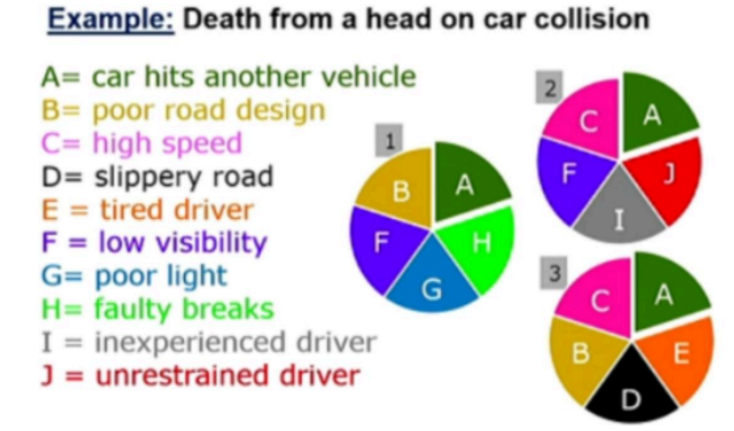
Component Cause
It contributes to an individual factor that contributes to causing disease.
It is shown as a piece of the pie.
Necessary Cause
It is the component that appears in every pie or pathway.
Without it, disease won’t occur.
Sufficient Cause
The complete pie or pathway to form a disease.
There can be two or more pies or pathways that lead to the development of a particular disease
Communicable Disease
It is brought by a specific infectious agent or its toxic products capable of being either directly or indirectly transmitted from man to man, animal to man, animal to animal, or from the environment.
These are usually acute.
These are infectious in nature, as they develop quickly in individuals, with a rapid onset, and short duration of diseases.
Only two are chronic:
HIV/AIDS
Leprosy (Mycobacterium leprae)
Non-Communicable Disease
A type of disease that occurs in an individual which cannot be transmitted towards another person.
Chronic in nature, as the disease takes place for a long time and progresses slowly.
Natural History of Disease
Refers to the sequence of events pertaining to the progression of a disease process.
Stage of Susceptibility
During this stage, an individual becomes more prone to develop a disease brought about by various factors and mainly due to a higher rate of exposure from the pathogen.
Susceptibility due to exposure.
NOTE: Exposure is the parameter that is looked at in this stage.
Stage of Subclinical Disease
As the disease progresses comes its influence in the physiological activities of the individual’s body without him/her being aware of them.
Pathologic changes already develop.
However, the person is asymptomatic.
Incubation Period
It happens from the time of exposure to onset of symptoms for infectious diseases.
Latency Period
It happens from the time of exposure to onset of symptoms for chronic diseases.
Stage of Clinical Disease
There is an involvement of Diagnosis in this stage, as symptoms start to appear in an individual.
Diagnoses are being made to validate the existence of an abnormality in the body, which may differ in terms of severity.
Alterations and affectations in the Activities of Daily Living (ADL) are present.
Involvement of Spectrum of Disease
The range as to the effect of disease process in an individual from mild to severe.
Infectivity
The proportion of exposed individuals, either symptomatic or asymptomatic, to infection.
Pathogenicity
Infected individuals who manifest and develop clinically apparent disease.
Virulence
Clinically apparent cases that are severe/fatal; life-threatening.
Stage of Recovery, Disability, or Death
It is the end result of experiencing the disease, whether he/she recuperates from the condition or it will worsen to death.
It could lead to irreversible complications or end of life of an individual.
Chain of Infection
The result of continuous interaction of the elements that could lead to the transmission of agent from one susceptible host to another.
Infectious Agent
Involves microorganism, especially in the form of pathogens, that brings forth diseases.
Reservoir
It serves as a “starting point” for the occurrence of communicable disease.
It is the source or habitat in which the agent normally lives, grows, and multiplies.
Portal of Exit
The path by which a pathogen leaves its host.
Usually corresponds to the site where the pathogen is localized.
Mode of Transmission
Involves the pattern as to how the infectious agent is spread from reservoir to the susceptible host.
Human Reservoir
Most common type of reservoir for infectious diseases transmitted from person to person.
It can either be Case or Carrier.
Case (SYMPTOMATIC)
Person identified as showing symptoms of particular disease and is under investigation.
Carrier (ASYMPTOMATIC)
Person with inapparent infection, but is capable of transmitting pathogen to others.
Animal Reservoir
Focuses on humans being incidental hosts in an animal to animal transmission.
Zoonosis
Infectious disease transmitted from vertebrate animals to humans.
Focuses on humans being incidental hosts in an animal to animal transmission.
Environmental Reservoir
Can be in the form of soil and other inanimate (non-living) matter.
Direct Transmission
Infectious agent is transferred from a reservoir directly to a susceptible host.
Direct Contact
Involves:
Skin-to-skin contact
Kissing
Copulation (Intercourse)
Droplet Spread
Involves:
Sneezing
Coughing
Talking
Indirect Transmission
Infectious agent is transferred from a reservoir to a susceptible host by suspended air particles, inanimate objects, and animate intermediaries.
Airborne
Carried by dust or droplet nuclei suspended in air.
Vehicle
Transmission through food, water, biologic products, and fomites.
Fomites
These are any contaminated substances.
Vectors
Carry an infectious agent through purely mechanical means.
Portal of Entry
Refers to the manner in which a pathogen enters a new susceptible host.
Susceptible Host
The final link in the chain of infection where an individual potentiates the development of disease.
Sporadic Disease
Disease that occurs infrequently and irregularly.
It is separated widely in time and place that they show no or little connection with each other.
Involves diseases that go on and off, just like seasonal diseases or cases.
It could be the starting point of an epidemic.
Endemic Disease
The constant presence and/or usual prevalence of a disease within a geographical area, all throughout the year.
Includes diseases that exclusively occur in one area.
Usual or expected frequency of disease within a population.
Hyperendemic Disease
Refers to persistent, high levels of disease occurrence.
Disease is constantly present at high incidence and/or prevalence rate.
Incidence Rate
Involves new cases; occurrence of cases.
Prevalence Rate
Combination of old and new cases, and how they relate to one another.
Epidemic Disease
The increase, often sudden, in the number of cases of diseases above what is normally expected.
Involves unusual occurrences in the community of disease.
The “excess” of expected occurrence.
Disease Outbreak
Shares a similar definition with epidemic, but it is used for more limited geographical area.
Meaning to say, the disease is confined only to a specific barangay or community.
It can turn into an epidemic once it worsens.
Disease Cluster
Refers to an aggregation of cases grouped in place and time.
Suspected to be greater or higher than the number expected.
If outbreaks occur in a specific location, clusters can occur in more specific areas.
Pandemic Disease
Refers to an epidemic that has spread over several countries or continents.
It usually affects a large number of people of a large portion of the population.
Involves Exotic Disease.
Diseases that are imported into a country in which they do not occur.
Factors that Increase the Cases of Diseases
Presence and increase of potency or virulence of disease agents.
Presence of pathogenic agent in an area or setting where it has not been before.
Enhanced mode of transmission, as more susceptible hosts are exposed.
Change in susceptibility of the host response to the pathogenic agent.
Factors that increase host exposure or involve introduction through new portals of entry.
Prevention and Control Program (Environmental Sanitation)
Study of factors in man’s physical environment which may have deleterious effects on his health, well-being, and survival.
Environment, Health, and Safety (EHS) Program
Responsible for the promotion of healthy environmental conditions and; ● Prevention of environmental-related diseases through appropriate sanitation strategies.
Major Programs
Health and Sanitation
Water Supply sanitation
Proper excreta and sewage disposal systems
Food sanitation program
Hospital waste management programs

