chapter 12- female reproductive system
0.0(0)
 Studied by 3 people
 Call Kai
 Learn
Learn Practice Test
 Spaced Repetition
 Match
Match Flashcards
 Knowt Play
Card Sorting
1/170

There's no tags or description
Looks like no tags are added yet.
Last updated 10:04 PM on 4/27/23
Name | Mastery | Learn | Test | Matching | Spaced | Call with Kai |
|---|
No analytics yet
Send a link to your students to track their progress
171 Terms
1
New cards
Gynecology
anatomy and physiology of the female genital system
2
New cards
Obstetrics
studies female reproduction, pregnancy, and childbirth
3
New cards
function of reproductive system
secrete female hormones, develop female secondary sexual characteristics, produce ova (eggs), menstruate, conceive and bear children, and produce milk to nourish infants
4
New cards
ovary
small, egg-shaped gland- the female gonads
5
New cards
uterus / womb
inverted pear-shaped organ held in place by ligaments
The fundus is the rounded top. \n –The body is the wide, central part. \n –The cervix is the narrow neck
The fundus is the rounded top. \n –The body is the wide, central part. \n –The cervix is the narrow neck
6
New cards
Anovulation
Failure of the ovaries to release a mature ovum even though the menstrual cycle is normal
7
New cards
Ovarian cancer
Cancerous tumor of an ovary; rarely symptomatic until quite large and metastasized
8
New cards
Salpingitis
infection or inflammation of the uterine tube
9
New cards
Polycystic ovary syndrome (PCOS)
Ovaries contain many semisolid cysts; follicles enlarge but fail to release an ovum. \n • Enlarged follicles turn into painful cysts. \n • Cysts eventually fill the ovaries
10
New cards
Endometrial cancer
Cancerous tumor of the endometrium of the uterus; earliest symptom is abnormal bleeding
11
New cards
Leiomyosarcoma
Cancerous tumor of the smooth muscle of the uterus
12
New cards
Endometriosis
Development of endometrial tissue in the uterine tubes and pelvic cavity; caused by upward flow of sloughed off endometrium
13
New cards
Myometritis
Inflammation or infection of the uterine muscle; when accompanied by pus, it is pyometritis
14
New cards
Pelvic inflammatory disease (PID)
Infection that spreads from the cervix to the uterus, uterine tubes, and ovaries; often caused by a sexually transmitted disease
15
New cards
Uterine prolapse
Downward movement of the uterus due to ligament stretching or pelvic floor muscle weakness; associated with childbirth and age
16
New cards
Follicle-stimulating hormone (FSH)
follicle enlargement and ovum maturation
17
New cards
Luteinizing hormone (LH)
causes the follicle to rupture and release the ovum
18
New cards
Estradiol
type of estrogen that produces the female secondary sexual \n characteristics that occur during puberty
19
New cards
Amenorrhea
The absence of menstrual periods due to hormone imbalance, disease, or stress
20
New cards
Dysmenorrhea
Painful menstruation due to excess prostaglandin, endometriosis, pelvic inflammatory disease (PID), or uterine fibroids
21
New cards
Menopause
Normal cessation of menstrual periods in middle \n age; ovulation stops and the menstrual period ceases
22
New cards
Menorrhagia
Menstrual period with excessively heavy flow or a menstrual period lasting more than 7 days; caused by hormone imbalance, fibroids, or endometriosis
23
New cards
Oligomenorrhea
Very light menstrual flow or infrequent menstrual periods in a woman who previously had normal periods; caused by hormone imbalance
24
New cards
Premenstrual syndrome (PMS)
Breast tenderness, fluid retention, bloating, and mild mood change in the days before menstruation; caused by high hormone levels
25
New cards
Cervical cancer
Cancerous tumor of the cervix that involves dysplasia, ulceration, and bleeding. \n • HPV infection is a predisposing factor. \n • When localized to one site, it is considered carcinoma in situ (CIS)
26
New cards
Cervical dysplasia
Abnormal growth of squamous cells in the surface layer of the cervix; precancerous condition that can be caused by HPV infection
27
New cards
Bacterial vaginosis
Bacterial infection caused by Gardnerella vaginalis; there is a white or gray discharge with a fishy odor
28
New cards
Candidiasis
Yeast infection caused by Candida albicans, often during an antibiotic regimen; there is itching and leukorrhea
29
New cards
Cystocele
Herniation of the bladder into the vagina due to weakness of the vaginal wall
30
New cards
Dyspareunia
Difficult or painful intercourse or pain after intercourse; caused by infection, pelvic inflammatory disease (PID), endometriosis, or structural issues
31
New cards
Rectocele
Hernia of the rectum into the vagina due to weakness in the vaginal wall; can interfere with bowel movements
32
New cards
Vaginitis
Vaginal inflammation or infection. \n • Inflammation is due to irritation from chemicals in spermicides or douches. \n • Infection is due to yeast infection or bacterial or viral STD infection
33
New cards
Failure of lactation
Lack of milk production from the breasts after childbirth; caused by hyposecretion of prolactin from the anterior pituitary gland
34
New cards
Galactorrhea
Discharge of milk from the breast when a woman is not pregnant or breast feeding
35
New cards
Breast cancer
Cancerous adenocarcinoma of the lactiferous lobules; may be swelling, enlarged lymph nodes, nipple discharge, and peau d’orange
36
New cards
Abruptio placentae
Partial or complete separation of the placenta from the uterine wall prior to the third stage of labor; disrupts blood flow and oxygen to the fetus
37
New cards
Abnormal presentation
Birth position in which the head is not the presenting part. \n • Breech (feet first) \n • Transverse lie
38
New cards
Ectopic pregnancy
Pregnancy in which a fertilized ovum implants outside of the uterus, often in the uterine tube
39
New cards
Gestational diabetes mellitus
Temporary disorder of glucose metabolism during pregnancy; increased estradiol and progesterone block the action of insulin from the pancreas
40
New cards
Incompetent cervix
Premature dilation of the cervix during the second trimester of pregnancy; can result in miscarriage of the fetus
41
New cards
Mastitis
Inflammation or infection of the breast; caused by milk engorgement or Staphylococcus aureus
42
New cards
Morning sickness
Temporary nausea and vomiting in the first trimester of pregnancy due to elevated estradiol and progesterone
43
New cards
placenta previa
Incorrect position of the placenta in which it partially or completely covers the cervical canal; cervical dilation disrupts the connection between the placenta and uterus
44
New cards
Preeclampsia
Hypertensive disorder with increased blood pressure, edema, weight gain, and proteinuria; can progress to eclampsia with seizures
45
New cards
Postpartum hemorrhage
Continual bleeding after delivery from the site \n of placental separation; caused by \n hyposecretion of oxytocin
46
New cards
Premature labor
Regular uterine contractions of labor that begin before the fetus is mature enough to be born; the cervix dilates and blood and amniotic fluid leak
47
New cards
meconium
first stool- thick, greenish-black, and tar like
48
New cards
Apnea
Temporary or permanent cessation of breathing after birth; the immature nervous system fails to maintain a constant respiratory rate
49
New cards
Fetal distress
Decreased blood flow through the placenta or umbilical cord causes lack of oxygen to the fetus; fetal heart rate (FHR) decreases and meconium passes
50
New cards
Growth abnormalities
Growth problems associated with maternal illness, malnutrition, or smoking. \n • Small for gestational age (SGA) \n • Large for gestational age (LGA) \n • Appropriate for gestational age (AGA)
51
New cards
Jaundice
Yellow discoloration of the skin; due to inability of the newborn liver to conjugate bilirubin from red blood cells
52
New cards
Meconium aspiration
Inhalation of meconium that has been passed in the amniotic fluid; it can block the airway and cause respiratory distress or death
53
New cards
Nuchal cord
Umbilical cord wrapped around the neck of the fetus; a tight cord can impair blood flow to the brain, causing brain damage or death
54
New cards
Infant respiratory distress syndrome (IRDS)
Difficulty inflating the lungs to breathe due to a lack of the substance surfactant; occurs most often in premature infants who cannot yet make surfactant
55
New cards
BRCA1 and BRCA2
Blood test that shows whether a patient has inherited the BRCA1 or BRCA2 gene mutation; these mutations increase the risk for breast and ovarian cancers
56
New cards
Estrogen receptor (ER) assay
Cytology test that examines malignant breast cells for estrogen receptors; presence of receptors indicates that the tumor requires estradiol and progesterone to grow
57
New cards
Papanicolaou (Pap) test or smear
Cytology test to detect dysplasia or carcinoma in situ (CIS) of the cervix; cells are scraped from the cervix and placed on slides or in vials for microscopic examination
58
New cards
Antisperm antibody test
Laboratory test that detects antibodies against sperm in a woman’s cervical mucus. \n • Some antibodies attack the tail of the sperm and prevent swimming. \n • Others prevent penetration of the ovum by the sperm
59
New cards
Hormone testing
Blood test that determines the levels of FSH and LH released by the anterior pituitary and the levels of estradiol and progesterone released by the ovaries
60
New cards
Amniocentesis
Test of the amniotic fluid; ultrasound guidance is used to collect the fluid sample. \n • Chromosome studies indicate genetic abnormalities. \n • Include tests to indicate neural tube defect. \n • Also, tests to indicate fetal lung maturity
61
New cards
Pregnancy test
Blood test to detect human chorionic gonadotropin (hCG) secreted into the blood by a fertilized ovum; positive result is diagnostic of pregnancy, but ectopic pregnancy and hydatidiform mole give a false positive. \n Urine dip stick tests (over the counter pregnancy test) is looking for the presence of hCG as well
62
New cards
Ultrasonography
High-frequency sound waves that produce images of a developing fetus or structural abnormality of the pelvic organs
63
New cards
Colposcopy
Visual examination of the vagina and cervix using a lighted instrument with magnification
64
New cards
Gynecologic examination
Physical examination of the external and internal genital; patient is in the dorsal lithotomy position. \n • External genitalia are examined for lesions, rashes, and discharge. \n • Internal genitalia are bimanually examined for tenderness or masses. \n • Internal genitalia are visually examined using a speculum. \n • Pap test is performed
65
New cards
Breast self-examination (BSE)
Systematic palpation of all areas of the breast and underarm to detect lumps, masses, and enlarged lymph nodes; used to detect early signs of cancer
66
New cards
Tanner staging
System of five stages used to describe the development of the female breasts from childhood through puberty; also used to describe development of female genitalia
67
New cards
Mammography
X-ray procedure that creates an image of the breast; compresses and flattens the breast. \n • Xeromammography uses a photon beam and dry chemical developer. \n • MRI is used to create clearer images when there are multiple cysts
68
New cards
Amniotomy
Rupture of the amniotic sac with a hooked tool
69
New cards
Apgar score
Newborn assessment at 1 and 5 minutes following birth; low score indicates the need for special care
70
New cards
Assisted delivery
Facilitation of delivery using a vacuum extractor
71
New cards
Assisted reproductive technology (ART)
Procedures to assist in the process of conception
72
New cards
Epidural anesthesia
Local anesthesia of the abdomen, perineum, and legs during labor and delivery (L&D); anesthetic drug is injected into the epidural space
73
New cards
Obstetrical history
Documentation of past pregnancies and deliveries; uses the G/TPAL (gravida/term, premature, abortion, living) system. \n • Nulligravida \n • Primigravida \n • Multigravida
74
New cards
GTPAL
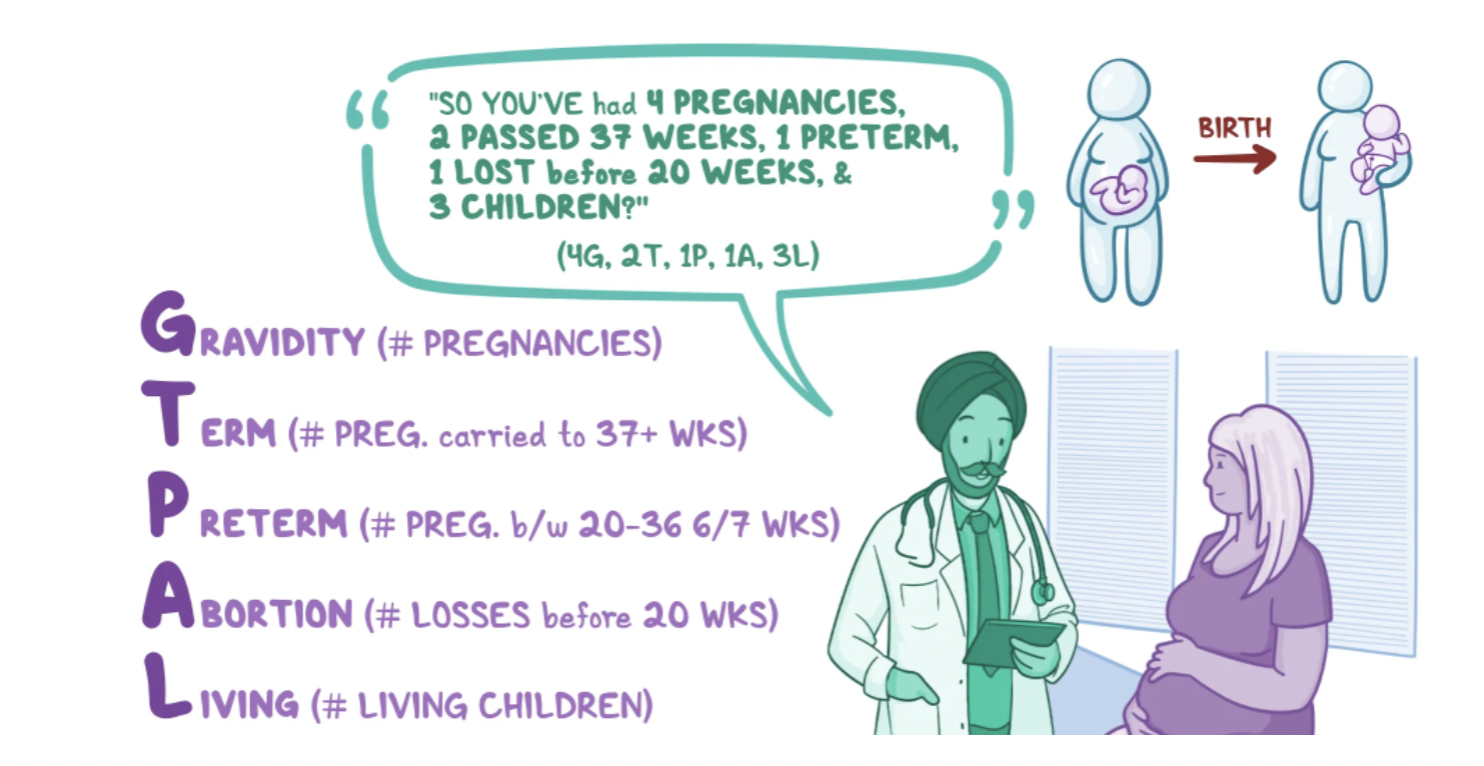
75
New cards
Antiyeast drugs
Topical treatment for Candida albicans infection
76
New cards
Drugs for amenorrhea
Correct a lack of hormones that contribute to amenorrhea and abnormal uterine bleeding
77
New cards
Drugs for contraception
Suppress the release of FSH and LH from the anterior pituitary to prevent pregnancy
78
New cards
Drugs for endometriosis
Suppress the menstrual cycle to cause atrophy of endometrial implants in the pelvic cavity
79
New cards
Drugs to dilate the cervix
Topical medications to dilate and efface the cervix during labor
80
New cards
Drugs to induce labor
Stimulate the uterus to increase the strength and frequency of uterine wall contractions
81
New cards
Hormone replacement therapy (HRT)
Treat the symptoms of menopause associated with a decreasing level of estradiol.
82
New cards
Nonsteroidal anti-inflammatories (NSAIDs)
Treat pain associated with dysmenorrhea.
83
New cards
Ovulation- stimulating drugs
Treat infertility by stimulating the anterior pituitary gland to secrete FSH and LH
84
New cards
Tocolytic drugs
Suppress uterine contractions to prevent premature labor and delivery
85
New cards
Biopsy (Bx)
Removal of a uterine tissue specimen to diagnose uterine bleeding and cancer; small specimens are collected through the vagina via catheter
86
New cards
Cryosurgery
Destruction of small areas of abnormal tissue in the cervix using a cryoprobe and extremely cold liquid nitrogen
87
New cards
Dilation and curettage (D&C)
Removal of abnormal tissue from inside the uterus using a curet that scrapes the endometrium
88
New cards
Endometrial ablation
Destruction of the endometrium using heat (laser, hot fluid, or electrode) or cold (cryoprobe) to treat dysfunctional bleeding
89
New cards
Hysterectomy
Removal of the uterus through the abdomen or the vagina
90
New cards
Oophorectomy
Removal of an ovary because of large ovarian cysts or cancer; bilateral oophorectomy removes both ovaries
91
New cards
Laparoscopy
Visualization of the abdominopelvic cavity, uterus, uterine tubes, and ovaries; tools can be used along with the scope to perform procedures
92
New cards
Salpingectomy
93
New cards
94
New cards
95
New cards
96
New cards
97
New cards
98
New cards
Reconstructive breast surgery
Rebuilds the breast after mastectomy; may use an implant, TRAM flap, or DIEP flap
99
New cards
Cerclage
Purse-string suture around the cervix to prevent premature dilation; removed prior to delivery
100
New cards
Cesarean section (C-section)
Surgical procedure to remove a fetus through an abdominal incision; done because of CPD, failure to progress, past due delivery, or medical problems
 Note
Note  Flashcards (229)