UNIT 3: FECAL CONCENTRATION TECHNIQUES
 Call Kai
 Learn
Learn Practice Test
 Spaced Repetition
 Match
Match Flashcards
 Knowt Play
1/23

There's no tags or description
Looks like no tags are added yet.
Name | Mastery | Learn | Test | Matching | Spaced | Call with Kai |
|---|
No analytics yet
Send a link to your students to track their progress
24 Terms
low;
negative;
Schistosoma and Taenia
Indications of Fecal Concentration
• When the number of organisms in the stool specimen is ____
• When the initial wet mount examination is _______
• When the detection of _______________ is required
protozoan cysts;
worm eggs & larvae
Advantages of Fecal Concentration:
1. Can recover all types of __________ and _________ (e.g., roundworms, schistosomes, tapeworms, and other flukes)
protozoan trophozoites
Disadvantages of Fecal Concentration:
1. Not recommended for ________________ (destroyed in the procedure)
T
T or F
Thus, whenever possible, the stool should be concentrated.
Sedimentation
Flotation
2 General Types of Concentration Techniques
Sedimentation
2 General Types of Concentration Techniques
In this technique eggs and cysts settle down at the bottom following centrifugation.
It involves concentration of stool specimens by centrifugation. The protozoan cysts and helminths eggs are concentrated at the bottom of the test tube because they have greater density than the suspending medium.
specific gravity lower ;
sediment.
2 General Types of Concentration Techniques
Sedimentation: Solutions of a _____________ than the parasitic organisms are used thus concentrating the eggs, cysts and other forms in the _______
Floatation
2 General Types of Concentration Techniques
Uses solutions which have higher SG than the organisms to be floated so that the organisms rise to the top and the debris sinks to the bottom
Floatation
2 General Types of Concentration Techniques
Produces a cleaner material than the sedimentation technique
eggs and cysts
2 General Types of Concentration Techniques
Floatation: the walls of ___________ often collapse, thus hindering identification;
some parasite eggs do not float
Acid Ether Concentration Technique
Formalin-Ether/Formalin-Ethyl Acetate Concentration Technique
Merthiolate-Iodine-Formaldehyde Concentration Technique
Types of Sedimentation
10mL of 10% formalin;
1 gram;
7mL mark;
3mL of ether, or ethyl acetate;
one minute;
supernatant;
Formalin-Ether Concentration Technique
• Procedure
1. Add ____________ to approximately _______ of feces and stir using an applicator stick, until it becomes a slightly cloudy suspension;
2. Fit a gauze pad into a funnel and place the funnel on top of the centrifuge tube;
3. Pass the fecal suspension through the pad into the centrifuge tube until the _______ is reached;
4. Remove the pad and discard it with the lumpy residue;
5. Add _________________________, and mix well for one minute;
6. Transfer back to the centrifuge tube and centrifuge for __________;
7. Loosen the fatty plug (i.e., debris) with an applicator stick, and pour away the ___________ by quickly inverting the tube.
8. Replace the tube in its rack and allow the fluid on the sides of the tube to drain down to the sediment. Mix well and transfer a drop to a slide for examination under a cover glass;
9. Use the 10x and 40x objectives to examine the whole area under the cover glass for ova, cysts, and larvae.
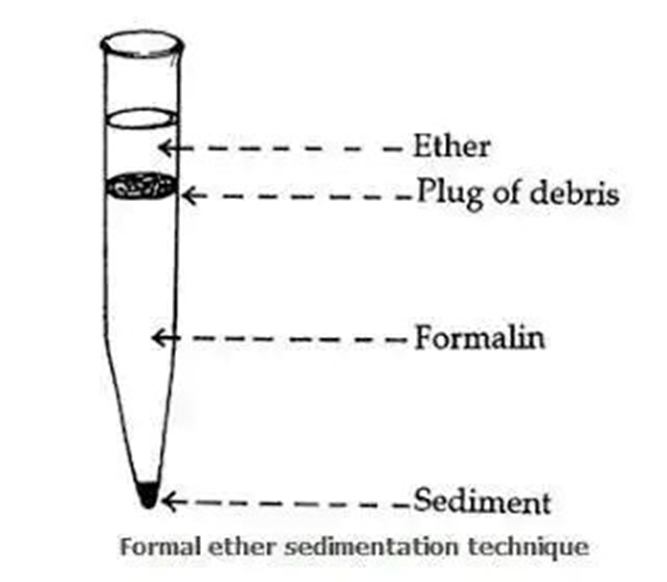
Name the parts in FECT
Formaldehyde-ether/ethyl acetate concentration
Used for the routine recovery of protozoan cysts, helminth larvae and ova, including operculates and schistosoma eggs
Hymenolepsis nana eggs
Giardia lamblia & Iadomoeba butschilii cysts
Formaldehyde-ether/ethyl acetate concentration
Disadvantages: Not for ___________________ and ____________________________
Brine flotation/saturated salt solution concentration
Sheather’s sugar centrifugal concentration
Zinc sulfate concentration
Types of Floatation
Brine flotation/saturated salt solution concentration
Types of Floatation
Used for the recovery of ova other than operculates and Schistosoma
Recommended for the screening of hookworms in a less suitable environment
Inexpensive, easy-to-perform (rapid)
Shrink = hookworm and strongyloides larvae, protozoan cysts, and Schistosoma eggs
Float = Clonorchis, Opistorchis, and Heterophyid fluke eggs
Brine flotation/saturated salt solution concentration
Shrink =
Float =
500 g table sugar
320 ml distilled water
phenol crystal melt in hot waterbath 6.5 g
Sheather’s sugar centrifugal concentration
Composition of Sheather’s sugar solution:
nematode eggs and protozoan cysts
Sheather’s sugar centrifugal concentration
Advantage: Reveals most ________________________
Fluke eggs and tapeworms
nematode larvae
Sheather’s sugar centrifugal concentration
Disadvantage: ___________________ are not demonstrated well;
most _______________ are not demonstrated well
1 gram;
1 part;
2 parts;
1,500 RPM for 10 minutes;
10 minutes
Sheather’s sugar centrifugal concentration
Ø Soften _______ of feces with water;
Ø Strain the aqueous suspension through a gauze;
Ø Mix ________ aqueous suspension with _____ of Sheather’s sugar solution;
Ø Pour into a centrifuge tube, centrifuge at ____________
Ø Pour the supernatant into a meniscus and add a sufficient solution to bring the meniscus to the top
Ø Place a coverslip and wait for _________;
Ø Examine under a microscope
Types of Floatation
Ø A simple and efficient method for the recovery of ova, larvae, and protozoan cysts
Ø Recommended for the mass examination of roundworm eggs and protozoan cysts
Ascaris, Trichuris, Trematodes, and Pseudophyllid eggs;
fatty stools
Zinc sulfate concentration
Disadvantage: not suitable for the recovery of _________________________
not convenient when working with ______

