DBB: 12 - Drug experience-dependent plasticity - glutamate and environment
 Call Kai
 Learn
Learn Practice Test
 Spaced Repetition
 Match
Match Flashcards
 Knowt Play
1/23

There's no tags or description
Looks like no tags are added yet.
Name | Mastery | Learn | Test | Matching | Spaced | Call with Kai |
|---|
No analytics yet
Send a link to your students to track their progress
24 Terms
how is all the evidence from (DBB: 11) a correlation
drug exposure → neuronal changes
drug exposure → behavioural changes
happen at the same time but does mean they caused each other
what causation do we want to find and how do we do that
the neuronal changes CAUSES behavioural changes
we would remove the neuronal changes to see if it also removes the behavioural changes
what do cocaine injections do to AMPAR surface expression and AMPAR/NMDAR ratios in the accumbens
increase them
what are the 2 types of major AMPARs
GluR2-containing AMPAR
GluR2-lacking AMPAR
explain what GluR2-containing AMPARs are
most adult neurons have AMPARs with GluR2-subunits
passes Na+ but NOT Ca2+
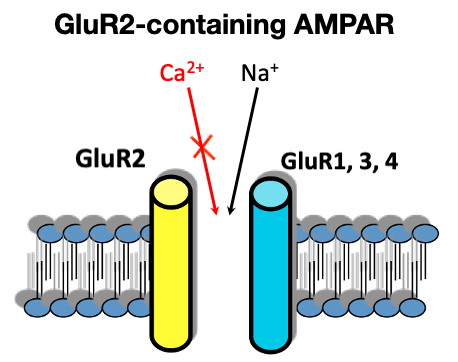
explain what GluR2-lacking AMPARs are
juvenile neurons have AMPARs withOUT GluR2-subunits - rare in adults
passes Na+ AND Ca2+
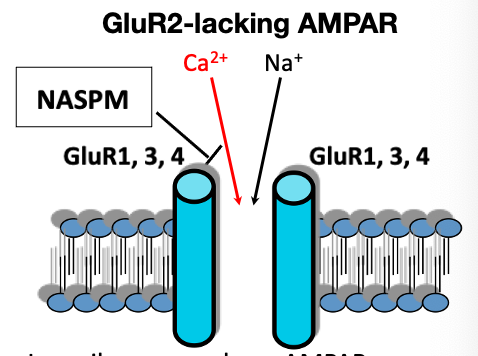
what does it mean that it passes both
more positivity → more plasticity (because Ca2+ has encourages more plasticity)
can look at the receptor specifically with NASPM antagonist
(1) Conrad et al (2008) procedure and findings
long term withdrawal from cocaine self-administration increases cocaine-seeking and altered AMPAR composition in NAc
rat self-administered for 10 days
looked at drug seeking on day 1 and 45 drug free in relation to NAc AMPAR subtypes
found:
drug seeking goes up as time goes on (incubation of cocaine-seeking) - we know this for all drugs
at day 1 - receptors were typical GluR2-containing
at day 45 - found more GluR2-lacking AMPARs
is this casual though
not yet - use NASPM antagonist
if we infuse NASPM directly into NAc to block GluR2-lacking receptors at day 1 and 45
what do we find
day 1 = drug seeking didn’t change (since there wasn’t anything to block yet)
day 45 = cocaine-seeking went down as GluR2-lacking receptors are now ‘blocked’
what we 3 studies findings on the importance of drug environment interactions
drug effects are influenced by ‘set and setting’
the environment modulates cocaine-induced alterations in NAc neuronal morphology
the environment modulates cocaine-induced glutamate release in NAc
what were 2 commonalities of these studies
repeated cocaine injections in ‘novel’ compared to home environments /context produced more robust locomotor sensitisation and more NAc spine density/glutamate release
cocaine administration environment modulates cocaine induced behaviour and neuronal activity
by why
because rats make cocaine-context association
its a learned association → association was recalled → produced a bigger effect when taking cocaine
how did Hubel and Wiesels work on the visual cortex inspire research into this question
they found that a specialised group or ‘ensemble’ of neurons encode specific stimuli
used in vivo electrophysiology revealed in visual cortex that a subset of neurons respond to bars of light in a certain orientation
e.g. a group of neurons responds to only diagonal bar, another group only to vertical bar etc.
so what is the hypothesis in relation to drug, environment and sensitisation
there must be a specific group of neurons that respond and store memories about specific environments and drug effects
what other technique can look at neuronal ensembles
imagine techniques
do neuronal ensembles also react to specific environments? Study (2)
distinct neuronal ensembles are activated by different environments contexts in hippocampus
a mouse explores two different environments (A and B) - differnet in terms of visual look
e.g. wall and floor pattern
hippocampus imaged live with activity sensors in mice
some neruons specifically react to context A, and others Context B
how does this relate to cocaine and context
well the NAc gets its information from the hippocampus which stores a lot of information about the environment and sends excitatory projections
study (3) Koya et al procedure and findings
cocaine-context associations modulate cocaine-induced behaviour and neuronal activity
paired group (aka novel group - taken to square chamber for cocaine)
once a day for 7 days → 7 days drug free test in square chamber → get sensitised (obvs)
non-paired group (control group - taken to a ‘non-home environment’ for cocaine injections)
once a day for 7 days → 7 days drug free test in square chamber (not location they got cocaine injection) → not sensitised at all
what does this show
that learned association between cocaine and cocaine administration environment plays a big role in modulating the two responses of behaviour and neuronal activity
need the previous learned cocaine association to get the sensitisation response
how can we show a potential causation for this
in the paired group about 2-3% of NAc neurons have Fos (more neurons activated → more sensitised)
so if this is what is causing sensitised response… remove Fos neurons to see if you still have that sensitised response
how would you selectively silence the Fos containing neurons
take regular rats but where Fos expressing neurons also have a beta-gal protein in them
Daun02 is a prodrug which interacts with beta-gal and causes neuronal death
so if you inject Daun02 into NAc → active neurons will express Fos → therefore beta-gal → and die
how did they do this in the original ‘paired group’ study
gave the Daun02 compound in the accumbens to paired group rats on ‘context day’ (with cocaine as well obvs)
this silences context A ensemble → kills of those cocaine-context neurons
and then on test day - sensitisation goes down
what happens when you bring rats to a different environment and inject cocaine
you should have a different group of neurons turned on and expressing beta-gal
so if you kill those neurons, the context A ensemble stay intact → if you bring them back to context A → the neurons aren’t damaged so they will sensitise

