4.1.8.8 - Public ownership, privatisation, regulation and deregulation of markets
 Call Kai
 Learn
Learn Practice Test
 Spaced Repetition
 Match
Match Flashcards
 Knowt Play
1/19

There's no tags or description
Looks like no tags are added yet.
Name | Mastery | Learn | Test | Matching | Spaced | Call with Kai |
|---|
No analytics yet
Send a link to your students to track their progress
20 Terms
Public Ownership =
State control of firms, industries or other assets
Nationalisation =
The transfer of assets from the private sector to public ownership
Examples of Nationalisation in UK
Network Rail in 2014
Bank of England in 1946
Arguments FOR Public Ownership / Nationalisation
Ability to Control Natural Monopolies
Natural monopoly is when the most efficient number of firms in an industry is one because of high entry costs meaning always achieving EOS
Therefore, if no nationalisation and controlled by private sector, it would create a private monopoly which might seek to set higher prices which exploit consumers → reduced allocative efficiency
Therefore, better to nationalise to have a public monopoly
Maximise Social Welfare
Gov will focus more on maximising social welfare rather than just maximising profits for shareholders. Can therefore:
Minimise negative externalities in production
Provide non-profit goods/services
Provide socially optimum level of g&s
Ensure prices are low and fair for consumers
Greater Control of Economy
Control of key strategic industries (coal, steel, rail, utilities) can be seen as best way to control an unstable market economy
Also, a single integrated system run by gov may be more efficient than multiple businesses operating simultaneously (e.g. one rail network, one road system)
Arguments AGAINST Public Ownership / Nationalisation
X-Inefficieny & Lack of Dynamic Efficiency:
Lack of competitive pressure & subsidies from gov leads to:
Organisational slack & average costs rise → X-inefficiency
Less pressure on managers to drive down unit costs → ↓Productive efficiency
Less incentive to reinvest in innovation & R&D + Less supernormal profit → ↓Dynamic efficiency
Lack of Expertise:
Often better managers & leaders are found in the private sector where the financial rewards are greater
Worsen Gov Finance:
Gov responsible for funding all the required costs of the industry → Large opportunity cost
Funding all capital investment
+ Gov will not collect any corporation tax revenue
Privatisation =
Sale of government owned (public owned) assets to the private sector
Examples of Privatisation in UK
Royal Mail in 2013
British Gas in 1986
British Airways in 1987
Arguments FOR Privatisation
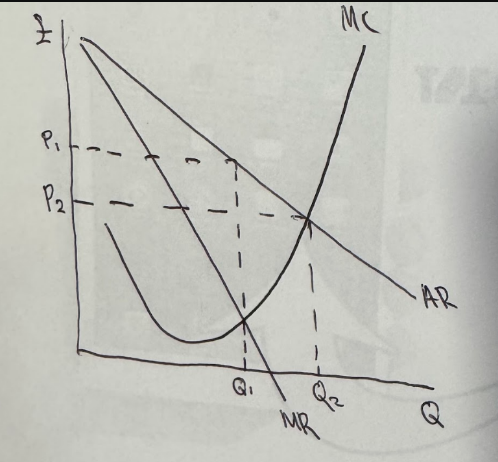
Monopoly vs PC diagram
Increased Competition Improves Efficiency
Competition & profit motive → firms incentivised to cut average costs → ↑Productive efficiency
To be competitive and survive, must cut unnecessary costs → ↓X-inefficiency
↑Price competition → firms undercut each other’s prices → Lower prices → ↑Allocative efficiency
↑Supernormal profits → ↑Dynamic efficiency
Improves Gov Finances
In SR, Sale of assets increases revenue
In LR, reducues public spending & borrowing + increases corporation tax rev
Arguments AGAINST Privatisation
Cannot Control Natural Monopolies
Natural monopoly is when the most efficient number of firms in an industry is one because of high entry costs meaning always achieving EOS
Therefore, if privatisation, it could create a private monopoly which might seek to set higher prices which exploit consumers → reduced allocative efficiency
If do attempt to split natural monopoly when privatising, loss of a lot of economies of scale → Less productive efficient
Loss of Social Welfare
Private firms focus on profit maximising rather than improving social welfare. Could lead to:
Increased negative externalities in production
Under-provide merit goods
High and unfair prices for consumers → ↓Allocative efficiency
Evaluating Privatisation (IDO’s)
The type of industry - industries that produce public goods should not be privatised as introducing profit motive does not make sense
Effectiveness of regulators - Need regulators to prevent abuse of monopoly power
Degree of contestability or competition - If low barriers to entry, competition likely to be healthy
Regulation =
Setting rules and controls that restrict market freedom
Example of Regulation in UK
2012 Financial Services Act in response to GFC, introduced the FCA, PRA & FPC to regulate financial services.
Arguments FOR Regulation
Allocative Efficiency
Max prices → ↑allocative efficinecy
Reduces Monopoly Power
Block mergers, break up monopolies
Max prices to limit monopoly profits
Health & Safety at work
Price Discrimination & Consumer Rights
Reduces Neg Externalities
Arguments AGAINST Regulation
Reduces possible benefits of Monopolies:
Reducing supernormal profits may eliminate R&D opportunities → ↓Dynamic efficiency
Costly:
Regulation requires lengthy investigations → large cost to taxpayers
Risk of Gov Failure:
Regulatory capture - regulatory agencies, meant to protect the public, instead promote the commercial interests of the industry they regulate → makes misallocation of resources worse
Free market argument:
Process of creative destruction will remove monopoly power in LR
Regulatory Capture =
A form of government failure where regulatory agencies, meant to protect the public, instead promote the commercial interests of the industry they regulate.
i.e. operating in favour of producers rather than consumers
Deregulation =
Removal of rules and controls that restrict market freedom in order to increase the efficiency of markets
Supply-side policy which removes barriers to entry
Deregulation Chain of Analysis
Deregulation is the removal of rules & controls that restrict market freedom.
This is a supply-side policy, which removes barriers to entry and thus facilitates contestability
This should increase both actual & potential competition
As a result, monopoly firms convert to monopolistic competition
Therefore, in LR, supernormal profits are eroded away.
Market price should become lower, closer to that of allocative efficiency
Example of Deregulation in UK
‘Big Bang’ - Deregulation of financial markets
Arguments FOR Deregulation
Increased competition:
Productive Efficiency
↑Competition → ↑Price competition → Firms need to minimise costs so they can offer similar prices → ↑Productive efficiency
Reduce X-Inefficiency:
↑Competition → Firms have to reduce unnecessary costs and cut organisational slack to survive → Reduces X-Inefficiency
Allocative Efficiency:
↑Competition → Price competition - firms undercut each other’s prices → Price falls closer to P=MC → More allocatively efficient
Improves consumer choice:
More alternative firms to buy from
Increased contestability:
Firms reduce prices due to threat of competition
No risk of regulatory capture
Arguments AGAINST Deregulation
Reduces possible benefits of Monopolies:
Reducing supernormal profits may eliminate R&D opportunities → ↓Dynamic efficiency
Price Discrimination & Consumer Rights
Neg Externalities

