IACA Testing Candidate Question Prep
 Call Kai
 Learn
Learn Practice Test
 Spaced Repetition
 Match
Match Flashcards
 Knowt Play
1/47

Earn XP
Description and Tags
This flashcard set includes recommended knowledge from Professor Hoffman a former crime analyst in Florida who is highly respected and all of the IACA's testing portion for the "hiring an analyst" section of their website which can be accessed here: https://www.iaca.net/hiring-an-analyst
48 Terms
Given a set of numbers, what is the mean?
Sample: 9, 4, 2, 5, 7, 4, 2, 3, 4, 3, 4, 8, 6, 7, 8
Mean = 5.067
Given a set of numbers, what is the median?
Sample: 9, 4, 2, 5, 7, 4, 2, 3, 4, 3, 4, 8, 6, 7, 8
Median = 4
Given a set of numbers, what is the mode?
Sample: 9, 4, 2, 5, 7, 4, 2, 3, 4, 3, 4, 8, 6, 7, 8
Mode = 4
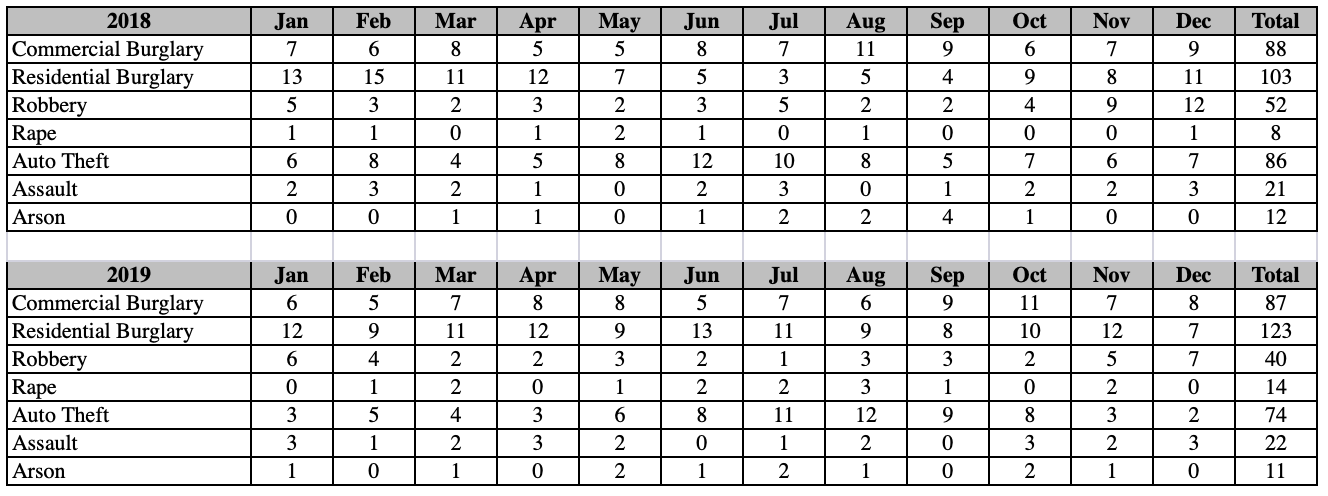
What is the percentage change in Robbery between 2018 and 2019?
-23%

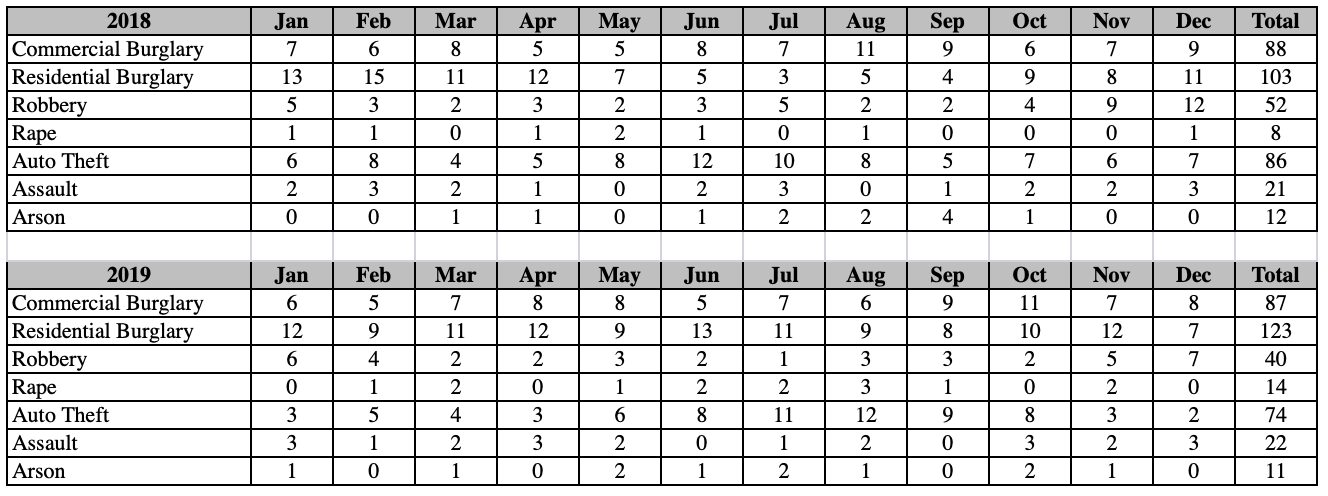
What is the percentage change in Residential Burglary between the last 6 months of 2018 and the last 6 months of 2019?
42.5%

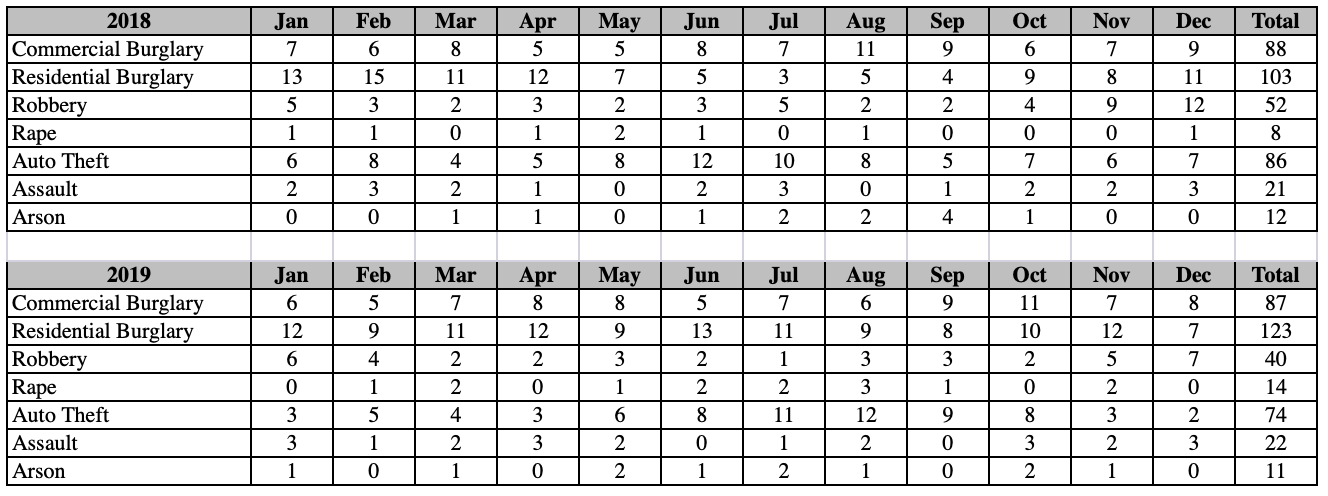
Analyze the Robbery crime category and discuss what you see. What inferences can be made from the data?
Robbery cases should be reviewed to determine what types of robberies are happening (bank, street, convenience stores, etc.) in order to see if there is an increase in one specific sub-type that is accounting for the overall rise.
Possible theory – Increase in Robbery in Nov. and Dec. of 2018 may be due to the holiday season. More people walking around with gifts and money provide more targets for offenders.
Possible theory – A known offender may have been released from custody in the fall of 2018 and/or arrested in early 2019 accounting for spike in Robberies in between.
Determine the crime rate per 100,000 (the standard for UCR comparisons) given the following statistics:
Robbery: 45, Population: 50,000
90

Determine the crime rate per 100,000 (the standard for UCR comparisons) given the following statistics:
Auto Theft: 140, Population: 200,000
70

Determine the crime rate per 100,000 (the standard for UCR comparisons) given the following statistics:
Assault: 114, Population: 250,000
45.6

Which type of analysis describes the daily identification and analysis of emerging or existing crime patterns, including series and hot spots?
Tactical crime analysis
Analyzing long-term crime trends, problems, and their causes is the focus of which type of analysis?
Strategic crime analysis
The study of demographic changes in a jurisdiction, preparation of Uniform Crime Reports, and the creation of crime information for presentation to City Council all fall under which type of analysis?
Administrative crime analysis
Which type of analysis describes the study of a police department’s own operations and policies, including its allocation of personnel, money, equipment, and other resources?
Operations analysis
Which type of analysis concentrates on the collection and dissemination of information about criminals, particularly organizations and conspiracies?
Criminal Intelligence Analysis
Two or more related crimes believed to be committed by the same offender or group of offenders is a:
Series
A statistical procedure designed to determine if there is a relationship between two variables is:
Correlation (this will always be a value between -1 and 1)
What is the process of translating addresses or numeric coordinates into points on a map. In law enforcement, this is mostly referred to as “address matching”:
Geocoding
The acronym, “GIS” stands for:
Geographic Information System
An area of high crime, events that form a cluster, or a single place with many crimes all describe a:
Hot spot
The process in which an analyst reviews police reports with the aim of identifying and analyzing a pattern of crimes that is believed to be committed by the same offender or offenders is called:
Crime series analysis
The acronym, “SARA” stands for:
Scanning, Analysis, Response, Assessment
Which of the following is NOT a NIBRS Group A data segment?
Summary
Which of the following is NOT a Part-I Crime?
Kidnapping
What can you never divide by?
Zero
When looking at things to see how they might be related, what should you look at?
Look at the time of the event, location, victim/target characteristics similarities, behavioral signatures (maybe a criminal always leaves a symbol behind), physical evidence (DNA), similar or vehicle suspect descriptions.
What does CAD stand for?
Computer-aided dispatch (essentially a fancy term for 911 call)
What does FI (sometimes known as FIR or FC) stand for?
FI = Field interview
FIR = Field interview report
FC = Field contact
When there is no criminal activity but suspicious behavior, law enforcement talks to someone and takes note of the interaction.
What is the first thing that an analyst should do after hearing about crimes in an area?
They should look at field reports and traffic tickets in the area from the previous weeks to see if anything matches the crime that happened.
When a district commander asks you why there is an uptick in motor crimes, what is the first thing that you do?
The first step is to determine the reason behind his belief in the rise in crimes. For example, an analyst should initiate collaboration and seek data to support or dismiss his claim.
What does NIBRS stand for?
National Incident-Based Reporting System
What does UCR stand for?
Uniform Crime Reporting Program
How does NIBRS differ from UCR
UCR (the FBI’s traditional summary reporting system) is an aggregate, monthly tally of selected crimes, so it mostly tells you “how many” offenses a jurisdiction recorded, with limited incident detail; NIBRS is a newer, incident-based system that reports details about each crime event (e.g., circumstances, victims, known offenders, location, time) and counts multiple offenses within the same incident rather than applying UCR’s hierarchy rule that typically records only the most serious offense.
What should you do if you catch a co-worker stealing or misusing agency hardware/software?
You should give them an opportunity to take responsibility tell the chain of command and if they do not then make sure that you do.
What does ILP stand for?
Intelligence led policing
What does RTCC stand for?
Real-time crime centers
How do you find the crime rate per 100,000 people?
(number of incidents/population) x 100,000
How do you find the percent change of a data set?
(new value - old value/old value) x 100
What role does a crime analyst play in law enforcement?
Information sharing within and outside the agency
Review reports to determine and analyze trends and patterns
Provide analytical support for investigations
Prepare crime statistical reports
Create and distribute bulletins on suspects, patterns and trends
Provide regular reports on crime activity in the agency’s jurisdiction
Develop effective strategies and tactics to prevent future crimes
Help in planning effective use of resources and future resource needs
Who would you think the crime analyst’s primary “customers” are and why?
Patrol Officers – provide information and analysis on offenders, patterns, hot spots, officer safety concerns, and crime statistics
Traffic Officers – provide data/statistics/reports on traffic incidents
Detectives – provide analytical support and research for case investigations
Command Staff – provide reports on crime statistics, trends and resource planning
Crime Prevention Unit – provide neighborhood crime information
City Officials – provide information on crime statistics and trends
Citizens – provide updates regarding crime trends affecting the community
Outside agencies – exchange information on crime patterns, series and offenders
Prosecutors – create products for prosecutors and courtroom presentations
Describe the activities/tasks that would be part of a crime analyst’s daily routine.
Review the calls for service on a daily basis
Identify crime and incident patterns
Disseminate information to department via bulletins or other information sharing processes
Provide investigative research on incidents and cases
Research offenders for crime activity, history, location, associates, vehicles, warrants, etc.
Liason with surrounding agencies to share information on related cases
Attend briefings to provide information to and receive information from officers
Produce ad hoc analytical reports for Command Staff
What information sources would you utilize to help identify a crime trend?
Records Management System (RMS)
Computer Aided Dispatch system (CAD)
Case reports
Regional Crime Analysts
Crime bulletins
Patrol officers and detectives
Regional information sharing systems
Regional information sharing meetings
Describe the general types of information that you would put into a bulletin to get information out to patrol officers on a crime series.
Suspect description (name, dob, height, weight, hair, eyes, address, etc)
M.O. description
History of series including locations, dates, times (crime matrix)
Pattern description of series
Map of incidents
Suspect photo
Vehicle photo (or sample if actual vehicle photo not available)
Surveillance photos
Request for action/response
Contact information for responsible officer/detective/crime analyst
You have determined that there is a crime series in your jurisdiction that may be linked to crimes in other cities. Describe what you as the Crime Analyst would do to disseminate this information?
Send a request for information to other agencies to see who has similar incidents
Talk with crime analysts or detectives from other agencies about their similar incidents
Create a matrix to help analyze the series
Create a bulletin to disseminate to your agency and outside agencies to inform them of the series
How could an analyst do problem-oriented policing?
Address a problem by more than just responding with officers
Thoroughly analyze the problem – there are different ways to look at a problem so it must be reviewed from all sides to determine the best course of action
Analyze solutions that go beyond arresting offenders
Utilize resources along with enforcement to solve the problem
Pro-actively try to solve problems rather than just react to the harmful consequences of problems
Deal with the conditions that create the problem
Evaluate responses for effectiveness
How would you work to gain the confidence of department personnel?
Provide useful and actionable information in a timely manner to officers
Regularly attend patrol briefings
Attend detective meetings
Go on ride-alongs with officers
Survey department personnel on usefulness of CAU products
What are the goals of a Crime Analyst?
Work with department personnel to solve crimes
Develop effective strategies and tactics to prevent future crimes
Conduct research to locate offenders
Help the department improve safety and quality of life for the community
Assist the organization to optimize internal operations
Provide analysis to help prioritize patrol and investigation resources
Detect and analyze community problems
Work with Command Staff to plan for future resource needs and enact effective policies
Assist Crime Prevention Unit in educating the public regarding crime activity and trends
What resources can a Crime Analyst use to obtain non-traditional police data in order to analyze a crime-related issue?
Motor vehicle registration data (DOL)
County real estate data
Business licenses
Telephone directories
Pawn data
Geographic Information Systems; Online geographic mapping applications
National Insurance Crime Bureau (NICB)
Social Security Index (SSI)
CARFAX
VIN Query
News media
Describe how crime analysis and intelligence are the same and how they differ.
Share common tools, techniques and skills
The smaller the agency the more likely an analyst will perform both types of analysis
Crime Analysis
Reduce crime and disorder using a problem-solving process
Identify and analyze patterns, trends and problems
Create and disseminate information that solves, reduces or prevents crime
Focus is more with local law enforcement
Intelligence Analysis
Collection and dissemination of information about criminals, particularly organizations and conspiracies
Investigative process looking for information on the structure and hierarchy of criminal organizations, flow of money and goods, relationships, and personal information on participants
Focus is more with larger agencies