Unit 2 AP Psychology
 Call Kai
 Learn
Learn Practice Test
 Spaced Repetition
 Match
Match Flashcards
 Knowt Play
1/99

Earn XP
Description and Tags
A lot of the phenomena mentioned in this set is literally based on perception: your brain decides to work in different ways to interpret info. This unit is literally just "your brain decides to interpret data in unique ways."
Name | Mastery | Learn | Test | Matching | Spaced | Call with Kai |
|---|
No analytics yet
Send a link to your students to track their progress
100 Terms
Top-Down Processing
Driven by previous expectations, schemas (frameworks for thinking) and interprets information
Bottom-Down Processing
A type of processing where you’re operating on sensory data, usually when data is new or unfamiliar. You learn by observing and taking in data rather than already knowing about it
Perceptual Set
Percieving something differently due to an emotion being percieved. “See what you expect to see” based on mood/context
Closure
Gestalt Psych (GP): Filling in gaps to create a whole shape
Figure-Ground
GP: Seperating objects from the background
Proximity
GP: Grouping things close together as being togetherS
Similarity
GP: Grouping things that look alike
Selective Attention
Choosing to focus on one thing at a time
Inattentional Blindness
Missing something in front of you because focus is elsewhere
Change Blindness
Failing to notice changes in a visual scene
Binocular Cues
Difference between the two eyes’ images calculates depth (Retinal Disparity) and the eyes turn inward (Converge) to look at an object close up
Relative Size
Smaller image is interpreted as being farther away
Interposition
One object blocking another looks closer
Relative Clarity
It looks like distant objects are blurrier
Texture Gradient
Your eyes percieve less detail with further distance
Linear Perspective
Parallel lines look like they converge at a point
Height in Plane
Higher objects in the visual plane look like they’re farther awayP
Phi Phenomenon
Lights blinking in sequence look like they’re moving
Stroboscopic Motion
Rapid series of still images moving creates an illusion of motion
Concepts
Mental categories to group similar people, objects, ideas; helps organize thinking and recognize patterns
Prototypes
The best or most logical example of a concept (EX: when you’re told fruit, you imagine an apple, not a tomato)
Schemas
Mental frameworks that drive thinking by organizing information into specific categories
Assimilation
Fitting new info into your previous schema
Accommodation
Changing what we already know to fit new info
Algorithms
Step-by-step methods that result in the right solution if done correctly. Good for logic and math; helpful to discover but may be time consuming
Heuristics
Mental shortcuts, rule of thumb. They’re faster but may result in error and can’t apply to everything,
Availability Heuristic
Basing judgements based on what comes to mind first (EX: overestimating crime rates due to news)
Representativeness heuristic
Judging something based on how well something matches a prototype (EX: thinking that a quiet kid is a writer instead of a lawyer)
Anchoring (Hueristic)
Relying too much on the first piece of information you recieve (EX: thinking that clothes all cost a specific amount and being shocked when the price increases)
Functional Fixedness
Seeing objects with only one use (lacking outside-the-box thinking)
Framing effect
How info is presented affects decision (EX: fail rate compared to pass rate)
Priming
Recent experiences shaping decisionsor thoughts (EX: seeing yellow and thinking banana)
Confirmation Bias
Looking for info to support an already held belief
Hindsight Bias
“I knew it” after something already happened (when you didn’t)
Overconfidence Bias
Overestimating accuracy or skills
Gambler’s Fallacy
Believing that luck will occur after a long time (one chance to win)
Sunk Cost Fallacy
Continuing something only because you’ve invested time/money/effort
Working Memory
Holding and using info in your mind
Cognitive Flexibility
Adapting to new or unexpected situations easily
Inhibitory Control
Resisting distractions or impulses
Divergent thinking
Coming up with many solutions to one problem
Creative Process
the process of discovery: preparing, incubating, insight, verification
Explicit/Declarative Memory
Consciously being able to recall general knowledge
Semantic
Facts and general knowledge that can be explicitly recalled
Episodic
Personal experiences that can be explicitly recalled
Implicit/Nondeclarative Memory
Doesn’t require conscious thought to remember
Procedural
Skills and habits that can be implicitly recalled
Priming
Skills and habits that can be implicitly recalled
Prospective Memory
Remembering things to do in the future (prospect)
Encoding
getting information from memory
Automatic Processing
Encoding: unconsciously declaring
Effortful Processing
Encoding: intentionally declaring
Retrival
Pulling information out from memory; better to retrive when you match the same conditions; can be triggered by cues
Sensory Memory
Briefly holds information (Iconic = visual lasts 1 second) and (Echoic = sound lasts 3-4 seconds)
Short-Term Memory
Holds 5 - 9 items, and lasts 20 seconds unless it is rehearsed
Long-Term Memory
Unlimited capacity/duration, holds both implicit and explicit memory
Central Executive
Directs Attention, coordinates to all parts
Phonological Loop
Deals with processing verbal and auditory info
Visuospatial Sketchpad
Deals with visual and spatial info
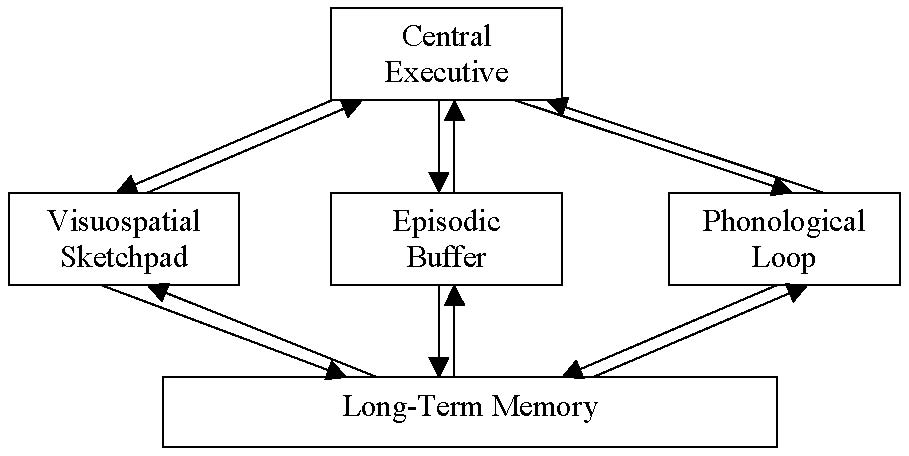
Working memory model
How we process information on a short-term scale in real time (know the diagram and what it represents)
Shallow to Deep Memory
Processing it structurally, phonemically, and semantically
Structural
What something looks like
Phonemic
How it sounds
Semantic
Meaning + linking to prior knowledge to deeply remember
LTP
Repeated learning and recall strengthening neural connectivity and helps convert to long-term memory
Encoding
First step in memory: converting information into a format that can be retrieved later on
Elaborative Rehersal
Making meaningful connections to things you already know about the topic
Self-testing
Forces retrieval through taking a practice test; usually under the same conditions as well
Method of Loci
Associating items with locations in a familiar place
Chunking
Grouping information into smaller, organized chunks
Spacing effect
Studying over time (distributed practice) helps because you can remember more
Primacy + Recency Effect
Items at the start and end of the list are remembered better
Autobiographical Memory
(LESS IMPORTANT VOCAB): Some people can perfectly recall personal information: usually because they may have more grey matter in memory areas, can form stronger emotional or personal connections, and may be able to frequently recall more
Retrogade
Forgetting past memories due to damage
Anterogade
Being unable to form new memories due to hippocampus (memory processing area) damage
Alzheimer’s Disease
Progressive brain disorder that starts with hurting short term memory, long term memory, and then stops cognitive abilities and function
Infantile Amnesia
Unable to recall memories before age 3 or 4 because of immature brain regions and lack of language/self at that age
Recall
Pulling information out without cues
Recognition
Being able to identify the right answer
Forgetting curve
We forget most of what we learn right after; re-reviewing is important to slow forgetting
Storage Decay
Even well-encoded, long term memory can fade if unused
Encoding failure
Info never fully entered long-term memory; usually with shallow processing
Retrival Failure
Memory exists but can’t be retrived right away
Proactive Interference
Old info makes it hard to remember new information (EX: can’t remember new password because old one interferes)
Retroactive Interference
New info makes it hard to remember old ones (EX: can’t remember previous Chemistry concept after doing an old one)
Repression
Blocking memories that are painful or anxiety-incuding (motivated forgetting). May lose memories and suppress them due to trauma
Misinformation Effect
New, misleading info gets added to an existing memory (being gaslit out of logic)
Source Amensia
Learning something and then forgetting where you heard it (EX: forgeting where you learned something)
Constructive Memory
Memories are being rebuilt when we recall it; may accidentally fill in gaps in recall
Imagination Inflation
Imagining an event can increase belief that it happened
Blending
Repeated events can merge in minds
IQ
Measuring intelligence quotients; useful for educational placement and identifying disabilities, but has been historically misused to justify discrimination. These tests are usually carried out on a basis of cultural context as well
Standardized Test
Consistent procedures and scoring for all
Relability
Test gives consistent results depending on how it’s given out
Validity
When the test measures specifically what it’s meant to: can construct (measure the right concept) and can predict performance (EX: GPA)
Test Norms
Scores are interpreted based on large comparison groups and must be updated over time
Sterotype Threat
Anxiety from fear of confirming sterotypes while testing harms testing (EX: a student who is told they will fail will do worse out of anxiety)
Socio-culture biases
Certain biases may make the test easier/harder; and this may disadvantage certain groups
Fixed Mindset
Those who believe that intelligence is unchangable will never be able to improve and will give up easily
Growth Mindset
Belief that intelligence can improve with effort and can result in resilience and learning sucess.

