Canadian Sentencing Process: Principles, Types, and Legal Frameworks, Law Unit 3
 Studied by 0 people
 Call with Kai
 Learn
Learn Practice Test
 Spaced Repetition
 Match
Match Flashcards
 Knowt Play
1/254

There's no tags or description
Looks like no tags are added yet.
Name | Mastery | Learn | Test | Matching | Spaced | Call with Kai |
|---|
No analytics yet
Send a link to your students to track their progress
255 Terms
definition of sentencing process
the judicial determination of a legal sanction to be imposed on a person found guilty of an offence
steps of the sentencing process
Entering a conviction either through trial or plea
Sentencing hearing
Consideration of the individual's criminal record
Aggravating/mitigating factors
Consideration of oral submissions by both the crown and defence attorneys in which they outline and justify what they believe to be an appropriate range of sentencing in the particular case
The judge weighs all of these factors and takes into account what he/she is trying to achieve with a particular sentence before rendering judgement. The judge also considers the types of sentencing that have been applied in similar cases.
historically, sentencing in canada has been primarily an exercise of ___________
judicial discretion
What is the maximum term of imprisonment set by the CCC for each offence?
The CCC sets a maximum term of imprisonment for each offence, but the type and length of the sentence are at the judge's discretion.
What types of sentences can judges impose under the CCC?
Judges can impose custodial sentences or sentences in the community.
What is an exception to the judge's discretion in sentencing?
Statutorily prescribed minimum penalties require judges to impose at least the minimum sentence.
What is the minimum penalty for impaired driving according to the CCC?
The minimum penalty for impaired driving is a $600 fine.
Who has discretion over the quantum of a sentence (length, amount of fine, etc.)?
The judge has discretion over the quantum of a sentence.
in which section of the CCC are the principles and purpose of sentencing outlined?
s 718
These principles are placed in the CCC as a clear guideline to judges and a statement of principles that give direction to our penal laws and sanctions.
name the 6 principles of Sentencing
1. denunciation/retribution
2. deterrence
3. protection of the public
4. rehabilitation
5. reparation
6. responsibility
what is denunciation/retribution?
Allows the judges to take into account:
Society;s disdain for the crime committed
The offender's character and past actions
why is R v. M (C.A.), [1996] 1 S.C.R. 500
The accused pled guilty to numerous counts of S. A., incest and assault with a weapon related to sexual abuse of his children over a period of years. None of these crimes carried a maximum penalty of life imprisonment. The trial judge and the SCC agreed to a cumulative sentence of 25 year's imprisonment.
what is deterrence?
Discourage convicted offenders from repeating their behvaiour (Specific Deterrence)
Discourage other individuals from committing the same type of crime (General Deterrence)
Sentences should cause individuals to seriously consider the consequences for their actions
It is difficult to arrive at a sentence that effectively achieves both specific and general deterrence
what is protection of the public
Should be a primary concern of the judge in sentencing
Involves not only the physical protection of persons but also the protection of property, individual rights and public morality
what is rehabilitation
Reform the criminal's behaviour and restore the person to a useful life in society
This ideally should be a central purpose of sentencing however it is the most difficult to achieve
which two parts of the principles of sentencing were added later?
reparation + responsibility
what is reparation?
To repay, repair or compensate the victim or community loss and harm
what is responsibility
For the offender to acknowledge the harm done to the victim and the community
what is a concurrent sentence
A sentence that overlaps with another for a period of time (Canada)
what is a consecutive sentence?
A sentence that runs separately for one or more other sentences to be served by the same individual (United States)
7 types for sentencing options
absolute and conditional charges
probation
fines
intermittent sentences
conditional sentences
incarceration
restorative justice programs/circle sentencing
explain absolute and conditional charges
Absolute Discharge: a sentence that free the offender with no conditions and no criminal record, No qualifications required
Conditional Discharge: A sentence that frees the offender with no criminal record but with court ordered conditions that must be followed
Discharge can be asked for as long as the offence doesn't have a minimum sentence of 14 years or life or go against the public interest
advantages of absolute and conditional charges
Works well for employment and immigration
Doesn't leave you with a record
disadvantages of absolute and conditional charges
Doesn't leave you with a record and you can say no to "do you have a criminal record" at an interview
Employers may not know exactly who they are employing
explain probation
Offenders are free to go, but they are under the jurisdiction of a correctional service
Can be combined with fines and suspended sentences and conditions that are meant to rehabilitate
Last up to 3 years
advantages of probation
Offenders of small crimes are free to go, under restrictions
Keeps the jails and trials functioning
Under strict rulings
disadvantages of probabtion
Hard to start up a life for the next 3 years without the feeling of pressure?
Someone has to be watching them...
explain fines
For less serious offences
Ex. Summary convictions can get up to a $2000 fine
Can include garnisheeing wages: taking money directly from a defendant's wages under court order
Victim fine service too to help support those affected
advantages of fine
Helps support victims
Offender doesn't have to go to jail
Keeps the system running
disadvantages of fines
Victims might not feel justice
What's to stop the offender from doing it again?
Can affect their living very quickly ($2000 is no joke)
explain intermittent sentences
90 days or less, allows flexibility for judges
Sometimes still allowed to work a job?
For offences with short mandatory minimum sentences
advantages of intermittent sentences
Offender can keep their job and most livelihoods
It's a super short sentence
Inconvenient so it will disencourage further actions
disadvantages of intermittent sentences
Messes with life a little
Inconvenient
explain conditional sentences
Introduced in 1996
Prison term is less than 2 years but not in jail, in community
Allows for incarceration to be used only for the worst crimes
Similar to probation but with house arrest
advantages of conditional sentences
Saves people from unnecessary incarceration
Allows space in jails for those who truly need it
disadvantages of conditional sentences
Victims may not feel justified
Life will be interrupted
Boring
explain incarceration
Harshest punishment in Canada and the rate is very high, but has fallen due to changes made to the system (see above :)
Run by both provincial and federal
Provincial is for sentences of 2 yrs or less
Federal is for longer sentences
Thought that this is possibly not the best solution to the problem, criminals actually get more dangerous after being in jail
advantages of incarceration
Protects citizens from danger
Proper punishment for horrendous actions
Justice for victims
disadvantages
Harsh punishments
Causes more danger
Changes lives forever
explain restorative justice programs/circle sentencing
"They help settle the conflict to the satisfaction of the parties involved"
Comes from indigenous
Big discussion
Respect between everyone
Canada's justice system has a long history of discrimination against Indigenous (ex. Donald Marshall in 1983, convicted to 11 years for a crime he didn't commit, everyone was shocked)
advantages of restorative justice programs/circle sentencing
More peaceful
Allows for better conclusions to conflict
Better rehabilitation for criminals
Respects Indigenous culture
disadvantages of restorative justice programs/circle sentencing
Justice for the victims
Might not reach the safest solution
importance of r v. gladue
1999, SCC states that RJP methods are included in the Criminal Code under s. 718
Judges should consider this first before jail
importance of R v. Moses
Judge Barry Stuart of the Yukon Territories stated that a change to the sentencing system needed to happen
Major decision
Dangerous Offender Declaration:
Section 753 of the CCC allows the court to categorize the most dangerous offenders (those whose past aggressive, violent or sexual behavior establishes a pattern that is unlikely to be able to be changed) and sentence them to an indefinite period of imprisonment
Youth Sentencing:
The youth criminal justice act provides the legislative framework for Canada's youth justice system. It includes a separate sentencing regime because the needs and citations of youth are different from those of adults
Define: mandatory minimum sentence and cruel and unusual sentence
MMS: a basis of what an offender should serve for the crime they committed, found in the criminal code, can be a constraint for judges (not all crimes are the same)
CUS: over the top punishment for their actions (ex. Too long jail time or the death penalty)
How does the use of hypothetical cases test the constitutionality of mandatory minimum sentences?
Those cases don't exist and so there was no precedent set for them
Hills should have found a real case instead
In the hypothetical, something that could have never been predicted might happen
Examples of the future
What are the advantages and disadvantages of mandatory minimum sentences?
Advantages:
Basis of dealing with the crime
Everyone gets the same treatment
Disadvantages:
Not everyone is in the same situation so different people need different sentences
Reduces judicial discretion
How have the various levels of courts dealt or addressed cases relating to this issue?
Judging based off of previous cases and the hypothetical case
Asking "is this a fair sentencing?"
Lower courts - judged minimum sentencing in this situation
Appellate courts - analyze their broader impact
SCC - provides final guidance on whether they comply with the Charter
Do you believe there is a correlation between the Liberal government repeal of some mandatory minimum sentences and the increase in gang-related crime?
Yes
Sentencing has become loose and so people are willing to test that
I think it's important that there is a basis for how much someone should be sentenced to
Repeal - striking it down
Capacity in prisons would take a hit if we always stuck with mandatory minimums
What might be the potential dangers of fake case law, (generated by AI), being presented in court?
There may not be complete truth in what is shown
AI is known for making things up and not being completely perfect
can mislead judges and lawyers by relying on legal precedents that do not exist
Al legal information can confuse juries and make them trust false evidence or arguments, affecting how they assess credibility and reach a fair verdict
Undermines the rule of law and accuracy of legal decision making
Risk of fake cause law becoming accepted over time if not caught
Damages public confidence in the justice system
Could result in unfair outcomes for accused persons
How might AI driven "deep fakes" have an impact on juries?
Juries are not experienced in legal matters
Can be easily duped
creates convincing but false audio or video evidence
Jurors are more likely to trust and remember audiovisual evidence
Can distort jurors memory and perception of reality
Increases risk of wrongful convictions or acquittals
Leads to skepticism where jurors may doubt real evidence (liars dividend)
Define: liar's dividend, water marking
Liar's dividend: defendants arguing in court that the evidence against them is AI generated
Watermarking: something on the image or video to tell the court that this is AI generated
In what ways could the justice system address the challenges of AI in the courtroom?
Strict limits
Rules to follow
General understanding of use
use expert witnesses to analyze digital evidence,
Impose stronger penalties for presenting false or Al manipulated evidence
Develop standardized verification systems (e.g., watermarking)
Provide clear jury instructions on how to evaluate Al related evidence
Carefully Balance probative value vs. Prejudice when admitting evidence
What defence was used in the Brown case?
Extreme intoxication to the point of Automatism
What is Section 33.1 of the CCC and why is it "complicated and controversial"?
Talks about self-induced extreme intoxication
The offender took the drug to a point that he probably knew was too far but then he had no control over his actions.... So how do you punish it?
Also not really well worded
Prevents the accused from using extreme intoxication as a defence
Goes against the charter
How did the SCC rule in this and two similar cases? What was their rationale? Do you support the unanimous decision?
Sullivan and Chan cases - 2 men consumed drugs and then stabbed their family members, in state of psychosis
Decided that section 33.1 was too unconstitutional and that it counts as a defence for Brown's case
I feel that there should be some sort of fine and restrictions on him to help give peace of mind to the family and change his actions for the future but i don't think it deserves major jailtime
How could parliament enact legislation to "protect victims of violent crime committed during extreme intoxication"?
I feel that there should be some sort of fine and restrictions on him to help give peace of mind to the family and change his actions for the future but i don't think it deserves major jailtime
In what way was an expert witness used in the Brown case?
Used to determine his level of intoxication and how much punishment is constitutional
Is it possible for the legal system to balance the rights of both the accused and victims and still achieve justice?
I feel that there should be some sort of fine and restrictions on him to help give peace of mind to the family and change his actions for the future but i don't think it deserves major jailtime
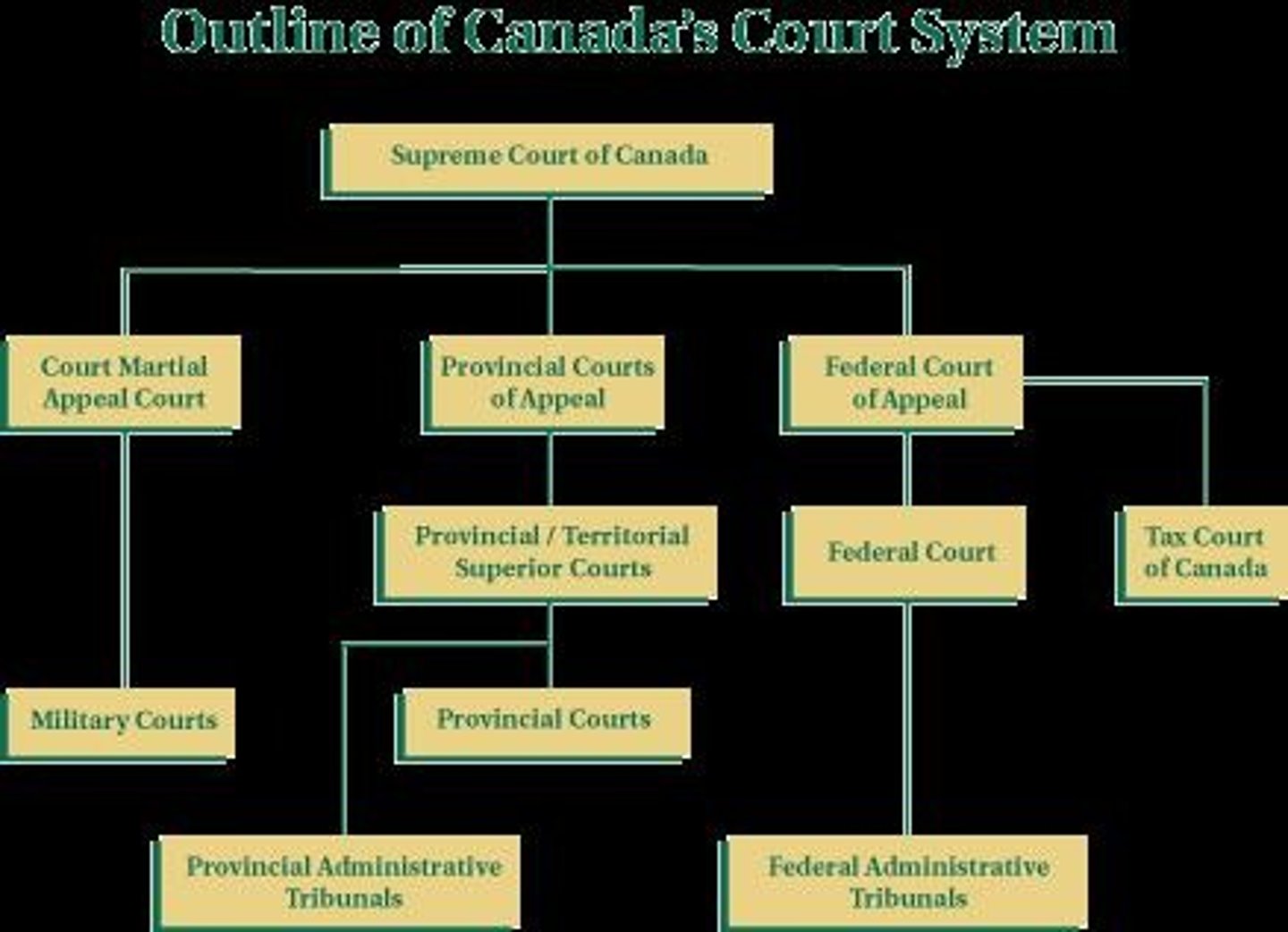
What is the Supreme Court of Canada?
The Supreme Court of Canada is Canada's highest court. It is the final court of appeal for all litigants,
whether individuals, organizations or government. Its jurisdiction includes both the civil law of the
province of Quebec and the common law of the other provinces (including Ontario) and the
territories. The Supreme Court has jurisdiction over disputes in all areas of the law, including
constitutional law, administrative law, criminal law and civil law.
What are the Provincial and Federal Courts?
Each Canadian province and territory has it own court system, with trial courts, (provincial/territorial
court and superior court) and a Court of Appeal or appellate division that hears appeals from the
lower courts (with the exception of Nunavut, which only has one level of trial court). Ontario has the
Ontario Court of Justice, the Superior Court of Justice, and the Court of Appeal for Ontario.
What is the Federal Court System?
Parallel to the Ontario court system and the court systems of other Canadian provinces and
territories, is the Federal court system. The Federal Court of Canada hears certain matters of federal
concern that are set out in statute, including claims against the Government of Canada and civil suits
in federally-regulated areas such as immigration, and intellectual property (e.g. copyright). The
Federal Court of Appeal hears appeals from the Federal Court of Canada, the Tax Court of Canada
and the Immigration and Refugee Board and other Boards created by the Federal government. In
some cases, parties may be able to sue in either the federal court system or the Ontario court system.
Describe the Structure of the courts of Canada
COL: What does Substantive Law identify?
The rights and duties of a person or level of government.
COL: What does Procedural Law outline?
The methods and procedures that must be followed in enforcing substantive laws.
COL: What does Substantive Law define in the context of criminal code?
The nature and substance of a crime.
COL: What does Procedural Law dictate in criminal code?
How arrests, bail hearings, and trials must happen, protecting the rights of the accused.
COL: name the 11 categories of law
substansive
procedural
domestic
international
public
private
family
contract
tort
estate
property
COL: What is Domestic Law?
A law that governs activities within a particular country.
COL: What is International Law?
A law that has jurisdiction in more than one country.
COL: What can Domestic Law's area of influence be? And give example
Firearms Act (has no jurisdiction outside Canada).
COL: What can International Law's area of influence be?
Two or more countries share the law, such as treaties.
Sometimes can cover a whole area
COL: What is Public Law?
The area of law that regulates activities between a state and its citizens.
COL: What does administrative law govern and what is it under?
Relations between individuals and government agencies, boards, and departments.
under public law
COL: What is criminal law and what is it under?
The area of law that prohibits and punishes behavior that injures property and society as a whole.
COL: What is Private Law?
The body of law that regulates disputes between individuals, businesses, and organizations, sometimes called civil law.
COL: Who is the plaintiff in civil law?
The party suing.
COL: Who is the defendant in civil law?
The party being sued.
COL: Who is the defendant in criminal law?
The person charged with an offense.
COL: What is Family Law?
Family Law: the area of private law that governs relations among
members of a family
ex. laws for marriage, divorce, child support
COL: What is contract law?
Contact Law: the area Of private law that governs agreements between people or companies to purchase or provide goods or services
> business related laws
> ex. Colleen vs. Ready to Ride (company failure, this law states she can sue)
> written or verbal
COL: What is Tort Law?
Tort Law: area of private law covering civil wrongs + damages that one person or
Company causes to another, when the wrongs or damages arise in dependantly
of a contractual relationship
> individuals suing companies or (more often) person v. person suing
COL: What is estate law?
area of private law that regulates wills and probates and determines what happens to a person's property after death
> ex. wills
COL: What is property law?
area of private law that applies primarily to the buying, selling and renting of land and building and their use
> ex. real estate, belongings (jewelry [tangible], stocks [intangible], etc), buy/rent of land [tangible]
WIC: What is the definition of crime?
Any act or omission, the doing of which is offence under federal legislation
WIC: What is a crime?
the federal gov controls criminal law and only parliment can enact laws making certain conduct crimes
eg. criminal code of Canada, youth criminal justice act, controlled drugs and substances act, the income tax act, the Canada labour code
each identifies the criminal act and makes rules for prosecution and punishment
provincial statutes also create offences for certain conduct but they are not true criminal offences
provincial offences or quasi-criminal offences
> eg. Careless driving (highway traffic act), drinking under age (liquor licence act), radial sales tax act
WIC: What is the definition of liability?
legal term indicating that a person is responsible for his/her conduct
WIC: What is civil liability?
a person's legal responsibility to pay compensation to another person who has suffered a loss because of the violation of private law
each individual has the private right to seek a remedy in the courts if he/she has suffered a loss because of wrongful conduct
WIC: What is criminal liability?
a person's responsibility for conduct that can lead to sanctions imposed by the state
eg. fines, probation, conditional sentence ("house arrest"), intermittent sentence ("weekends"), imprisonment
LEC: What is required for an act to be considered a crime?
The accused must have committed an illegal act (actus reus) and had the required state of mind (mens rea).
LEC:What does 'actus reus' mean?
Latin for 'the guilty act'; it refers to the physical component of the crime.
LEC:What does 'mens rea' refer to?
The mental element ('the guilty mind') that accompanies the commission of the actus reus.
LEC:What is the subjective standard in criminal law?
It concerns the accused's state of mind (intent, knowledge, recklessness) at the time of the act.
LEC: What is the objective standard in criminal law?
It involves determining what a reasonable person would have understood or foreseen in the circumstances.
LEC: What is absolute liability in criminal offences?
Offences that only require proof of an unlawful act or omission, without needing to prove intent.
LEC: What is strict liability in criminal offences?
Offences that require proof of an unlawful act or omission but allow the accused to prove 'due diligence' as a defense.
LEC: What must the Crown prove in cases requiring mens rea?
The Crown must prove intent beyond a reasonable doubt.
LEC: What are regulatory offences?
Non-criminal violations of federal or provincial statutes related to business, health and safety, or the environment.
 Note
Note  Flashcards (265)