fund cell exam 2 quiz questions
 Call Kai
 Learn
Learn Practice Test
 Spaced Repetition
 Match
Match Flashcards
 Knowt Play
1/19

There's no tags or description
Looks like no tags are added yet.
Name | Mastery | Learn | Test | Matching | Spaced | Call with Kai |
|---|
No analytics yet
Send a link to your students to track their progress
20 Terms
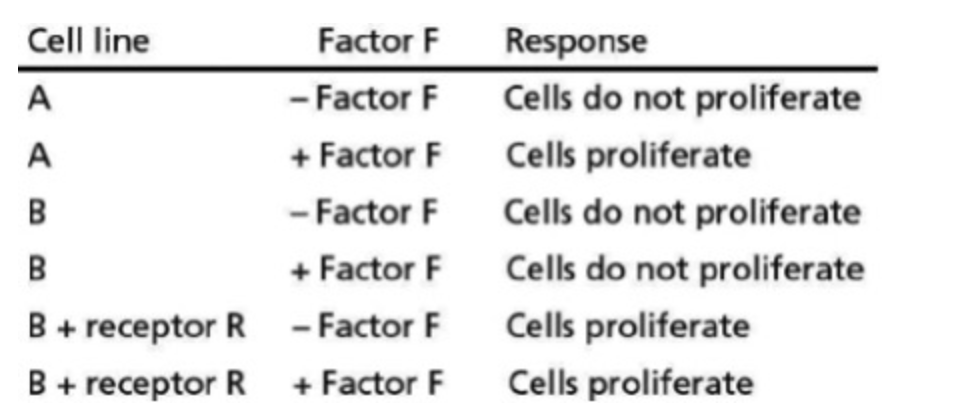
Cell lines A and B both survive in tissue culture containing serum but do not proliferate. Factor F is known to stimulate proliferation in cell line A. Cell line A produces a receptor protein (R) that cell line B does not produce. To test the role of receptor R, you introduce this receptor protein into cell line B, using recombinant DNA techniques. You then test all of your various cell lines in the presence of serum for their response to factor F, with the results summarized in Table 16-9. Which of the following cannot be concluded from your results above?
Binding of factor F to its receptor is required for proliferation of cell line A.
Cell line A expresses a receptor for factor F.
Receptor R binds to factor F to induce cell proliferation in cell line A.
Factor F is not required for proliferation in cell line B
Receptor R binds to factor F to induce cell proliferation in cell line A.
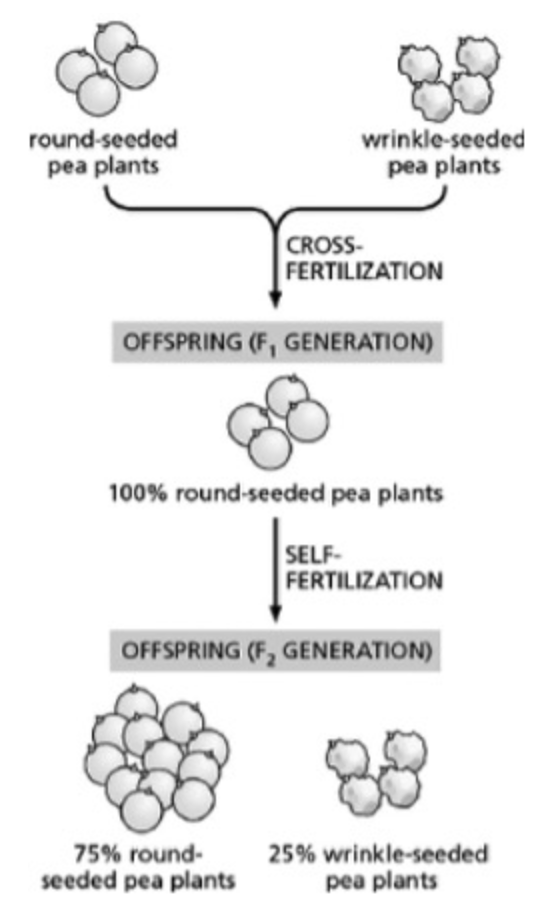
Which of the following statements about the experiment diagrammed in Figure 19-28 is TRUE?
If you crossed the round-seeded pea plants from the F2 generation with the wrinkle-seeded pea plants from the F2 generation, you should get 100% round-seeded pea plants.
If you crossed all the round-seeded pea plants from the F2 generation with true-breeding wrinkle-seeded pea plants, you would get more round-seeded pea plants in the next generation than if you crossed all the round-seeded pea plants from the F1 generation with true-breeding wrinkle-seeded pea plants.
The reason you do not see wrinkle-seeded pea plants in the F1 generation is because the round-seeded pea plants used to create the F1 generation were not true-breeding strains.
The gene for round-seeded pea plants is on a different chromosome from the gene for wrinkle-seeded pea plants, which is why you get 25% wrinkle-seeded pea plants in the F2 generation.
If you crossed all the round-seeded pea plants from the F2 generation with true-breeding wrinkle-seeded pea plants, you would get more round-seeded pea plants in the next generation than if you crossed all the round-seeded pea plants from the F1 generation with true-breeding wrinkle-seeded pea plants.
Acetylcholine is a signaling molecule that elicits responses from heart muscle cells, salivary gland cells, and skeletal muscle cells. Which of the following statements is FALSE?
A. Heart muscle cells, salivary gland cells, and skeletal muscle cells all express an acetylcholine receptor that belongs to the transmitter-gated ion channel family.
B. Heart muscle cells decrease their rate and force of contraction when they receive acetylcholine, whereas skeletal muscle cells contract.
C. Heart muscle cells, salivary gland cells, and skeletal muscle cells all respond to acetylcholine within minutes of receiving the signal.
D. Active acetylcholine receptors on salivary gland cells and heart muscle cells activate different intracellular signaling pathways.
A. Heart muscle cells, salivary gland cells, and skeletal muscle cells all express an acetylcholine receptor that belongs to the transmitter-gated ion channel family.
The growth factor Superchick stimulates the proliferation of cultured chicken cells. The receptor that binds Superchick is a receptor tyrosine kinase (RTK), and many chicken tumor cell lines have mutations in the gene that encodes this receptor. Which of the following types of mutation would be expected to promote uncontrolled cell proliferation?
a mutation that prevents the binding of the normal extracellular signal to the receptor
a mutation that prevents dimerization of the receptor
a mutation that destroys the kinase activity of the receptor
a mutation that inactivates the protein tyrosine phosphatase that normally removes the phosphates from tyrosines on the activated receptor
a mutation that inactivates the protein tyrosine phosphatase that normally removes the phosphates from tyrosines on the activated receptor
There are organisms that go through meiosis but do not undergo recombination when forming haploid gametes. Which of the following statements correctly describes the gametes produced by such an organism? (Assume that these organisms are diploid, that each of the two homologous chromosomes are genetically distinct as typically found in the wild, and that these organisms have more than one chromosome.)
This organism could potentially produce 2n genetically distinct gametes, where n is its haploid number of chromosomes.
All gametes formed during a single meiosis will be identical.
The fusion of any two gametes produced by such an organism that does not undergo recombination during meiosis will create a cell that is genetically identical to that individual
Due to the random assortment of homologs, each of the gametes formed during a single meiosis will be different
This organism could potentially produce 2n genetically distinct gametes, where n is its haploid number of chromosomes.
Somatic cells __________.
do not contain sex chromosomes.
leave no progeny.
are not necessary for sexual reproduction in all eukaryotic organisms.
are used to produce germ-line cells when organisms reach sexual maturity
leave no progeny.
During nervous-system development in Drosophila, the membrane-bound protein Delta acts as an inhibitory signal to prevent neighboring cells from developing into neuronal cells. Delta is involved in __________ signaling.
contact-dependent
paracrine
neuronal
endocrine
contact-dependent
Organisms that reproduce sexually:
create zygotes that are genetically identical to each other
can reproduce only with a partner that carries the same alleles.
undergo a sexual reproductive cycle that involves an alternation of haploid cells with the generation of diploid cells.
must be haploid, unlike organisms that reproduce asexually
undergo a sexual reproductive cycle that involves an alternation of haploid cells with the generation of diploid cells.
Which of the following statements is TRUE?
All sexually reproducing organisms must have two copies of every chromosome.
Gametes have only one chromosome.
Diploid organisms reproduce only sexually.
Another name for the fertilized egg cell is the zygote.
Another name for the fertilized egg cell is the zygote.
Which of the following statements is TRUE?
A. A cell-surface receptor capable of binding only one type of signal molecule can mediate only one kind of cell response.
B. Any foreign substance that binds to a receptor for a normal signal molecule will always induce the same response that is produced by that signal molecule on the same cell type.
C. To function, all extracellular signal molecules must be transported by their receptor across the plasma membrane into the cytosol.
Extracellular signal molecules that are hydrophilic must bind to a cell-surface receptor so as to signal a target cell to change its behavior.
D. Extracellular signal molecules that are hydrophilic must bind to a cell-surface receptor so as to signal a target cell to change its behavior.
Progression through the cell cycle requires a cyclin to bind to a Cdk because
the cyclins are the molecules with the enzymatic activity in the complex.
without cyclin binding, a cell-cycle checkpoint will be activated.
the binding of a cyclin to Cdk is required for Cdk enzymatic activity.
cyclin binding inhibits Cdk activity until the appropriate time in the cell cycle.
the binding of a cyclin to Cdk is required for Cdk enzymatic activity.
Which of the following statements about the function of the centrosome is FALSE?
Centrosomes typically contain a pair of centrioles, which is made up of a cylindrical array of short microtubules.
Centrosomes are the major microtubule-organizing center in animal cells
Centrosomes contain hundreds of copies of the γ-tubulin ring complex important for microtubule nucleation.
Microtubules emanating from the centrosome have alternating polarity such that some have their plus end attached to the centrosome while others have their minus end attached to the centrosome.
Microtubules emanating from the centrosome have alternating polarity such that some have their plus end attached to the centrosome while others have their minus end attached to the centrosome.
Which of the following events does NOT usually occur during interphase?
DNA is replicated.
The centrosomes are duplicated.
The nuclear envelope breaks down.
Cells grow in size.
The nuclear envelope breaks down.
Intermediate filaments are made from elongated fibrous proteins that are assembled into a ropelike structure. Figure 17-6 shows the structure of an intermediate filament subunit. You are interested in how intermediate filaments are formed, and you create an intermediate filament subunit whose α-helical region is twice as long as that of a normal intermediate filament by duplicating the normal α-helical region while keeping a globular head at the N-terminus and a globular tail at the C-terminus; you call this subunit IFαd. If you were to assemble intermediate filaments using IFαd as the subunit, which of the following predictions describes the most likely outcome?
Filaments assembled using IFαd will interact with different cytoskeletal components.
Sixteen tetramers assembled from IFαd will be needed for a ropelike structure to form.
Dimers of IFαd will form by interactions with the N-terminal globular head and the C-terminal globular tail.
Filaments assembled using IFαd will form dimers that are twice as long as dimers assembled from normal intermediate filaments.
Filaments assembled using IFαd will form dimers that are twice as long as dimers assembled from normal intermediate filaments.
What would be the most obvious outcome of repeated cell cycles consisting of S phase and M phase only?
The cells produced would get smaller and smaller.
The cells would not be able to replicate their DNA.
The cells would get larger and larger.
The mitotic spindle could not assemble.
The cells produced would get smaller and smaller.
Which of the statements below about intermediate filaments is FALSE?
Each filament is about 10 μm in diameter.
They can be anchored to the plasma membrane at a cell–cell junction.
They can be found in the cytoplasm and the nucleus.
They can stay intact in cells treated with concentrated salt solutions
Each filament is about 10 μm in diameter.
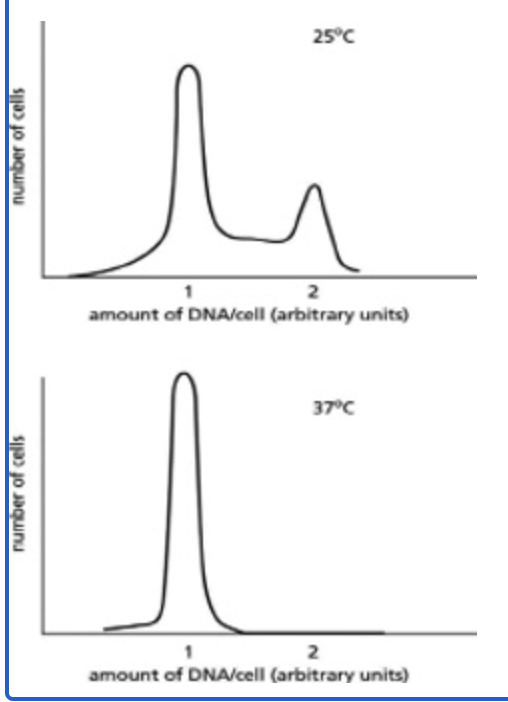
A mutant yeast strain stops proliferating when shifted from 25°C to 37°C. When these cells are analyzed at the two different temperatures, using a machine that sorts cells according to the amount of DNA they contain, the graphs in Figure 18-2 are obtained. Which of the following would NOT explain the results with the mutant?
inability to activate proteins needed to enter S phase
inappropriate production of a signal that causes the cells to remain in G1
inability to initiate DNA replication
inability to begin M phase
inability to begin M phase
Which of the following statements about the cytoskeleton is TRUE?
All eukaryotic cells have actin, microtubules, and intermediate filaments in their cytoplasm.
Actin filaments and microtubules have an inherent polarity, with a plus end that grows more quickly than the minus end.
The cytoskeleton provides a rigid and unchangeable structure important for the shape of the cell.
The three cytoskeletal filaments perform distinct tasks in the cell and act completely independently of one another.
Actin filaments and microtubules have an inherent polarity, with a plus end that grows more quickly than the minus end.
Which of the following statements is FALSE?
The phosphorylation and degradation of Cdc6 help to ensure that DNA is replicated only once in each cell cycle.
The loading of the origin recognition complexes (ORCs) is triggered by S-Cdk.
DNA synthesis begins at origins of replication.
DNA synthesis can only begin after prereplicative complexes assemble on the ORCs
The loading of the origin recognition complexes (ORCs) is triggered by S-Cdk.
For both actin and microtubule polymerization, nucleotide hydrolysis is important for
Correct answer:
decreasing the binding strength between subunits on filaments.
stabilizing the filaments once they are formed
increasing the rate at which subunits are added to the filaments.
promoting nucleation of filaments.
decreasing the binding strength between subunits on filaments.
Explore top notes

