Cognitive Psychology Chapter 7 Mental Imagery and Cognitive Maps
 Studied by 0 people
 Call Kai
 Learn
Learn Practice Test
 Spaced Repetition
 Match
Match Flashcards
 Knowt Play
1/85

There's no tags or description
Looks like no tags are added yet.
Name | Mastery | Learn | Test | Matching | Spaced | Call with Kai |
|---|
No analytics yet
Send a link to your students to track their progress
86 Terms
Perception requires both ____ and ____ processing.
bottom-up, top-down
Mental imagery is ____.
knowledge-driven
Mental imagery
mental representation of stimuli when those stimuli are not physically present in the environment.
Most of the psychological research on mental images focuses on ____.
visual imagery
Spatial imagery is extremely important in the ____ disciplines.
STEM
As ____ psychology gained popularity, however, researchers rediscovered imagery.
cognitive
Shepard & Metzler (1971)
Mental rotation task
Tasks that called for greater rotations took longer. The relationship between rotation and reaction time is a straight line.
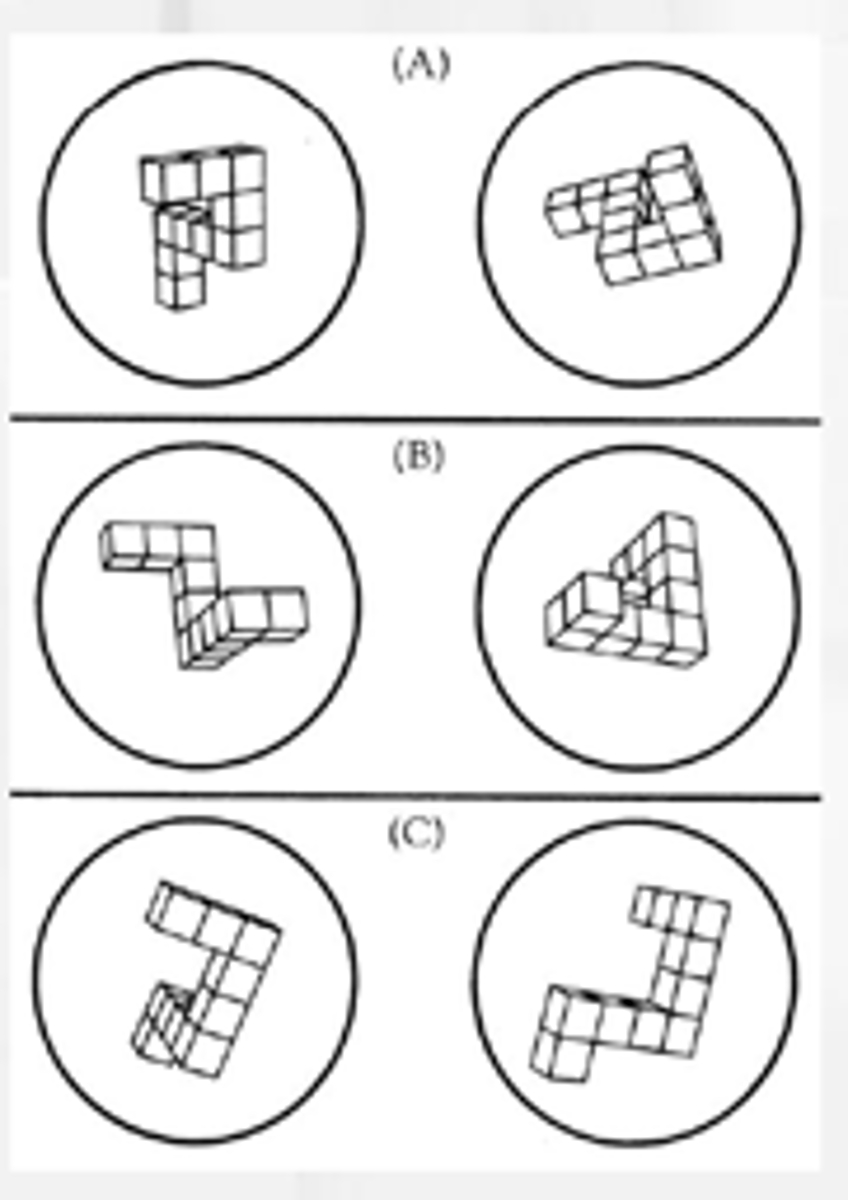
People make judgments more quickly if they need to rotate a mental image ____.
just a short distance
Mental-rotation and handedness
Kotaro Takeda and his coauthors (2010) asked the participants in their study to look at pictures of a human hand and to identify whether they were viewing a left hand or a right hand. Right‐handers recognized a right hand faster than a left hand. In contrast, left‐handers recognized right and left hands equally quickly. However, both groups recognized upright pictures faster—and more accurately—than upside‐down pictures.
Elderly people perform more ____ than younger people on a mental‐rotation task.
slowly
Research shows that deaf individuals who are fluent in American Sign Language (ASL) are especially skilled in
looking at an arrangement of objects in a scene and mentally rotating that scene by 180 degrees
Why should deaf people perform so well on mental rotation tasks that require them to look at an arrangement of objects in a scene and mentally rotate that scene by 180 degrees?
They have an advantage because they have had extensive experience in watching a narrator produce a sign. Then, they must mentally rotate this sign 180 degrees. They need to perform this rotation frequently, so that they can match the perspective that they would use when producing this sign.
imagery debate
Do our mental images resemble perception (using an analog code), or do they resemble language (using a propositional code)?
analog code
a representation that closely resembles the physical object
According to the analog‐code approach, mental imagery is a close relative of ____
perception
Under the framework of analog code, when you are engaged in mental imagery, you create
a mental image of an object that closely resembles the actual perceptual image on your retina
propositional code
an abstract, language-like representation; storage is neither visual nor spatial, and it does not physically resemble the original stimulus
According to the propositional‐code approach, mental imagery is a close relative of ____.
language
Zenon Pylyshyn's arguments for propositional code
- it would be awkward—and perhaps unworkable—to store information in terms of mental images. For instance, people would need a huge space to store all the images that they claim to have.
- also emphasizes the differences between perceptual experiences and mental images. For example, you can reexamine and reinterpret a real photograph. Mental images are less likely to be so stable and easy to re‐reference over time.
Shepard and Metzler's work on mental rotation supports an ____ perspective.
analog
a propositional code would predict similar reaction times for these two conditions:
the language‐like description for the figure would not vary with the amount of rotation
Kosslyn et al. (2001) motor cortex and mental rotation
Participants who had originally rotated the geometric figure with their hands now showed activity in their primary motor cortex—the same part of the brain that had been active when they had rotated the figure with their hands. In contrast, consider the participants who had originally watched the electric motor as it rotated the figure. On the mental‐rotation task, these people now showed no activity in the primary motor cortex. Without the "hands‐on" experience, their primary motor cortex was not active.
Kosslyn et al. (2001) language's effect on brain activity during mental rotation
when people received the standard instructions to rotate the figure, their right frontal lobes and their parietal lobes were strongly activated. In a second condition, the participants were instructed to imagine rotating themselves so that they could "see" the figure from a different perspective. These instructions produced increased activity in the left temporal lobe, as well as in a part of the motor cortex
What practical implications do mental rotations have for people recovering from a stroke?
By watching the rotation of virtual‐reality figures, these individuals can provide stimulation to their motor cortex. This form of "exercise" can shorten the time required before they make actual motor movements by themselves
People with prosopagnosia have comparable problems in creating
visual imagery for faces
Neuroimaging evidence in favor of analog perspective
the primary visual cortex is activated when people work on tasks that require detailed visual imagery. This is the same part of the cortex that is active when we perceive actual visual objects.
Pearson (2019) proposed that the ____ is responsible for initiating the creation of visual mental imagery.
frontal lobe
What phenomenon is difficult for the analog account to accomodate?
the effect of ambigious visual images
Why did Reed (1974) claim that people store pictures as descriptions, using a kind of propositional code?
the high error rate on his star of David study.
Ambigous figure study
- image could look like a duck or a rabbit. when asked to give a second, different interpretation, none of the 15 people could do so. In other words, they apparently could not consult a stored mental image.
- Next, the participants were asked to draw the figure from memory. Could they reinterpret this physical stimulus? All of them looked at the figure they had just drawn, and all 15 were able to supply a second interpretation.
It's often easy to reverse a visual stimulus while you are ____ that is ambiguous. In contrast, it's usually more difficult to reverse a ____.
looking at a physical picture, mental image
It seems likely that people often use an analog code when they are thinking about ____. In contrast, people may use a propositional code when the figures are more ____.
fairly simple, complex
Research confirms that there is a ____ between the distance to be scanned in a mental image and the amount of time required to scan this distance
linear relationship
What does Paivio's research about clock hand angles demonstrate?
With real objects, people take a long time to make decisions when two angles are very similar to each other. When the two angles are very different, people respond quickly. The research demonstrates that people show the same pattern with their visual images. This study demonstrates strong support for the proposal that people use analog codes, rather than propositional codes.
Research has confirmed that visual imagery can ____ with your visual perception.
interfere
Segal and Fusella (1970) study about interference
In part of this study, they asked participants to create a visual image, for example, a visual image of a tree. As soon as the participants had formed the requested image, the researchers presented a real physical stimulus, for example, a small blue arrow. The researchers then measured the participants' ability to detect the physical stimulus.
Segal and Fusella's (1970) results showed that people had more problems detecting the physical stimulus when the mental image was in the same sensory mode. For example, when the participants had been imagining the shape of a tree, they had trouble detecting the small blue arrow. The mental image interfered with the real visual stimulus. In contrast, when they had been imagining the sound of an oboe, they had no trouble reporting that they saw the arrow. After all, the imagined sound and the arrow—a visual stimulus—represented two different sensory modes.
visualizers
ndividuals who report the experience of constructing strong mental images
verbalizers
rely less on mental images and more on verbal descriptions
The categories of visualizer and verbalizers represent
biases that individuals have regarding the types of representations that tend to be activated during cognitive processing.
Nishimura et al. (2016) MEG technique study
In their experiment, Nishimura and colleagues administered a scale designed to determine whether an individual has a more visualizer or verbalizer cognitive style. Neural responses were recorded as participants were asked to visualize objects, such as a famous landmark in the Japanese city of Kyoto, where this experiment was conducted. As hypothesized, visualizers produced more activity in occipital regions of cortex, regions that are strongly implicated in processing visual information. Verbalizers, on the other hand, produced more activation in areas often associated with linguistic processing, such as frontal cortical areas.
Magnetoencephalography (MEG)
records magnetic field fluctuations produced by neural activity during the processing of stimuli presented to participants
There are gender similarities in ____ and ____ ability.
verbal, mathematics
Gender differences in spatial visualization are ____.
small
Gender differences in spatial perception are ____.
moderate
Gender differences in mental rotation are ____.
moderate to high
Some studies report that the gender differences disappear when
the task instructions are changed and when people receive training on spatial skills
Gender differences in spatial ability in childhood and adolescence
A more recent meta‐analysis on the development of gender differences in spatial ability found that in childhood, males have a small advantage on mental rotation tasks. This difference in performance on spatial tasks increased in magnitude, however, across adolescence. In addition, a large portion of the gender differences in spatial rotation can be traced to the fact that boys often have more experience with toys and sports (and perhaps even video games) that emphasize spatial skills
auditory imagery
our mental representation of sounds when these sounds are not physically present
People reported higher imagery ratings for ____ imagery than for ____ imagery.
visual, auditory
Pitch
a characteristic of a sound stimulus that can be arranged on a scale from low to high
In the case of pitch, the distance between the two actual tones is ____ with the distance between the two imagined tones.
correlated
Timbre
sound quality of a tone
Andrea Helpern et al (2004) study on auditory imagery and timbre
To assess auditory imagery for timbre, Halpern and her colleagues asked each participant to rate the similarity of timbres in two conditions. In the perception condition, the participants listened to a 1.5‐second segment of one musical instrument, followed by a 1.5‐second segment of another instrument. They heard all possible pairings of the eight different instruments. For every pair, the participants rated the similarity of the two perceptual stimuli. In the imagined condition, the participants heard the names of the instruments, rather than their sounds. They heard all possible pairings of the eight names for the different instruments.
The results showed that the ratings for timbre perception and for timbre imagery were highly correlated with each other (r = .84). In other words, the participants showed that their cognitive representation for the timbre of an actual musical instrument is quite similar to the cognitive representation for the timbre of an imagined musical instrument.
cognitive map
a mental representation of geographic information, including the environment that surrounds us
In general, our cognitive maps represent areas that are too ____ to be seen in a single glance. As a result, we create a cognitive map by integrating the information that we have acquired from many ____ views
large, successive
In general, the research on cognitive maps emphasizes _____ settings, as well as high ____ validity.
real-world, ecological
Research on cognitive maps is part of a larger topic called ____.
spatial cognition
Spacial cognition
primarily refers to three cognitive activities: (1) our thoughts about cognitive maps; (2) how we remember the world we navigate; and (3) how we keep track of objects in a spatial array
Individual differences in spatial‐cognition skills are quite ____.
large
People tend to be accurate in judging their ability to find their way to unfamiliar locations. In other words, your ____ about your ____ ability may be reasonably correct.
metacognition, spatial
People with poor spatial skills ____ (can/can't) improve their performance.
can
Our cognitive maps typically include ____ knowledge.
survey
survey knowledge
relationship among locations that we acquire by directly learning a map or repeatedly exploring an environment
Your cognitive map will be easier to judge and more accurate if you
acquire spatial information from a physical map that is oriented in the same direction that you are facing in your cognitive map.
Why do people make mistakes in their cognitive maps?
- The mistakes that people display in their cognitive maps usually "make sense" because they are systematic distortions of reality.
- These mistakes reflect a tendency to base our judgments on variables that are usually relevant.
- They also reflect a tendency to judge our environment as being more well organized and orderly than it really is.
heuristic
a general problem-solving strategy that usually produces a correct solution... but not always.
People often use heuristics to make judgments about cognitive maps. As a result they tend to show systematic distortions in ____, ____, and ____.
distance, shap, relative position
People's distance estimates are often distorted by factors such as
(1) the number of intervening cities, (2) category membership, and (3) whether their destination is a landmark.
Distance estimates and number of intervening cities
The number of intervening cities had a clear‐cut influence on their estimates. For example, when the cities were really 300 miles apart on this map, people estimated that they were only 280 miles apart when there were no intervening cities. In contrast, these target cities were estimated to be 350 miles apart with three intervening cities. Notice that this error is consistent with the concept of heuristics. If cities are randomly distributed throughout a region, two cities are usually closer together when there are no intervening cities between them. In contrast, two cities are likely to be farther apart when there are three intervening cities.
Distance estimates and category membership
Research shows that the categories we create can have a large influence on our distance estimates. Study results: participants tended to shift each location closer to other sites that belonged to the same category. For example, they typically remembered the courthouse as being close to the police station and other government buildings. However, these shifts did not occur for members of different categories. For instance, the participants did not move the courthouse closer to the golf course.
Border bias
people estimate that the distance between two specific locations is larger if they are on different sides of a geographic border, compared to two locations on the same side of that border
Example of a "same-category heuristic"
Even though the epicenter of the earthquake was the same distance from both vacation homes, the participants in the "Oregon earthquake group" were 20% more likely than the control group to choose a Washington home. Similarly, the participants in the "Washington earthquake group" were 25% more likely than the control group to choose an Oregon home.
Notice that this study demonstrates a "same‐category heuristic." It's generally a good strategy to guess that two cities are closer together if they are in the same state, rather than in adjacent states.
landmark effect
general tendency to provide shorter estimates when traveling to a landmark rather than a non landmark
90-degree-angle heuristic
represent angles in a mental map as being closer to 90 degrees than they really are
What is the 90-degree-angle heuristic an example of?
It is easier to store a schematic version of an event, rather than a precise version of the event that includes all the trivial details.
We use heuristics when we represent relative positions in our mental maps. Which two kinds of errors do these heuristics encourage?
rotation heuristic, alignment heuristic
rotation heuristic
We remember a slightly tilted geographic structure as being either more vertical or more horizontal than it really is
alignment heuristic
We remember a series of geographic structures as being arranged in a straighter line than they really are
What is an example of a rotation heuristic?
Which is farther west, San Diego or Reno?
What is an example of an alignment heuristic?
Which is farther north, Rome or Philadelpia?
Our cognitive maps are not ____ "map‐in‐the‐head" replicas of geographic reality
perfect
Franklin & Tversky (1990) study on verbal descriptions of 10 different scenes
After the participants had read each description, they were instructed to imagine that they were turning around to face a different object. They were then asked to specify which object was located in each of several directions. (For example, which object is "above your head"?) In all cases, the researchers measured how long the participant took to respond to the question. These researchers found that people could rapidly answer which objects were above or below; their reaction times were short for these judgments. People required somewhat longer to decide which objects were ahead or behind. Furthermore, they took even longer to decide which objects were to the right or to the left. In all these studies, people judged the vertical dimension more quickly than ahead-behind or left-right dimensions.
spatial framework model
emphasizes that the above-below spatial dimension is especially important in our thinking, the front-back dimension is moderately important, and the right-left dimension is least important
Why is the vertical (above-below) dimension especially important when we are in a typical upright position?
1. The vertical dimension is correlated with gravity; neither of the other two dimensions has this advantage.
2. The vertical dimension on an upright human's body is physically asymmetric. That is, the top (head) and the bottom (feet) are very easy to tell apart, and so we do not confuse them with each other.
What two characteristics lead to judgment times for front-back dimension that are fairly fast?
1. we usually interact with objects in front of us more easily than with objects in back of us, introducing an asymmetry.
2. a human's front half is not symmetric with the back half, again making it easy to distinguish between front and back.
the situated cognition approach
we make use of the helpful information in the immediate environment or situation to help us understand many cognitive tasks
 Note
Note  Flashcards (32)