Social-Psychological Explanations of Obedience
 Studied by 0 people
 Call Kai
 Learn
Learn Practice Test
 Spaced Repetition
 Match
Match Flashcards
 Knowt Play
1/13

There's no tags or description
Looks like no tags are added yet.
Name | Mastery | Learn | Test | Matching | Spaced | Call with Kai |
|---|
No analytics yet
Send a link to your students to track their progress
14 Terms
What is legitimacy of authority?
An explanation which suggests we are more likely to obey people who we perceive to have authority over us. This authority is justified by the individual’s position of power within the social hierarchy
What is destructive authority?
When authority figures with legitimate powers, use them for destructive purposes
Why does Milgram supports the legitimate authority theory of obedience?
authority figure= experimenter
examples of legitimacy= uniform that was a lab coat and Yale uni being the location
findings= 65% of pps obeyed at 450v and 100% of pps went to 300v
in the uniform and location variations, pps were less likely to obey as it was not perceive to be legitimate authority
What is agent state?
A psychological state where we feel no personal responsibility for our behaviour because we believe ourselves to be acting for an authority figure i.e. as their agent
What is autonomous state?
When an individual is free to behave according to their own principles and therefore feels a sense of responsibility for their own actions
What is an agentic shift?
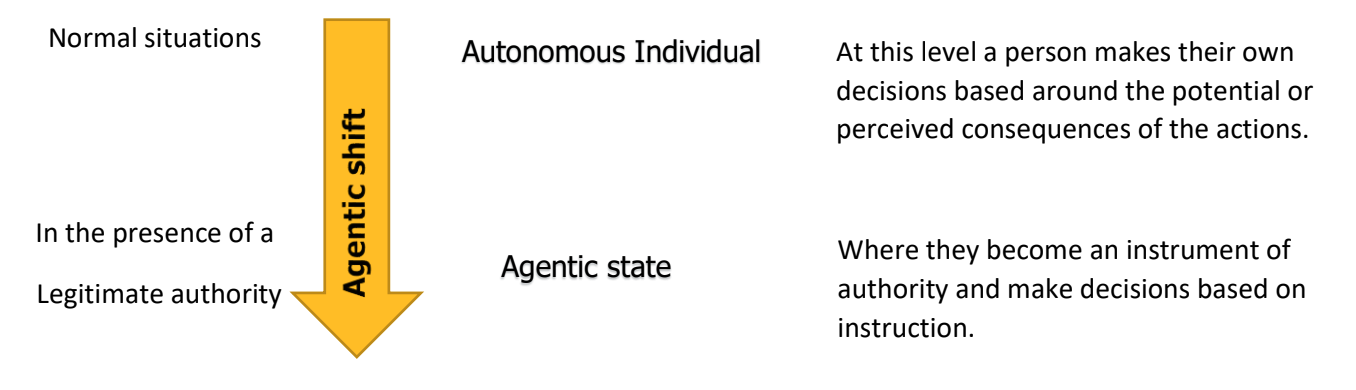
What are binding factors?
Aspects of the situation that allow the person to ignore or minimise the damaging effects of their behaviour and thus reduce the ‘moral strain’ they are feeling
These factors explain why many of Milgram’s participants said they wanted to quit, but didn’t.
What are the binding factors?
distance
victim blaming
justification
Why does Milgram’s study support the agentic state as an explanation for obedience?
authority figure= experimenter
agent= teacher/pp
how the shift occurs= when the pp is in the presence of the experimenter
binding factors= cannot see learner, experimenter said that they would take responsibility and used prods
what happened= 65% obeyed at 450v
proximity+ touch proximity= obedience dropped as pps could see harm being caused, increasing moral strain
remote authority= obedience dropped when authority figure gave orders to a telephone, easier to stay in an autonomous state
evaluation of Legitimacy of Authority: supporting research
Blass & Schmitt (2001) showed a film of Milgram's original obedience study to students and asked them to identify who they felt was responsible for the harm to the learner
The students blamed the experimenter rather than the participant, stating that the experimenter was both the legitimate authority and the expert authority (i.e., a scientist).
The above finding shows that the legitimacy of authority is a valid concept when discussing destructive obedience
HOWEVER, people have individual differences: A major limitation is that legitimacy cannot explain why 35% of participants in Milgram's original study resisted the authority figure despite the same situational pressures. This suggests that internal factors, such as an Internal Locus of Control or personality traits, also play a role
evaluation of Legitimacy of Authority: cannot explain obedience
Rank & Jacobson (1977) found that 16 out of 18 hospital nurses disobeyed orders from a doctor to administer an excessive drug dose to a patient. The doctor clearly has legitimate authority and yet, the majority disobeyed. This disobedience may be explained by dispositional factors.
evaluation of agent state: supporting evidence
The majority of Milgram’s ppts resisted giving shocks at some point in the study. They asked who was responsible if the learner is harmed. When the experimenter stated that he was responsible, many ppts continued with the procedure with no further objections.
HOWEVER The theory cannot fully explain why 35% of participants in Milgram's original study resisted the pressure to obey. If the agentic shift was a universal response to authority, everyone under the same situational pressure should have obeyed to the maximum voltage
evaluation of agent state: cannot explain disobedience
Rank & Jacobson (1977) found that 16 out of 18 hospital nurses disobeyed orders from a doctor to administer an excessive drug dose to a patient. The nurses stayed in an autonomous state despite a direct order. The agentic shift can only account for some instances of obedience.
Nature vs Nurture: Situational vs Dispositional Factors
Situational/Social-Psychological (Nurture): Explanations like the Agentic State suggest that people obey because they shift responsibility to an authority figure. Similarly, Legitimacy of Authority argues we obey based on a person’s perceived position in a social hierarchy.
• Dispositional (Nature): Critics argue that these theories ignore the role of personality. The Authoritarian Personality theory suggests that some people are naturally more predisposed to obedience due to their upbringing.
• Interactionism: Focusing solely on social-psychological factors is criticised for "hugely oversimplifying" obedient behaviour. Because not everyone obeys in the same situation—such as the 35% of participants in Milgram’s study who refused to go to 450 volts—it suggests that internal disposition must interact with social pressures
 Note
Note  Flashcards (96)