PSY 110 - Exam #3 Umiami Gillis
 Call Kai
 Learn
Learn Practice Test
 Spaced Repetition
 Match
Match Flashcards
 Knowt Play
1/108

There's no tags or description
Looks like no tags are added yet.
Name | Mastery | Learn | Test | Matching | Spaced | Call with Kai | Chat |
|---|
No analytics yet
Send a link to your students to track their progress
109 Terms
What are Freud's three structures of the personality?
Id, Ego, and Superego
What is the ID?
Pleasure Principle
What is the Ego?
Reality Principle
What is the Superego?
Morality Principle
What are the 8 defense mechanisms?
repression, rationalization, projection, displacement, regression, reaction formation, denial, sublimation
What is repression?
Unconsciously pushing negative thoughts away
What is rationalization?
Making excuses for behaviors that are considered unacceptable
What is projection?
when someone attributes his or her own feelings to another person or group.
What is displacement?
when someone takes their negative emotions and focuses them on a different, safer target.
What is regression?
A reversion to immature patterns of behavior.
What is reaction formation?
Doing the opposite of what someone tells you to do in order to maintain the illusion of independence
What is Denial?
Refusing to acknowledge some aspect of reality
What is Sublimation?
Converting improper impulses into more socially accepted behavior
What are Freud's psychosexual stages of development?
Oral, Anal, Phallic, Latent, and Genital
What is the Oral Stage?
0-2 years old, pleasure centers on the mouth- sucking, biting, chewing
What is the Anal Stage?
- 2-3 years
- toilet training, pleasure focuses on bladder & bowl elimination, control issues
What is the Phallic stage?
- 3-7 years
- genital pleasure center, Oedipus & Electra complex create incestuous feelings
Oedipus vs. Electra complex
A girl (Electra) or a boy (Oedipus) aged 3-7 becoming unconsciously sexually attracted to their parent of the opposite sex and hostile to their parent of the same sex
What is the Latent stage?
- 6-12 years (until puberty)
- Sexual energy dormant, focus on school work & play with same sex friends, not interested in the opposite sex
What is the Genital stage?
- 12> years
- reawakened sexual instincts with the goal of reproduction
- mature sexual relationships
How did Erik Erikson's theory differ from Freud?
Freud believed personality is shaped only in childhood (emphasis on sexual nature), while Erikson believed personality is shaped throughout your lifespan (emphasis on social nature)
What is Carl Jung's theory?
Founded the School of Analytical Psychology, believed that the ego was completely obvious and whom you think you are
Collective Unconscious (Carl Jung)
Carl Jung's concept of a shared, inherited reservoir of memory traces from our species' history
Archetypes (Carl Jung)
Universally understood models of people, behaviors, or personalities;
example: good vs. evil
Mandala (Carl Jung)
A geometric design or pattern that represents the cosmos or deities in various heavenly worlds.
Anima (Carl Jung)
The unconscious feminine side of a man
Animus (Carl Jung)
The unconscious masculine side of a woman
The Behavioral Model of Personality
-Personality is learned through
Classical conditioning
Operant conditioning
Observational (social) learning
The Humanistic Model of Personality & the work of Carl Rogers
people are intrinsically good, with an innate drive to make themselves better; Carl Rogers was the first real psychologist
Unconditional Positive Regard
according to Rogers, an attitude of total acceptance toward another person
Active Listening
when you are fully aware and concentrate on what is being said rather than passively hearing what the speaker is trying to convey
What are the 5 common responses to emotional communication?
Reflect (THE BEST), Evaluate, Interpret, Reassure, or Probe
What does Biology have to offer about personality differences in animals?
Animals are very easy to be bred and trained; breeding personality. Pit bulls have been bred to aggressively attack small running things.
What does Biology have to offer about personality differences in people?
Men are more physically aggressive than women. When a woman is unusually aggressive, she usually has high levels of testosterone.
What was the work of Jerome Kagen on shyness?
A shy adult is more likely to have been high-reactive (fearful or excited by dangled object) in infancy and childhood than their bold and sociable counterparts, who were most likely low-reactive (non-responsive to dangled object)
What was found by the identical twin studies where they were separated at birth?
identical twins who are reared apart had the same chance of being similar as twins who were raised together.
What are Objective personality tests?
They involve the administration of a standard set of questions or statements to which the examinee responds using a fixed set of options and can be scored with an answer key
What are the 4 Objective Personality tests?
MMPI, 16-PF, MCMI, NEO-PI
What does MMPI stand for & what is it?
Minnesota Multiphasic Personality Inventory; a psychological test (First personality test in US)that assesses personality traits and psychopathology. It is primarily intended to test people who are suspected of having mental health or other clinical issues.
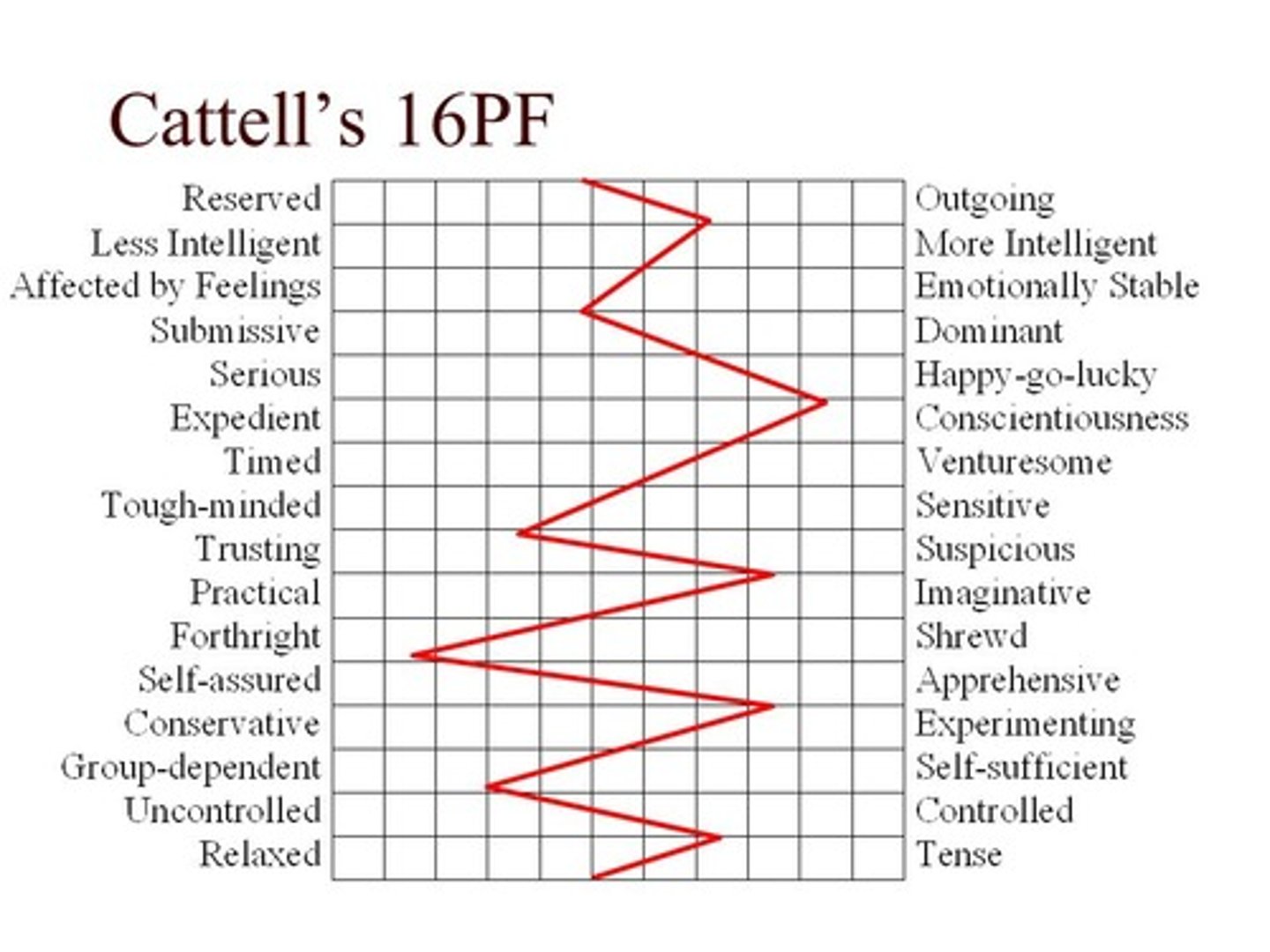
What is the 16-PF test?
16 PF (Personality Factors) measures personality on two hierarchical levels, primary and secondary traits, and has been developed as a result of extensive factor analyses of large arrays of behavioral items.
What is the MCMI test and what does it stand for?
Millon Clinical Multiaxial Inventory (MCMI) invented by Theodor Millon - substitute for the MMPI; a self-report assessment tool used to help diagnose and treat personality disorders.
What is the NEO-PI test?
a personality inventory that assesses an individual on five dimensions of personality, the so-called Big Five personality traits. These traits are openness to experience, conscientiousness, extraversion, agreeableness, and neuroticism.
What are Projective Tests?
a psychological test in which words, images, or situations are presented to a person and the responses analyzed for the unconscious expression of elements of personality that they reveal.
What are the 5 Projective Tests?
Rorschach Inkblot, TAT (Thematic Apperception Test), Incomplete Sentence, Word Association, Draw-A-Picture
What is the Rorschach Inkblot Test?
A set of 10 inkblots, designed by Hermann Rorschach; seeks to identify people's inner feelings by analyzing their interpretations of the blots
What is the TAT (Thematic Apperception Test)?
shows you a picture and asks you to tell you what will happen next and what has happened before.
What is the incomplete sentence test?
give you sentences that are not finished. Say things like, "If only I had __."You are supposed to put the first thought that comes into your mind. When you read these, they are very revealing.
What is the Word Association test?
reading words to a respondent who then answers with the first word that comes to mind
What is the Draw-A-Picture test?
used for children; kids draw pictures and they are very revealing. Draw a picture of something that happened - family, house, tree, etc.
What are Research Methods?
approaches that social scientists use for investigating the answers to questions
What are the 4 Research Methods?
Type A/B, Internal/External Locus of Control, Optimism/Pessimism, Need for Achievement
What is Type A/B?
People with type A personalities may be ambitious, competitive, and aggressive. People with type B personalities may be patient, flexible, and laid-back.
What is Internal/External Locus of Control?
Internal - believes that they are in control of their own actions and believes that what happens is something they have caused
External - what happens comes from outside their control, feel helpless in a stressful situation
What is Optimism/Pessimism?
Looking on the positive side of things/focusing on the negative side of things. Glass is half empty/full (usually determined by who raised you)
What is the Need for Achievement?
The extent to which an individual has a strong desire to perform challenging tasks well and to meet personal standards for excellence (This comes from observational observation from your parents.)
Darwin History of Intelligence Testing
Darwin’s Origin of the Species 1859 – beginning of psychology and intelligence. He suggested that animals and plants evolved through natural selection; this is a fact now.
Galton History of Intelligence Testing
First to attempt to measure intelligence, Sir Francis Galton's Anthropometric Lab in London in 1884 - measured differences between humans such as breathing capacity, height, weight, memory, vision, etc, to measure fitness
Binet History of Intelligence Testing
Went to law school and was a medicine, but he never practiced. Dabbled in measurement because many schools were overcrowded and the teachers were frustrated because there were students who could not learn in a regular school.
Binet-Simon Scale of 1906
The first intelligence test given to children ages 3-11, that measures intellectual and cognitive ability; included 30 questions, such as asking about the difference between "boredom" and "weariness," or asking the test-taker to follow a moving object with just one eye.
The Terman Stanford-Binet Intelligence Scale of 1916 in California
brought Binet test to the United States; had to norm the test (give to a large representative group, and look at the distribution of grades; compare an individual to the norm) because it was in a different language (French).
What is the formula for IQ?
IQ=MA (mental test age) /CA (chronological real age) x100
Army Alpha Test
a verbal test, measuring such skills as ability to follow directions.
Army Beta test
A nonverbal intelligence test developed during World War I by I/O psychologists to assess illiterate recruits.
What are the three Wechsler scales and the age range for each?
WAIS (age 16 and up) – Wechsler Adult Intelligence Scale – one of the most widely used intelligence scales
WISC → (age 6-16) – Wechsler Intelligence Scale for Children
WPPSI → (age 4-6) – Wechsler Preschool and Primary (first grade) Scale of Intelligence
What are the three big ideas in Psychometrics?
Reliability, Validity, and Standardization
What is Reliability?
The results of psychological investigations are said to be reliable if they are similar each time they are carried out using the same design, procedures and measurements
What is validity?
a test is valid if it measures what it claims to measure. For example, a test of intelligence should measure intelligence and not something else (such as memory).
What is standardization?
test is given under standardized conditions. When these tests are administered, they are administered under the exact same conditions.
What is test-retest reliability?
the consistency of measures when the same test is administered to the same person twice.
What is criterion validity?
evaluates how accurately a test measures the outcome it was designed to measure.
What are the 4 theories of Intelligence as covered in the lecture?
Spearman, Thurstone, Guilford, and Gardner
What is the Spearman's two factor theory of Intelligence?
Spearman's two-factor theory proposes that intelligence has two components: general intelligence ("g") and specific ability ("s").
What is Thurstone's theory of intelligence?
7 primary mental abilities in Thurstone's model were verbal comprehension, word fluency, number facility, spatial visualization, associative memory, perceptual speed, and reasoning (intelligence is a cluster of the abilities)
What is Guilford's theory of intelligence?
states that a person's success in general intelligence may be traced all the way back to fundamental mental talents or intellectual elements
What is Gardner's theory of multiple intelligences?
claims that human beings have different ways in which they process data, each being independent. The eight types of intelligence described by Gardner include: musical-rhythmic, visual-spatial, verbal-linguistic, logical-mathematical, bodily-kinesthetic, interpersonal, intrapersonal and naturalistic.
What are the basics of the nature/nurture issue?
The expression "nature vs. nurture" describes the question of how much a person's characteristics are formed by either "nature" (genetics) or "nurture" (upbringing).
Describe the work of Arthur Jensen
Arthur R. Jensen, an educational psychologist who ignited an international firestorm with a 1969 article suggesting that the gap in intelligence-test scores between black and white students might be rooted in genetic differences between the races, died on Oct. 22 at his home in Kelseyville, Calif.
How does Test Bias relate to validity?
A test is not considered biased simply because some students score higher than others. A test is considered biased when the scores of one group are significantly different and have higher predictive validity, which is the extent to which a score on an assessment predicts future performance, than another group.
Original Sin
The goal of childbearing is to save the child by driving out the primitive, animalistic, and self-centered things. Many traditional religions include baptizing the child to save them from original sin.
Tabula Rasa
the theory that individuals are born without built-in mental content, and therefore all knowledge comes from experience or perception.
Innate Goodness
children are born without any predisposed sin or evil nature.
Nobel Savage Theory
a theory developed by Jean Jacques Rousseau, that man in his natural state is good
Developmental Continuity vs. Discontinuity
Continuous development is that which occurs gradually over time. An example from the domain of physical development is height. Discontinuous development, however, is categorical and refers to changes in stages
Cross Sectional research vs. Longitudinal research
In a cross-sectional study you collect data from a population at a specific point in time; in a longitudinal study you repeatedly collect data from the same sample over an extended period of time.
Fluid intelligence vs. Crystallized intelligence
Fluid intelligence refers to abilities needed for abstract reasoning and speeded performance whereas crystallized intelligence refers to knowledge acquired through one's culture including verbal ability and social knowledge
What are the three stages of prenatal development and the corresponding ages?
Zygote 0-2 wks
Embryo 2-8 wks
Fetus 2-9 months
What are teratogens?
substances that cause birth defects
What are teratogen examples?
Aspirin (Respiratory Problems), alcohol (FAS), heavy metals (lead & mercury), Vitamins A & D, Thalidomine (mutated limbs), Rubella
What are some advantages of breast feeding?
Breastfeeding can help protect babies against some short- and long-term illnesses and diseases. Breastfed babies have a lower risk of asthma, obesity, type 1 diabetes, and sudden infant death syndrome (SIDS). Breastfed babies are also less likely to have ear infections and stomach bugs.
Freud - Oral Gratification (social attachment)
the baby is hungry and needs to be satisfied, cats go where food is, baby only wants mother to satisfy it's needs.
this is not completely true because if a dog loves a person it won't just move next door to get better food
Harlow and Zimmerman (1959) Contact Comfort
concluding the physical holding and touching is more important in bonding than the food dependency, their theory beat Freud's theory because it ran to mother figure, not feeder. Baby bonded to mother like doll because contact comfort was more important, monkeys were raised in isolation
Konrad Lorenz - Imprinting, during a critical period
Looked at ducks that hatch, they imprint and follow the first thing they saw, the baby ducks have no idea what the mother is supposed to go. They did it with humans/dogs
Critical period, animals must figure out mother in order to survive
Raises question, do human babies imprint?
What about when children is adopted? They can readapt to new mother during certain period as well
Erik Erikson (1968) Trust vs Mistrust
Babies need to form a sense of trust in their primary caregiver or they form a sense of mistrust, but they could still insecurely bond
Mary Ainsworth's Strange Situation Test
Securely attached child will be upset that mom left but engage with new caregiver, and show happiness when mother returns
Insecure child whines and fusses when mom leaves, and wont interact with babysitter and wont settle down, when mom returns they may show anger, may be affected later on when they cant interact well with relationships/teachers/friends
Piaget's 4 stages of cognitive development
sensorimotor, preoperational, concrete operational, formal operational
Sensorimotor stage
in Piaget's theory, the stage (from birth to about 2 years of age) during which infants know the world mostly in terms of their sensory impressions and motor activities
Preoperational stage
in Piaget's theory, the stage (from about 2 to 6 or 7 years of age) during which a child learns to use language but does not yet comprehend the mental operations of concrete logic
Concrete Operational Stage
in Piaget's theory, the stage of cognitive development (from about 6 or 7 to 11 years of age) during which children gain the mental operations that enable them to think logically about concrete events
Formal Operational Stage
in Piaget's theory, the stage of cognitive development (normally beginning about age 12) during which people begin to think logically about abstract concepts
Assimilation
interpreting our new experiences in terms of our existing schemas