Veterinary Ethics Scenarios
 Studied by 0 people
 Call Kai
 Learn
Learn Practice Test
 Spaced Repetition
 Match
Match Flashcards
 Knowt Play
1/7

Earn XP
Description and Tags
Name | Mastery | Learn | Test | Matching | Spaced | Call with Kai |
|---|
No analytics yet
Send a link to your students to track their progress
8 Terms
You are a veterinary student who is undertaking a clinical placement in a practice that services the greyhound industry. You are asked to attend a greyhound meeting and assist the veterinarian carry out their contracted responsibilities in
providing veterinary oversight for a race meeting.What will you do?
Communicate your concerns to the veterinarian you are working with so they are aware of the situation. They may be able to give you some guidance in how to handle the situation.
Think of it as an opportunity to learn and observe the veterinary practices involved in the racing industry and assist in providing exceptional care to the patients you see.
Ideally you would still attend the greyhound meeting as you are a vet student and you are there to learn. However, if you feel immensely uncomfortable with the situation and feel it would impact the care you provide.
You work for a veterinary practice and have to pregnancy test 300 head of cattle as part of the export protocol required to select non-pregnant cattle for export. What will you do?
Discuss the situation with another vet and enquire if they could do the task instead of you. It is the clients legal right to receive this service, so if no other veterinarian is able to assist you, you are obligated to complete the pregnancy testing for the client.
Try to compartmentalise the task in your head. You are there to provide a service for the client and provide exceptional care to the patients.
Think of your contractual obligations as a veterinarian to provide this service for the client.
An owner presents to you a dog with a terminal disease. The dog is not eating, it is losing weight, you cannot cure the illness but the owner wants to continue with treatment. What will you do?
Discuss quality of life concerns with the owner. Ensure this is a two-way conversation.
Discuss what continuing the treatment will actually do for the animal.
Compromise:
Continue treatment but have frequent regular check-ins
Discuss future stages at which you’d recommend reconsidering options, i.e. “when it gets to this stage, I believe we should seriously consider…”
Politely remind the client of their obligations regarding animal welfare as they are legally responsible for their pet, i.e. RSPCA
Last resort → Advise that you will be unable to continue providing the treatment for their animal.
Either discuss transferring care to another vet at the practice, or provide details of another clinic that may be able to assist.
A client appears in your hospital for the second time in 4 weeks with her 2-year old dog. At the first visit you diagnosed a moderate case of flea allergy dermatitis, dispensed an appropriate medication and advised the owner to vacuum her house thoroughly, set off an appropriate flea egg hatching inhibitor (“flea bomb”) to help prevent recurrence of the problem. As the client and the dog enter your examination room, it is apparent that the dog’s condition has deteriorated. You suspect that little attempt has been made to control the
flea population in the environment. She now tells you for the first time that the dog has been impossible to house train, barks a lot and she wants to put it to sleep. What would you do?
Provide the client with other options, i.e. surrender to a rescue or utilise appropriate training services
Advise against euthanasia as mild FAD is a treatable condition (not terminal)
Have a two way conversation with the client enquiring about the positive things that the dog brings to her life/why she got the dog in the first place. This may help to remind the client about the positive associations she has with the dog and may provide motivation to better her relationship with the dog and fix the route problem.
Ask another veterinarian for advice, or to provide the service to the client instead of yourself
We cannot deny the client her legal right to receive this service if it is what she chooses, as the dog is technically her “property”
It is the height of the foot and mouth disease outbreak in the UK. As part of the surveillance and eradication program you visit a renowned cattle stud. Your task is to examine all of the cows in the herd for symptoms of the disease. You detect 5 cows with what could be early signs of the disease. The owner begs you to not report the finding and he will quietly get rid of the affected cows. This stud is his lifetimes work and his only means of livelihood.
Is your obligation to the patients, or the clients, or are there other dimensions that you need to consider?
As a veterinarian, you have a legal obligation to report the findings. As soon as you suspect the presence of disease, you should be on the phone to report it. There are wider implications beyond the owner and his farm.
You have only detected 5 affected cows during that visit to the property, but there could be other cows that are yet to show signs of disease. So even if the farmer were to quietly get rid of the affected cows, it will likely still be a disease presence on the farm.
You are called out to do a prebreeding examination on a mare. She has just arrived at the stud today from another farm. She had been served by a stallion 2 to 3 weeks ago. Another vet had examined her yesterday with an ultrasound. Finding no evidence of a pregnancy he injected the horse with a dose of prostaglandin (which can shorten a horses reproductive cycle and result in the mare coming in heat within about 5 days). When you examine the mare to determine if she is coming in heat you find that she is pregnant.
What should you do as the previous injection of prostaglandin will cause the mare to abort?
To whom do we have an obligation to in this example?
The other vet is not incompetent, it was an honest mistake.
In this example, you have an obligation to both the client and the other vet to be honest and open about your findings.
You must effectively communicate with all parties.
Note: It is important to be able to accurately preg test a mare at 14 days, especially regarding the detection of twins, as one will need to be reduced in utero.
You are presented with a dog that has been hit by a car. On examination
you notice that a bone in the hind leg will require a surgical procedure to
correct the problem or alternatively the leg will need to be amputated.
You provide the owner with a detailed explanation and the options
available. The owner is unable to afford any of the options but is able to
afford to euthanise the dog.
What should you do?
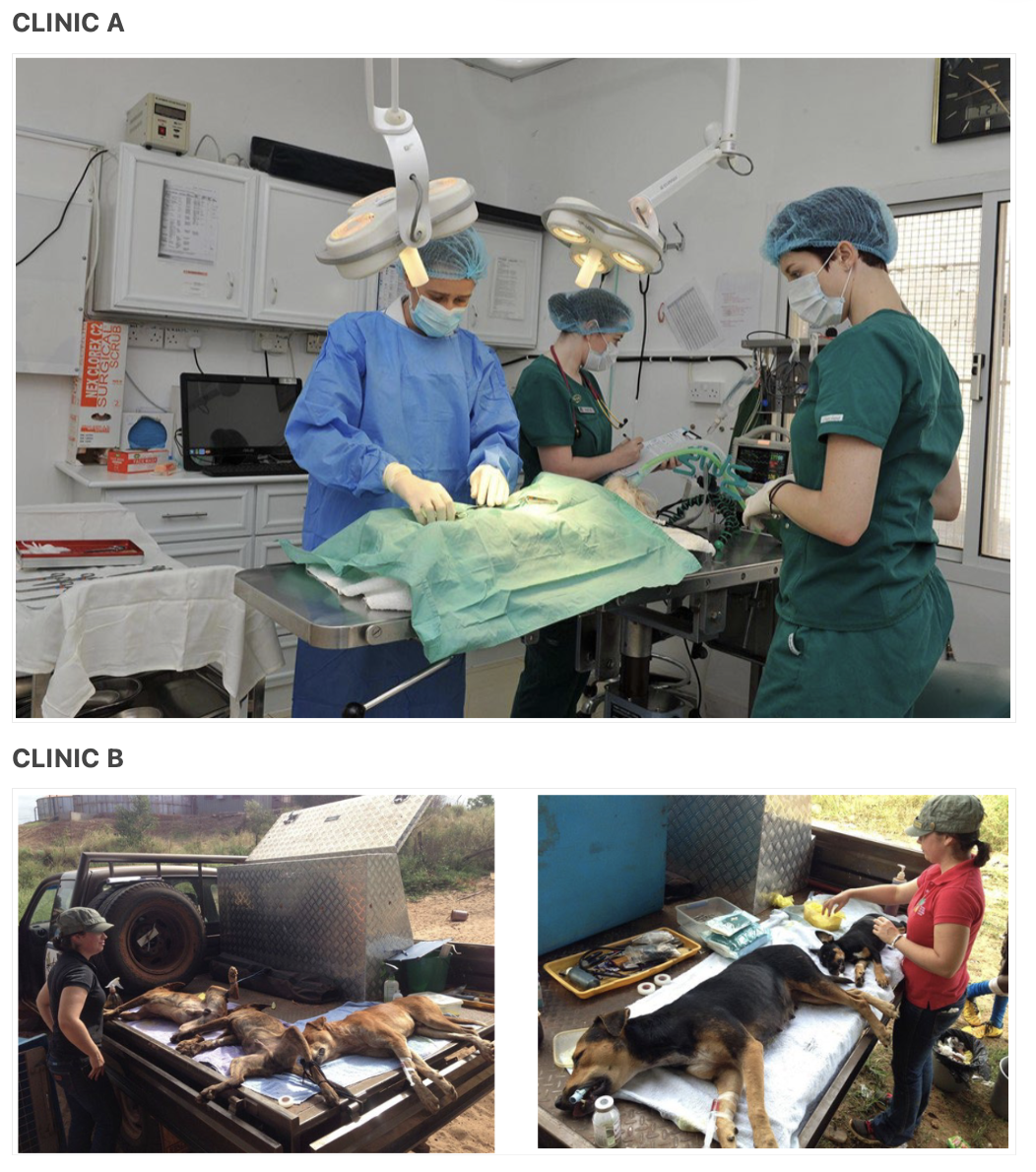
Compare Clinic A and Clinic B - Discuss any ethical conflicts?
Clinic A appears to be the standard sterile surgery environment.
Clinic B appears to be unhygienic and unsterile.
However, it is important to consider the context of these situations, i.e. location and availability of resources.
If Clinic B was being used despite there being available facilities and an abundance of resources (as in Clinic A), then it would be a significant ethical issue.
If Clinic A was not maintained and was in the condition of the facilities used in Clinic B, then it would be a significant ethical issue.
However, given the context of each scenario, there is not a significant ethical conflict.
 Note
Note  Flashcards (334)