Lecture 5 - CRE & dynamic choice
 Call Kai
 Learn
Learn Practice Test
 Spaced Repetition
 Match
Match Flashcards
 Knowt Play
1/18

There's no tags or description
Looks like no tags are added yet.
Name | Mastery | Learn | Test | Matching | Spaced | Call with Kai |
|---|
No analytics yet
Send a link to your students to track their progress
19 Terms
Dynamic choice under risk
Choice problems where outcome determined by combination of choices and risks (with known probability) with at least one of:
– More than one moment of choice
– More than one moment when chance resolved
– A chance resolved even before agent has any choice to make
How are dynamic decision problems represented
Decision trees
4 principles of rational dynamic decision-making used in orthodox economic modelling
- Frame Independence
- Forward-looking rationality / Separability
- Dynamic consistency
- (Standard) Reduction of compound lotteries
Frame independence definition
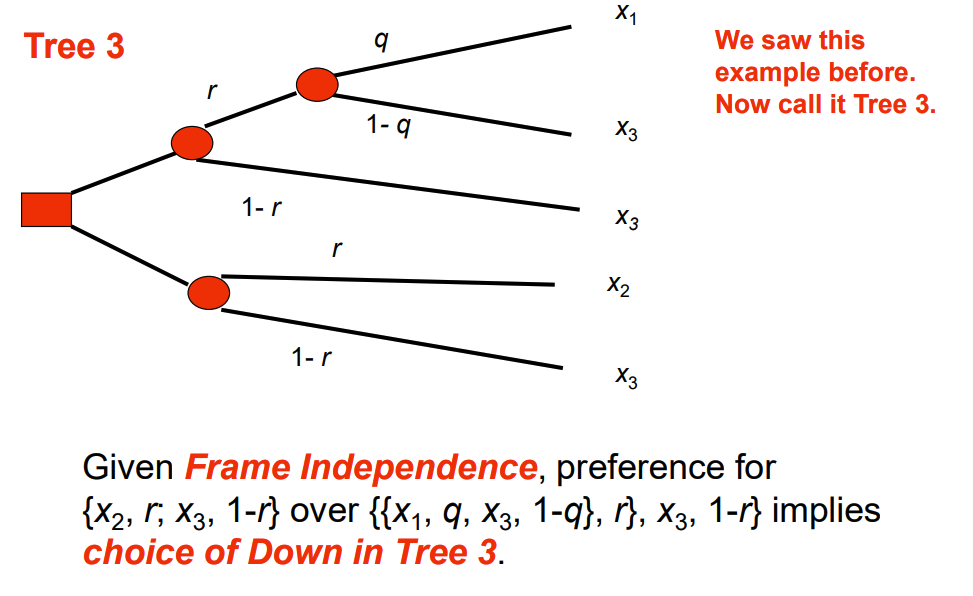
Person will make same decisions in any 2 dynamic decision problems that have the same decision tree
regardless of framing the choices made will be the same if the underlying decision tree is identical
their dynamic choice behaviour can be analysed in decision trees
Compound lottery
A lottery where at least one of the prizes is entry to another lottery
- Chance node that leads to another chance node
(Standard) Reduction of compound lotteries definition
Decision makers under standard thinking are modelled as reducing compound lotteries to a probabilistically equivalent simple lottery by multiplying out probabilities
(Standard) Reduction of compound lotteries decision tree
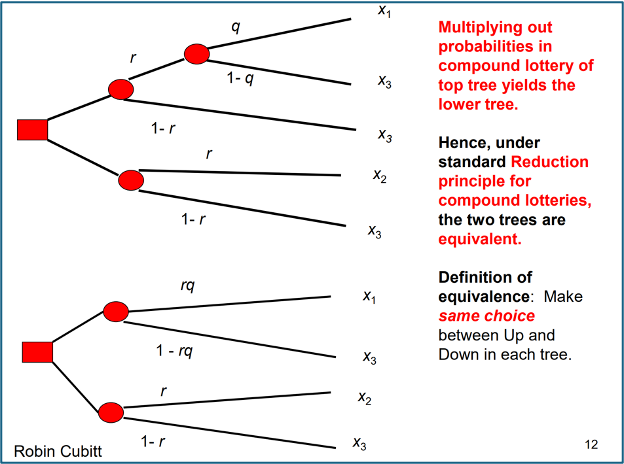
Person sees up as a simple lottery and so tree 1 becomes tree 2
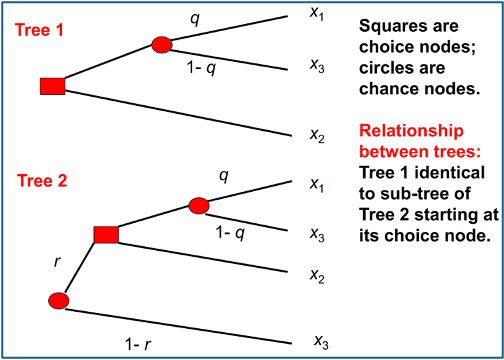
Forward-looking rationality / Separability definition
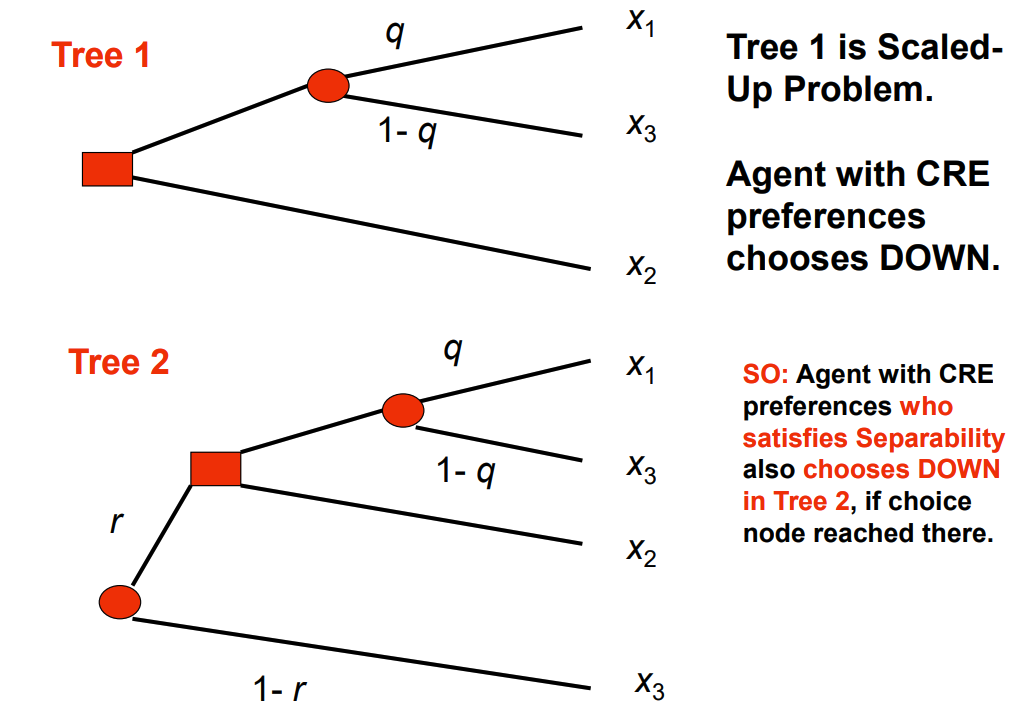
At any choice node, the agent’s choice matches what they would choose at the initial node of the tree obtained by “snipping off” the sub-tree at the choice node from parts of the original tree not reachable from the sub choice node
The sub tree then becomes ‘identical’ to the agent
Forward-looking rationality / Separability decision tree
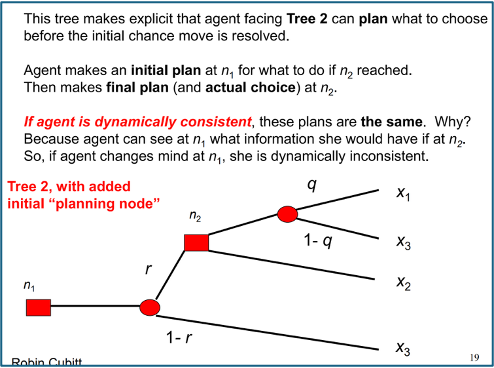
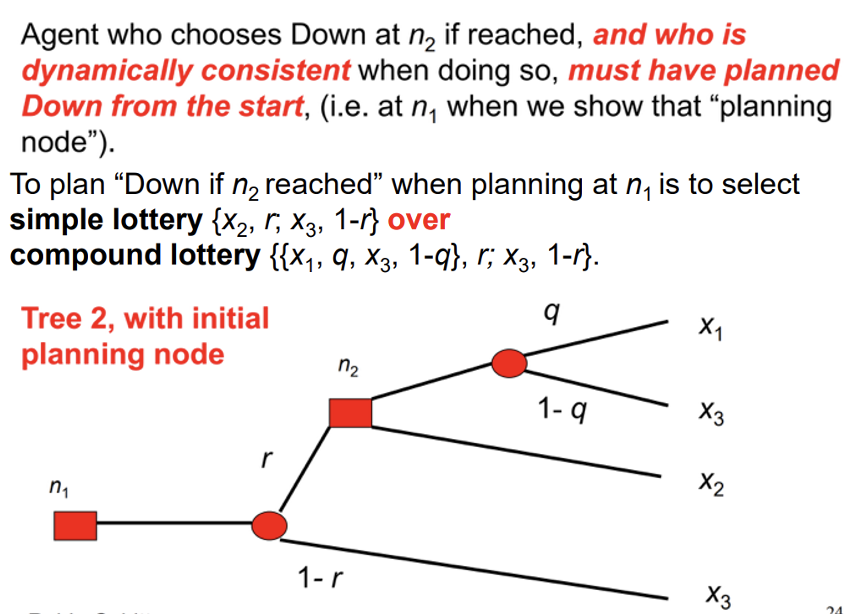
Dynamic consistency definition
in a decision problem with a sequence of choices, a rational agent should:
- Plan ahead
- Not change plans unless new information available
Dynamic consistency decision tree
Scaled up vs scaled down CRE preferences overview
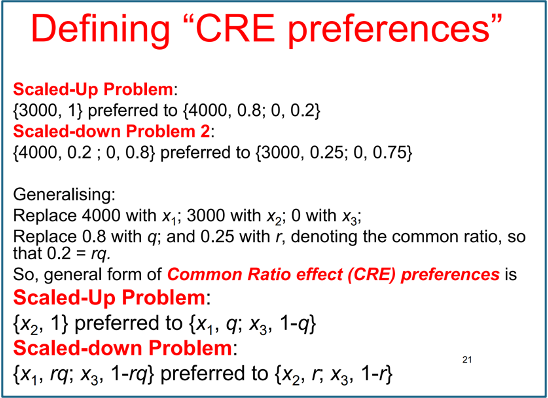
Scaled up vs scaled down CRE preferences - CRE choice on decision tree
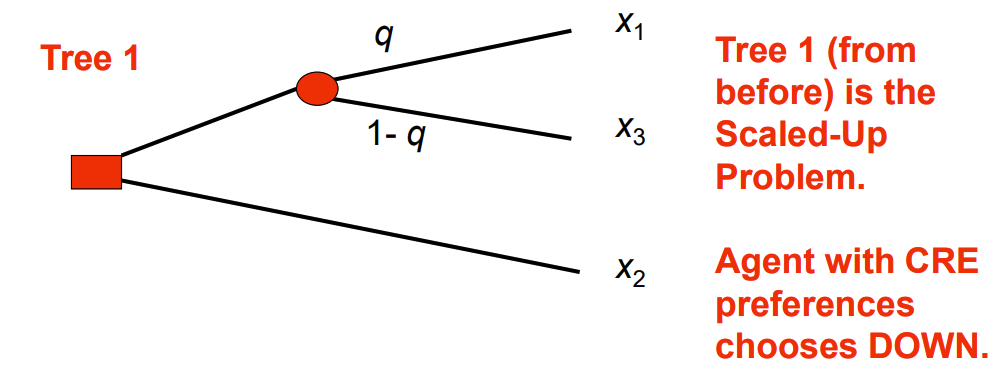
Scaled up vs scaled down CRE preferences - separability
Scaled up vs scaled down CRE preferences - dynamic consistency
Scaled up vs scaled down CRE preferences - frame independence
Scaled up vs scaled down CRE preferences - standard reduction of compound lotteries
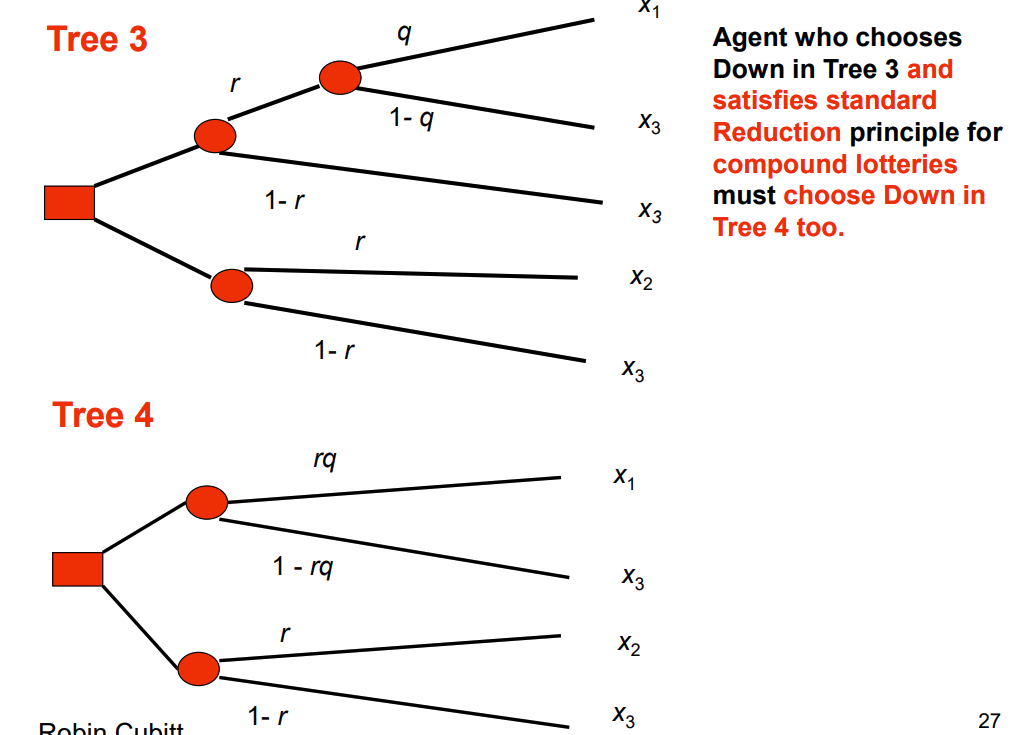
Scaled up vs scaled down CRE preferences - CRE vs SRCL
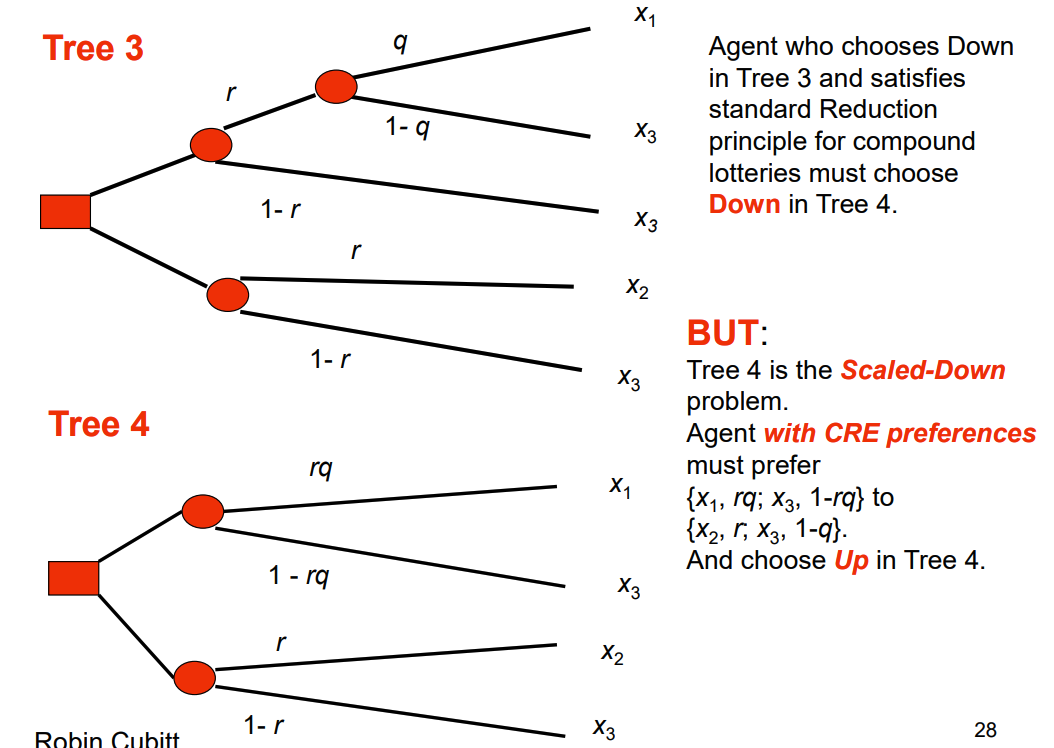
CRE vs principles of rational dynamic decision-making
Not compatible
It is impossible to have and always act on CRE preferences while also satisfying ALL of the 4 principles
BUT it doesn’t tell us which one it violates
CRE preferences require Down in Tree 1 and Up in Tree 4
BUT rational dynamic choices select either UP or DOWN at every tree

