Herpetology Final (Exams 1 & 2)
 Studied by 4 people
 Call with Kai
 Learn
Learn Practice Test
 Spaced Repetition
 Match
Match Flashcards
 Knowt Play
1/47

There's no tags or description
Looks like no tags are added yet.
Name | Mastery | Learn | Test | Matching | Spaced | Call with Kai |
|---|
No study sessions yet.
48 Terms
What are the osmoregulatory pressures on a sea turtle?
Sea turtles often lose internal water but gain salt ions from the surrounding environment
What is true about the thermal environment selected by adult salamanders?
On average, larvae select a warmer environment to speed up development
Who has the most advanced hearts in the animal world?
Crocodilians
In crocodilians the right to left ___ allows them to divert blood away from ___ circulation while diving
Shunt ; pulmonary
What is an accurate description of the counter-current exchange system we discussed for ectotherms such as Leatherback turtles and blue-fin tuna?
Blood vessels in close proximity cause heat to move from higher to lower heat
Heart chambers that all have blood with the same O2 concentration could be observed in which animal?
Red backed salamander
All amphibians possess what two types of skin glands?
Mucous and granular
What is Lacrimal?
A specific type of salt glands possessed by sea turtles and diamond terrapin
What is Gastralia?
Abdominal ribs found in crocodilians and tuatara
What is Stratum Corneum?
Outermost skin layer that is shed by amphibians
What is a Caruncle?
Term for the specialized “tooth” that is used by tuatara, turtles and crocodilians to aid in egg emergence
What is a Nupital Pad?
Seasonal epidermal modifications of the front feet of male frogs and toads that facilitate amplexus
What is Amplexus?
The mating position of frogs and toads, in which the male clasps the female about the back.
What is Neotenic?
Term used for amphibians that retain larval characteristics as adults
What is Granular?
The “warts” on toad skin are actually concentrations of these glands
What is a Pelvic Patch?
A section of heavily vascularized and thin skin used by some amphibians to uptake water
True or false? All non-avian reptiles have three chambered hearts
False. Most non-avian reptiles (like lizards, snakes, turtles) have three-chambered hearts, but crocodilians (alligators, crocodiles, caimans) are reptiles that possess a more advanced, four-chambered heart
True or false? Amphibians and reptiles in Michigan are about to engage in hibernation to survive the winter
False. Amphibians and reptiles brumate (brumation), mammals hibernate.
True or false? Generally speaking salamander skin is far more important for respiration than the lungs are
True. Many species are lungless, salamanders respirate mostly from their skin and also absorb moisture from it.
What is true regarding squamate species diversity?
Squamates have a high species diversity relative to other vertebrate orders, only fish have more species
What amniote lineage has no living representatives? (They are all extinct)
Anapsids (Anapsida)
What statement about plesiosaurs and pliosaurs is TRUE?
Pliosaurs probably pursued larger prey than plesiosaurs
What is the primary source of direct evidence for reconstructing color patterns in some pterosaurs?
Fossilized remains of melanosomes preserved in feathers
How is it that many amphibians can withstand extracellular temperatures as low as -6 degrees C?
They produce cryoprotectants (like glucose or glycerol) that act as antifreeze, preventing ice from forming inside cells.
What is the adaptive benefit of the epidermal modifications on the feet of Spadefoot toads and Rain frogs that we observed in several videos?
Efficiency in burrowing/digging + burying themselves
What is the most common nitrogenous waste type associated with Anura and Squamata? Explain the trade-offs associated with each and why it is adaptive for that particular group.
Anura: Urea. Moderate water use, lower toxicity, but higher energy cost than ammonia.
Tadpoles also can use ammonia which is very toxic, but low energy cost.
Squamata: Uric acid. Very low toxicity, very low water requirement, but also a very high energy cost to produce.
Briefly describe two conditions where natural selection seems to favor the evolution of salt glands in reptiles.
Arid/desert climates: to remove salt without losing too much water
Marine/high-salt environments: to excrete excess salt from seawater intake
Which letter shows the larvae you would expect to find in a pond environment? Explain why?
(A has the most developed gills, B has slightly developed gills, C has no developed gills)
A
Well-developed gills are needed for low-oxygen pond water as they increase the surface area for gas exchange and help to extract enough oxygen.
The gigantic species of pterosaurs probably..
Saved energy by being especially good at gliding (soaring)
Fossilization is a rare event, particularly for soft tissues. Under which conditions is fossilization most likely?
Rapid burial in low-oxygen environments
When scientists classify groups like theropods, dromaeosaurids, and anklyosaurs as monophyletic, what are they emphasizing about the relationships among the organisms in that group?
The organisms share a common ancestor and include all of its descendants
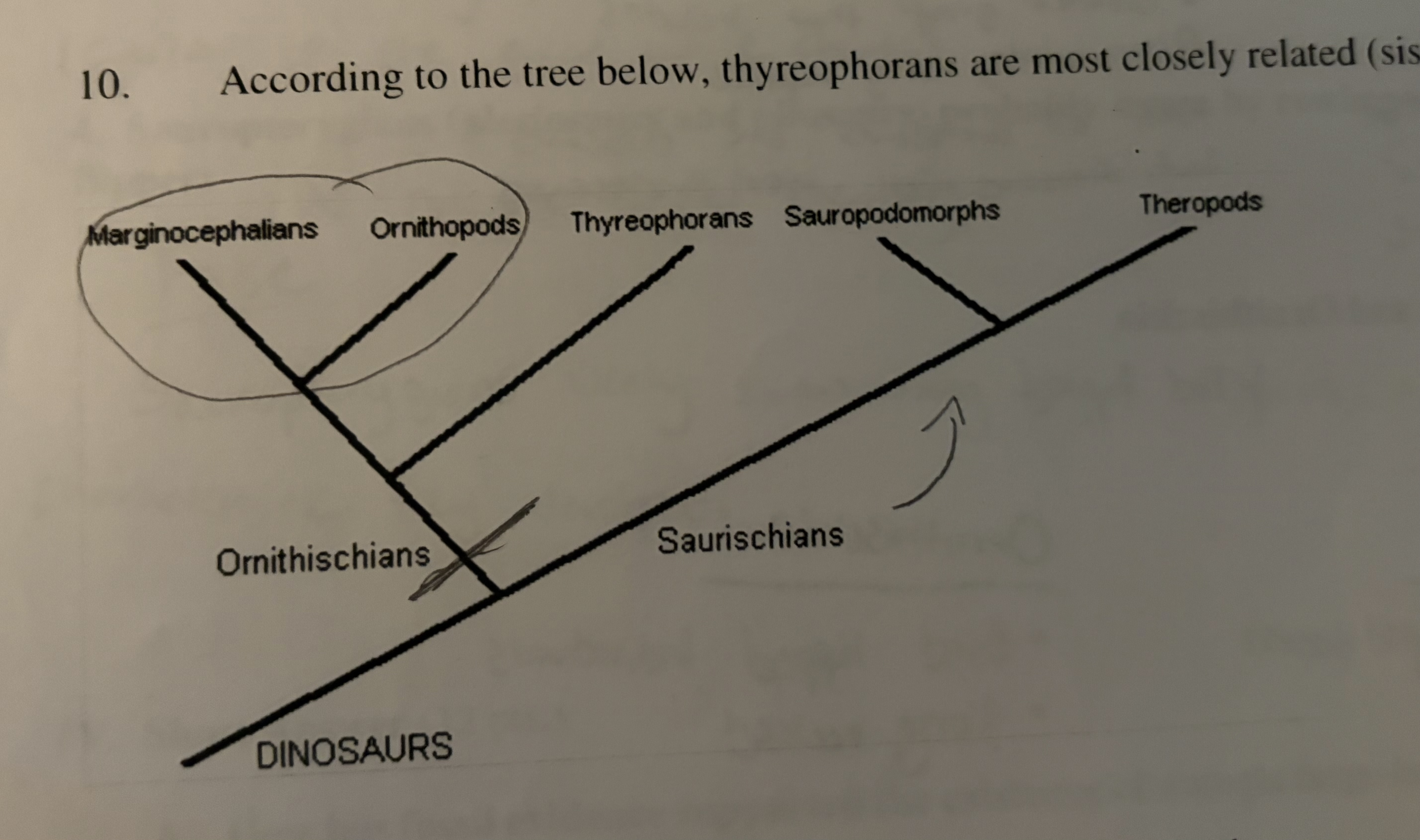
According to the tree, thyreophorans are most closely related to (sister) to:
The clade that includes marginocephalians and ornithipods
Which group of dinosaurs retained a generally ancestral archosaur skull?
Saurischian dinosaurs
Dinosaurs are different from other archosaurs in what way?
They have a derived pelvis
Compare and contrast Dinosaurs and Archosaurs
Dinosaurs: Unique pelvis, allowed upright stance, unique features not shared with other archosaurs
Archosaur: Broader group that includes dinos, crocs, living reptiles. Not all archosaurs are dinosaurs but dinosaurs fall under Archosaurs
Compare and contrast Saurischia and Ornithischia
Saurischia: leaf-shaped teeth, lizard hipped, long necked
Ornithischia: bird hipped, pubis backward, long necked
True or false? Tiktaalik had both ancestral and derived characteristics.
True. It showed fish-like traits, and tetrapod like traits. It was the species to make the move onto land making it a transitional form.
True or false? Most pterosaurs lived near water because most of their fossil remains have been found in aquatic sediments.
False. Some may have lived near water, but aquatic areas fossilize organisms more easily, preservation bias, not actual habitat preference.
We cannot assume most pterosaurs lived near water just because conditions were met for fossils.
True or false? Some mosasaurs were probably deep divers when searching for food underwater.
True. Bone structure and evidence of the bends suggest some species were adapted for deep diving in pursuit of prey.
True or false? Sauropterygians (plesiosaurs and pliosaurs) probably swam by rowing with their front flippers
False. They likely swam using all 4 flippers.
How has fossil evidence supported the existence of a single large land mass?
Fossils of the same species were found on different continents, which would not have been able to travel between them unless at some point these landmasses were connected.
Describe ONE of the main hypotheses proposed to explain the advantages for early amphibians moving onto land?
To escape crowded aquatic environments. Early amphibians may have moved onto land to avoid intense competition and large aquatic predators, gaining access to safer, less crowded habitats.
Pteranodon and ichthyosaurs had ___ aspect ratio wings/fins respectively. Fill in the blank and explain why this particular aspect ratio wing or fin was important for the organism that had it. Choose either Pteranodon or Ichthyosaurs for your explanation.
Ichthyosaurs had high aspect ratio fins which were long and narrow.
This shape reduces drag and allows for fast, efficient swimming, ideal for open-ocean predators that needed speed to chase prey and travel far.
Caecilians superficially resemble snakes but are actually amphibians. Propose an evolutionary explanation for why they physically resemble a completely different order?
Convergent evolution. Although they do not share the same ancestor, they likely faced similar environmental conditions or occupied the same niche which allowed them to develop such similar features.
What are the ecological implications associated with the estimated size of the olfactory bulb in T.rex?
A big olfactory bulb, such as the one found in T.rex was used for smelling prey. It shows that they were a highly effective predator and/or scavenger.
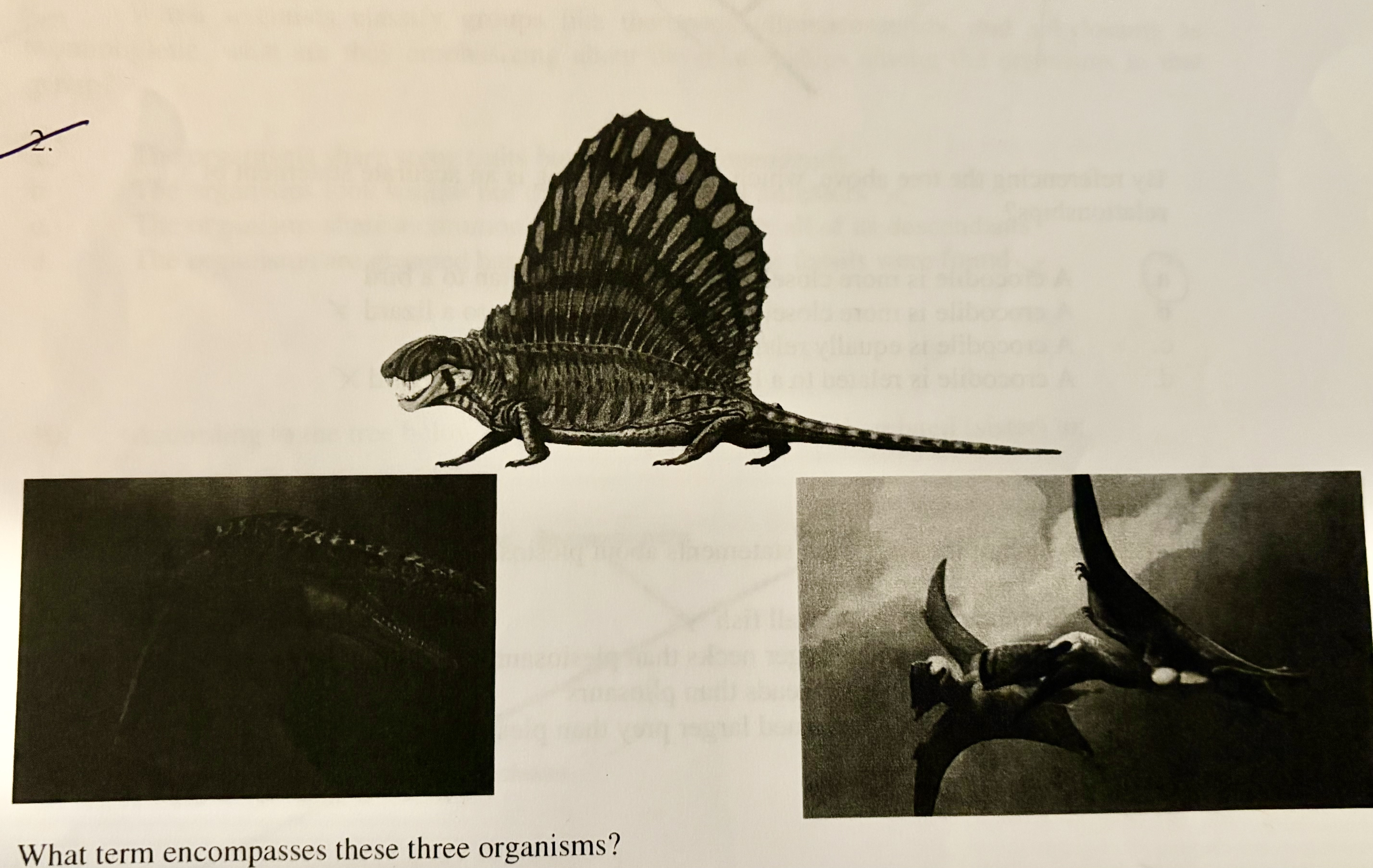
What term encompasses these three organisms?
Amniotes
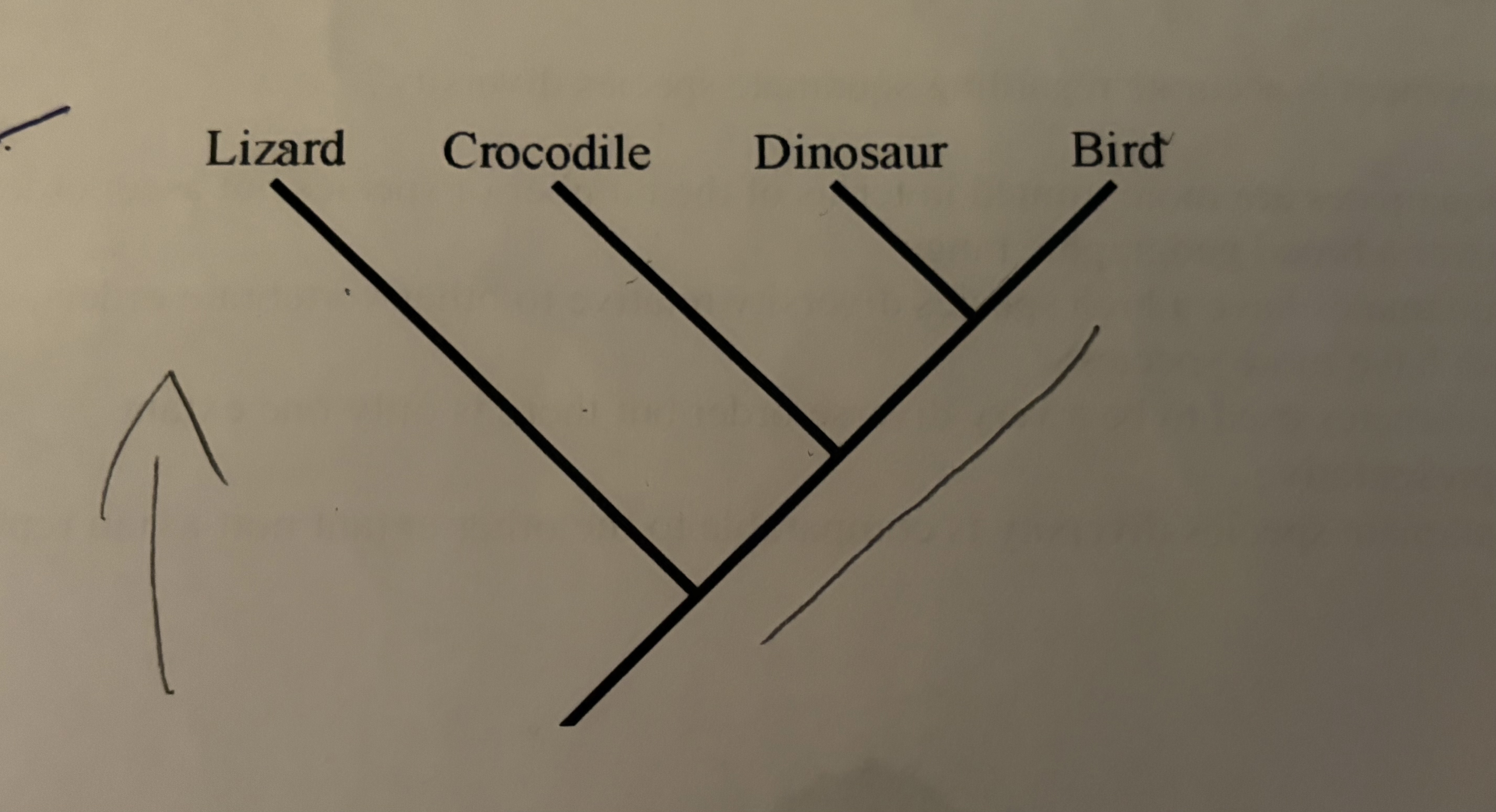
By referencing the tree above, which of the following is an accurate statement of relationships?
A crocodile is more closely related to a bird than a lizard.
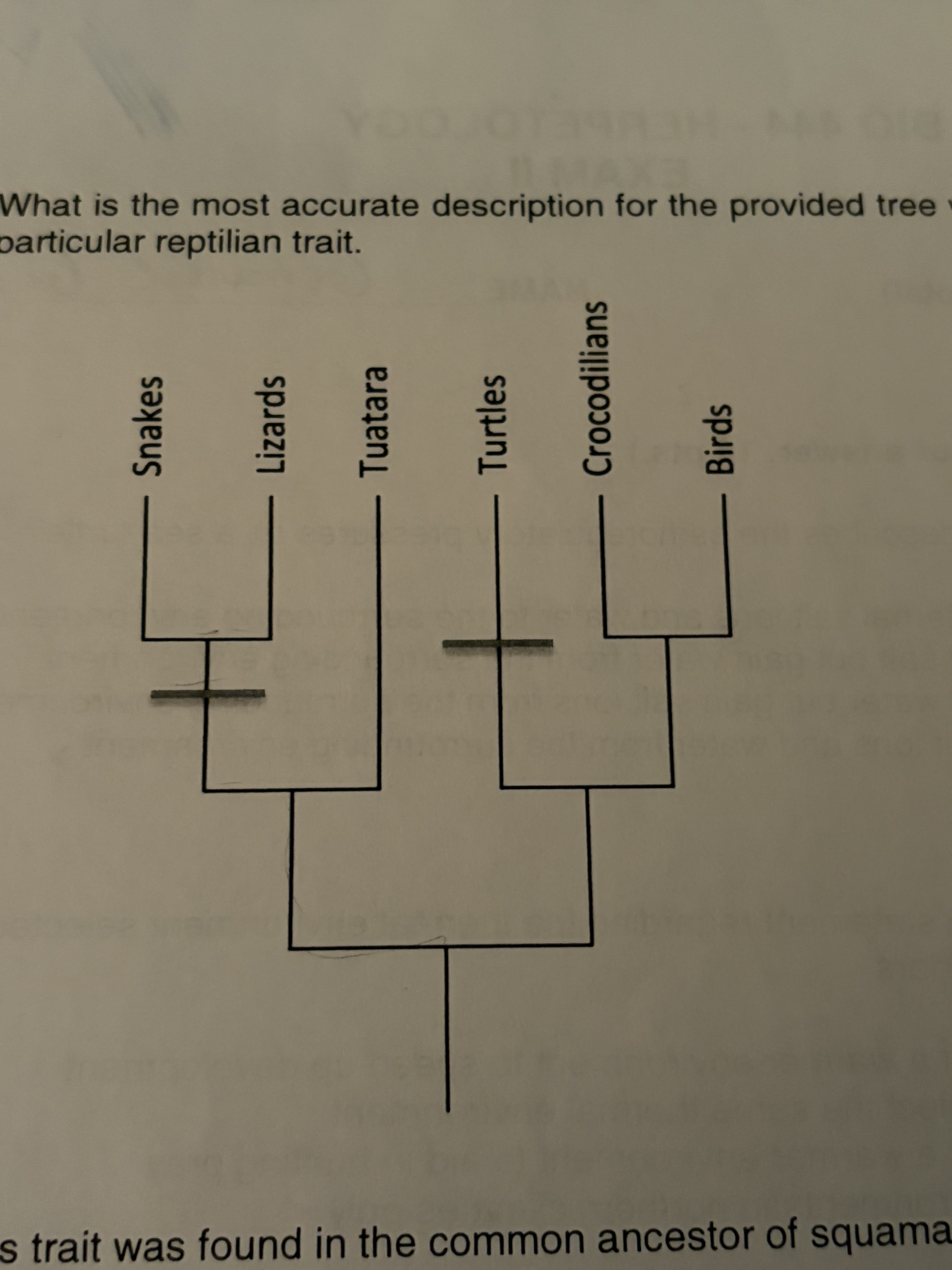
What is the most common accurate description for the provided tree with the two lines indicating a particular reptilian trait?
This trait was found in the common ancestor of squamates, and evolved independently in testudines.
 Note
Note  Flashcards (91)