Calc 2 Test 1 Memorization
 Studied by 0 people
 Call Kai
 Learn
Learn Practice Test
 Spaced Repetition
 Match
Match Flashcards
 Knowt Play
1/33

There's no tags or description
Looks like no tags are added yet.
Name | Mastery | Learn | Test | Matching | Spaced | Call with Kai |
|---|
No analytics yet
Send a link to your students to track their progress
34 Terms
∫sinx dx?
-cosx + C
∫cosx dx?
sinx + C
∫csc(x) dx?
ln |cscx-cotx| + C
∫csc^2(x) dx?
-cotx + c
∫sec(x)tan(x) dx?
secx + C
∫csc(x)cot(x) dx?
-cscx + C
∫(e^x) dx?
e^x + C
∫1/√(x^2+1) dx?
tan^-1(x) + C
∫1/√(x^2-1) dx?
sin^-1(x) + C
∫secx dx?
ln|sec(x)+tan(x)| + C
∫tanx dx?
ln|secx| + C
∫cotx dx?
ln|sinx| + C
∫e^-x dx?
-1/e^x + C
What does ln(1) = ?
0
ln(0) = ?
infinity
How to know when you have to do IBP?
If you can't u-sub and the integral has 2 functions that don't simplify into 1, ex: ∫(e^x)(sin(2x))dx
What is the integration by parts formula?
∫u dv = uv - ∫v du
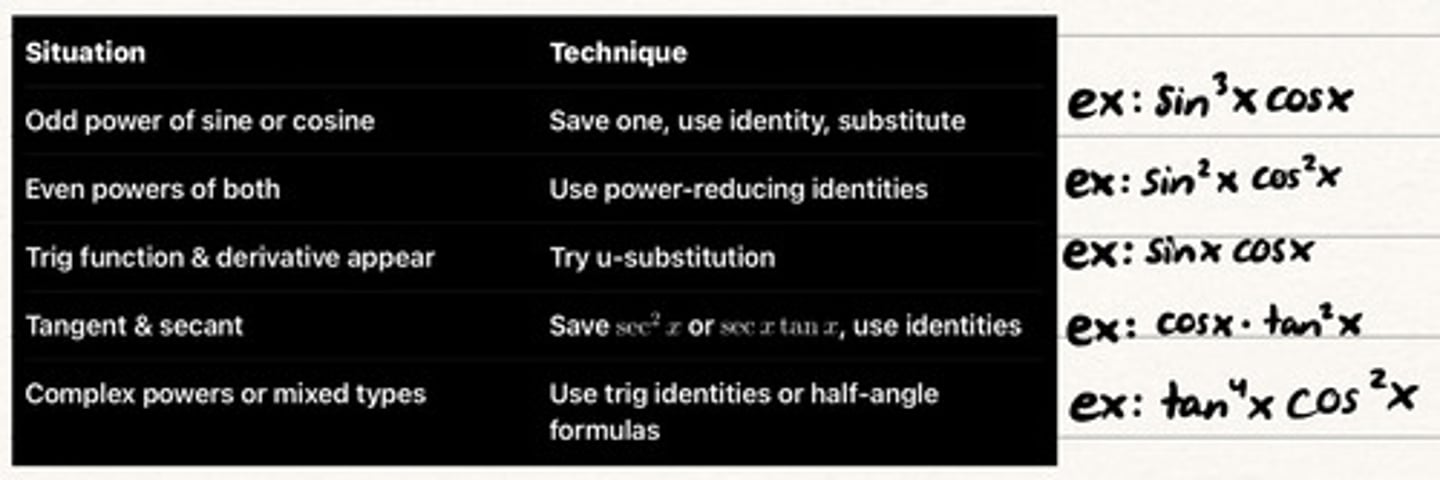
When doing trig integration what do you do if there's an odd power of sine or cosine (ex: sin^3(x))?
Break off one factor (ex: sin(x)), then convert the rest using a pythagorean identity (like sin^2(x) + cos^2(x)= 1), then u-sub
goal: reduce power to get something like u^n du
When doing trig integration what do you do if both powers are even?
use power-reducing identities to rewrite everything in terms of cos(2x) or sin(2x) then u-sub
goal: create an integral with no powers
When doing trig integration what do you do if you see tan or sec (or cot and csc)?
look to use identities like tan^2(x)+1=sex^2(x), then save a factor like sec^2(x) or sec(x)tan(x) to help you u-sub
goal: turn integral into something like ∫u^n du
Tips for trig integration
1. Always check if du matches part of the integral (to u-sub instantly)
if not..
2. Try rewriting powers with identities
3. Try pulling out a factor like sinx or sec^2(x)
Trig integration summary of what to do table
The 3 different cases for trig sub:
Look for these if you can't just u-sub
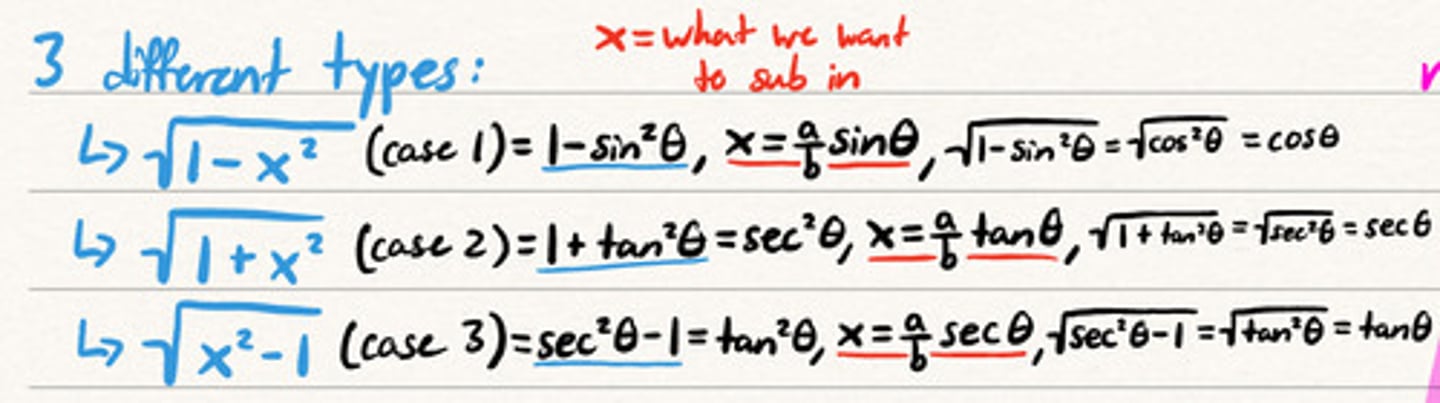
When doing trig sub and converting back to x from trig(theta) does the trig disappear or stay?
Disappear! Instead of tan(x/3) it should be x/3
Memorize the forms for partial integration:
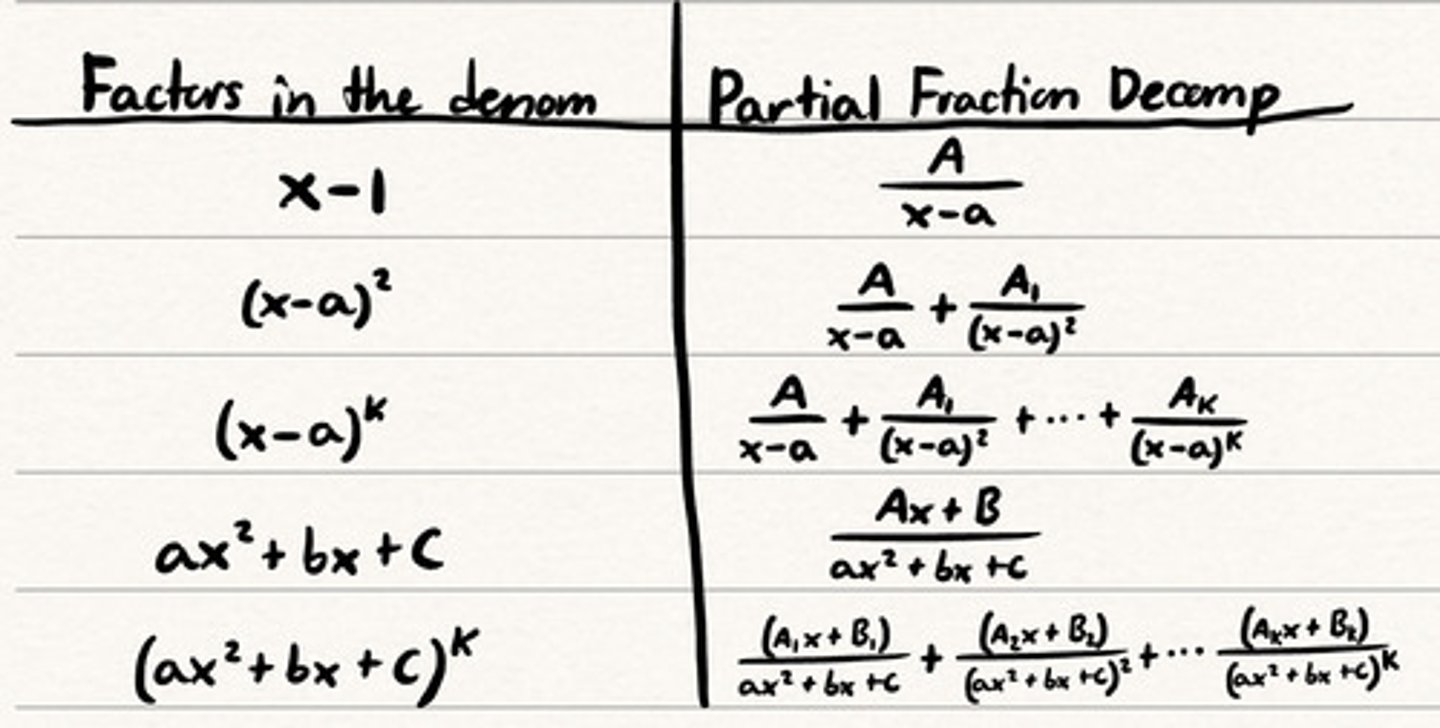
For partial integration what format will your answer be in if your integral looks something like ∫1/(x-a) dx?
A ln |x-a| + C
For partial integration what format will your answer be in if your integral looks something like ∫1/(x^2+a^2) dx?
1/a arctan(x/a) + C
this is on your formula sheet, but it is good to know that this typically happens with irreducible quadratics with a constant numerator
The 1st type of improper integral (infinite bounds):
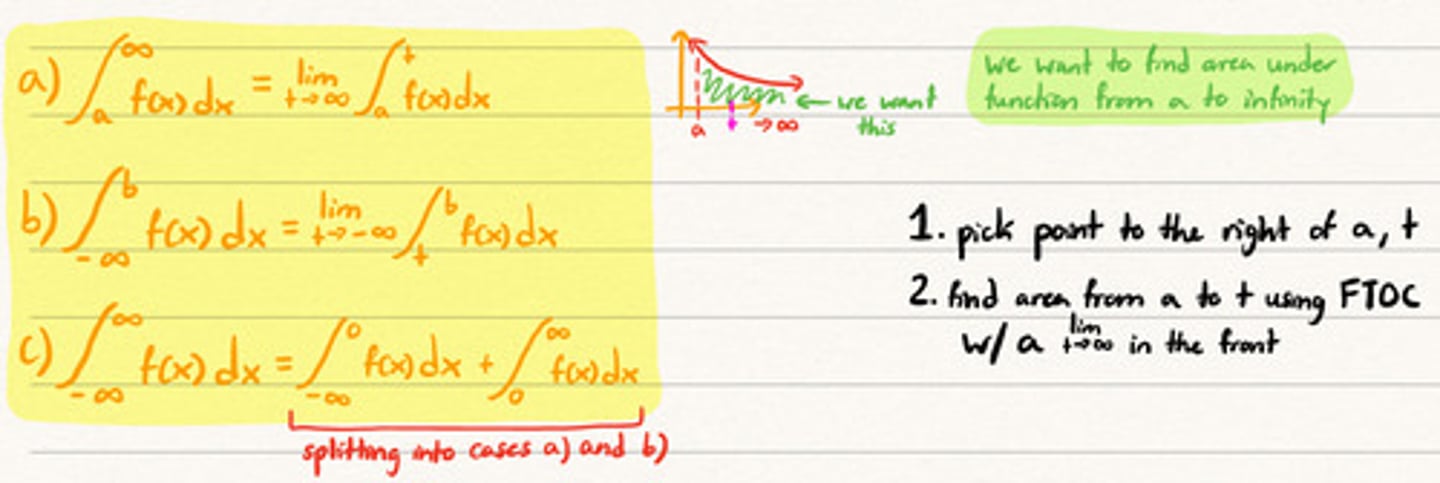
The 2nd type of improper integral (non-continuous):
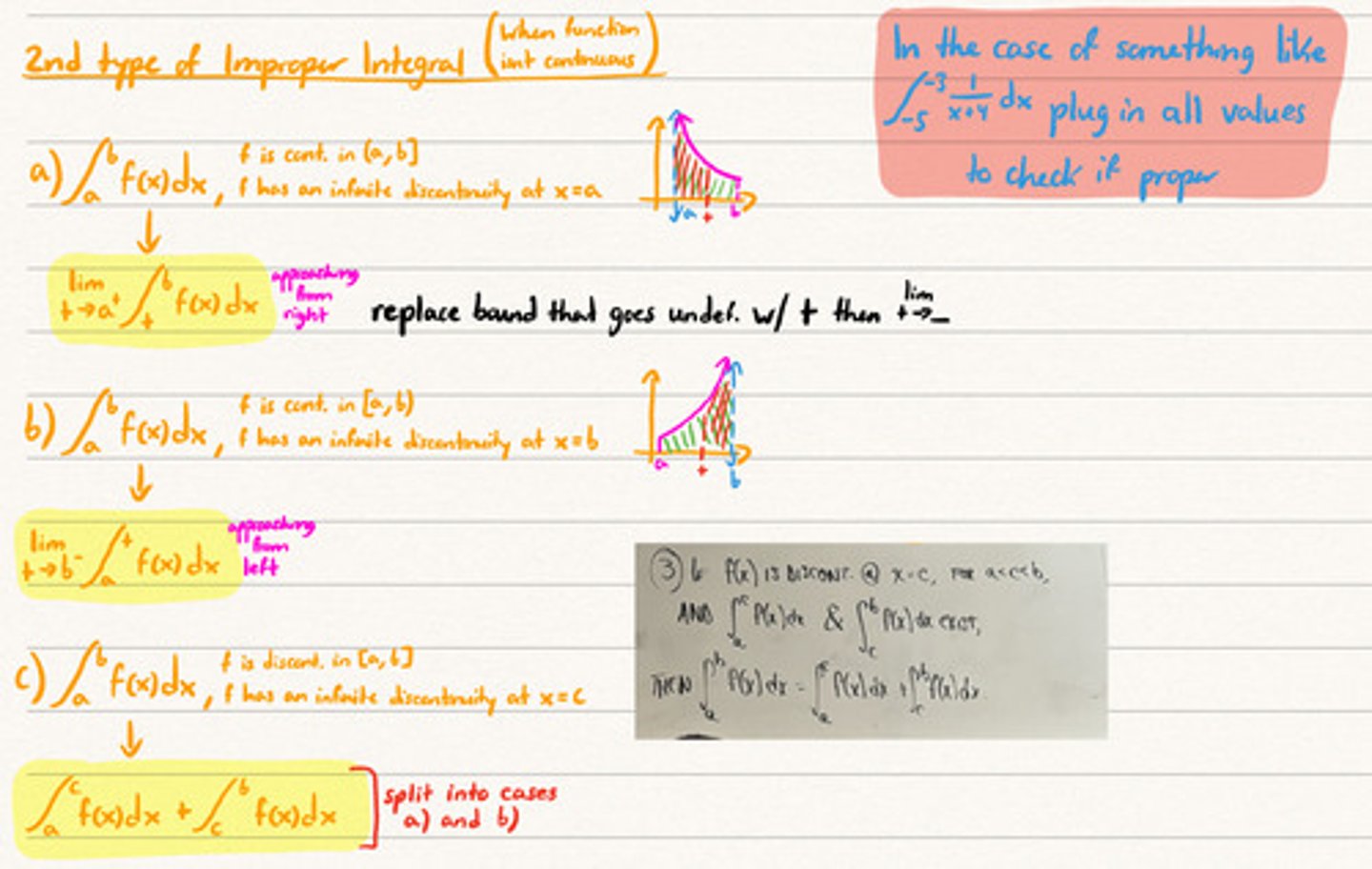
If your answers looks something like: 1/3 + infinity does the limit converge or diverge?
diverge
What is it called when a limit exists? (ex: your answer is 2/3)
converge
Does anything you get in indeterminate form (ex 0-0) converge or diverge?
diverge
Know unit circle (for trig int):
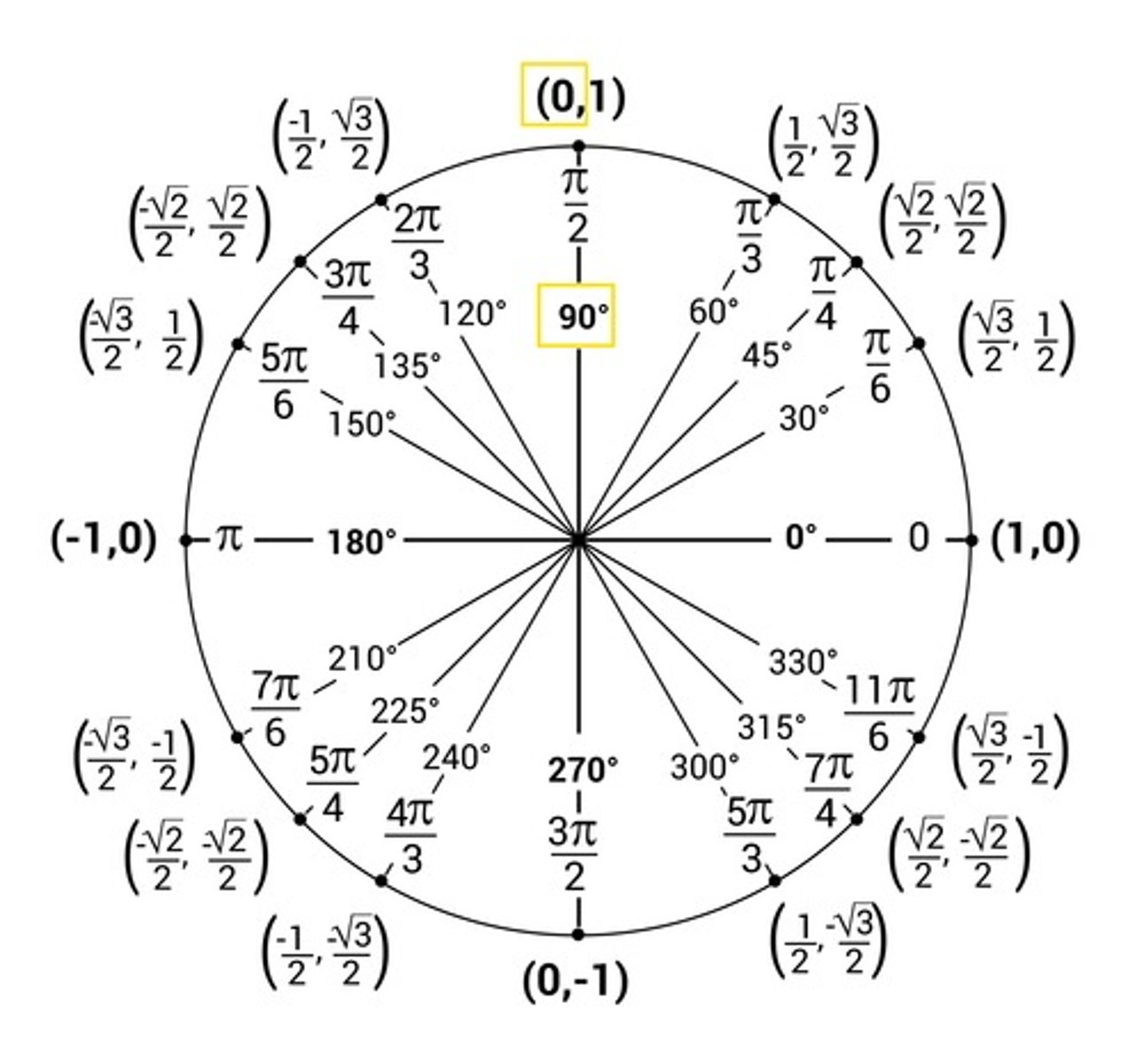
When solving an indefinite integral make sure you don't forget to add....
+ C
 Note
Note  Flashcards (32)