Viruses and Prions Study Guide
 Call Kai
 Learn
Learn Practice Test
 Spaced Repetition
 Match
Match Flashcards
 Knowt Play
1/38

There's no tags or description
Looks like no tags are added yet.
Name | Mastery | Learn | Test | Matching | Spaced | Call with Kai |
|---|
No analytics yet
Send a link to your students to track their progress
39 Terms
General Characteristics of Viruses
Acellular
Obligatory intracellular parasites
Require living host cells to multiply
Contain DNA or RNA
Contain a protein coat, not plasma membrane
No ribosomes
No ATP-generating mechanism
Lack genes for many products needed for reproduction, requires exploitation of host-cell genomes to reproduce
What determines host range in a virus?
The spectrum of host cells a virus can infect
Most viruses infect only specific types of cells in one host
Determined by specific host attachment sites and cellular factors
Bacteriophages—viruses that infect bacteria
Size ranges from 20nm to 1000nm in length
Define Enveloped virus
Lipid, protein, and carbohydrate coating on some viruses
Define Naked virus/Non-enveloped virus
Lack an envelope/outer lipid bilayer
Enclosed with a capsid
Define Spikes
Projections from outer surface—means of attachment, viral recognition
Define Virion
Complete, fully developed viral particle
Define Phage conversion
The host cell exhibits new properties
Ex: Cotynebacterium diphtheriae, which causes diphtheria, is a pathogen whose disease-producing properties are related to the synthesis or a toxin
Can a virus infect any cell?
No, because they are highly specific
Define Latent vs chronic viral infection
Latent: Sleeping virus
Virus remains in asymptomatic host cell for long periods
Viral genome may be integrated into hose genome (HIV) or be separate piece of DNA (VZV)
May reactivate due to changes in immunity, age, stress, etc.
Chronic:
Once infected the virus can be detected in tissues and continously thereafter
Virus becomes inactive (dormant) inside host cells and later reactivates
Define Virusoid
Subviral particles best described as non-self-replicating ssRNAs
Requires that the cell also be infected with a specific “helper” virus
Define Generalized vs Specialized transduction
Generalized Transduction: Random piece of bacterial chromosomal DNA is transferred by the phage during the lytic cycle.
Specialized Transfuction: At the end of the lysogenic cycle, when the prophage is excised and the bacteriophage enters the lytic cyle
Specialized only occurs in a lysogenic cycle, Generalizes occurs in a lytic cycle.
What are the steps to specialized transduction?
1) Prophage exists in galactose-using host (containing the gal gene)
2) Phage genome exercises, carrying with it the adjacent gal gene from the host (picks up DNA flanking from the entrance of the host cell)
3) Phage matures and cell lyses, releasing phage carrying gal gene
4) Phage infects a cell that cannot utilize galactose (lacking gal gene)
5) Along with the prophage the bacterial gal gene becomes integrated into the new host’s DNA
6) Lysogenic cell can now metabolize galactose
Define Receptor mediated endocytosis
A mechanism for a virus to penetrate into a cell, happens to non-enveloped and enveloped viruses.
Define Membrane fusion
A mechanism for a virus to penetrate into a cell, happens enveloped viruses.
Define RNA dependent RNA polymerase
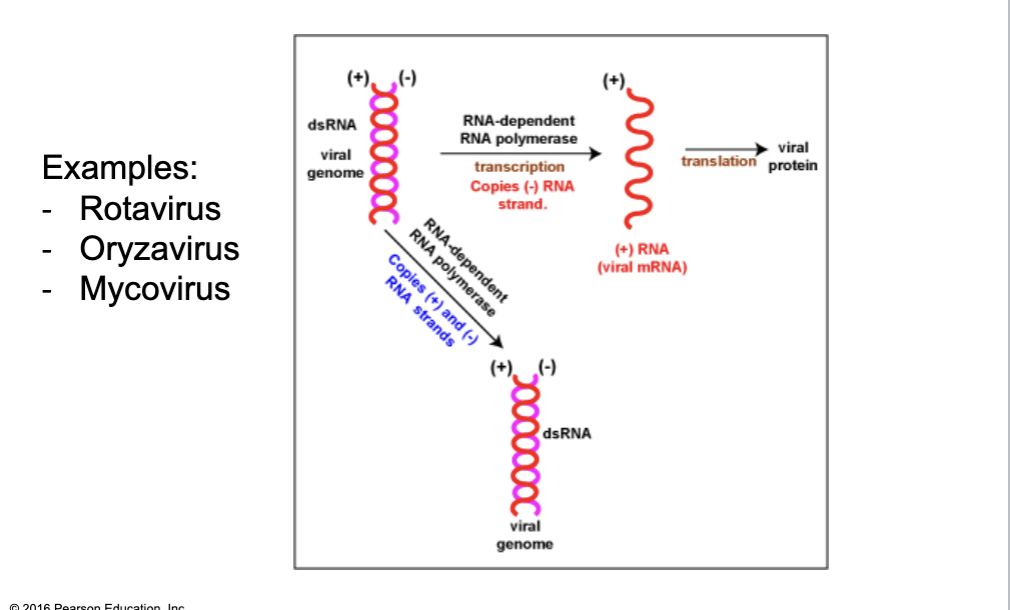
RNA dependent RNA polymerase requires a template to replicate RNA
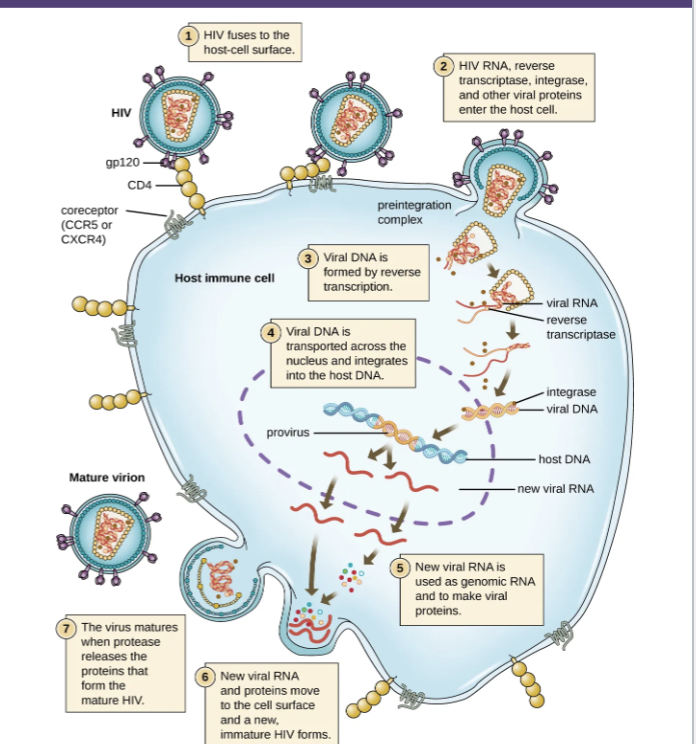
Define Reverse transcriptase, integrase, protease (3 enzymes important for Retroviruses)
Reverse transcriptase: Allows for reverse transcription to occur, makes a copy that copies RNA → DNA → dsDNA
Integrase: DNA can walk into the nucleus to become part of the host genome
Protease: Needed to modify proteins that are unique to the virus for it to mature.
Define Oncovirus
A type of retrovirus, virus capable of causing cancer
Define Antigenic drift
Gradual accumulation of small genetic mutations in a virus
Define Antigenic shift
Abrupt, major change in influenza A virus, creating a new subtype
Describe the following viral component: Capsid or coat
Protein coat made of capsomeres (subunits)
Describe the following viral component: Nucleic acid
Core genetic material contained in a virus, serves as a blueprint to colonize a host cells machinery for replication
Describe the following viral shapes: Helical, Icosahedral or polyhedral, Complex
Helical: Hollow, cylindrical capsid
Polyhedral: Many sides
Complex: Complicated structures

Describe viral replication of bacteriophage (both the lytic and lysogenic cycles) in detail.
Include the steps in order and a brief description of what is happening at each step.
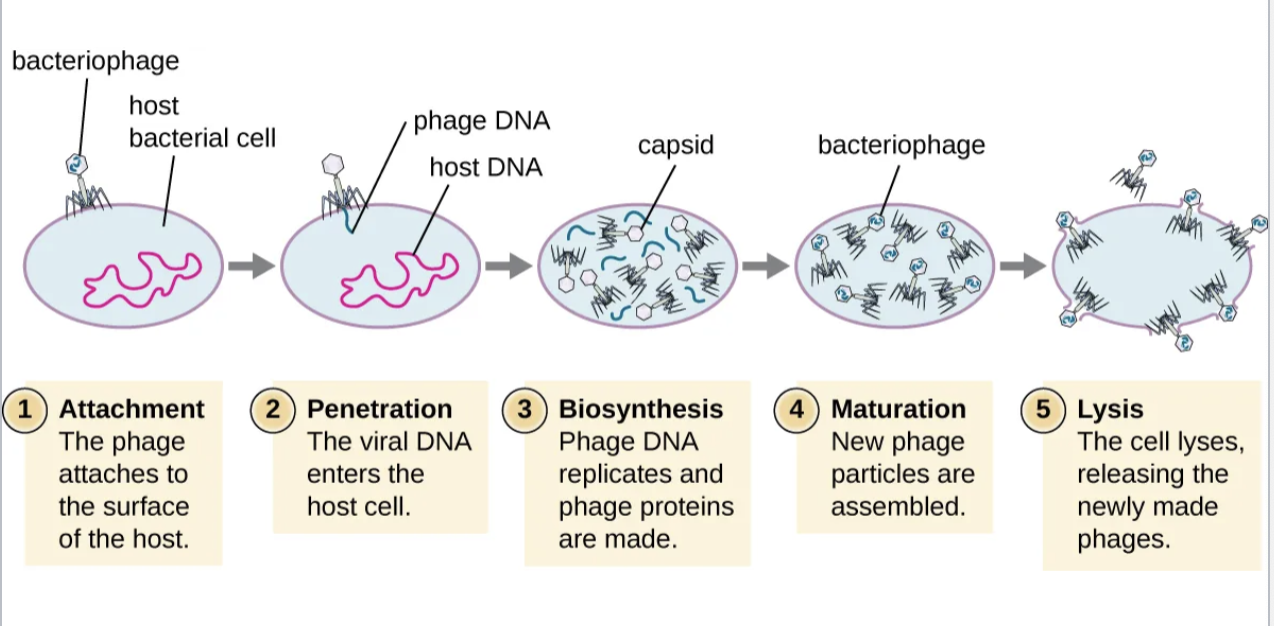
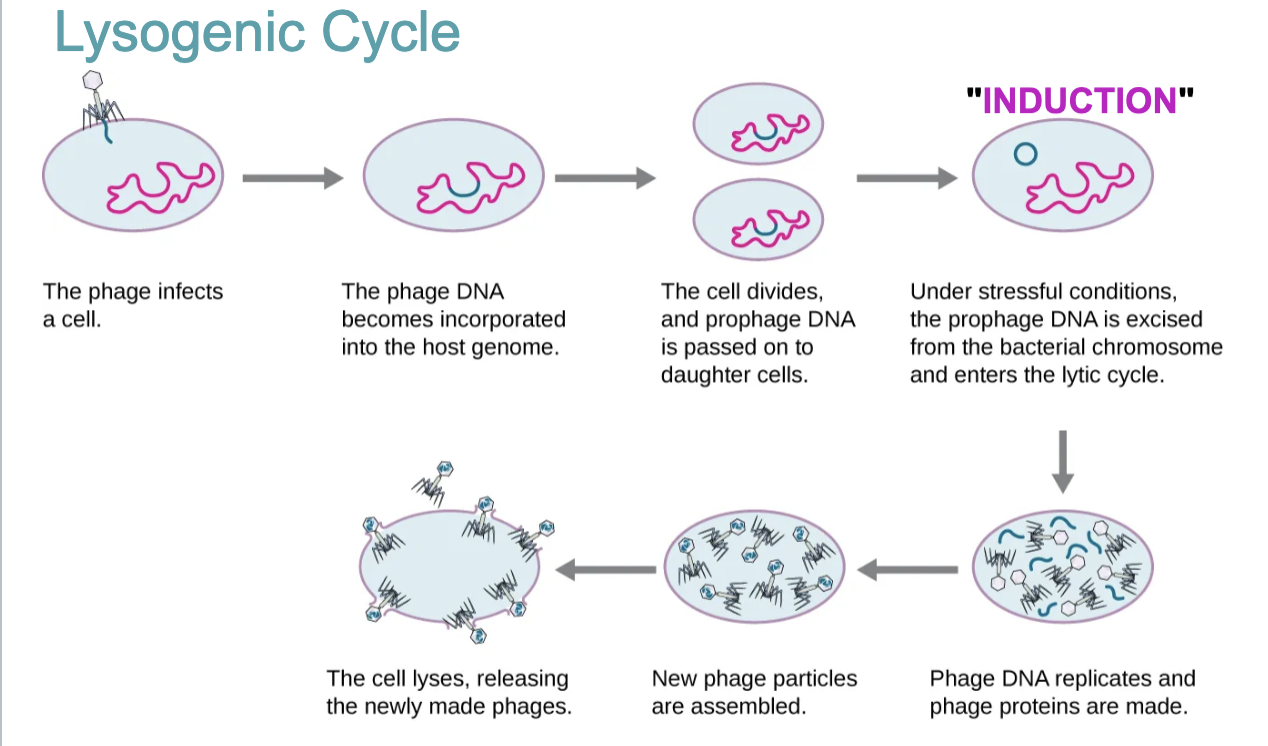
Lysogenic cycle lets the cell live before the virus makes copies and destroys the cell
Lysogenic cycle the viral DNA becomes part of the host DNA (prophage)
Induction: When the virus feels threatened and stressed and enters a lytic cycle
How do bacteriophages get nucleotides and amino acids to make their body parts, if they dont have any metabolic enzymes?
From the host cell they infect
Some bacteria produce toxins and can cause disease only when it is lysogenic. What does this mean?
They use phage conversion by creating new properties.
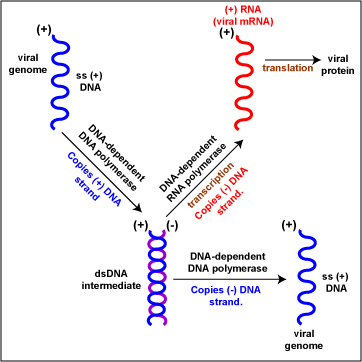
ssDNA (single stranded DNA) Replication
dsRNA (Double stranded RNA) Replication
Positive single strand RNA (+ssRNA) Replication
Can work the same way mRNA does, and immediately use mRNA to make proteins, makes complementary strand
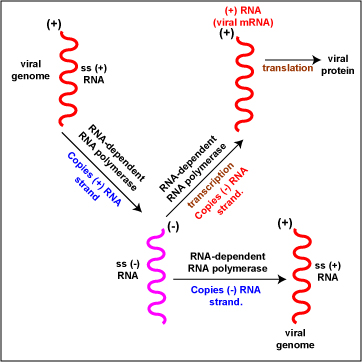
Can either come with its own RdRp or make its own, meaning it doesn’t not need to bring the enzyme with it
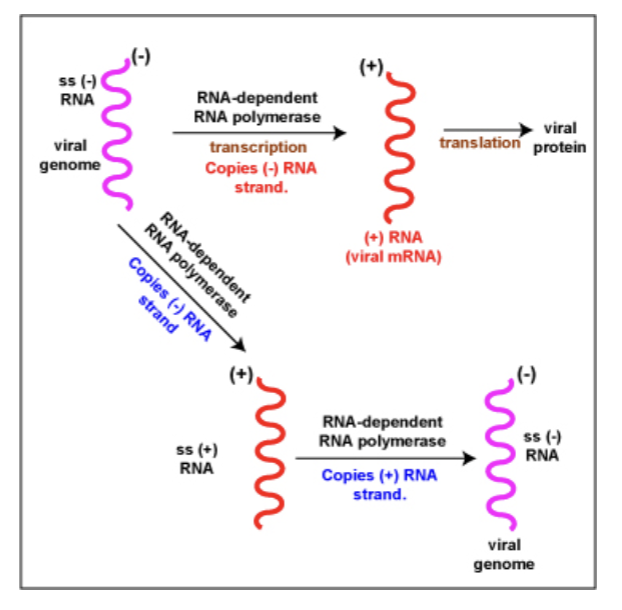
Negative single strand RNA (-ssRNA) Replication
Complementary to mRNA, would have to convert the -ssRNA to a + strand to make protein
Has to travel with its own RNA-dependent RNA polymerase to make a complementary + strand
Retrovirus replication
A chronic virus because the virus becomes a part of the host genome
Why do we need a flu vaccine every year?
Because influenza viruses can go through antigenic shift and antigenic drift
Describe how antiviral drugs are able to inhibit viral replication
Describe latency of animal viruses
Latent virus = sleeping virus
virus remains in asymptomatic host cell for long
periods
Viral genome may be integrated into host genome (HIV) or be a separate piece of DNA (VZV)
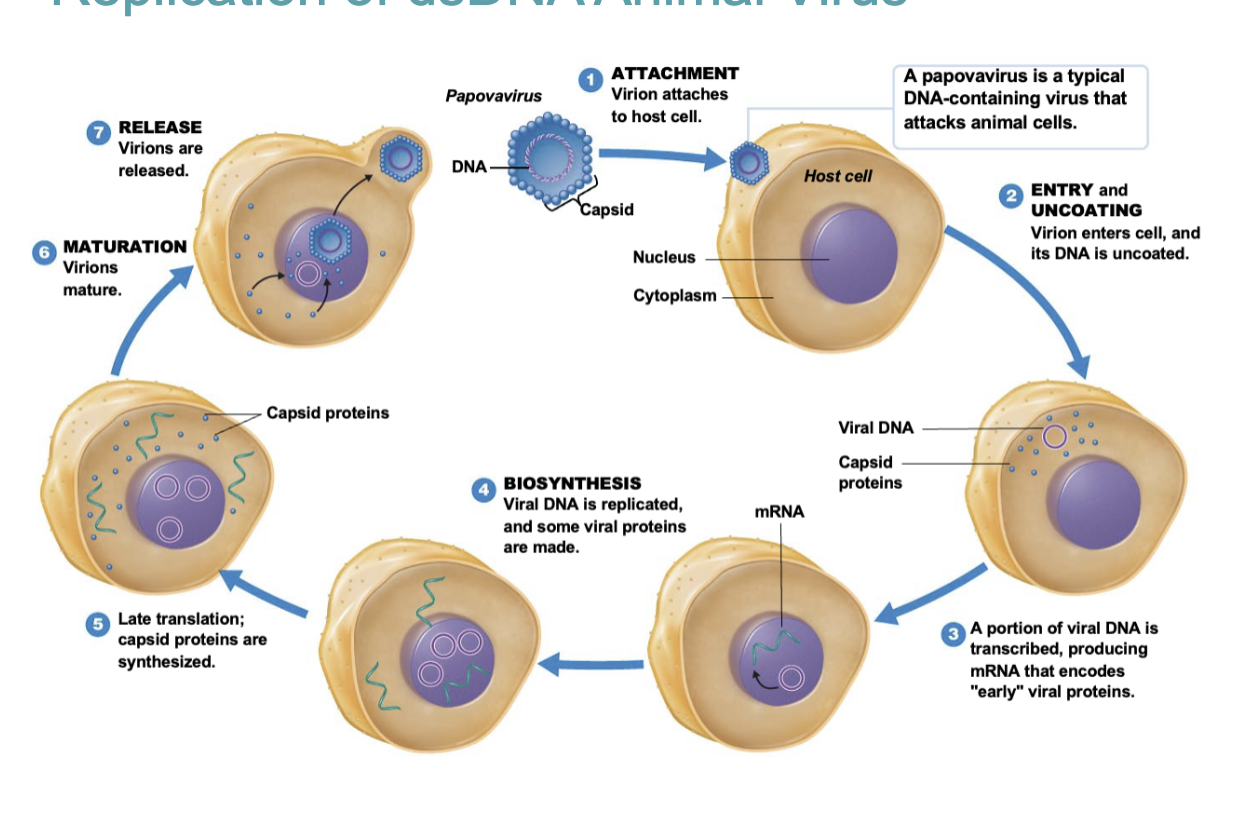
List the steps followed by typical enveloped, double stranded DNA virus when it encounters its host.
Describe the role of viruses in contributing to certain cancers
Causes persistent infection
Inserts genetic material
Induce chronic inflammation
A scientist discovers that a virus increases cell proliferation without integrating into DNA. Suggest two possible mechanisms.
Define prion
Proteinaceous infectious particles
Inherited and transmissible by ingestion, transplant, and surgical instruments
Why is Prion considered infectious?
They are misfoleded proteins that can force normal proteins in the brain to adopt their abnormal, disease-causing shape
How to destroy Prions?

