BIO Q1
 Studied by 23 people
 Call Kai
 Learn
Learn Practice Test
 Spaced Repetition
 Match
Match Flashcards
 Knowt Play
1/144

There's no tags or description
Looks like no tags are added yet.
Name | Mastery | Learn | Test | Matching | Spaced | Call with Kai |
|---|
No analytics yet
Send a link to your students to track their progress
145 Terms
Binary Fission
a type of asexual reproduction for prokaryotes (bacteria and archaea) and single-celled eukaryotes
Binary fission
sometimes referred to as “division in half”
Prokaryotes and Single-celled eukaryotes
What type/s of cells undergo binary fission?
The origin of replication is replicated. As a result, there are then two copies of the origin. One of its copies moves rapidly towards the other end of the cell by a mechanism involving an actin-like protein.
On the first step of binary fission, what happens to the origin of replication?
a mechanism involving an actin-like protein
In the first step of binary fission, what helps one copy of the origin move rapidly towards the other end of the cell?
The cell elongates
During the second step of binary fission, replication continues. One copy of the origin is now at each end of the cell. What happens to the cell during this step?
The plasma membrane is pinched inward by a tubulin-like protein, and a new cell wall is deposited.
During binary fission, what happens once the replication finishes?
a tubulin-like protein
In binary fission, what pinches the plasma membrane inward?
two daughter cells
What is the result at the end of binary fission?
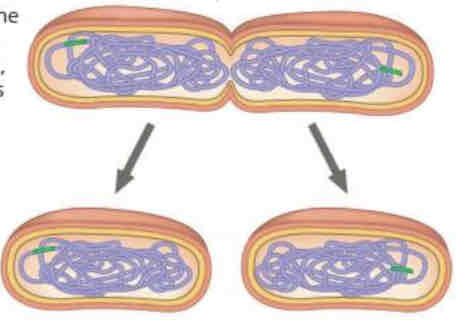
the plasma membrane is pinched inward by a tubulin-like protein, a new cell wall is deposited, then as a result, two daughter cells are formed.
Describe what step of binary fission is happening in the picture.
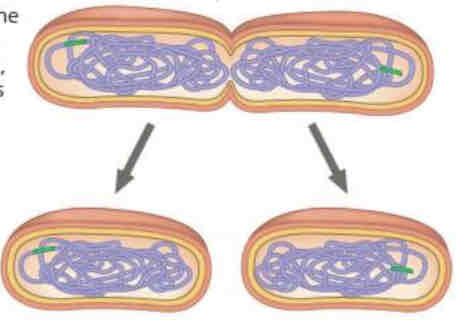
origin of replication
In binary fission, where does replication begin?
sex cells
If mitosis is for somatic cells, meiosis is for?
The cell elongates
During the second step of binary fission, replication continues. One copy of the origin is now at each end of the cell. What happens to the cell during this step?
chromatid
one of two identical halves of a chromosome that has been replicated in preparation for cell division.
a tubulin-like protein
In binary fission, what pinches the plasma membrane inward?
two daughter cells
What is the result at the end of binary fission?
the plasma membrane is pinched inward by a tubulin-like protein, a new cell wall is deposited, then as a result, two daughter cells are formed.
Describe what step of binary fission is happening in the picture.
origin of replication
In binary fission, where does replication begin?
sex cells
If mitosis is for somatic cells, meiosis is for?
sex cells
If mitosis is for somatic cells, meiosis is for?
chromatin
a mixture of DNA and PROTEINS that form the chromosomes found in the cells of humans and other higher organisms.
The plasma membrane is pinched inward by a tubulin-like protein, and a new cell wall is deposited.
During binary fission, what happens once the replication finishes?
a tubulin-like protein
In binary fission, what pinches the plasma membrane inward?
two daughter cells
What is the result at the end of binary fission?
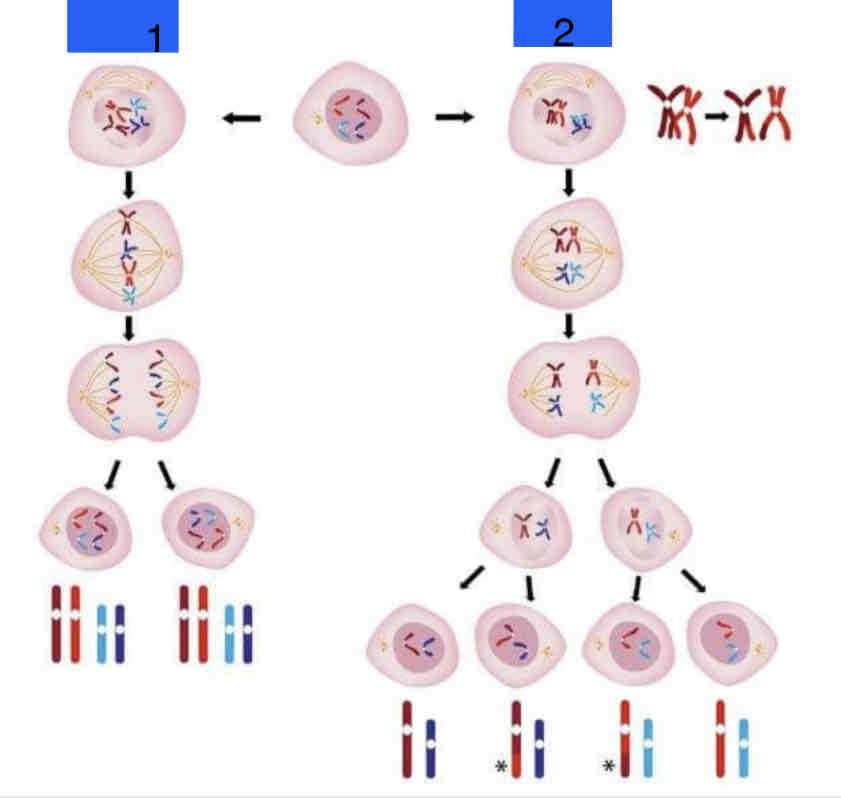
synapsis and crossing over
What occurs in Prophase I of meiosis that doesn’t occur in Prophase of mitosis?
spermatogenesis
male gamete or sperm cell development
paternal chromosome/sister chromatids
maternal chromosome/sister chromatids
A pair of homologous chromosomes is made up of:
synaptomemal complex
this proteinaceous structure or complex connects paired homologous chromosomes
DNA breaks
During synapsis, what happens first before the synaptonemal complex forms?
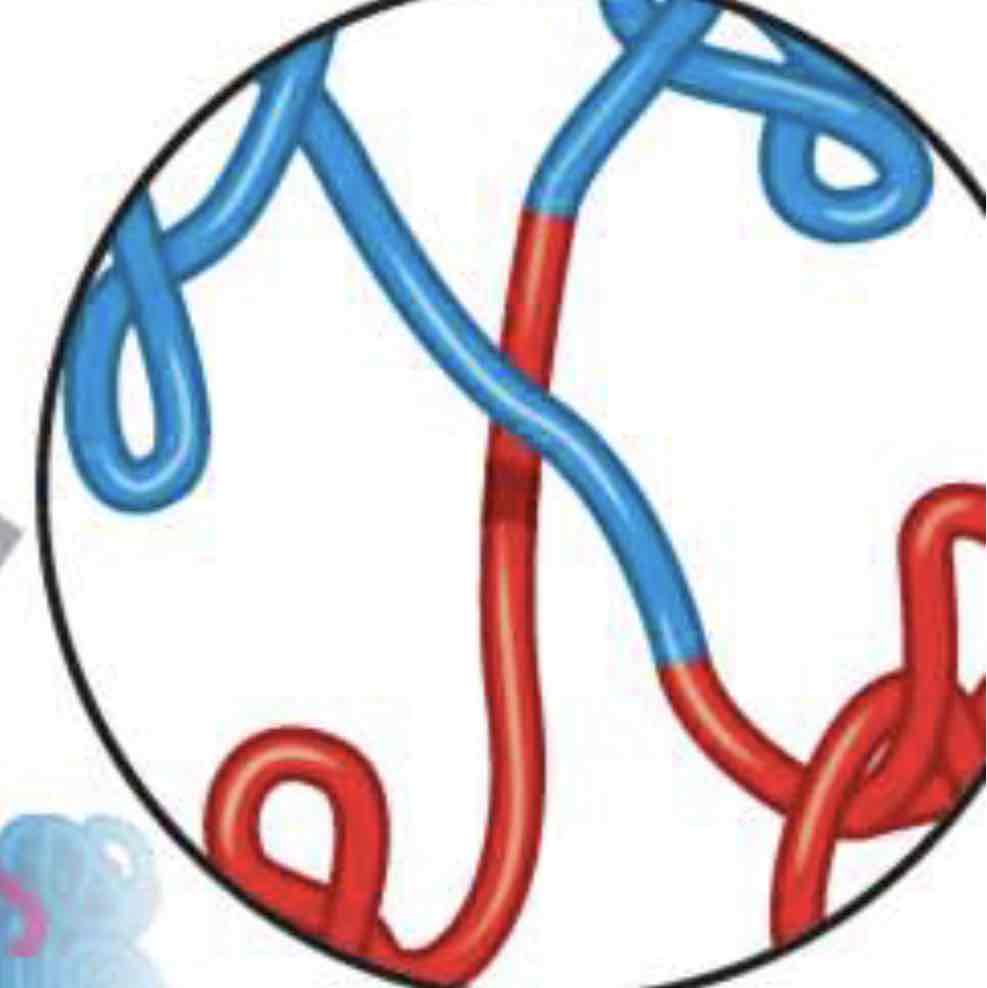
crossing-over
What happens after synapsis?
crossing-over
what process is happening in the picture?
spermiogenesis
final stage of spermatogenesis, which sees the maturation of spermatids into mature, motile spermatozoa
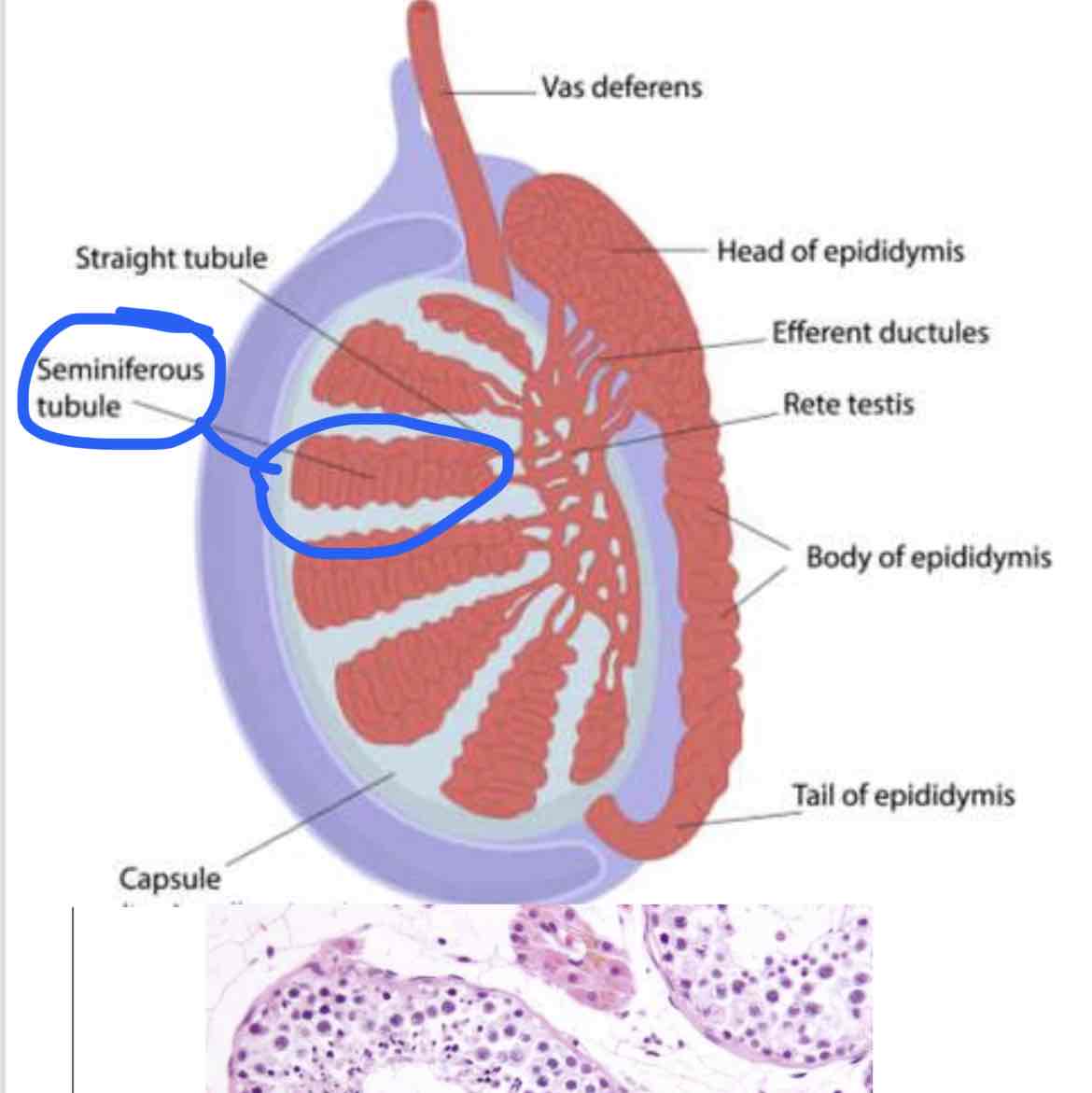
seminiferous tubules of testicles after puberty
where does meiosis occur in males?
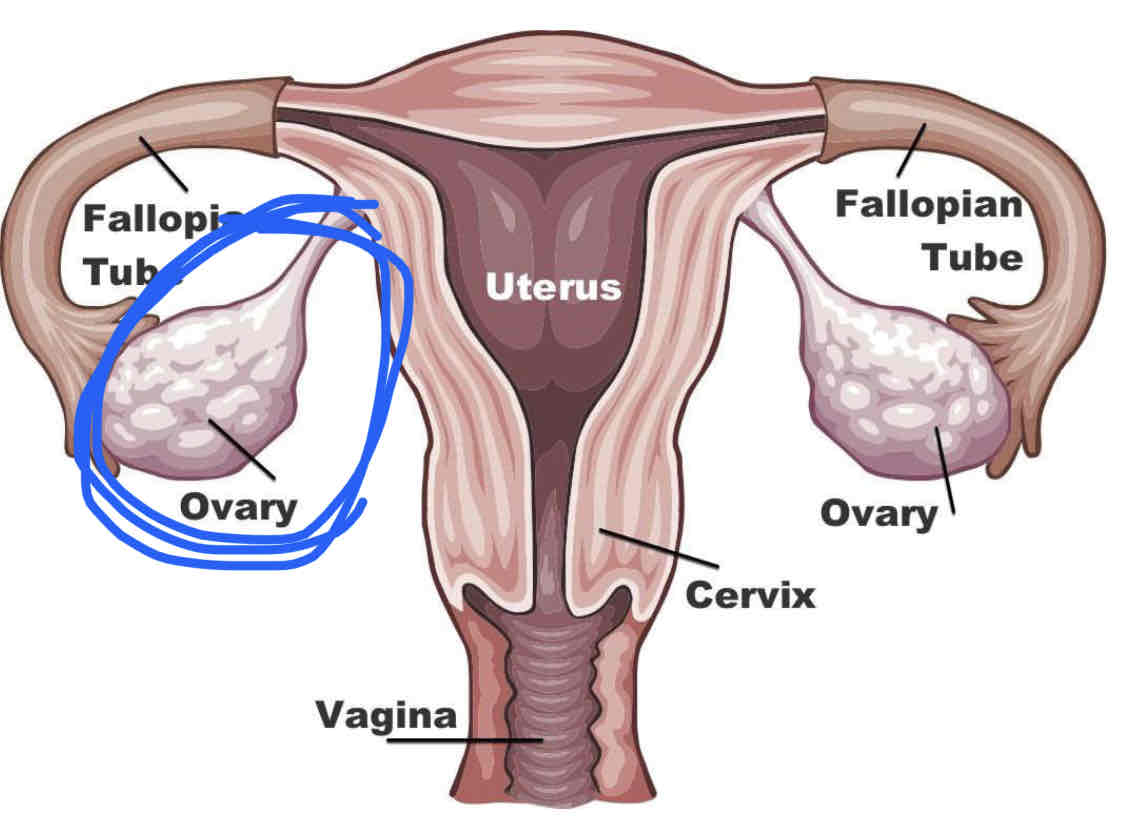
ovary (produces on large egg cell; other cells produced in the process are polar bodies)
where does meiosis occur in females?
haploid cells
if mitosis results to diploid cells, meiosis results to?
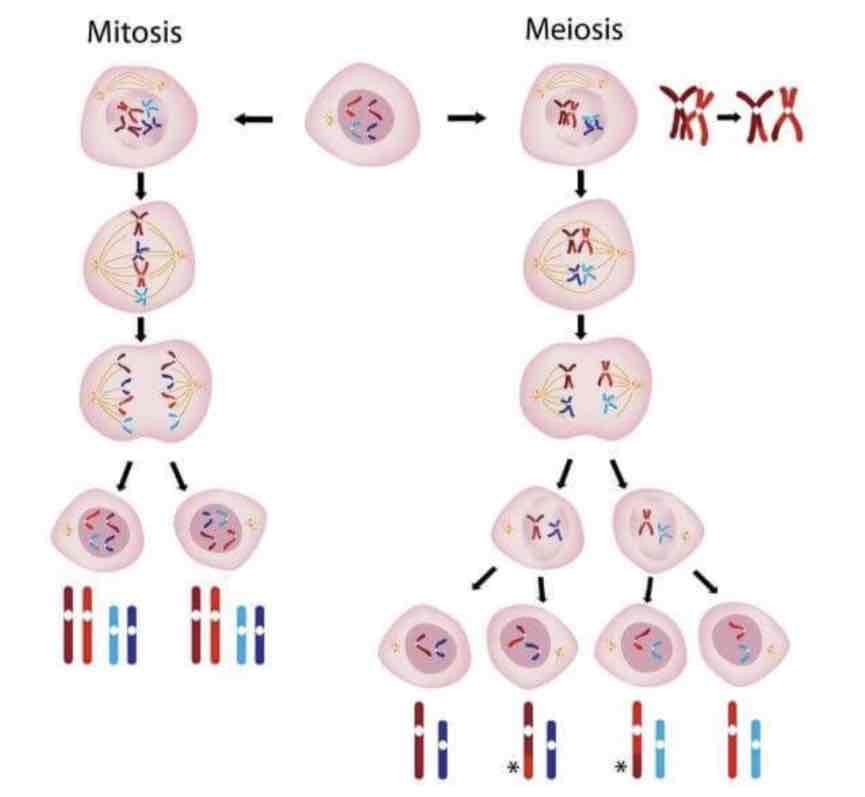
mitosis
meiosis
indentify which one describes mitosis, and which one describes meiosis.
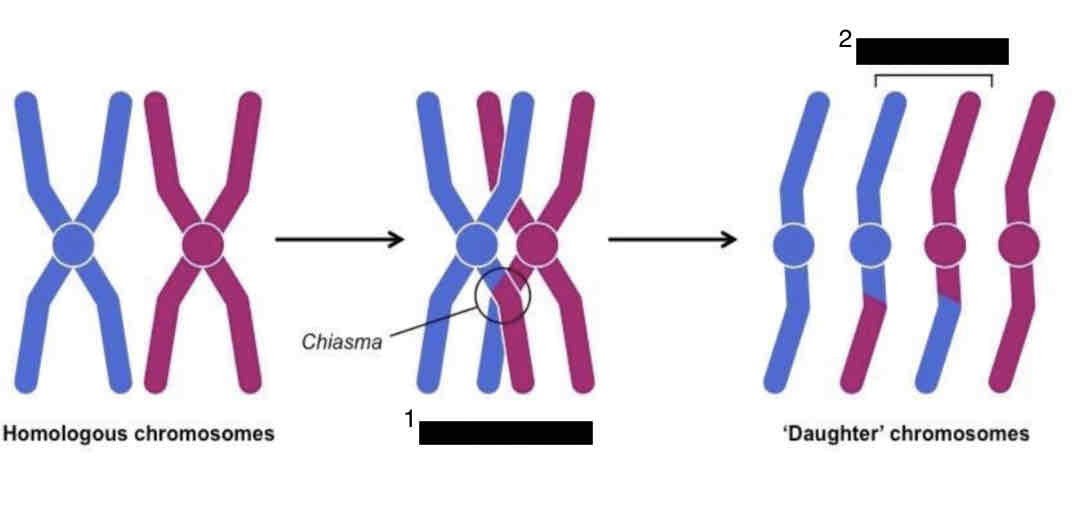
synapsis and crossing over
What occurs in Prophase I of meiosis that doesn’t occur in Prophase of mitosis?
Synapsis
Pairing of homologous chromosomes
independent assortment
Genes are inherited independently of one another and therefore give rise to different chromosome combinations.
the two (sister) chromatids of each chromosome move as a unit towards the same pole.
During anaphase I of meiosis, sister chromatid cohesion persists at the centromere. As a result, what happens?
two haploid daughter cells. each daughter cell has a complete haploid set if duplicated chromosomes.
Telophase I and cytokinesis result to?
cleavage furrow
in meiosis, what forms during cytokinesis?
meiosis II
Which meiosis (I or II) is more similar to mitosis?
they are not genetically identical
Because of crossing over in meiosis I, what happens to the two sister chromatids of each chromosome?
4 haploid daughter cells, each with a haploid set of unduplicated chromosomes
What is the result of meiosis?
genetically distinct (from the parent and from each other)
each daughter cell produced in meiosis is ________
synapsis and crossing over (occurs only in meiosis; prophase I)
Alignment of homologous pairs at the metaphase plate
separation of homologs
3 significant differences between mitosis and meiosis:
crossing-over will be impaired resulting to less genetic variation among the gametes produced. disruption like this in the meiotic process can lead to chromosomal abnormalities and ferltility problems. (chromosome pairing, synapsis and crossing-over is essential for proper chromosome segregation and making functional gametes)
if the synaptonemal complex disappears, what will happen?
crossing-over
exchange of DNA between paired homologous chromosomes (one from each parent)
alleles
Crossing-over results in new combinations of _______ in the gametes.
they are not genetically identical
Because of crossing over in meiosis I, what happens to the two sister chromatids of each chromosome?
4 haploid daughter cells, each with a haploid set of unduplicated chromosomes
What is the result of meiosis?
Prophase I
During what phase of meiosis I, do microtobules from one pole or the other attach to the kinetochores, one at the centromere of each homolog and move them towards the metaphase plate?
he predicted that preventing flies from having direct contant with the meat will prevent appearance of maggots. he made three setups: an unsealed flash with meat inside, a sealed flask with meat inside, and a flash with meat inside covered with a gauze. the results of this experiment were in line his prediction.
What did francesco redi do to disprove aristotle’s theory?
john needham
He claimed that microorganisms in broth developed independently of other cells.
he heated a nutrient broth to kill microorganisms and then covered the vial right after. he then observed appearance of microorganisms in the sealed vials. because of the results, he argued that those microorganisms must have risen spontaneously from the nutrient broth and concluded that living organisms could emerge from nonliving matter under the right conditions.
What did john needham do to prove his claim statement?
lazzaro spallanzani
Who disagreed with needham’s conclusion?
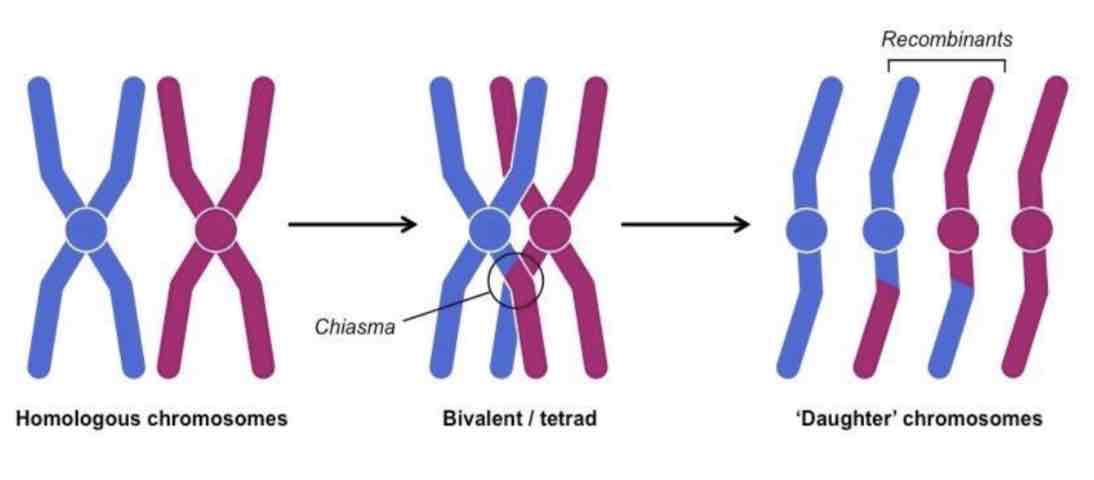
homologous chromosomes
Paired chromosomes that essentially have the same gene sequence, loci (gene position), centromere location, and chromosomal length. They may differ in alleles.
bivalent/tetrad
recombinants
fill in the blanks.
Prophase I
During what phase of meiosis I, do microtobules from one pole or the other attach to the kinetochores, one at the centromere of each homolog and move them towards the metaphase plate?
abiogenesesis
this hypothesis states that the primtive life on earth originated from lifeless matter and it took miilions of years to transpire.
time (bio-right away, abio-millions of years)
from nonliving w/ pneuma (bio), organic compound (abio)
driproved (bio), currently still being studied and researched (abio)90
3 key differences between bio and abiogenesis:
stanley-urey experiment
what experiment is being conducted in the picture?
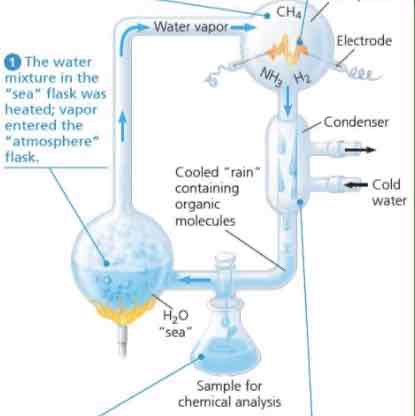
robert hooke
he discovered cells
He performed the same experiment except he covered the flask earlier, already sealing the broth as he heats it. he observed no appearance of microorganisms.
How did lazzaro spallanzani disprove needham’s conclusion?
louis pasteur
who really debunked aristotle’s thoery of spontaneous generation?
matthias schleiden
he studied plant cells.
theodore schwann
he concluded that animals are made up of cels
rudolph virchow
he suggested that cells came from pre-existing cells through cell division.
all living organisms are made up of cells
cells are the basic unit of sturcture, function and organization in all living organisms
cells come from pre-existing cells
three postulates of the cell theory:
nucleus
the information central of the cell
robert hooke
contains most of the genes in a eukaryotic cell
nuclear envelope
first discovered live cells.
nuclear lamina
netlike array of protein filaments
robert brown
first discovered the nucleus.
theodore schwann
where are ribosomes found?
rudolph virchow
this cellular component is responsible for reading the mRNA sequence and translating the genetic code into a specific string of amino acids, which grow into long chains that fold to form proteins.
time (bio-right away, abio-millions of years)
from nonliving w/ pneuma (bio), organic compound (abio)
driproved (bio), currently still being studied and researched (abio)90
3 key differences between bio and abiogenesis:
stanley-urey experiment
what experiment is being conducted in the picture?
louis pasteur
first discovered live cells.
nuclear lamina
responsible for Synthesis of lipids and steroids/hormones (sex hormones), metabolism of carbohydrates, detoxification of drugs and poisons, and storage of calcium ions
robert brown
first discovered the nucleus.
theodore schwann
where are ribosomes found?
rudolph virchow
this cellular component is responsible for reading the mRNA sequence and translating the genetic code into a specific string of amino acids, which grow into long chains that fold to form proteins.
time (bio-right away, abio-millions of years)
from nonliving w/ pneuma (bio), organic compound (abio)
driproved (bio), currently still being studied and researched (abio)90
3 key differences between bio and abiogenesis:
stanley-urey experiment
what experiment is being conducted in the picture?
nucleus
contains most of the genes in a eukaryotic cell
smooth ER
responsible for Synthesis of lipids and steroids/hormones (sex hormones), metabolism of carbohydrates, detoxification of drugs and poisons, and storage of calcium ions
smooth ER
its outer surface lacks ribosomes
rough ER
its surface is studded with ribosomes and is involved with the production, folding, quality control and dispatch of some proteins.
rough ER
responsible for moving protein and other carbohydrates to the Golgi Bodies
golgi apparatus
products of the ER, such as proteins, are modified and stored and then sent to other destinations.
cytosol
cell membrane
secretion
lysosome
proteins the enter the golgi apparatus are sent to 1 of its 4 paths. list down all 4 paths.
cytosol
the "soup" within which all of the cell's organelles reside
cytosol
home of the cytoskeleton
lysosome
one of its functions is to digest (hydrolyze) macromolecules.
mitochondria
powerhouse of the cell
mitochondria
site of cellular respiration
mitochondria
this organelle is self-replicating and have their own DNA.
endosymbiotic theory
this theory states that the mitochondria and chloroplast in eukaryotic cells were once aerobic (produce energy with oxygen) bacteria (prokaryote) that were ingested by a large anaerobic (produce energy without oxygen) bacteria (prokaryote)
 Note
Note  Flashcards (99)