PLACEBO to Discovery & Development of Organic Medicinal Chemicals
 Studied by 1 person
 Call Kai
 Learn
Learn Practice Test
 Spaced Repetition
 Match
Match Flashcards
 Knowt Play
1/14

There's no tags or description
Looks like no tags are added yet.
Name | Mastery | Learn | Test | Matching | Spaced | Call with Kai |
|---|
No analytics yet
Send a link to your students to track their progress
15 Terms
Placebo effect
A phenomenon when a patient receives a placebo treatment will have a perceived or actual improvement of medical condition
Pharmacophore
the region of the molecule containing the essential organic functional groups that directly interact with the receptor active site and, therefore, confers the biologic activity of interest
• Physicochemical properties used to develop new pharmacologically active compounds;
• Their mechanism of action;
• The drug's metabolism;
• Possible biological activities of the metabolites;
• Importance of stereochemistry in drug design;
• The methods used to determine what “space” a drug occupies.
Considerations in understanding the principles of medicinal chemistry:
Cimetidine
as an antinuclear antibody test/drug
study of the changes in antagonism of H2 -histamine receptors induced by varying the physical properties of structure based on histamine.
Receptors
substance to which a drug needs to interact with to elicit pharmacologic response
a relatively small region of a macromolecule which may be an/a: enzyme, structural or functional group/component of CM, specific intracellular substance such as proteins and nucleic acids.
Random sampling/screening of higher plants
Traditionally, how drugs are discovered?
Random screening
(with enzyme linked assays or receptors from gene cloning) of existing drugs lead to identification of new LEAD drug.
e.g. Amantadine
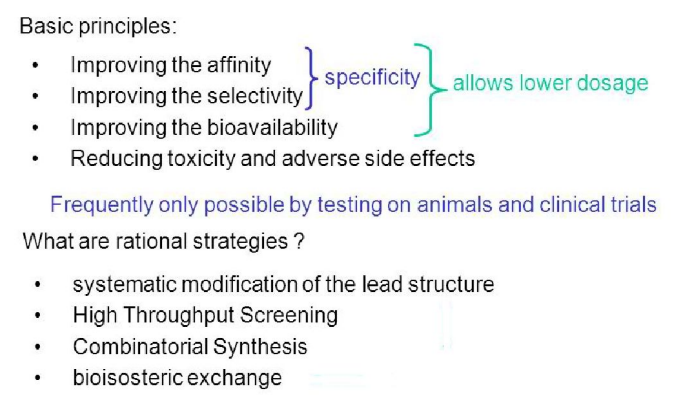
Rational Drug Design
refers to a process in which finding of new medication is based on knowledge of biological target is done
involves design of small molecules that are complementary in shape and charge to the biomolecular target.
Begins with hypothesis that modulation of a specific biological target may have therapeutic value.
X-ray crystallography
Nuclear magnetic resonance
Molecular graphics
Computational chemistry
opposite approach to high-volume screening using techniques like: Rational Drug Design
HIV protease inhibitor
ACE inhibitors
H 2 antagonists
Leads to the development of drugs;
Categories of Rational Drug Design
Development of small molecules with desired properties for targets, biomolecules has functional roles in cellular processes and 3D structural information
Development of small molecules with predefined properties for targets, whose cellular functions and their structural information maybe known or unknown.
Random Screening
Molecular Manipulation
Molecular Designing
Drug Metabolites
Serendipity
Strategies/Methods of Drug Discovery
Serendipity
Penicillin
5-FU
Minoxidil
Sildenafil
Levodopa
Chlorpromazine
LSD by Albert Hofmann “acid trip”
“Mustine” = mustard gas
Nitrous oxide
Albert Hofmann
LSD “acid trip”
Mustine
mustard gas
 Note
Note  Flashcards (87)