LEC 3 - Pectoral Girdle
 Call Kai
 Learn
Learn Practice Test
 Spaced Repetition
 Match
Match Flashcards
 Knowt Play
1/21

There's no tags or description
Looks like no tags are added yet.
Name | Mastery | Learn | Test | Matching | Spaced | Call with Kai |
|---|
No analytics yet
Send a link to your students to track their progress
22 Terms
What does the upper limb refer to? Give its fx
=The arm (brachium), forearm (antebrachium), hand and the pectoral girdle
FX=to move freely and therefore sense and grasp objects around the body
Describe the pectoral girdle/shoulder And its fx
PG=is comprises of the clavicle and scapula.
FX=links the free limb of to the axial skeleton at the SC joint. (Acts as a mobile base to help extend the range of movement of the free limb.)
Muscles associated with the PG extended onto the front and back of the thorax + also onto the pelvic rim
What is the most mobile joint in the body?
=shoulder joint
(More mobile=more unstable=needs more muscle to control and stabilise it)
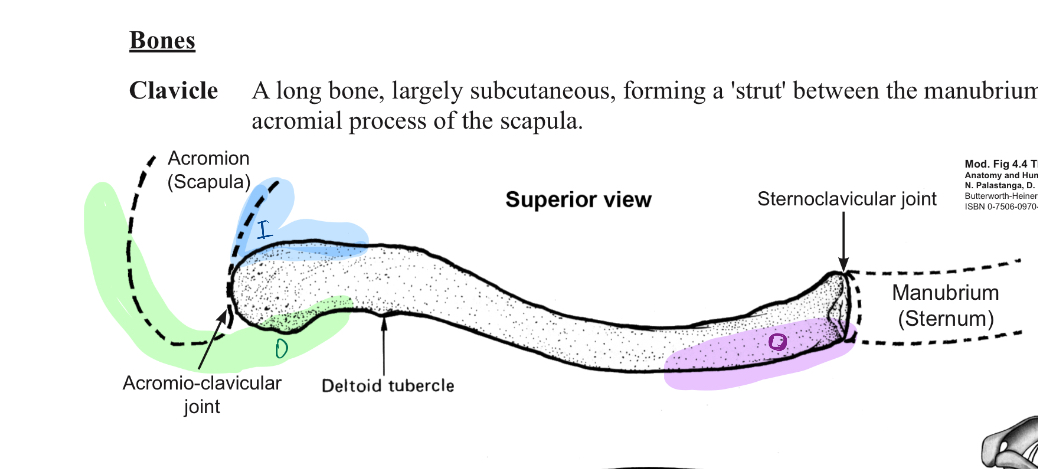
What muscles insertions or origins are in the coloured sections?
BLUE=trapezium insertio
GREEN=deltoid origin
PURPLE=pec major origin
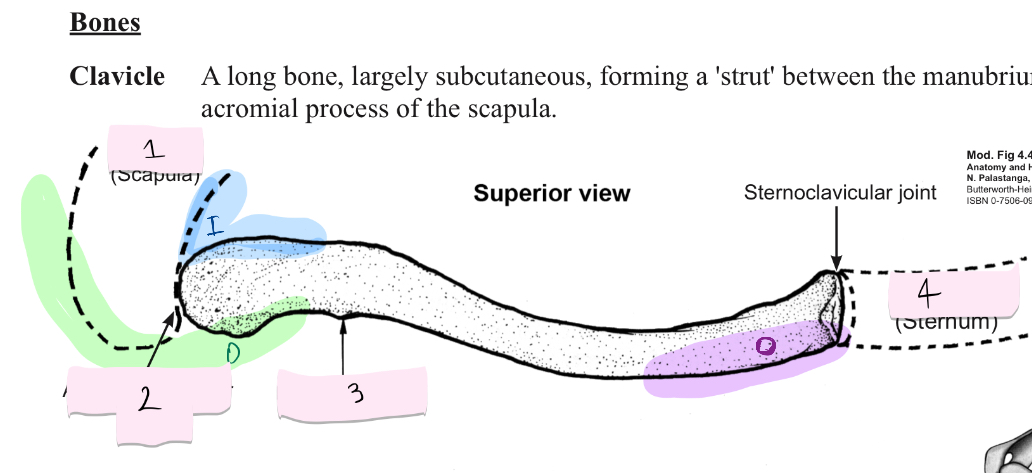
Gives the names of what is covered in 1,2,3 and 4
1=acromium
2=acromio-clavicular joint (AC)
3=deltoid tubercle
4=manubrium
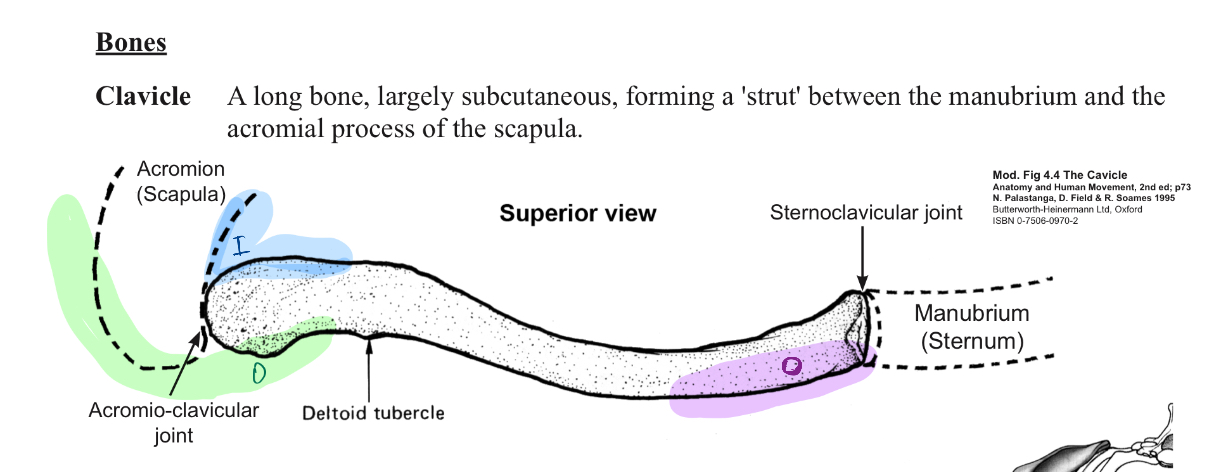
What part of the clavicle is most prone to fracture?
=middle third as no ligaments or muscle attach so less stable
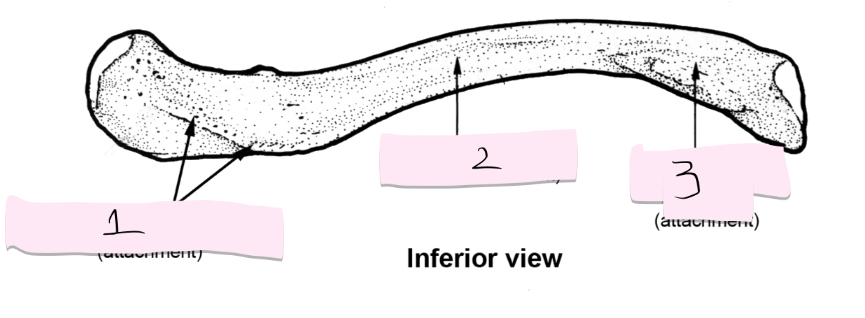
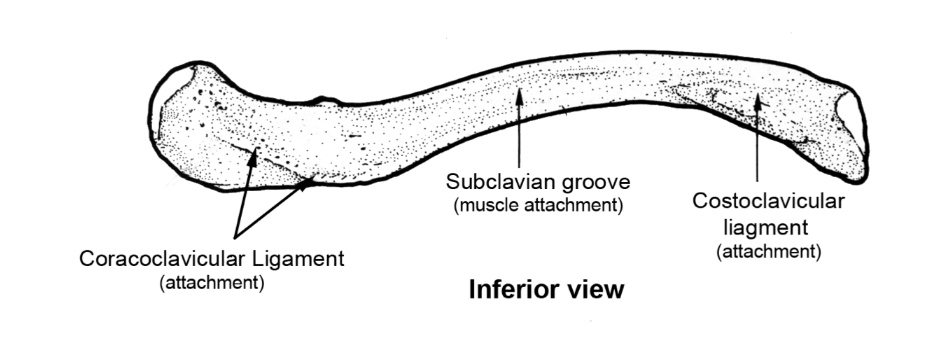
What is the names of the covered parts?
1=coracoclavicular ligament
2=subclavian groove (subclavius muscle inserts)
3-costoclavicular ligament
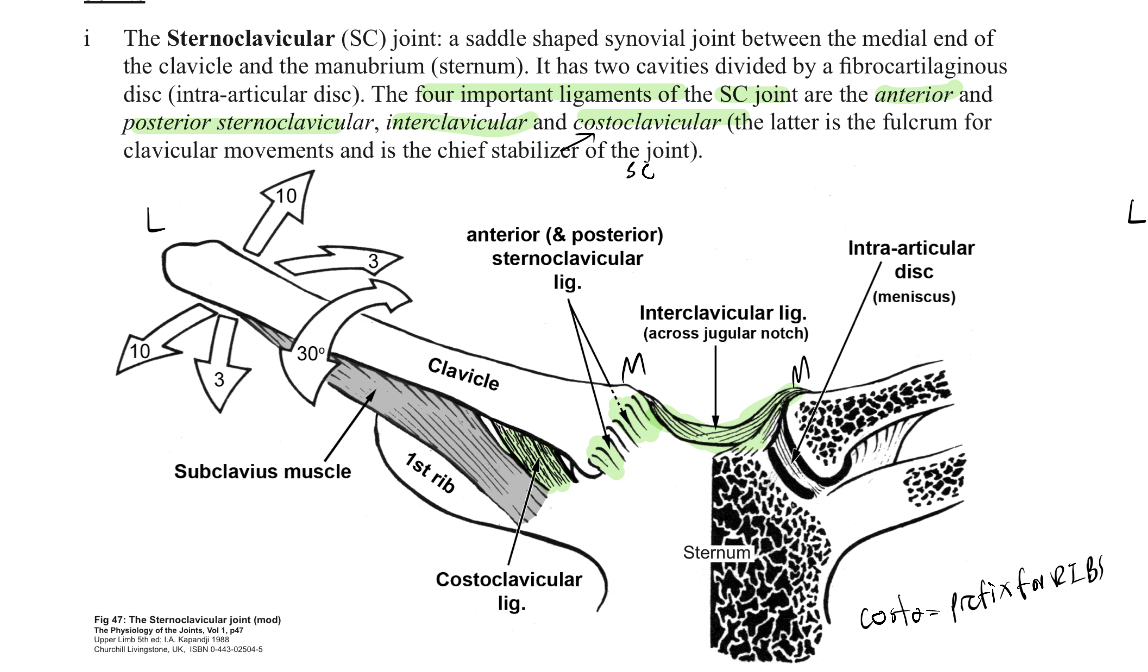
What are the four ligament of the sternoclavicular joint?
1/ant sternoclavicualr ligament
2/post sternoclavicualr ligament (these are stronger to prevent damage to nerves and blood vessels posterior to the clavicle)
3/interclavicular ligament (across jugular notch)
4/costoclavicular ligament (chief stabiliser)
What is inside the AC joint?
A wedge shaped fibrocartilagenous intra-articulate disc.
FX=alllows the clavicle and scapulae to move independently
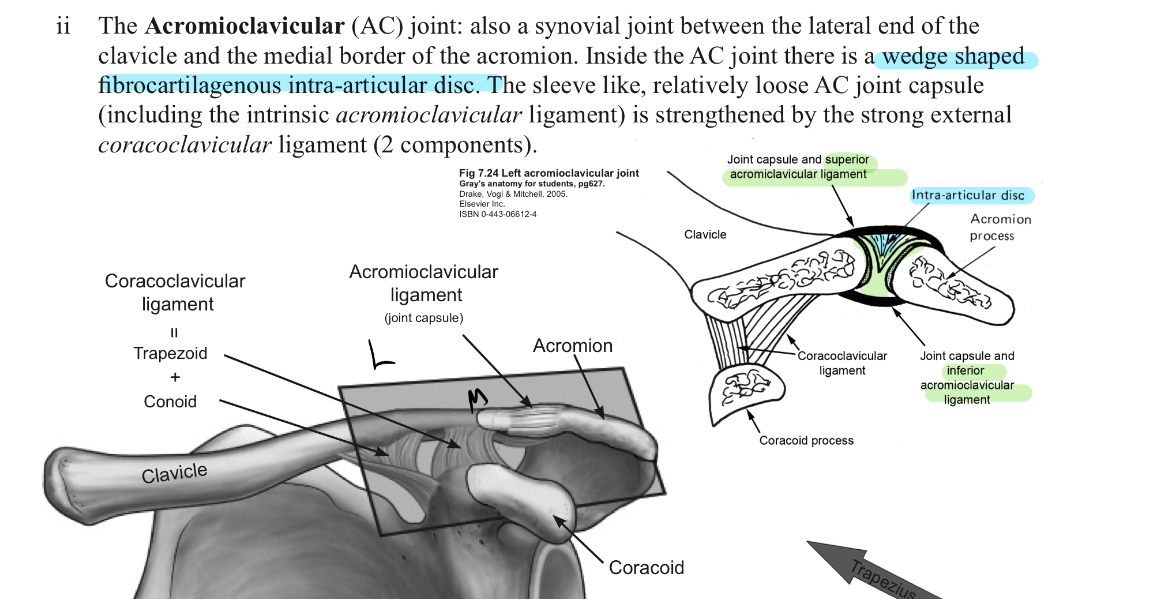
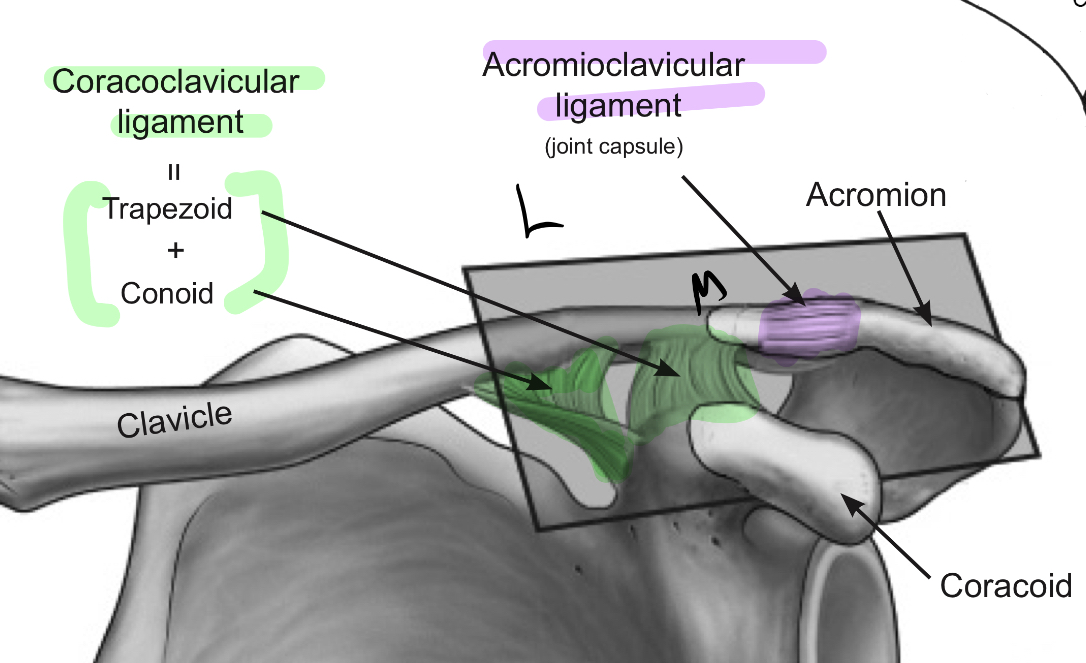
Describe the ligaments of the AC joint
x1 Intrinsic=acromioclavicular ligament
x2 Extrinsic/external coracoclavicular ligament
What type of joints are the AC and SC joints?
Synovial joints
What is the conceptual joint?
=not a true joint.
It acts to brace the scapula up against the thorax
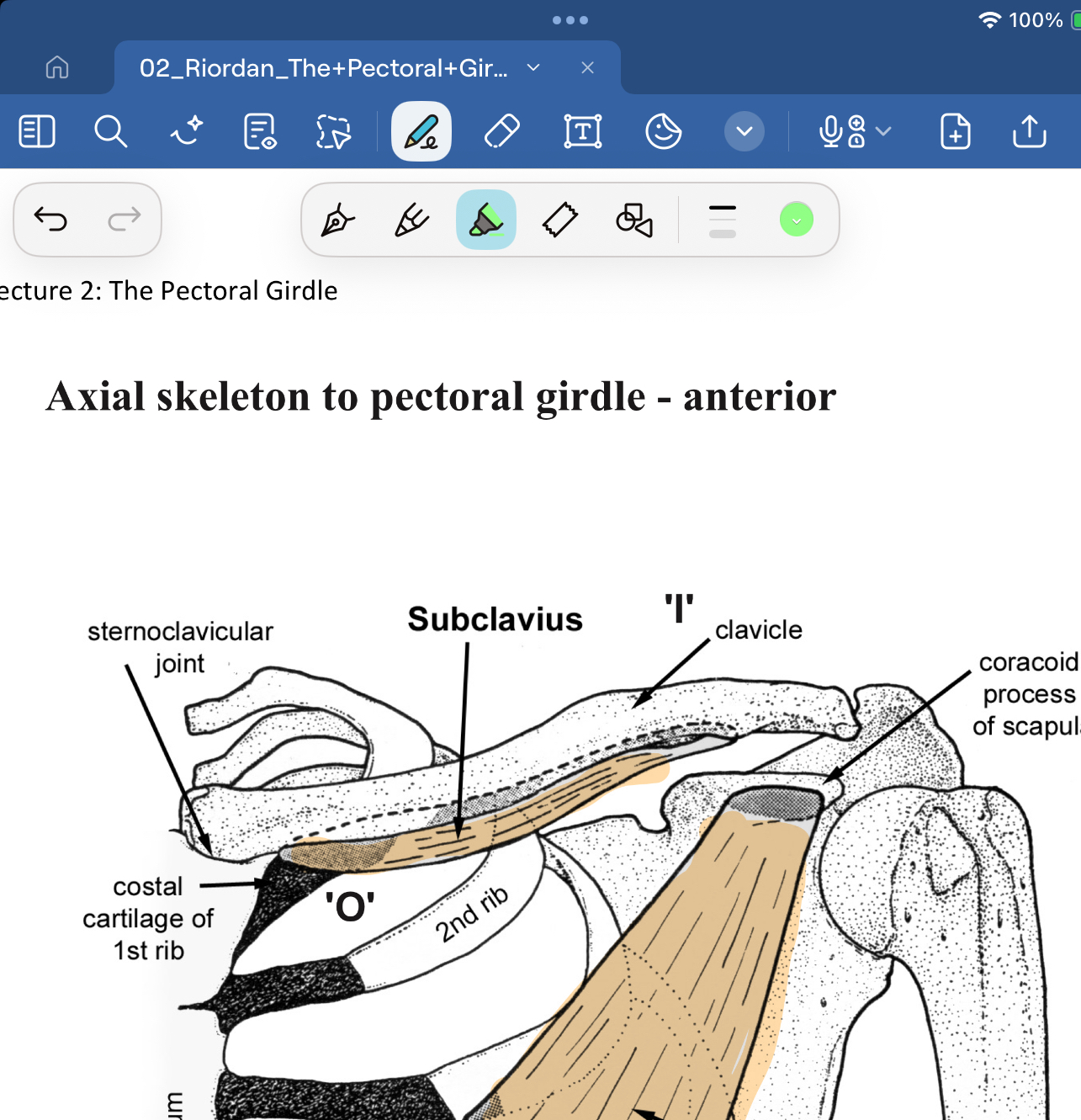
Describe the O, I, A and IN of SUBCLAVIUS
O=costal cartilage of first rib
I=subclavian groove (inferior clavicle surface)
A=braces clavicle to prevent it being pulled out from SC joint
IN=subclavina nerve C5
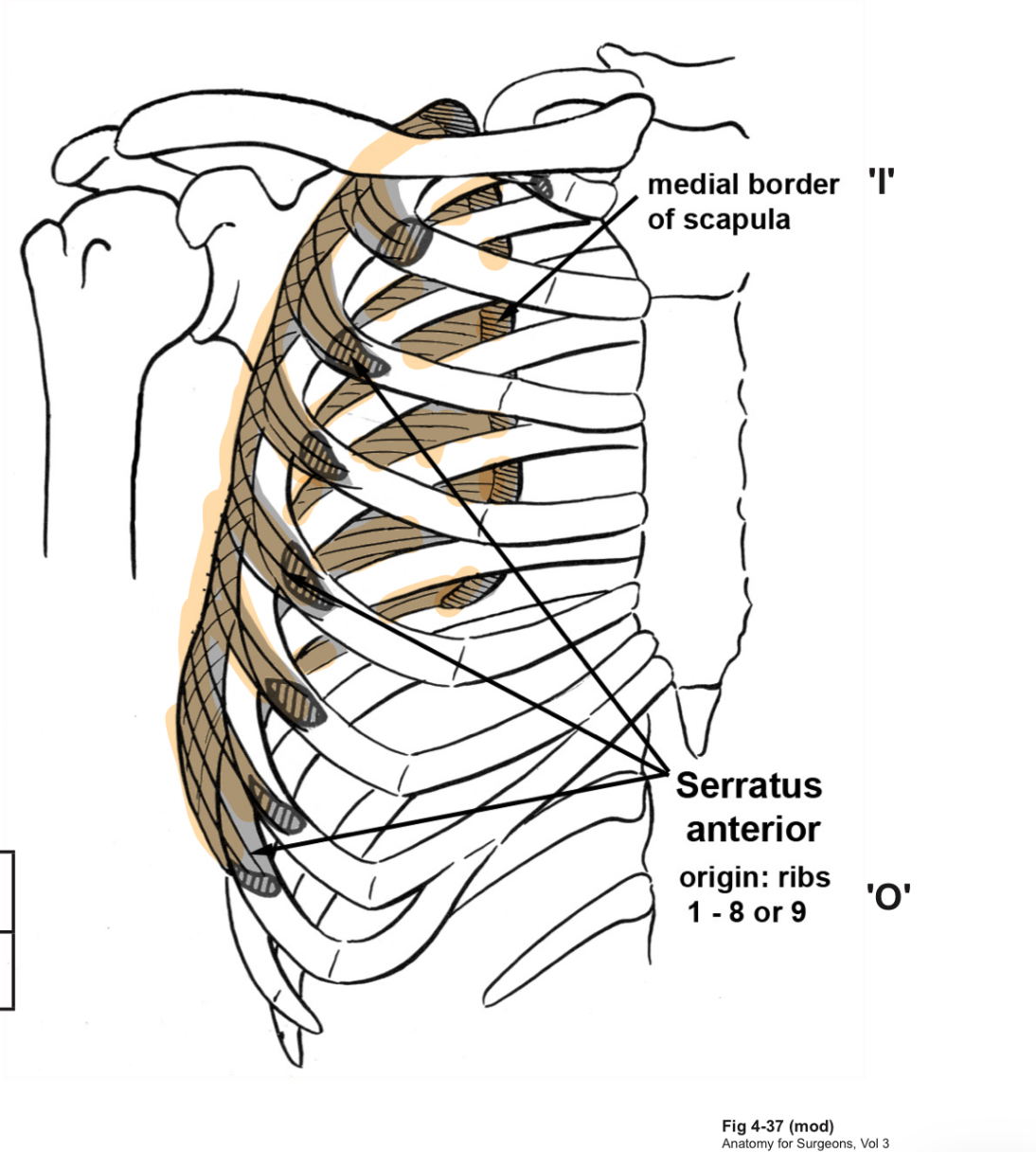
Describe the O, I, A and IN of SERRATUS ANTERIOR
O= ribs 1→8/9
I= medial border of scapula
A=protracts the scapula. Lower fibres help to superiorly rotate the scapula
IN=long thoracic nerve
CLINICAL RELEVANCE=wing scapula occurs when thoracic nerve is severed and therefore nerve supply to serratus anterior is compromised (normally holds the scapula against the thorax)
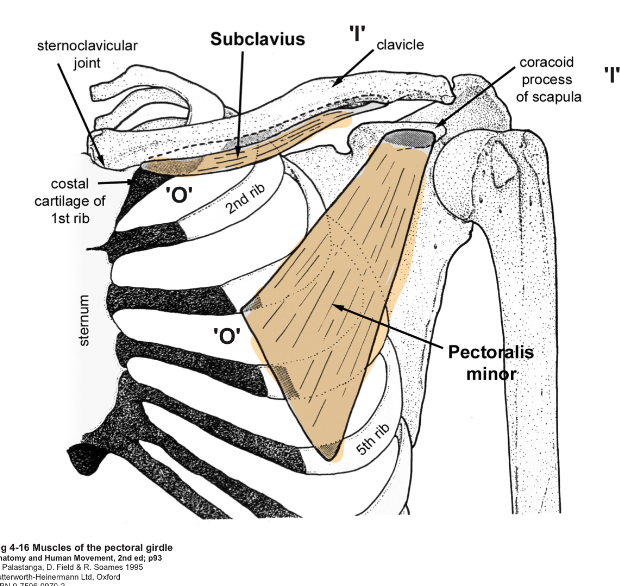
Describe the O, I, A and IN of PECTORALIS MINOR
O= ribs 3→5 (anterior-lateral side)
I= coracoid process
A=depresses scapula. (Helps with breathing)
IN=medial pectoral nerve
(Medial pec nerve must pass through pec minor to reach pec major)
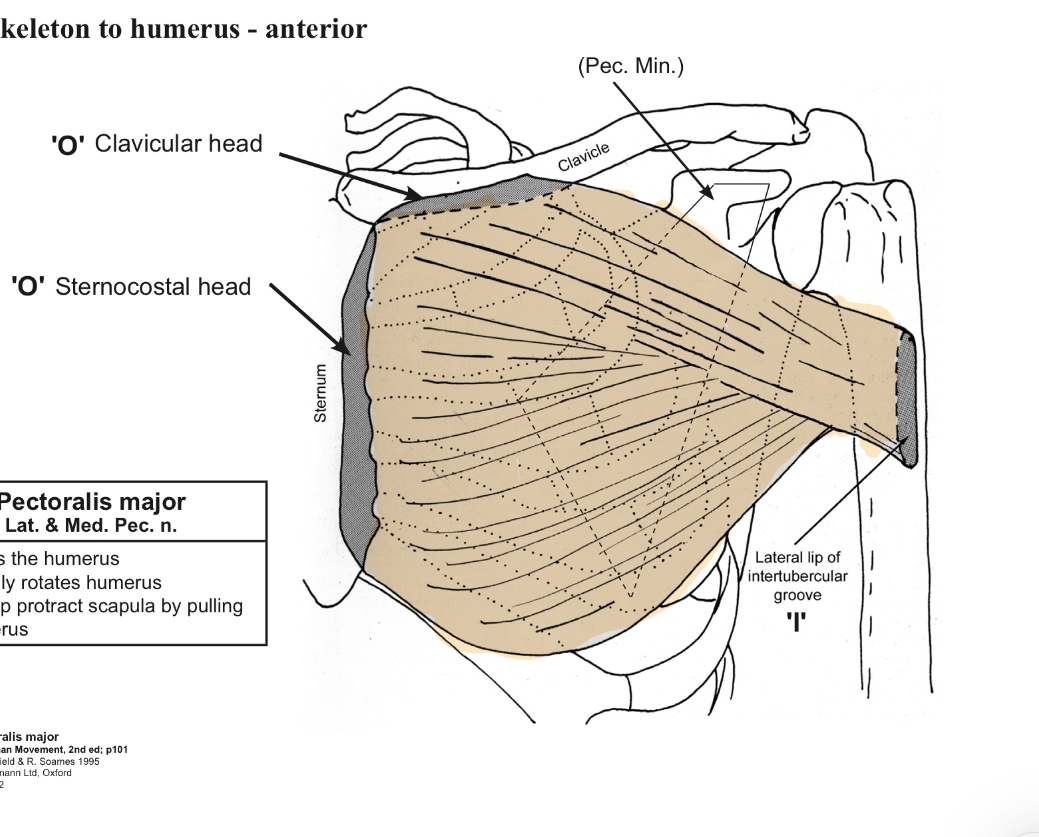
Describe the O, I, A and IN of PECTORALIS MAJOR
O=sternum (sternocostal head) and clavicle (clavicular head)
I=lateral lip of intertubular groove (front of humerus)
A=adduction and internal rotation of humerus. can help protract the scapula
IN= lateral and medial pectoral nerves
Describe the O, I, A and IN of TRAPEZIUS (Posterior muscle)
O= broad origin from superior nuchal lines to T12 (cervical and thoracic spinal processes)
I=anatomical horseshoe S=clavicle Middle=accromium I=spine
A=all=retracts scapula S=elevates scapula Mid=retracts scapula Inf=depresses scapula. S and In=superior rotation of scapula
IN=accesory nerve (cranial nerve X)
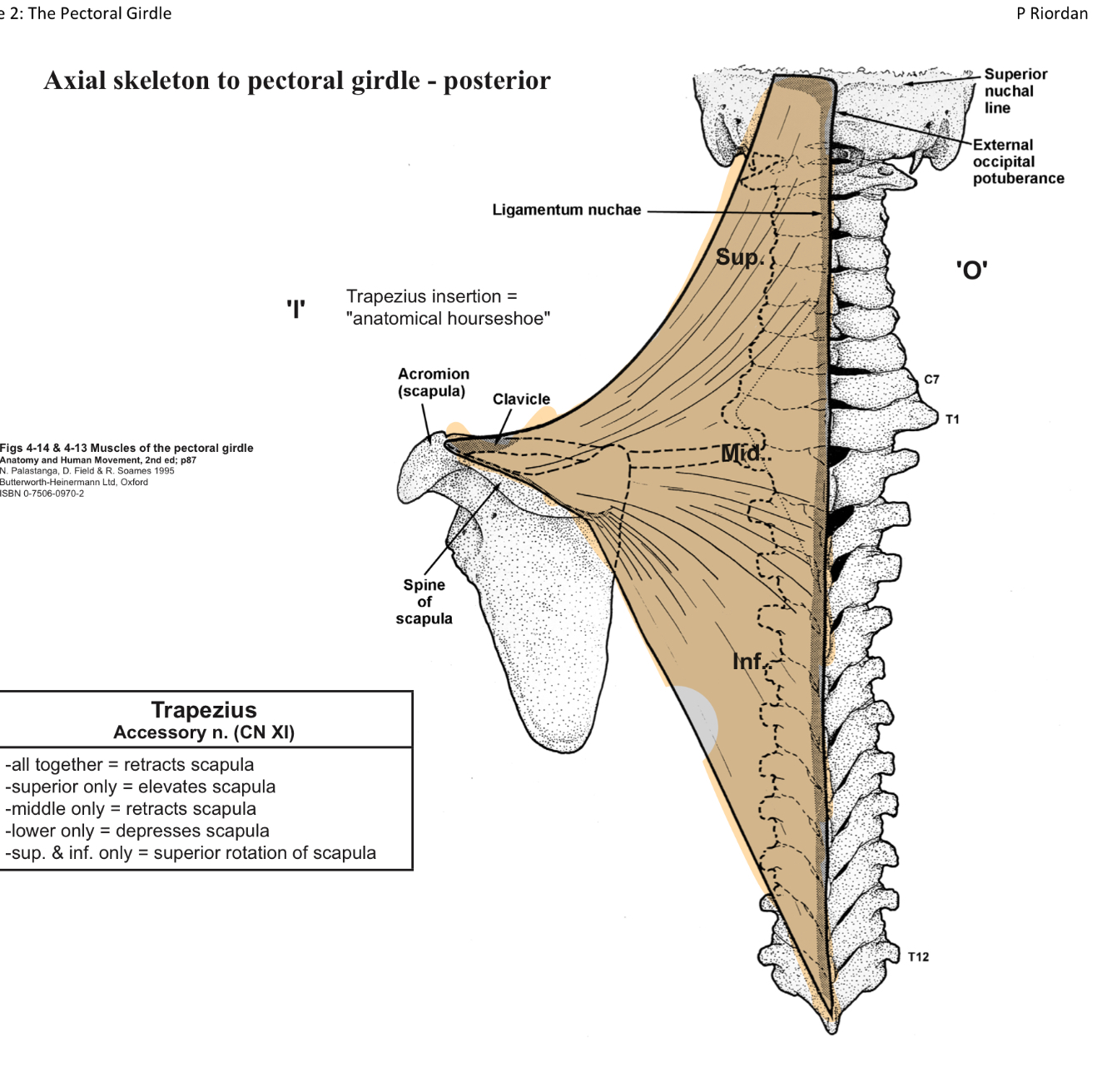
Describe the O, I A, & IN of TRAPEZIUS (posterior muscle)
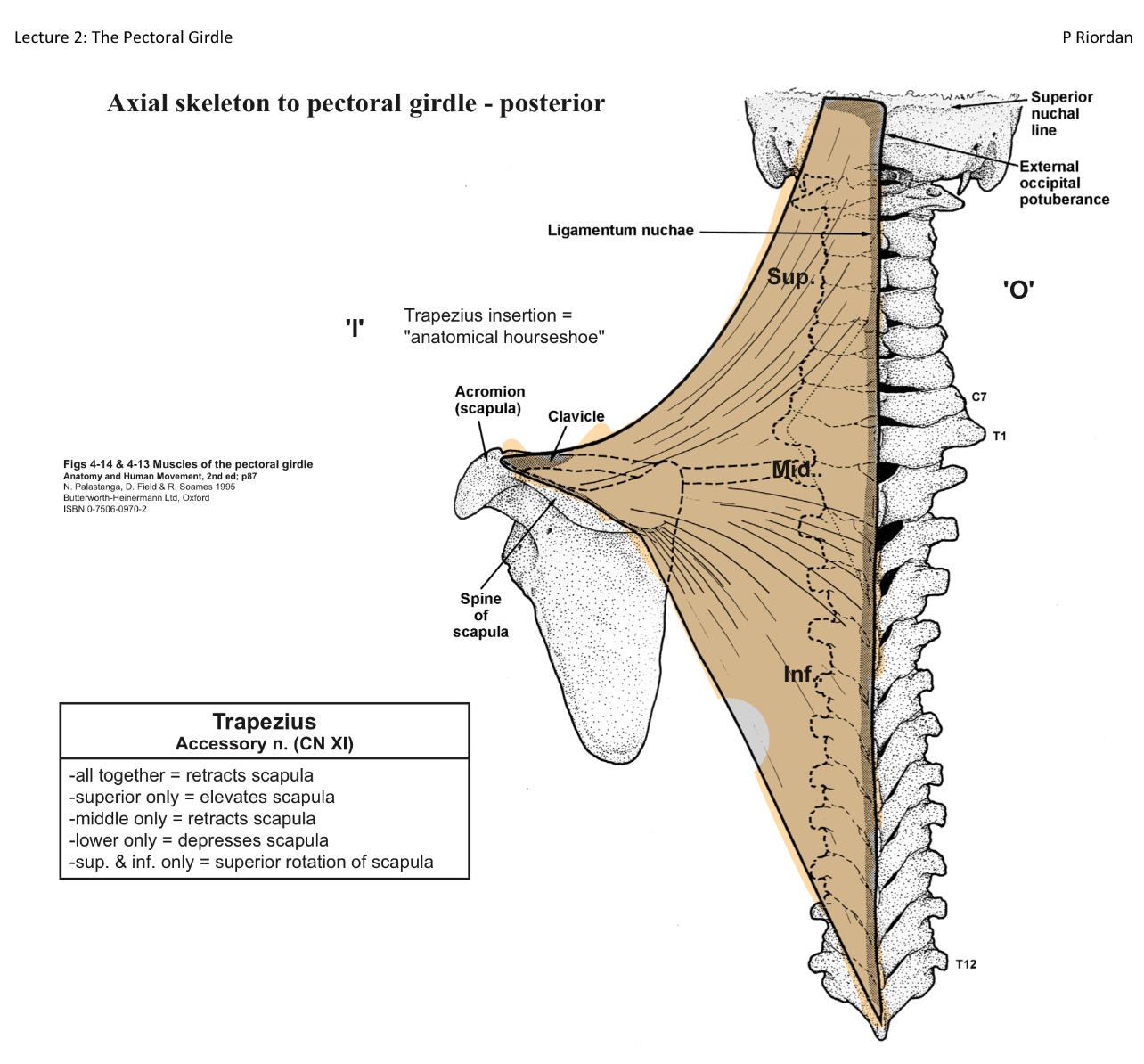
O= Broad origin from superior nuchal line to T12 (cervical and thoracic spinal processes)
I=Anatomical horseshoe (sup=clavicle, middle= acromion, inferior=spine of scapula)
A=All=retracts scapula. Sup=elevates scapula, Mid= retracts scapula Inf=depresses scapula. Sup and Inf=superior rotation of scapula
IN=Accesory nerve (cranial nerve X)
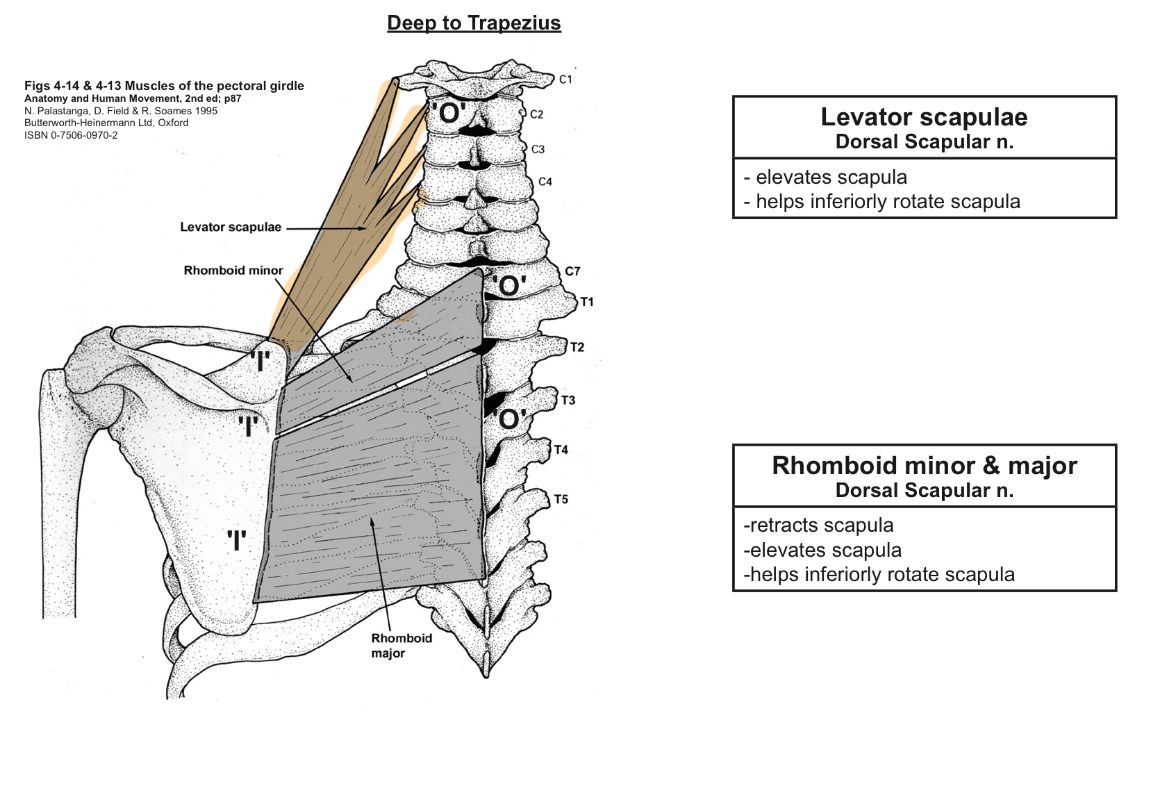
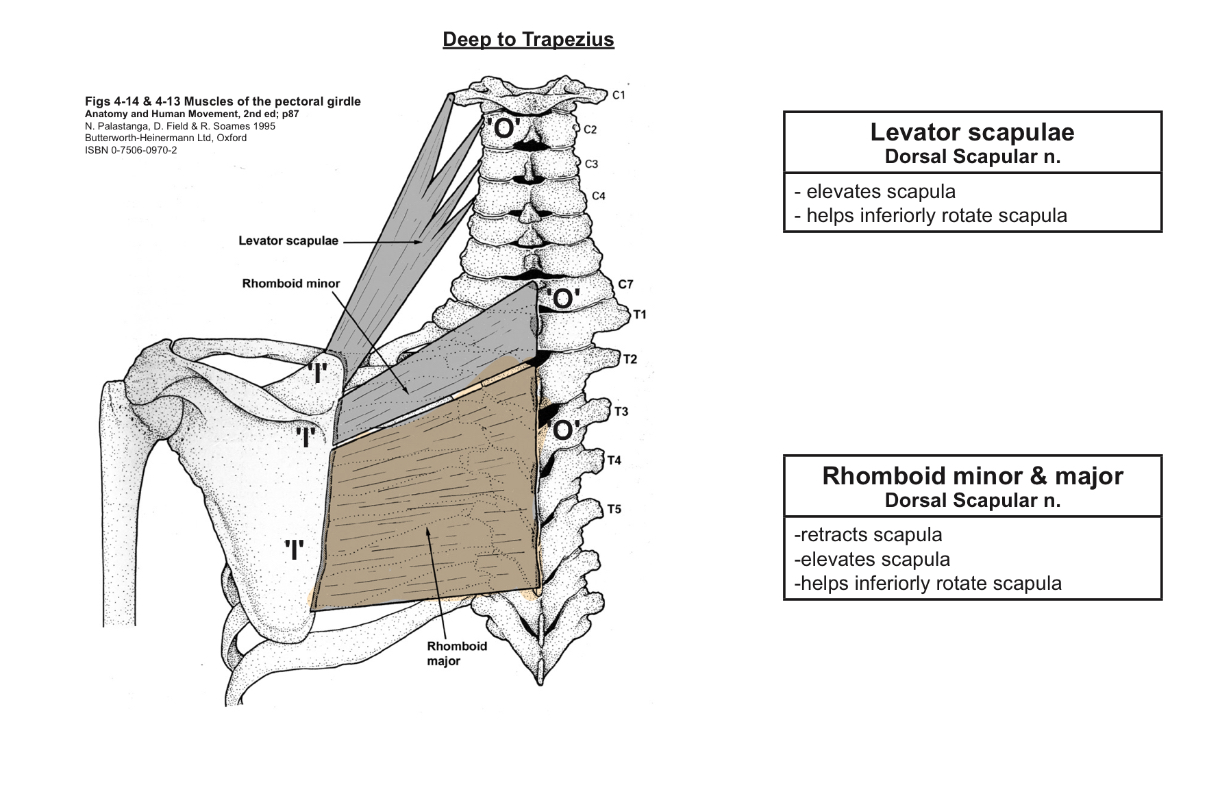
Describe the O, I A, & IN of LEVATOR SCAPULAE (PM)
O=transverse processes of C1-C4
I=superior angle of scapula
A=elevates scapula, lateral flexes/extends the neck
IN=dorsal scapula nerve (& C3, C4)
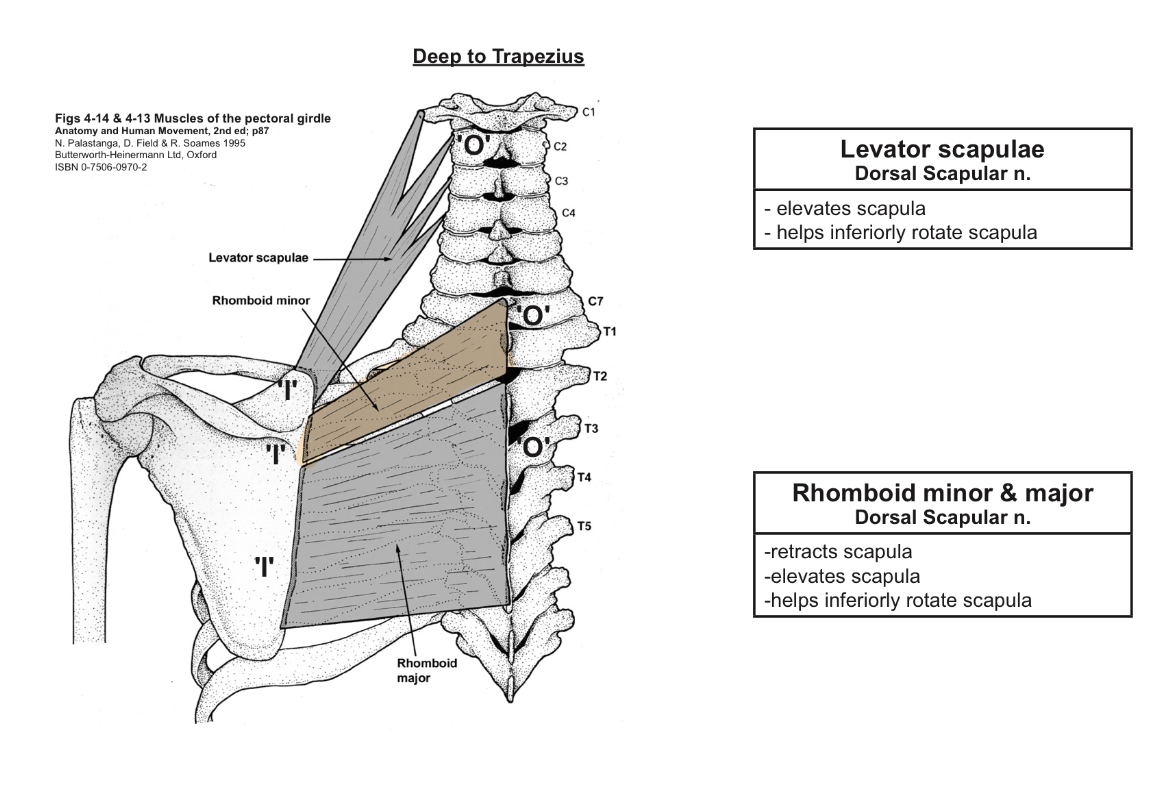
Describe the O, I A, & IN of RHOMBOID MINOR (PM)
O= C7-T1 spinous processes
I=medial border of scapula
A=retracts scapula, can also elevate scapula
IN=dorsal scapular nerve
Describe the O, I A, & IN of RHOMBOID MAJOR (PM)
O=T2-T5 spinous processes
I=medial border of scapula
A=retracts scapula, can also elevate scapula
IN=dorsal scapula nerve
Describe the O, I A, & IN of LATISSIMUS DORSI (PM)
O=broad origin —> spinous processes T7-S5 and iliac crest
I=Floor of inter-tubercular groove on anterior humerus
A=Adducts and internally rotates humerus, over fibres can depress scapula
IN=thoracodorsal nerve

