ESF EFB 311 Principles of Evolution Exam 2
 Call Kai
 Learn
Learn Practice Test
 Spaced Repetition
 Match
Match Flashcards
 Knowt Play
1/168

There's no tags or description
Looks like no tags are added yet.
Name | Mastery | Learn | Test | Matching | Spaced | Call with Kai |
|---|
No analytics yet
Send a link to your students to track their progress
169 Terms
What is natural selection?
a MECHANISM of evolution
What are examples of mechanisms of evolution?
mutation, migration/gene flow, genetic drift, and natural selection.
What are Darwin's Postulates?
1. Individuals within populations are variable
2. Variations among individuals are heritable
3. Individuals vary in survival/reproduction.
4. Survival/reproduction is nonrandom with respect to traits. Favorable variations are selected for.
What is fitness?
ability to survive and reproduce. Contribute to future generations.
What is gene flow?
movement of alleles from one population to another
What is genetic drift?
A change in allele frequencies caused by random events
Are gene flow and genetic drift the same?
No
Are polymorphisms maintained longer in small populations or large ones (assuming genetic drift alone).
Large ones. Less chance an allele can be fixed.
What is a polymorphism?
more than 1 allele at a locus within a population
What are sources of evolution?
mutation, gene flow, diversifying/disruptive selection, balancing selection.
What are forces that remove polymorphism?
genetic drift and directional selection
How is polymorphism maintained?
Balancing selection
- multiple niche polymorphisms
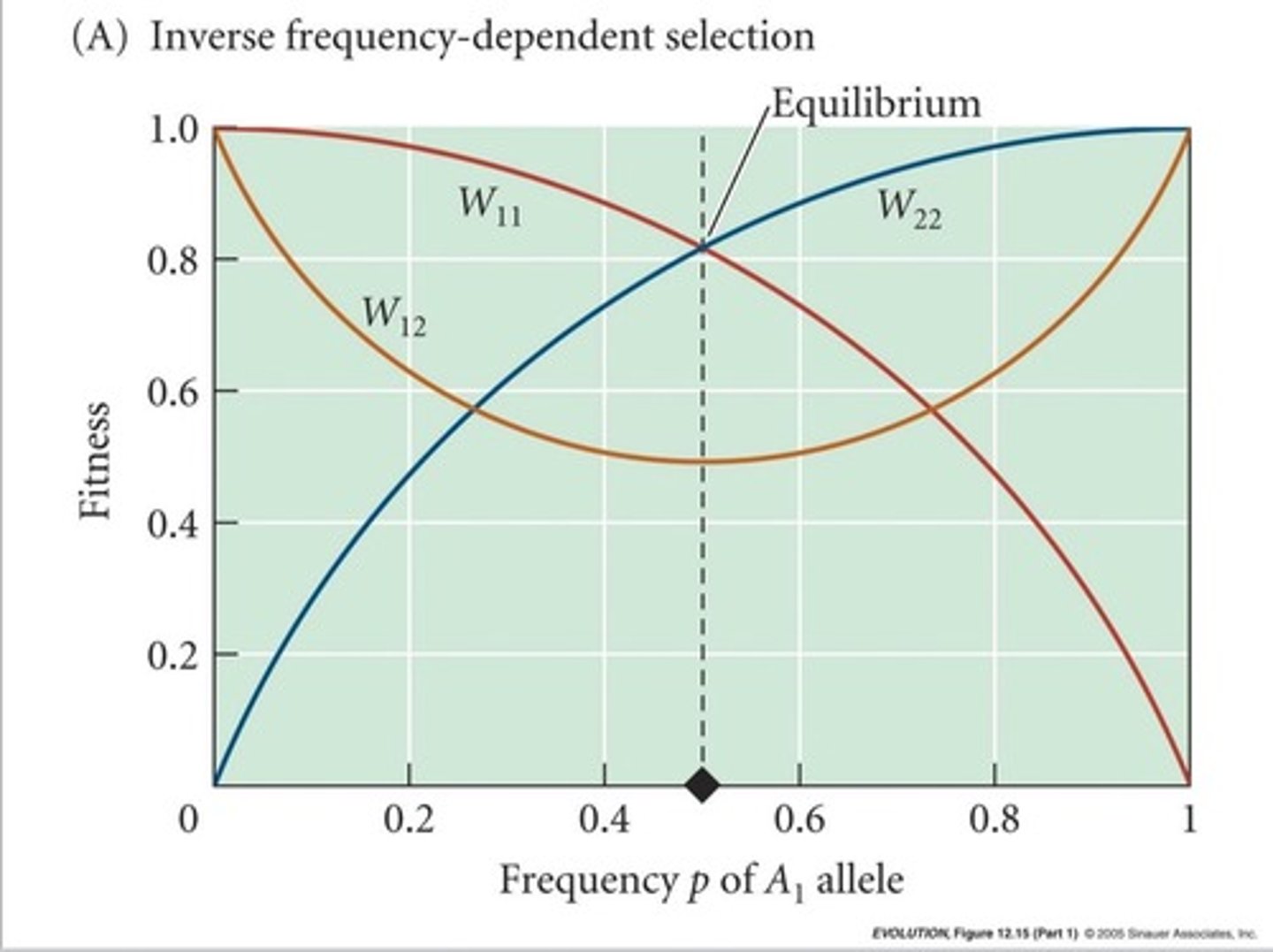
- inverse frequency dependence
What is multiple niche polymorphism?
Different forms of a species are adapted to each niche.
What is inverse frequency-dependent selection?
The rarer a phenotype, the greater its fitness (scale-eating cichlid)
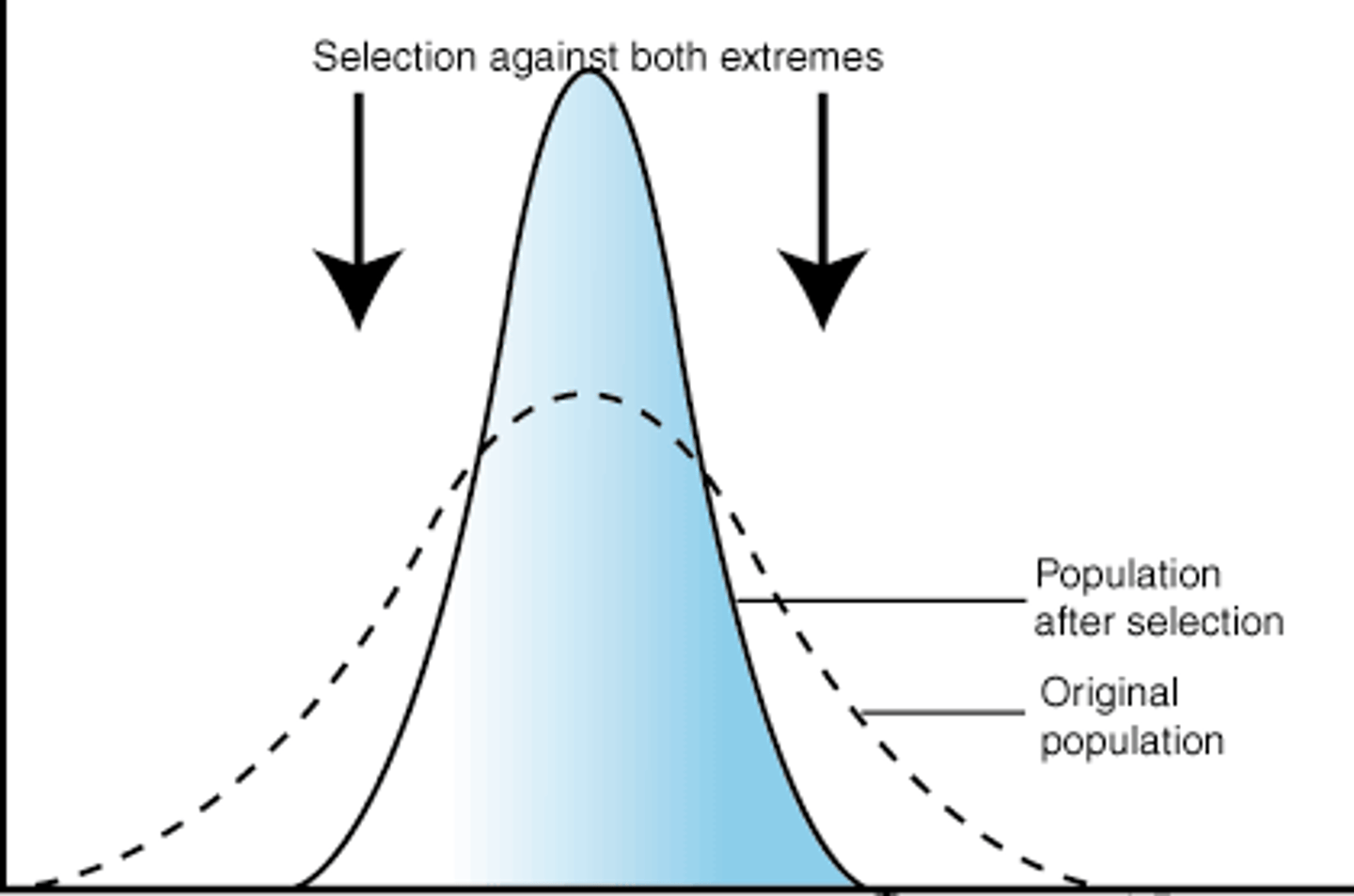
What is stabilizing selection?
favors intermediate variants and acts against extreme phenotypes
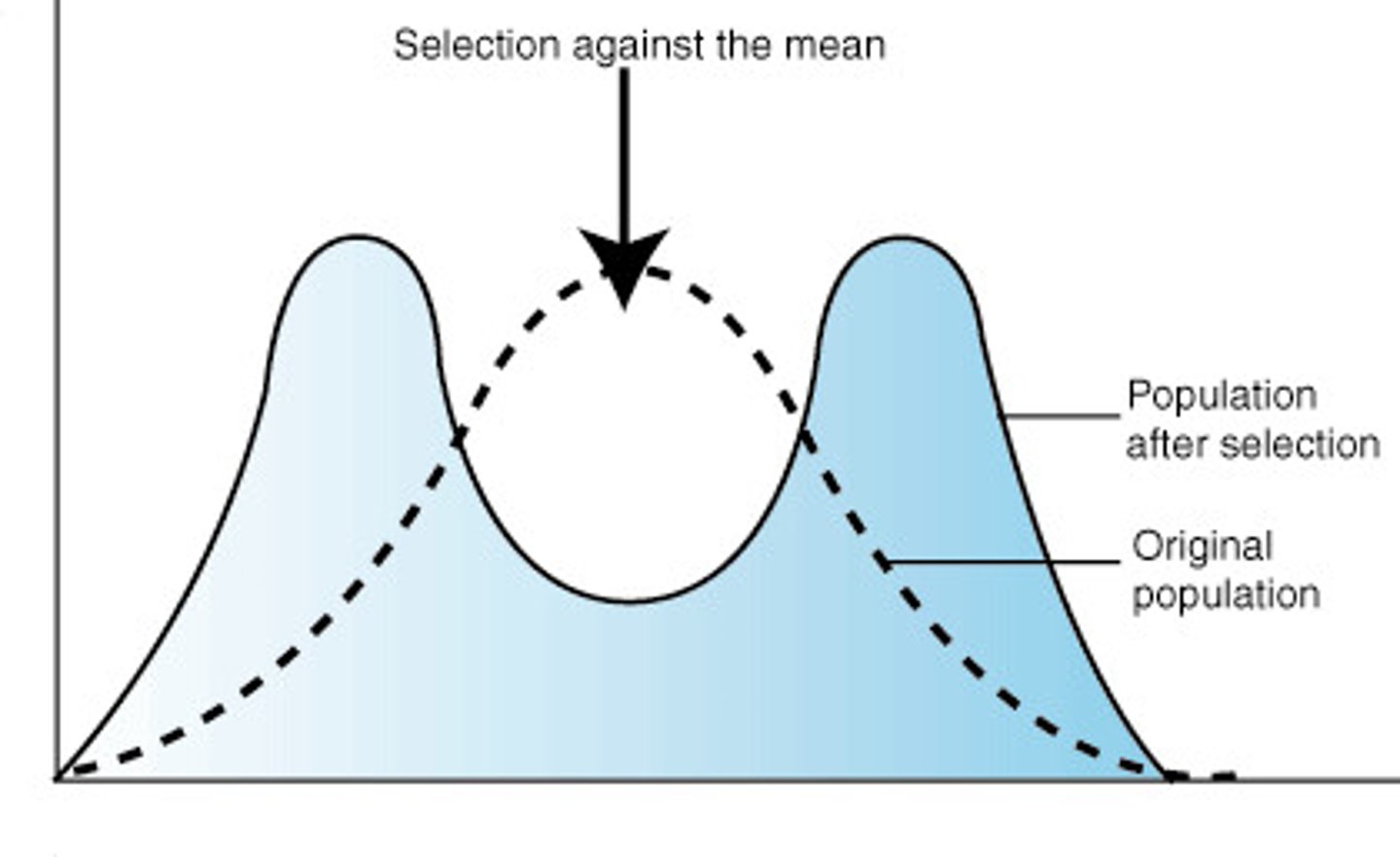
What is diversifying selection?
selection that favors both extremes
What is balancing selection?
occurs when natural selection maintains stable frequencies of two or more phenotypic forms in a population
What are the different modes of natural selection?
Directional
Stabilizing
Disruptive (Diversifying)
What is phenotype variance?
variance in measurements of a quantitative trait in a population (height)
What is a quantitative trait?
a measurable phenotype that depends on the cumulative actions of many genes and the environment
What are QTLs
quantitative trait loci (can include many loci)
What happens to trait differences as you increase environmental variance?
They become less discrete.
What happens to trait differences as you decrease the number of loci involved in phenotypic variance?
They become more discrete.
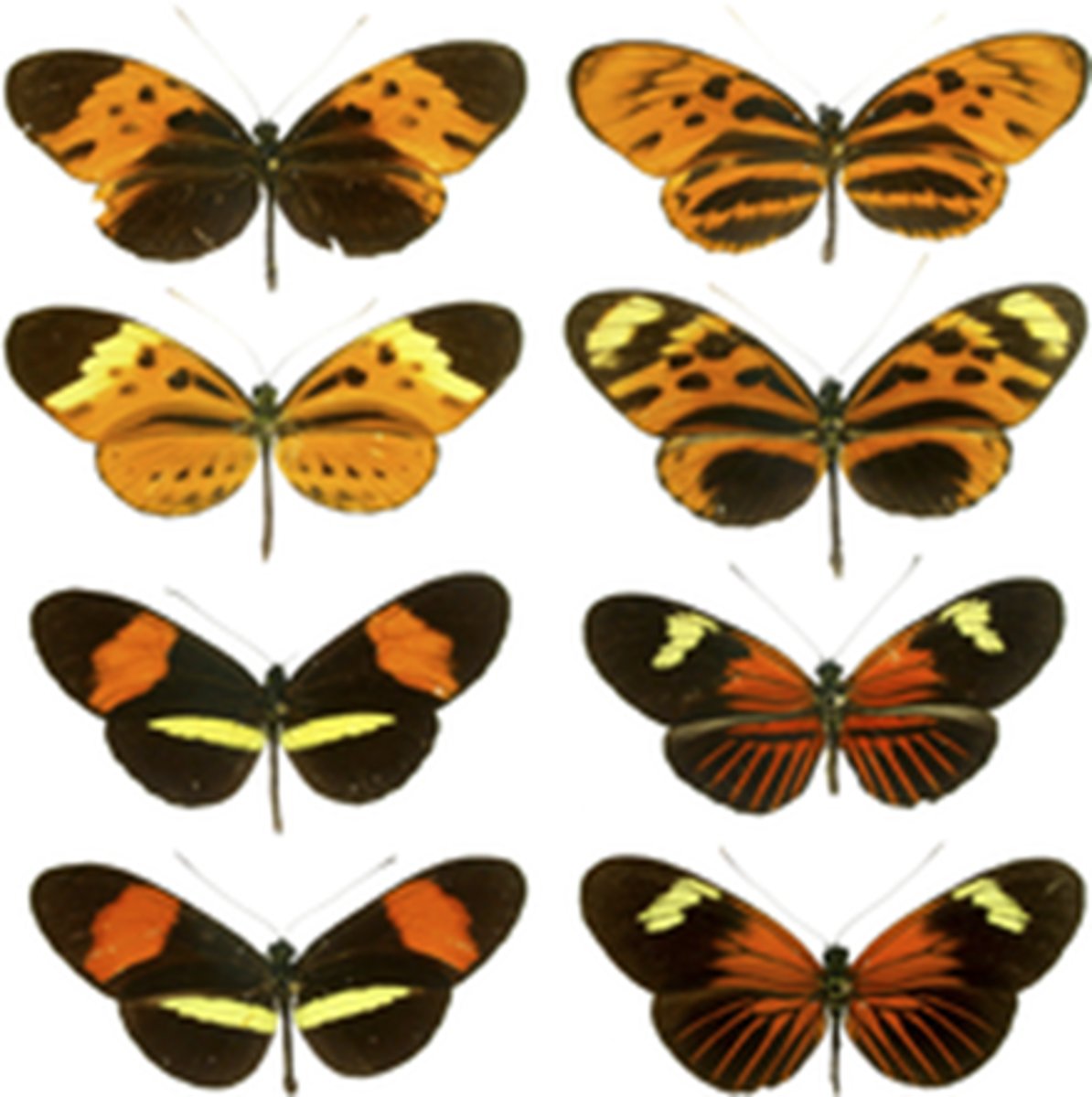
What is positive frequency dependent selection?
selection favors more common phenotype in a population (Peruvian butterflies)
What is a polymorphic species?
A species with a lot of different morphs/variation.
How can large changes in quantitative traits occur?
Evolution of new allele frequencies producing genotypes that were rare or absent prior.
Does natural selection act on phenotype or genotype?
Phenotype
Sticklebacks having different amounts of bony armor depending on the ecosystem (Freshwater VS Marine) is an example of what?
Polymorphisms
Did the Eda allele mutate independently in every freshwater lake? (Sticklebacks).
No, it had all low plated sticklebacks had a common ancestor. This displays genetic variation within the species as the Eda allele already existed. Just in a low proportion.
Why are there very few "completely armored" sticklebacks in freshwater lakes?
Energetic cost was high. They didn't need the defense in freshwater so fish without it grew faster and bigger.
How did coat color evolve in the rock pocket mouse?
Predation selection on fur coat color. light colored mice on black rock are easy to see.
Did the allele for black fur color arise once or more than once?
More than once across the range of mice! Phenotype not a result of gene flow but individual mutations across different loci.
if the selection coefficient (s) is greater than zero, is the measure of evolution (change in p) positive or negative?
Positive. The character state with an advantage will become fixed by selection.
What is fitness (w).
fitness of a genotype is averaged over all the individuals in a population.
How is fitness (w) determined?
survivorship x reproductive output in both males and females
How do you calculate overall fitness?
Multiplying the components of fitness
What are the components of fitness?
Viability Selection
Sexual Selection
Fecundity Selection
Gametic Selection
Compatibility Selection
Why is overall fitness important?
determines the outcome of natural selection
What is viability selection?
survivorship of offspring
What is sexual selection?
ability to get mates
What is fecundity selection?
Ability to make eggs/sperm or seeds/pollen.
What is gametic selection?
sperm/pollen competition in fertilization.
What is compatibility selection?
Compatibility of gametes after fertilization.
What is the selection coefficient (s)?
Differences in fitness from the "best" genotype which has a fitness of 1.
What does it mean if the selection coefficient is positive?
The genotype has an advantage over the previously accepted "best" genotype.
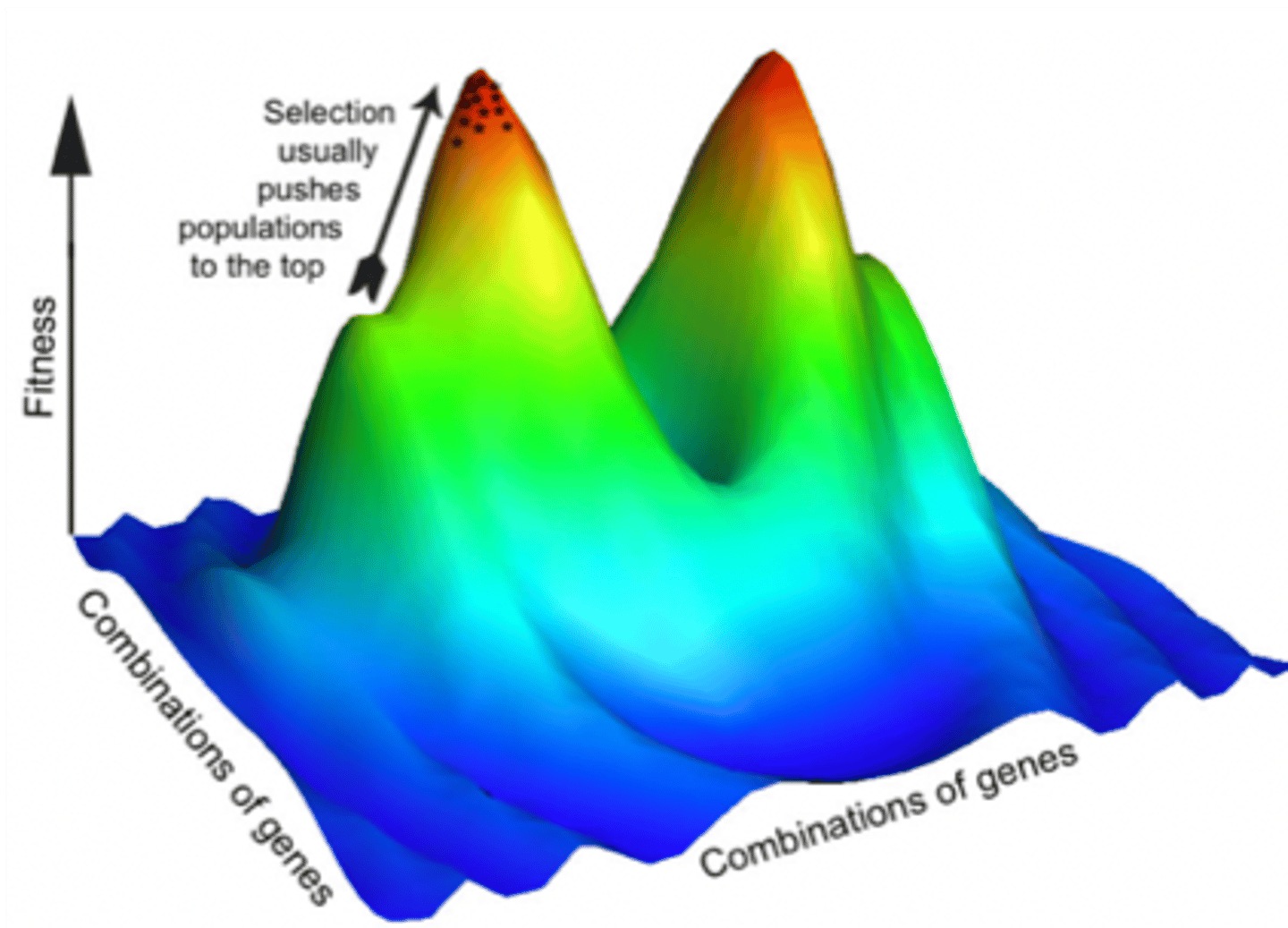
What is an adaptive landscape?
shows how the mean trait value in a population effects the populations mean fitness.
How does natural selection, in combination with the genes involved in the development of bird bills, act in the evolutionary radiation of Galapagos finches?
Environmental changes (ie drought) caused a selection on existing variation of finch bills. Selection for finches with bigger bills to crush the bigger seeds.
What is an example of disruptive (diversifying) selection?
Spadefoot tadpoles
1. mature fast and get out of ephemeral pool
2. mature slow and get big to avoid predators
T/F A larger population is less at risk of extinction in a changing environment.
True. Longer time to adapt to the change before population hits critical levels.
T/F A species with more genetic variance for a trait adapts more rapidly to environmental changes
true
T/F Some adaptations can make a big difference in mass extinction resistance.
True
1. salt resistance in the face of rising sea levels
2. dispersal modes
What is phenotypic plasticity?
the ability of an organism to change its phenotype in response to changes in the environment.
How is phenotypic plasticity different from evolution?
The genes are already there, its the same genotype, same individual.
T/F Some species are better equipped to adapt to certain types of environmental changes than others.
True
What type of species is at an adaptational disadvantage (two)?
Species with long generation times
Clonal organisms
What are owl adaptations?
fringed primary feathers muffle sound and allow for stealthy flight.
Enormous eyes allows for night vision
fluffy feathers and feathered legs provide insulation
radar dish head channel sound to the asymmetrical ears
What is Seilacher's Triangle?
organisms form results from the interplay of historical phylogeny (genetic variation), functional adaptation (biotic/abiotic factors), and structural (architectural/material strength limits).
T/F New adaptations are modifications of existing traits/existing developmental pathways.
True
T/F There is an "ultimate" form of a species that is perfectly adapted.
False.
Ex: Owls are not waterproof
What are constraints?
Constraints are things that shape an adaptation. Think Seilacher's Triangle
What is an example of a structural constraint?
Keratin beaks can only be so tough to break certain types of seeds
What is an example of a functional constraint?
What is an example of a phylogenetic constraint?
owls needing a certain type of feather to enhance their radar dish face. Relying on their ancestors genetic variation to modify the trait.
What does the metaphor of spandrels tell us about adaptations?
Adaptations may not have originally adapted for their role now. May have multiple functions at different points of time.
Is everything adaptive?
No. traits might get dragged along by their developmental correlation with selected for features
What is a "just so" story?
a plausible account of a trait's origin and function, but is not necessarily true.
What is an example of a "just so" story?
Giraffes necks are not made to reach food sources farther away from the ground but are instead a result of male-male competition for mates OR maybe the shape serves to enhance evaporative heat loss since females also have longer necks.
How could Stegosaurus plates been used? Two hypothesis.
1. Defensive armor (but they are light and hollow so unlikely).
2. Heat regulation via helping warm up or avoid overheating. (but no clear phylogenetic context)
T/F Stegosaurus plates are convection "fins" that help dissipate heat from the body by 30%
true
T/F Stegosaurus plates may have served a purpose in sexual selection.
True. There are two distinct categories (tall and wide morphs). Maybe served as recognition between individuals or for mating display.
What is one way we can see if traits are nonadaptive?
Comparative Approach:
Looking at phylogeny.
Ex: not all Stegosaurus had plates. Some had spikes, some had smaller surface areas.
What is N?
Census population size aka all individuals in a population
What is Ne?
effective population size aka the actual population breeding and contributing genetics to future generations
Can Ne be smaller than N? Why or why not?
Yes. Due to polyamorous mating systems and population bottlenecks.
What is a genetic bottleneck?
An event that causes a big reduction in a population and thus genetic diversity
The probability an allele will be lost during each generation of a bottleneck depends on what two things?
Severity of bottleneck (how much smaller is N)
Frequency of the allele
(how rare)
In a severe bottleneck, the population experiences (strong/weak) genetic drift
strong
What is founder effect?
special kind of bottleneck. Basically only a few individuals colonizing an area.
What are three types of introduction efforts?
Translocation
Reintroduction
Rewilding
What is translocation?
Individuals still present at the focal site but population is small or declining
What is reintroduction?
species has disappeared from a focal site but can be found elsewhere, colonize a suitable site
What is rewilding?
species has gone extinct everywhere and we need to use a closely related species with the goal of restoring ecosystem function.
How is effective population size (Ne) estimated?
genetic data, changes in allele frequency from generation to generation.
Why is effective population size more important than population size in conservation?
If there are 10,000 individuals but only 1,000 breed due to lack of habitat then genetic drift proceeds as if there were only 1000 individuals. Can lead to deleterious effects of inbreeding/loss of adaptive potential.
Why /how is the Laysan finch a good example for potentially understanding genetic drift and its consequences?
Its a small isolated island. We also know how big the population was (~100 in 1923) which allows us to have a documented initial population count (founders) and watch the genetics change as the population grows.
How can gene flow help prevent extinction?
Populations can be genetically rescued from inbreeding. Can bring populations to the same allele frequencies unless offset by drift/selection.
What is a panmictic population? AKA panmixia
When all the subpopulations are interbreeding freely forming a continuous population.
How do we identify population structure?
By comparing populations and seeing if there are deviations from H-W proportions (aka panmixia).
T/F Gene flow can counteract genetic drift
true
Isolated populations are (more/less) likely to differentiate between other populations.
more
Why are Laysan finches a good study species for genetic drift and founder effects?
Translocations provide introduced populations on other islands that we can monitor since their inception. Islands isolated from each other.
What is F-statistics (Fst)?
Compares variances in allele frequencies among populations
How do you calculate Fst?
Vq/(q)(1-q)
q = mean frequncy of one of the alleles
Vq = variance among populations in the alleles frequency.
An Fst that equals zero (is/is not) panmixia
it is panmixa, meaning no variation AMONG populations. Not necessarily IN populations.
What does an Fst value of 1 mean?
All individuals in a population are fixed for one allele in one population and one in the other.
T/F alleles are lost/fixed in higher rates in small populations
true
What is Nm mean?
Number of migrants into the population
T/F Genetic drift favors one allele over another.
False
T/F An allele can become fixed even without natural selection
true! From genetic drift and stochastic events.
What tool can we use to help uncover "cryptic speceis"?
Phylogenetic patterns

