Technical measures and privacy-enhancing technologies
 Call Kai
 Learn
Learn Practice Test
 Spaced Repetition
 Match
Match Flashcards
 Knowt Play
1/51

Earn XP
Description and Tags
Outlines the strategies and techniques for enhancing privacy throughout the data life cycle, including: identity and access management; authentication, encryption, and aggregation; collection and use of personal information.
Name | Mastery | Learn | Test | Matching | Spaced | Call with Kai | Chat |
|---|
No analytics yet
Send a link to your students to track their progress
52 Terms
Why is encryption important when sending information on the internet
Encryption ensures that even if online data is intercepted, it cannot be understood. Like someone opening a postcard that isn't theirs but they can't decipher the text.
Encryption
Encryption is the scrambling of information that requires a key to be able to decipher.
Cryptosystem
A cryptosystem is a collection of materials needed to encrypt and decrypt information such as algorithms and keys as well as hardware, software and equipment.
Algorithms
These are mathematical rule based processes that are applied to a block of data
Key
A key is a small piece of data that modifies an algorithm’s result
Symmetric encryption?
Such as DES Uses the same key for encryption and decryption. Key is smaller which makes it more practical for encrypting large blocks of information and sharing it with multiple people.
Asymmetric encryption?
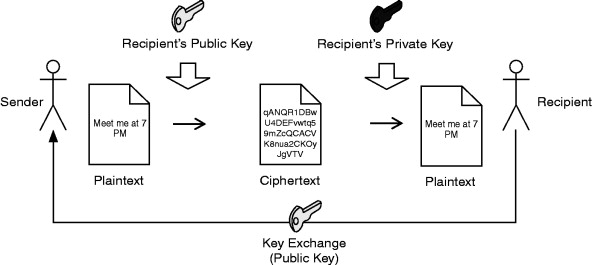
Uses one key for encryption and another key for decryption. Sender uses a public key to encrypt a message, and the recipient uses a private key to decrypt the message.
Application Encryption
Application encryption provides built-in encryption that is applied throughout a program.
Record Encryption
When records are encrypted one at a time which provides more enhanced and granular protection.
Field Encryption
Field encrption allows for specific fields of data to be encrypted, specifically very sensitive fields like credit card numbers.
Quantum Encryption
Quantum encrption (cryptography) uses quantum mechanics to encrypt messages.
Public-key infrastructure
Provides tools for obtaining and verifying public keys
How is Homomorphic encryption different from typical encryption?
It allows for encrypted information to be manipulated without being decrypted first.
What is Polymorphic encryption?
This is a powerful type of encryption that causes the algorithm to mutate with each copy of the code. The algorithm becomes difficult to recognize over time and harder to decrypt.
Mix Networks
This is a way to hide one’s traffic in a network by combining the traffic of multiple computers into one channel that is sent between multiple computers.
Access Management
Who can access the restricted data
Access control lists
Access control lists restrict unauthorised individuals, devices or services from accessing information.
Sophisticated access management
Restricts access based on more specific things like the user’s location, the time of access, the type of device being used etc
Least Privilege
The concept of granting individuals the lowest possible access rights that they need to complete tasks.
Role-based access controls
Access to information is granted to users based on their role/team in the organization rather than them as an individual.
Hybrid role-based and user-based controls
Common approach in an organization which blends the role-based access control and user-based access control.
Single Sign-On
SSO allows access to resources across different platforms by using just one ID and password. (think Microsoft and Google)
Federated Identity Model
With this method, a person’s identity is verified by a centralized service.
Remote Access and BYOD
Remote Access and Bring Your Own Device allow employees to access restricted resources on their own devices however this risks revealing personal information from the employee’s device.
Authentication
This is a process where you are validating someone’s identity and making sure they are who they say they are.
Four categories for authentication
Something you know (username or password)
Something you are (voice recognition)
Something you have (tokens, keys, ID badges and smart cards)
Where you are (Physical location that matches the expected location.)
What is “Identity”
The link between a piece of information and the individual or individuals associated with that data. Identity captures what we know about who that individual is.
What is “identifiability”
Identifiability is the extent to which a person can be identified.
What is the issue with having ‘High Identifiability’
This may put individuals at higher risk of tracking and identity theft.
Labels
These are characteristics that point to an individual. These can be precise, as in a name, or imprecise, such as with an attribute, depending on the context.
Identifier
These are codes or strings used to represent an individual, device or browser.
What are qualities of a strong identifier?
No two people have the same identifier, unique for each person
Think credit cards, passports and identification cards
What are qualities of a weak identifier?
May belong to more than one individual like first name
Why is it a good idea to restrict data privileges to ALL employees including C-Suite?
Reduces the risk of them accessing or being tempted to access information they shouldn’t. Or in the case that their account is compromised, they already won’t be able to access confidential information.
Multi-Factor Authentication
A way of authenticating one’s identity by requiring more than one method of authentication
Domain Based Message Authentication Reporting and Conformance (DMARC)
DMARC is an email authentication, policy and reporting protocol that protects a domain from being used in phishing emails, spoofing, and other email scams and cyberthreat activities. If an email passes authentication, then it will be delivered and can be trusted; if not, the email will be quarantined or rejected
Digital Rights Management
DRM ensures digital content (including video games) is only delivered to those authorized to receive it. It can also limit what assigned users can do with the content. For example, a person may be permitted to read a document, but not allowed to modify it.
Quasi-identifies
Quasi-identifiers combine data with external knowledge, such as publicly available information, to identify an individual. Such as debit card account numbers.
De-identification
One of the primary techniques used to prevent an individual’s identity from being connected to their personal information.
Pseudonymization
Data is pseudonymized by replacing individual identifiers (such as names) with numbers, letters, symbols, or a combination of these, such that data points are not directly associated with a specific individual.
Difference between pseudonymized and anonymized data.
Unlike anonymized data, pseudonymized data can be restored to its original state as long as the relationship between the original identifier and the pseudonym is documented.
Anonymized
In anonymized data, direct and indirect identifiers have been removed, and mechanisms have been put in place to prevent reidentification.
Tokens
Tokenization, an example of pseudonymization, is a system of deidentifying data which uses random tokens as stand-ins for meaningful data.
K-anonymity, l-diversity and t-closeness
These are techniques that have been developed to reduce the risk of data anonymity being compromised by someone who might combine it with known information to make assumptions about individuals in a data set.
K-anonymity
The creation of generalized, truncated or redacted quasi-identifiers as replacements for direct identifiers, such that a given minimum number (“k”) of individuals in a data set have the same identifier.
L-diversity
builds on k-anonymity by requiring at least “l” distinct values in each group of "k" records for sensitive attributes.
T-closeness
This further extends on l-diversity by reducing the granularity of data in a data set.
Secure Multi Party Computation
Cryptographic method that specifically allows multiple parties to jointly compute a function (such as an average or median salary) from private data without revealing the data to eachother.
What is the difference between traditional Encryption and Secure Multi Party Computation? (SMPC)
Compute without exposure.
Encryption protects data when it’s stored or transmitted while SMPC ensures confidentiality throughout the computation process itself.
What are the 8 Privacy Design strategies set up by Jap-Henk Hoepman?
Minimize, Separate, Hide, Abstract, Enforce, Demonstrate, Inform, Control
Minimize
Reduce the amount of interactions down to what is immediately necessary
Separate
Keep data subjects and their data completely separate from third parties.