Cell Biology Exam Two - Active Transport
 Call Kai
 Learn
Learn Practice Test
 Spaced Repetition
 Match
Match Flashcards
 Knowt Play
1/43

There's no tags or description
Looks like no tags are added yet.
Name | Mastery | Learn | Test | Matching | Spaced | Call with Kai |
|---|
No analytics yet
Send a link to your students to track their progress
44 Terms
What are the 3 ways that active transport pumps work?
Gradient-Driven
ATP-Driven
Light-Driven

What type of pump is this>
Gradient-Driven
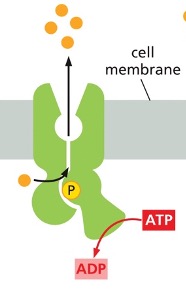
What type of pump is this?
ATP-Driven
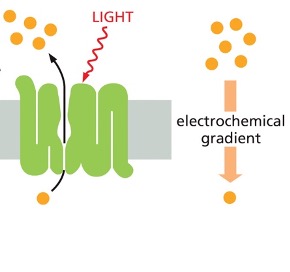
What type of pump is this?
Light-Driven
What is the other name for the sodium potassium pump?
Na+ / K+ / ATPase
What does the sodium potassium pump do?
uses energy from ATP hydrolysis to transport Na+ and K+ against their electrochemical gradients.
The sodium potassium pump actively pumps
2 potassium in
3 sodium out
The Na+ / K+ pump uses nearly ____ of the ATP in many cells
25%
The Sodium Potassium pump is needed to:
propagate electrical signals in nerve and muscle cells;
drive active transport of other molecules;
to maintain osmotic balance and cell volume
What are the 3 functions of active transport?
Solutes can be concentrated
Wastes can be removed
Maintain constant, non-equilibrium concentration of inorganic ions
Intestinal cells have higher concentrations of _____ than the lumen
glucose
the products of _____ are toxic if built up
cellular metabolism
For the sodium potassium pump what is the ratio of ATP to ions
1 ATP = 5 ions
The change of ATP to ADP allows
conformational change which allows phosphorylation
The release of the phosphate allows
conformational change back to normal
Calcium Ion Transport:
out of the cell or into the smooth ER lumen
making intracellular calcium ion concentrations extremely low
important for muscle contraction
There can be more that one pump per
vesicle
The Sodium Glucose Symporter in the Intestine:
gradient driven transport - secondary active transport
glucose transporters in the apical domain of intestinal epithelial cells transport two sodium and one glucose into the cell
gradients are different but direction is the same
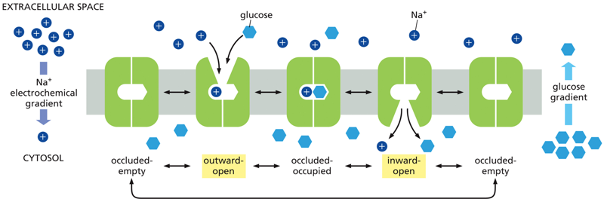
What does this image represent?
Sodium Glucose Symporter
ion pumps in bacteria, yeasts, and plant cells transport H+ out of the
cell
H+ is pumped out of the stomach lining cells, resulting in
acidity of gastric fluids
structurally distinct pumps transport H+ into
lysosomes and endosomes
Molecules can be transported against their gradient using __________ in the energetically favorable direction
energy from coupled transport of another molecule
sodium gradient is used to bring
essential nutrients in
Hydrogen gradient brings in
solute
The Sodium Gradient can be _______
exploited
Active Transport brings _______ into gut lumen
glucose
facilitated diffusion brings glucose into
extracellular fluid
some pumps are ____ driven
light
Some multi drug resistance pumps use ATP to pump toxins
out of the cell
ABC transporters have highly conserved
ATP-binding domains
ABC transporters stands for:
ATP-binding cassettes
What are good models
red blood cells
What is an example of an ion channel defect that looks like a pump defect
cystic fibrosis
The cystic fibrosis gene encodes a protein ______, in the ABC transporter family
CFTR
ATP synthases in mitochondria and chloroplasts are other types of
H+ pumps
When these pumps operate in reverse, the movement of ions down the electrochemical gradient is used to drive
ATP synthesis
Using energy:
up gradient
Making energy:
down gradient
True of False. The sodium potassium pump uses 1 ATP per ion transported.
False
True or False. The sodium potassium pump is a type of anti porter.
True
One similarity between facilitated transporters and pumps is their activity depends upon
conformational change
glucose transport into red blood cells requires facilitated diffusion while glucose transport into intestinal cells requires active transport. This difference in transporters is due to transport being ____ the concentration gradient into red blood cells and _____ the concentration gradient into intestinal cells.
Down ; Up
The sodium potassium pump makes the cell interior more _____ by pumping ______ sodium ions out of the cell for every ____ potassium ions pumped in.
Negative, 3, 2

