Eggs
 Studied by 0 people
 Call Kai
 Learn
Learn Practice Test
 Spaced Repetition
 Match
Match Flashcards
 Knowt Play
1/25

Earn XP
Description and Tags
Name | Mastery | Learn | Test | Matching | Spaced | Call with Kai |
|---|
No analytics yet
Send a link to your students to track their progress
26 Terms
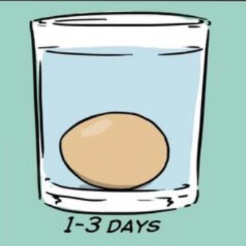
How should an egg float in water: 1-3 days?
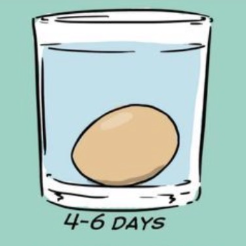
How should an egg float in water: 4-6 days?
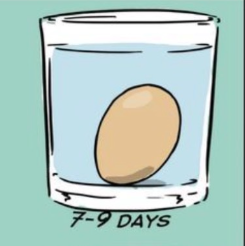
How should an egg float in water: 7-9 days?
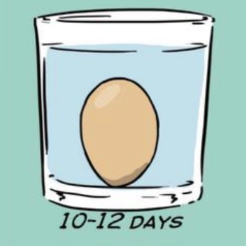
How should an egg float in water: 10-12 days?
How should an egg float in water: 13-15 days?
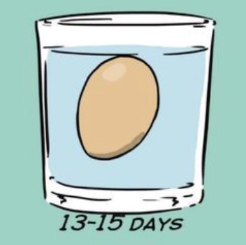
List all 8 functions of eggs when cooking?
Aeration, Binding, Coating, Glazing, Emulsifying, Thickening, Enriching and Garnish.
Explain ‘Aeration’ and give examples?
Air gets trapped within egg when protein stretches making mixture light and foamy, it can also be used as a raising agent in cakes e.g mousses, cold souffles, sponges and meringues.
Explain ‘Binding’ and give examples?
Eggs coagulate (solidify) if heated e.g fish cakes, burgers, stuffing, meatloaf, rissoles and falafel.
Explain ‘Coating’ and give examples?
Before frying, foods are coated in egg then dipped in bread crumbs or flour. The egg protein coagulates, sealing the food as it cooks forming a crispy coating & preventing overcooking e.g scotch eggs, fish cakes, rissoles and battered fish.
Explain ‘Glazing’ and give examples?
Beat egg, egg yolk, or egg white is brushed over the surface of food to give a shine and a brown colour e.g savoury pastry dishes, bread or scones.
Explain ‘Emulsifying’ and give examples?
Egg yolk contains lecithin (hold water+oil together and stops them for separating) e.g mayonnaise, aioli and a creamy mixture for cakes.
Explain ‘Thickening’ and give examples?
Egg protein coagulates on heating and causes thickening e.g sauce, custards and soups.
Explain ‘Enriching’ and give examples?
Adding egg to a dish makes it richer in nutrients e.g saucing, custards, mashed potato, milk puddings and pasta dishes.
Explain ‘Garnish’ and give examples?
Sliced boiled egg is used to add colour to a dish e.g salads.
What's the nutritional value of an egg?
A single large hard-boiled egg is a nutrient-dense, low in calories providing roughly 78 calories, 6–7.5g of high-quality protein, and 5g of fat, with almost no carbohydrates. Eggs are rich in essential nutrients, including vitamins B12, A, and D, and provide antioxidants for eye health.
List as many ways as you can of cooking eggs?
Boiled (in-shell)
Fried
Scrambled
Poached
Baked/Shirred
Omelets
Steamed
Basted
Coddled
Sources of eggs (where they come from)?
Chickens raised on a farm.
Hygiene and safety rules when using eggs?
Always wash hands, utensils, and surfaces with warm soapy water before and after handling raw eggs. Cook eggs until both the white and yolk are solid, and discard any with damaged shells.
What are the egg sizes?
Egg sizes (Small, Medium, Large, Extra-Large, Jumbo) are determined by weight, with a standard 10g difference between sizes.
Give two egg welfare schemes?
RSPCA Assured: RSPCA's food label dedicated to farm animal welfare, ensuring cage-free eggs from farms inspected to strict welfare standards.
British Lion Quality: A code of practice requiring strict standards for egg producers and packing centres, including salmonella vaccination, traceability, and high standards for hen welfare, covering free-range, barn, and enriched cage systems.
What’s the best advice to give people when buying eggs?
When buying eggs, the best advice is to prioritize pasture-raised or certified humane options for better nutrition and ethical standards, check the packing date instead of the "sell-by" date for freshness, and inspect for cracked shells.
What happens when eggs are stored?
When eggs are stored, they gradually lose moisture and carbon dioxide through their porous shells, causing the internal white to become thinner, the yolk to flatten, and the air pocket inside to grow larger. While they rarely go bad quickly if refrigerated, their quality declines over time.
What happens if you overwhisk or underwhisk egg whites?
Over-whisking egg whites causes them to become dry, clumpy, and grainy, resulting in a curdled texture that causes meringues or cakes to deflate. Under-whisking leaves them too loose, causing a weak foam that won't hold structure, leading to flat cakes or soft soufflés.
Why does meringue sometimes go runny?
Meringue goes runny or "weeps" primarily because of instability in the egg white structure, which can be caused by contamination, improper ingredient addition, or environmental factors. When the protein network fails to hold the air and moisture, the meringue collapses back into a liquid state.
Why do you get a black ring between the yolk and white and how can you avoid it?
Formed due to a chemical reaction between sulfur in the egg white and iron in the yolk, creating ferrous sulfide. This occurs when eggs are overcooked or boiled at too high a temperature. It is harmless but can be prevented by boiling for less time, using fresh eggs, and immediately cooling them in an ice bath.
What does the information found on an egg/egg box mean and why it is useful to consumers?
Egg box labelling, including farming method (0=Organic, 1=Free Range, 2=Barn, 3=Cage), country of origin, and best-before dates, allows consumers to choose products based on ethics, safety, and freshness. These codes ensure traceability and indicate animal welfare standards, while nutritional information and size help in purchasing decisions.
 Note
Note  Flashcards (25)