Western Art II 2
 Call Kai
 Learn
Learn Practice Test
 Spaced Repetition
 Match
Match Flashcards
 Knowt Play
1/39

There's no tags or description
Looks like no tags are added yet.
Name | Mastery | Learn | Test | Matching | Spaced | Call with Kai |
|---|
No analytics yet
Send a link to your students to track their progress
40 Terms
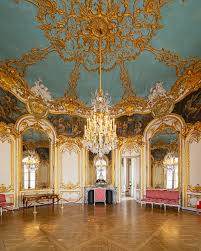
Salon de la Princesse, Germain Boffrand, Hotel de Soubise, Paris, Rococo Art and Architecture, 1725
Subject: room in the Hotel de Soubise in Paris, meeting place for the court after death of King Louis
Form: elegant town houses in the heart of Paris, intimate fashionable gatherings hosted by women of intellect, decorative, pastel colors, interest in dainty, graceful, elegant figures, light hearted mood surrounding favorite subject of the nobility: love, rooted in classicism but focus is on love, not rigid or symmetry based, intimate spaces, still used arched windows, not huge spaces, want to create airy and light spaces, motifs on the upper walls, forms that reflect the organic and curvilinear, sprout along the walls, consist of natural forms like plants and leaves (gold), light pinks, blues, and yellows, little cherubs perched in the room, plaster work,
Function: emphasis on embracing the wealth and the pretty lifestyles they had
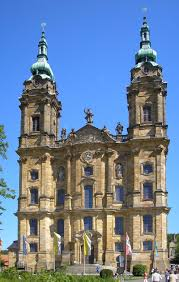
Church of Vierzehnheiligen, Balthasar Neumann, Germany, Rococo Art and Architecture, 1745
Subject: church of the 14 saints, pilgrimage church, follows the basilica plan
Form: modifications from normal basilica plan, commemorates vision of local shepherd - Christ child was surrounded by 14 saints, facade of dynamism, organic quality, structure that has two towers similar to middle ages, curves with convex and concave alternations, lot of front windows to introduce as much light as possible, sculptures on the roof, fully Rococo decorative interior, emphasizes vastness of interior, pastel colors with pink and yellow marble classical orders are being used but are changing, Corinthian capitals, vegetable patterns, seem to sprout and crawl all around interior of the church, frame created on ceiling, no illusionistic devices used, lot of wonderful colors, explosion of growth and busyness, plaster work used to imitate the columns, show of excess, carriage like extremities, site of the miracle, fourteen saints are all around the structure while the Christ child is shining at the top
Function: emphasis on embracing the wealth and the pretty lifestyles they had
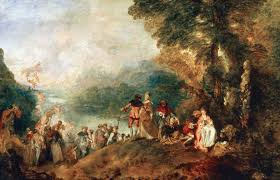
The Pilgrimage to Cythera, Jean-Antoine Watteau, Rococo Art and Architecture, 1725
Subject: gathering of wealthy noble figures all interacting with each other, fete galante - fanciful party
Form: epitome of Rococo style for painting, figures dressed well, dainty and elegant/slender figure types, portrayal with small waists and light feet, setting is lush and inviting, alive and full of vegetation, greens, yellows, and pinks and blues in the sky, waters down below look peaceful, luxurious image, engaging in the pursuit of love, frivolous past times, proper image of nobles engaging in respectful courtship, actions show they are paired, are leaving this idealic landscape that supports love, Cythera: home for the goddess Venus, boat has rococo forms, oarsmen are classically inspired, little cherubs are interacting with the nobles, figures are actually sad to be leaving, forced to head back to reality, little boy on the right is Cupid, in the form of a sculpture with flowers is Venus overseeing the activity (smiling and happy), tiny dog is present which shows loyalty, trees look like feather dusters
Function: emphasis on embracing the wealth and the pretty lifestyles they had
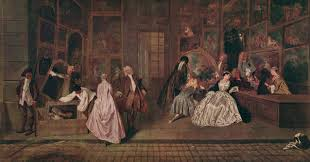
The Signboard of Gersaint, Jean- Antoine Watteau, Rococo Art and Architecture, 1725
Subject: shows interest in Dutch and Venetian art, wealthy customers, tons of paintings on display on the walls, picture of aristocratic sophistication
Form: seam in the center, two sided, slender figures, little faces and waists, big hairstyles for men, regular people too who are working, has symbolic content, actions and objects that convey a deeper message, close to the picture plane is a crate with packing material, putting away a large painting of Louis XIV - speaks to his death, passing of time and transience of existence, object in the back is a clock with lovers and an image of fame - fleeting, reminds the viewer of morality, elaborate Rococo style, mirror shows a couple with youth (portrait with forever preserve this), name of shop was “At The Sign Of The Great King,”
Function: picture is a signboard advertising an art gallery where you could purchase fine art in Paris, emphasis on embracing the wealth and the pretty lifestyles they had, marketing element: you will die, but a painting of you won’t
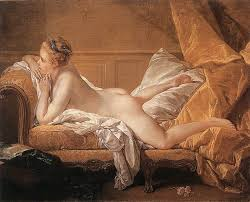
Girl Reclining: Louise O’ Murphy, Francois Boucher, Rococo Art and Architecture, 1751
Subject: image of a girl reclining, not proper, identifies the sitter as a seamstress in Paris, oil on canvas, model for Boucher
Form: very light and airy image, lot of yellows, whites, and pale pinks, shows the sitter is interested in something, golds, light blues, deep shadows underneath the coach, fully on display, legs are sprawled out
Function: emphasis on embracing the wealth and the pretty lifestyles they had, desire to commission works of beautiful nudes for private consumptions, intended for private pleasure
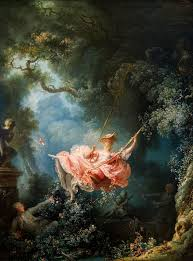
The Swing, Jean-Honore Fragonard, Rococo Art and Architecture, 1760
Subject: student of Boucher, a lover’s game, very Rococo, swinging woman has a man pulling the swing but another man is on the other side looking up at her, private painting
Form: pursuit of love, playful interactions of lovers, “innocent image,” mischief of amorous pursuits and flirtatiousness, woman’s dress is huge, lots of pink, figures are slender and elegant, lot of growth and vegetation growing everywhere, baron is looking up her dress and she is aware of it, bishop in the back has no idea, lot of light and dark imagery, lot of greens and vines, broccoli trees in background, bushes filled with roses, situated in a garden surrounding the country homes of the wealthy - secluded place, sculpture gives info about love pursuit, cupid iconography, a different sculpture is a winged figure who is shushing - don’t tell, you will spoil the fun of the event, lot of dynamism with kicking action
Function: emphasis on embracing the wealth and the pretty lifestyles they had, wanted this work to have his mistress on a swing being pushed by a bishop and then the baron himself is in the bushes
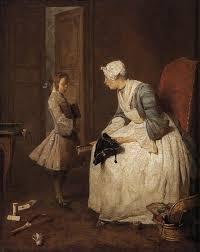
The Governess, Jean-Simeon Chardin, Rococo Art and Architecture, 1745
Subject: genre scene, interested in a daily life scene, Dutch feeling, governess speaking to little boy
Form: not exactly rococo, but the figure types are graceful and refined/dainty, outfit of the little boy, rosy cheeks, tiny feet of both figures, dark background, lot of wood elements, exquisitely rendered still life objects, moral undertones, toys/children’s games are all along the floor - behaving as a child, but the governess is telling him it is time to put the toys away and start studying, book in his arms, eyes are downcast, governess works while she sits, sewing, brushing his cap, bright white gown, tells him to put away his toys and study, warmth of this class/their lifestyle,
Function: aristocracy in France, fascination with how the “other people” lived, people who lived French middle class quaint lives, speaks to importance of responsibility, there is a time for play but also a time to learn, governess is setting a good example
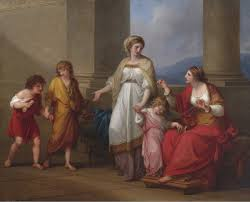
Cornelia Pointing to Her Children as Her Treasures, Angelica Kauffmann, Neoclassicism, 1790
Subject: noble and heroic, behaving with admirable virtues, setting examples of teaching the public important lessons, dependence on classical style, Swiss born artist but trained in Italy, also was in England, ancient roman subject, young boys who grew up to become reformers of Roman republic b/c of mother’s love and good example, noble people
Form: really warm composition, strong columns and foundations, historical painting, Cornelia vising with a friend, looking at jewelry and asking about her treasures so Cornelia points to her children as her treasures, not caught up in material wealth and gain, knows the importance of her children, reveals virtuous character, ideal example of a moral person, standing on higher ground than other woman, atmospheric background, marble is portrayed greatly, clear and direct image, simple setting, not overly decorative, took inspo from a wall excavation from Pompeii, ideal oval faces, long noses, pale skin, charming and grace in treatment of themes, softer lighting, sweeter faces, all across the front of the plane - keeps focus
Function: focus on appealing to the mind, connected to reviving the classical ideals, excavating cites of classical importance, classical motifs and subjects
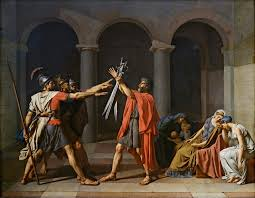
Oath of the Horatii, Jacques-Louis David, Neoclassicism, 1790
Subject: noble and heroic, behaving with admirable virtues, setting examples of teaching the public important lessons, dependence on classical style, studied in Rome, inspired by Renaissance and classical style, political image, monumental history painting, royal commission by King Louis XVI, story is ancient Roman history - point where Italy was separated and Rome was going to fight Alba, disputes would be decided by three brothers in each city (romans represented by Horatii brothers, Albans represented by Curiatii brothers), extreme patriotism - connects to French revolution, loyalty to city/country above all else, above family and personal interests
Form: very classical image, tall triumphant roman arches, Doric columns, marble floors, brothers swearing an oath in front of father holding their swords - act of selfless sacrifice for one’s country, classical clothes, women/children to the right are very sad and filled with grief, shows both sides to the story, mother, wife, sister, and child are connected to the Curiatti, someone is going to lose horribly, focus is across the front with light illuminating the figures, strong movements, emphasis on defined sculpted figures, idealized, muscular, athletic, garments are roman, frieze-like composition
Function: focus on appealing to the mind, connected to reviving the classical ideals, excavating cites of classical importance, classical motifs and subjects, art must contribute to education of the public, war is heroic
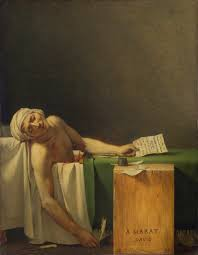
Death of Marat, Jacques-Louis David, Neoclassicism, 1790
Subject: noble and heroic, behaving with admirable virtues, setting examples of teaching the public important lessons, dependence on classical style, portrait of the Death of Marat
Form: French revolution is taking place, the French are suffering while the king and queen are living in luxury, either a Jacobin (Robespierre) or a monarchy supporter, John Paul Marat, member of Jacobin party and journalist, Charlotte Corday is a sympathizer to monarchy and murders Marat, used his death to promote Jacobin party - martyr for the cause, paints Marat as an ideal individual, simple, direct, packed with information, figure placed across the picture plane, simple dark background, Jacobins are not materialistic, laying in a bathtub, had a bad skin disease so he had a medicated bath, shows he is sickly but does not wallow in pity, instead he writes and works for the French people, dies with letter in hand that says she killed him, ink pot, quill in hand, everything smudged with blood, other letter is legible: sending money to a widow whose husband died fighting for the French people, body shows strength - heroic nudity, no visible skin disease, wound in chest is visible, light coming in illuminates knife and the quill still in Marat’s hand - when the monarchy disagrees they kill, when the Jacobins disagree they peacefully fight with words, framed in white
Function: focus on appealing to the mind, connected to reviving the classical ideals, excavating cites of classical importance, classical motifs and subjects, heroic image, showing the Jacobin party in good light
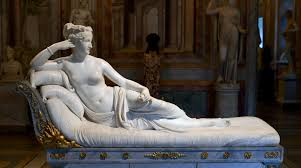
Pauline Borghese as Venus, Antonio Canova, Neoclassicism, 1810
Subject: noble and heroic, behaving with admirable virtues, setting examples of teaching the public important lessons, dependence on classical style, portrait, sister of Napoleon and married Italian prince
Form: figure betrayed modeled good qualities, draw emphasis with her beauty, celebrate who she is and associate with Venus, partially clad, classical nude display, lounging Venus, idealized, presented in a sensuous way, holds an attribute of Venus - golden apple, connects back to excavation, roman hair design, clothes are roman drapery, roman lounging couches for dining, details in carving, fully sculpted in the round, horizontal, frieze-like arrangement
Function: focus on appealing to the mind, connected to reviving the classical ideals, excavating cites of classical importance, classical motifs and subjects
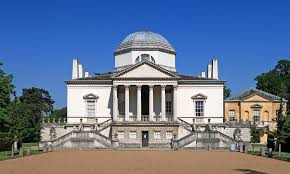
Chiswick House, Richard Boyle (Lord Burlington), West London, Neoclassicism, 1730
Subject: noble and heroic, behaving with admirable virtues, setting examples of teaching the public important lessons, dependence on classical style, domed country house
Form: architecture, strong influence of Palladio Venetian architecture, very symmetrical, sides mirror each other, lot of mathematical focus, clarity, precision of design, structure composed of solid geometric forms, cubic modules, octagonal dome, central plan, desire for balance, not as extreme as Palladio with other shapes and softer elements, distinct front with grand entry way - emphasis on front, visual dynamism, desire to adopt a classical style, Corinthian order, roman temple porch, pediments over windows, lot of energy with staircases in different directions
Function: focus on appealing to the mind, connected to reviving the classical ideals, excavating cites of classical importance, classical motifs and subjects
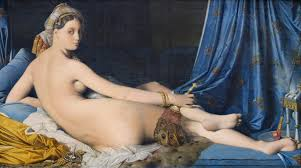
Large Odalisque, Jean-Auguste-Dominique Ingres, Neoclassicism, 1810
Subject: noble and heroic, behaving with admirable virtues, setting examples of teaching the public important lessons, dependence on classical style, a woman shown from the back looking over her shoulder, odalisque is a slave who is a part of the Turkish harem, student of David
Form: connected to romanticism, precision, formal purity, nice and defined edges, photographic clarity, smooth polished image, frieze-like arrangement, not heroic nudity, sensual image, fascination with the near east, emphasis on youth and beauty, grace, elements that help to place the reclining nude outside of the west, feather fan is eastern - exotic look, headdress is also eastern, broach, hookah is on the edge, slender figure, not muscular, looking back at viewer, deep blue fabric, gold fabric, accuracy to realism is important to him and the little details - looked at northern Italian art, little elongated - like the mannerists, warm skin, long curve of back
Function: focus on appealing to the mind, connected to reviving the classical ideals, excavating cites of classical importance, classical motifs and subjects, meant for private consumption, not a noble or heroic image
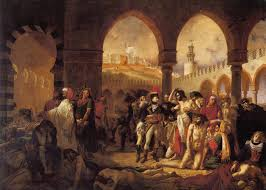
Napoleon in the Plague House at Jaffa, Antoine-Jean Gros, Neoclassicism, 1810
Subject: noble and heroic, behaving with admirable virtues, setting examples of teaching the public important lessons, dependence on classical style, student of David, subject addresses war, moment from a military conquest and accomplishment of Napoleon, idealized representation of event where French army is stricken with the plague
Form: unique in style, very warm yellow image, romantic inspired, softer and looser on details, image of suffering, visits the sick in a makeshift hospital, Napoleon is dressed in military uniform and directly interacting with plague individuals, hospital treating all kinds of people, lot of light and dark, pale and dark figures, setting: unique, architecture is exotic, lot of rounded windows - keyhole arch specific to Islamic architecture, rounded at the top, decorative linework, mosque converted to a hospital in Jaffa, religious structure with call to prayer tower in back, nudity is present but not heroic nudity - show of suffering and vulnerability, foreshortened figures - positions speak to sickness, placed dead figures right on picture plane - not appealing to the mind and instead aims to hit the emotions
Function: focus on appealing to the mind, connected to reviving the classical ideals, excavating cites of classical importance, classical motifs and subjects, wanted to elevate Napoleon beyond a general but connected to a god-like gesture, suggestion of healing power
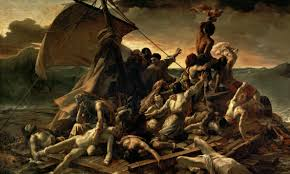
Raft of the Medusa, Theodore Gericault, Romanticism, 1810
Subject: scene of chaos and fear, people are in terror, waves are taking over the small raft as they try to get attention of ship leaving in the distance, monumental in scale, shows the struggles of nobodies on a monumental scale - assert these people are important because they are human beings too, French colonist boat crashes on coast of Africa, only a few lifeboats but high ranking members got on while the poorer people did not get lifeboats, raft built and towed behind a lifeboat - didn’t float, found them eventually with only 15 survivors out of 149
Form: great emphasis on color, more painterly manner of creating, muscular bodies, lot of dark and light contrast, water is dark, sky is mixture of light and scary dark, show of wind with sail and drapery, man vs nature, scene of pain and suffering of people, lot of dead, water is crashing on the wood boards, nature’s destructive abilities, scene of starvation, anger, drowning, had to debate cannibalism, very warm and very cold, no shelter, seasickness, hallucinations, creatures of the sea, wind, storms/waves, dehydration, internal fighting, lot of killing - first thing encountered is death, figure with bright red drapery is in deep sadness - cradles body of a young man,
Function: political freedom, freedom to imagine rather than reason, looking to feeling and emotion, freedom of movement, self-expression, and life, still look to show a lesson but emotions are stirred first, subjective, not based in antiquity - no desire for classical form, take inspo from literature, like thrilling and shocking dramatic scenes, engagement with the viewer over rational order and calm
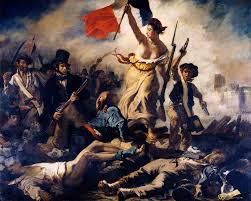
Liberty Leading the People, Eugene Delacroix, Romanticism, 1830
Subject: large scale painting to engage the viewer, real event portrayed in an imaginative and dramatic way: revolution of 1830 in France (July Revolution), forced abdication of Charles 10th (oppressive government), central figure is personified liberty holding a French flag and leading the common rebel people
Form: great emphasis on color, more painterly manner of creating, monumental presence, tricolor flag - introduced in 1789 revolution, looking back at massive crowd urging them forward into our space, dead bodies of both factions on the ground right in front of our faces, lot of bright colors, inspires hope and victory, figure has interesting dress and cap - Phrygian cap, reference to 1789 revolution (what they would have worn), association with freedom and free slaves, carrying modern weapons, disheveled figure at her feet looking up at her, three classes represented to show the wholeness of the people, boy is street urchin, middle class has high hat and bowtie, man in white shirt with sword is working class, all working for the freedom of all, dramatic lighting, softness and looseness of painting creates a cloudy setting, suggestion of chaos and war, buildings in background, smoke is clearing and blue skies are revealed, woman is highlighted by the whiteness of the background behind her head,
Function: political freedom, freedom to imagine rather than reason, looking to feeling and emotion, freedom of movement, self-expression, and life, still look to show a lesson but emotions are stirred first, subjective, not based in antiquity - no desire for classical form, take inspo from literature, like thrilling and shocking dramatic scenes, engagement with the viewer over rational order and calm
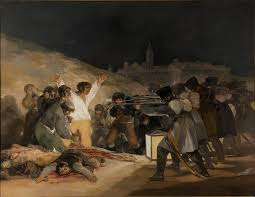
Third of May 1808, Francisco Goya, Romanticism, 1810
Subject: Spanish painter, specific real event that is personal to painter, part of a pair of images in Madrid, large scale, Napoleon’s French army has invaded Spain and forces the king and family to abdicate the throne, places brother in charge, the people revolt to this change and the French army begins to fight back, the French leaders kill many adult men in Madrid to set an example for the rest of Spain
Form: great emphasis on color, more painterly manner of creating, line shows the extreme nature of this decision, dramatic lighting highlights the whiteness of the shirt of the Spaniard, the lack of faces of the French and them being in the dark creates antipathy for them, show of fear and confusion, not rebellion and a show of people not understanding why they are being attacked, light associated with good, dead are scattered across foreground with blood all over the ground, faces of Spaniards are visible, buildings in background, guns are pointed in a line, French are a machine of death and not human anymore, proximity and aggressive nature are displayed, landscape shows no escape for the Spanish, white shirt symbolizes surrender and purity - fight is supposed to end and lives are saved but not this time, references Christ with holes in his hands - an innocent man being murdered unjustly
Function: political freedom, freedom to imagine rather than reason, looking to feeling and emotion, freedom of movement, self-expression, and life, still look to show a lesson but emotions are stirred first, subjective, not based in antiquity - no desire for classical form, take inspo from literature, like thrilling and shocking dramatic scenes, engagement with the viewer over rational order and calm, makes us feel bad for the Spaniards and hate the French,
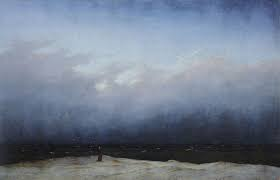
Monk by the Sea, Caspar David Friedrich, Romanticism, 1810
Subject: romantic landscape painting, sublime - reference the experience of nature that evokes powerful emotions in the viewer, extreme wonder or awe of nature, possible fear too, not too large of a composition
Form: great emphasis on color, more painterly manner of creating, huge scene and a sea rolling and a large sky filled with clouds, many are dark and foreboding, person is very small, shore is desolate, storm is rolling away, specific location on the Baltic sea, painter - personal connection and shows a monk turned away from viewer - would do outdoor shore sermons, atmospheric perspective, personal attitude towards nature: religious awe towards nature, reflection of God’s creation, divine truth, leads people to a better understanding of God
Function: political freedom, freedom to imagine rather than reason, looking to feeling and emotion, freedom of movement, self-expression, and life, still look to show a lesson but emotions are stirred first, subjective, not based in antiquity - no desire for classical form, take inspo from literature, like thrilling and shocking dramatic scenes, engagement with the viewer over rational order and calm
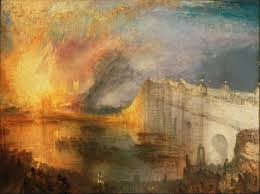
The Burning of the Houses of Lords and Commons, J.M.W. Turner, Romanticism 1830
Subject: very loud and dramatic painting, captures the destructive and powerful forces of nature, real contemporary event that he witnessed from the shore of the Thames in London, government building gets burned down
Form: great emphasis on color, more painterly manner of creating, very bright colors, crowd of people are obscured, people on boats, crowds on bridge too but all can only hope that nature can calm the fire, colors generated by the fire are incredible: loose painterly manner, frees fire from confining lines, intermingling of red, yellow, orange, and white - helps emphasize uncontrollable nature, starts to spread across to top of frame, sky and the Thames is also taken over by the fire, smoke is everywhere, brilliant colors pop against cooler colors of the sky background, feel heat of image, uses impasto technique - thick application of paint, human creation is rendered useless when nature takes over, two towers in background are Westminster Abbey, very dramatic
Function: political freedom, freedom to imagine rather than reason, looking to feeling and emotion, freedom of movement, self-expression, and life, still look to show a lesson but emotions are stirred first, subjective, not based in antiquity - no desire for classical form, take inspo from literature, like thrilling and shocking dramatic scenes, engagement with the viewer over rational order and calm
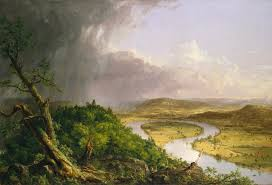
The Oxbow, Thomas Cole, Romanticism, 1830
Subject: American painter, scene of a large nature landscape, Hudson River School, went to Hudson River Valley with wilderness and vast nature, unique natural features, message of conservation - need to embrace and protect America as expansion takes place, real place, oxbow is a bend in a river that has been in existence for millions of years, background is oxbow and peaceful while foreground is dark and foreboding
Form: great emphasis on color, more painterly manner of creating, shows nature’s ability to adapt, its flexibility, its quickness to change, diagonals dividing the painting in half, small foreground area is alive, green, and growing while large background is light and dying/yellow showing how humanity kills nature - smokestacks, farming areas, deforestation, naturalness of nature remains in non-human areas, storm is forming with lightning, nature impacts itself and is destructive, snaps tree limbs, nature survives because it can adapt only to a certain point, not sure whether the storm is going towards the background or whether it has just come from it, half dead tree is cradling fully dead tree - other living things thrive and grow off of it, painter stands for preservation of the wonders of nature by showing the umbrella, backpack, and a self-portrait of him painting the oxbow
Function: political freedom, freedom to imagine rather than reason, looking to feeling and emotion, freedom of movement, self-expression, and life, still look to show a lesson but emotions are stirred first, subjective, not based in antiquity - no desire for classical form, take inspo from literature, like thrilling and shocking dramatic scenes, engagement with the viewer over rational order and calm, preserve the beauty and wonder of America
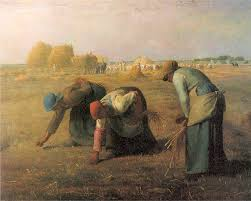
The Gleaners, Jean-Francois Millet, Realism, 1855
Subject: reality of the world they lived in, small scale, women figures have monumental presence, farmland being tended to by the people, shows the life of rural people
Form: peasant life, hard work, difficult labor, biblical ties - act of charity, can feel their pain, see the massive piles of wheat in the back, horses in background, little buildings, captures the difficulties of being a part of this class, regard for these individuals - respectful display, evoke a sense of dignity, color scheme is also very bland, acknowledges their situation and accepts it, show of admiration and respect, detailed clothing, heroic acceptance of their plight in the world, don’t see the faces of the women - not trying to portray the individuals, but the faces of the class, patches on sleaves, tears on shoulders, bowed heads
Function: truthful, unidealized, objective way of viewing the world, reject frivolous and superficial trappings of romanticism, not subjective interpretation, portray the truth of the world around them, address changing nature of the world in the 19th century, industrial revolution, focused on the ordinary
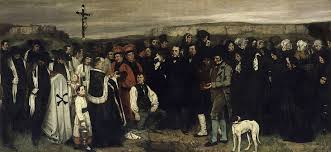
A Burial at Ornans, Gustave Courbet, Realism, 1855
Subject: reality of the world they lived in: lots of death, true history painting, what happens in many towns across the world on a monumental scale, honest record of a solemn ceremony
Form: not idealized, muted colors, lot of black, religious and political figures in red and white, hometown of the painter, developed landscape in the background and muted bright sky, obscured view of the dead - how he is actually experiencing the world, regular ordinary villagers, figures are not all looking the same way and not all together focusing, could be people gossiping, dog is present and also distracted, little children also present, can see the grave in the center - cropped, sides are also cropped so people are cut off - real life does not fit nice and neatly in a frame, scene extends beyond the frame, no heroic gestures, bright colors help guide the viewer’s eyes, dirty scene, thick and gritty paint application, Jesus is present through a sculpted figure on the cross
Function: truthful, unidealized, objective way of viewing the world, reject frivolous and superficial trappings of romanticism, not subjective interpretation, portray the truth of the world around them, address changing nature of the world in the 19th century, industrial revolution, focused on the ordinary
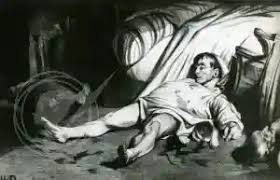
Rue Transnonain, Le 15 Avril 1834, Honore Daumier, Realism, 1830
Subject: black, white, and gray image, reality of the real world they lived in, printmaker, normally a satirist and would attack anyone for their position, not satirical though for this piece: captures the real event in Paris where the king of France sent his military to keep the peace among the poorer classes, Transnonain Street, cop was shot, massacred all the people in the building - old men, children, women - depicts the factual aftermath, lithograph
Form: truth was too harsh, lot of shadow work, gruesome truth, quality of a photograph, snapshot of what he sees in front of him, lot of textures, people in a tiny apartment, woman in the background shot off to the side, man of the house has fallen, stained with blood, unkempt, a baby is underneath him with its head split open, the grandfather is also fallen over with blood pouring, cropped to show reality, detailed horrors, scene of terror, unidealized senseless event, quiet image, chair flipped over, blood spattered over the floor
Function: truthful, unidealized, objective way of viewing the world, reject frivolous and superficial trappings of romanticism, not subjective interpretation, portray the truth of the world around them, address changing nature of the world in the 19th century, industrial revolution, focus on the ordinary
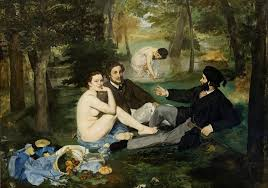
The Luncheon on the Grass, Edouard Manet, Realism, 1855
Subject: scene in nature, strange composition, four figures, wanted to depict realities of the real world, two prostitutes with two men discussing something, infamous painting, submitted to Salon D’Automne but not accepted, instead is a part of the Salon of the Rejected, seen as very scandalous
Form: lot of colors, beautiful landscape, pushes tradition to an extent - truly modern painter, light brushstrokes, details are fuzzy, bodies are unique and women are very pale and bright, naked women, men don’t seem to be surprised by her - improper image, trees are light brushstrokes, basket of fruit and foods are spilled out onto the ground, wants to display the truth of prostitutes - women who have been forced to take up the occupation and men that support this industry, greens, browns, and yellows are major colors, portraits of real people, brother is displayed too, the style is also reminiscent of traditional scenes, didn’t want to hide under terms of “Venus” or hide in private, not very realistic and accurate in rendering landscape and grass, scale of figures is not proper, boat is also too small, woman in back is way too big, woman in front is not idealized and is staring at us - not seductive and instead confrontational, clothes are also on the side, details of clothes are flat and too blended (doesn’t model traditional form), comments by saying that paintings are flat
Function: truthful, unidealized, objective way of viewing the world, reject frivolous and superficial trappings of romanticism, not subjective interpretation, portray the truth of the world around them, address changing nature of the world in the 19th century, industrial revolution, focused on the ordinary
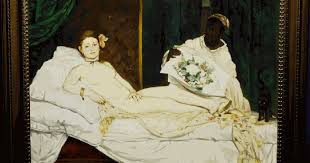
Olympia, Edouard Manet, Realism, 1855
Subject: references a reclining nude - Venus of Urbino, inappropriate large scale, submitted and accepted to the Salon, very scandalous and commented on, portrait of a prostitute, quality of a moment
Form: detailed bedding, holding herself harshly to comment on the nature of her job (pay to see), lot of white, green, and yellow/pale, young woman, serious and confrontational face, has a choker, flower in her hair, and shoes, black attendant is brought up close with flowers, flatter faces and bodies, cat is also flat and scared on the side, green velvet background, disheveled bed, horizontal image
Function: truthful, unidealized, objective way of viewing the world, reject frivolous and superficial trappings of romanticism, not subjective interpretation, portray the truth of the world around them, address changing nature of the world in the 19th century, industrial revolution, focused on the ordinary
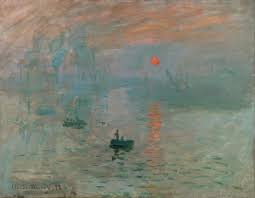
Impression: Sunrise, Claude Monet, Impressionism, 1870
Subject: name of movement is from this composition, scene of a harbor at sunrise, view of Le Havre (Monet’s hometown), small in scale
Form: sketch like nature, technique had spontaneous aspect, quick painting before things change too much, very objective, loose and visible brushstrokes - art critics were critical, lot of blues and reds, not precise or detailed, captures a sense of life and energy with potential to change, captures particular climate and atmosphere of a sunrise over the harbor, sun is low and bright red, body of water has tons of colors including blues and reds of sun, blurry forms, blue/purple coloration is taking over background, refused to use black because it is the absence of color - believes that light creates color, not overthought or over planned, not a lot of line work, believable image, background shows factories and smoke stacks, on plein air - more than sketching nature and actually painting in nature while not going back to the studio, don’t fill in what you know to be true
Function: avoids idealization, convey truth in artwork, similar to realism, challenges the Salon system, reflect movement and how light affects surfaces, exhibit work together as a group under a specific designation (independent exhibitions), capture a moment experienced firsthand in the moment - without idealized, subjective feelings and interpretations, optical experience - exactly what the eyes see
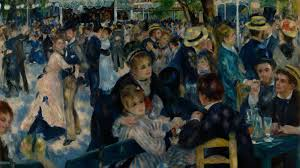
Moulin de la Galette, Pierre-Auguste Renoir, Impressionism, 1870
Subject: “The Pancake Meal,” dance hall situated in Paris, patio where people enjoyed nature and the sun, well dressed people of upper middle class
Form: lot of gas lights, tons of people, figures are put together but slightly blurred, smiling people, fresh faced, enjoying lots of activities, Monet’s influence: painterly and loose painting, short and angular strokes that capture movement, not a static piece, dancing and conversations, people playing cards, short brush strokes create liveliness, figures are cut off, backs are against the picture plane, figures are blobs of color in the background, lot of hats, fancy clothing, trees with leaves that are really loosely painted, people are caught in action, not painted solidly most of the time, blur with the environment around them, ground has tons of shadows, light is reflected through the trees onto the people, abstracted forms of color, odd face of little girl, person caught picking his teeth while thinking, no sky, has to filter through trees, faces don’t have a lot of lifelike detail, not idealized or evened up, seen in peripheral vision so some figures are blurred while others are in full detail
Function: avoids idealization, convey truth in artwork, similar to realism, challenges the Salon system, reflect movement and how light affects surfaces, exhibit work together as a group under a specific designation (independent exhibitions), capture a moment experienced firsthand in the moment - without idealized, subjective feelings and interpretations, optical experience - exactly what the eyes see
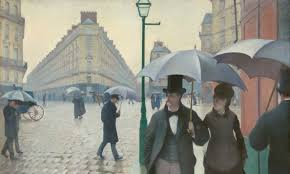
Paris Street, Rainy Day, Gustave Caillebotte, Impressionism, 1870
Subject: scene of city life, upper middle class in Paris on a rainy day
Form: shows wide streets, lot of umbrellas, fancy outfits of people, large buildings all around, street lamps, massive boulevards, growing number of people going to Paris so they need to expand, uniform looming apartment buildings for the people, introduction of gas lights on the streets, wet surfaces are rendered incredibly well - pavement on sidewalk looks wet, spaces between the stones have water in them, women and men present, piece is well put together, organized but unique because there are figures that we can’t see their faces or only half, store fronts close to the street, intersection near Saint Lazarus Train Station, cobblestone roads, lot of architecture, very open layout, horse drawn carriages, not very sketchy and loose like Monet, refined in detail, moment in time, people are cut off, outfits are well rendered, embrace the accidents of real life, figures are blurred in the distance, misty rain - blurs background and softens details in forms
Function: avoids idealization, convey truth in artwork, similar to realism, challenges the Salon system, reflect movement and how light affects surfaces, exhibit work together as a group under a specific designation (independent exhibitions), capture a moment experienced firsthand in the moment - without idealized, subjective feelings and interpretations, optical experience - exactly what the eyes see
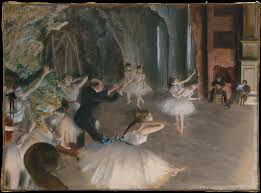
The Rehearsal on Stage, Edgar Degas, Impressionism, 1870
Subject: working in Paris, artist who is fascinated by the ballet, lot of performances that the upper middle class wanted to see, a scene where ballerinas are practicing on stage
Form: represent living forms in motion, complex movements of these ballet dancers, crowded everyone on one side, not a symmetrical composition, lot of unique forms, instructor is working with the center girls, also capturing girls stretching and waiting to go on stage, not flattering, yawning, flat faces that lose detail the more you go into the background, the bright light from below abstracts the features of faces, curtain is multicolored, lot of limbs make it hard to logically reassemble the groups, neck of a stringed instrument is interrupting our view, background is painted trees and props, two male figures are watching/lounging - speaks to the status of ballerinas (lower class), scantily garb - anyone willing to show their body was “available”, excuse to take advantage of young women, truthful to the moment, taking cues from nonwestern art - from Japanese woodcut prints, fascinated with Japan, asymmetrical composition that moves you quickly into the distance, higher horizon line giving a flatter appearance
Function: avoids idealization, convey truth in artwork, similar to realism, challenges the Salon system, reflect movement and how light affects surfaces, exhibit work together as a group under a specific designation (independent exhibitions), capture a moment experienced firsthand in the moment - without idealized, subjective feelings and interpretations, optical experience - exactly what the eyes see
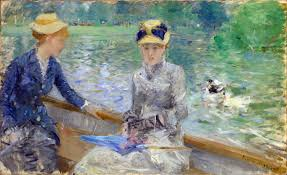
Summer Day, Berthe Morisot, Impressionism, 1870
Subject: scene of a two women in a small boat on a lake, upper middle class, large wooded park on the edge of Paris
Form: summer feeling for the day, water is beautifully rendered, lot of swiggles in the lake, trees are rendered as blobs in the background, little ducks in the pond, blues and greens dominate the image, floating peacefully and was a safe/recognizable location for women of this class, places were not proper for women to go but this place was allowed, umbrella on lap, really interesting edge of painting with the beingness of the background blending into the actual composition, quick loose strokes, garments are well rendered, sense of energy and change present, abstracted approach, lost a sense of solidity, merging with environment around them, cropped image and not idealized, hard to figure out where the artist is, one woman is staring right at viewer, little bit of grey and yellow too, horse and carriage are in the far background moving quickly along the path
Function: avoids idealization, convey truth in artwork, similar to realism, challenges the Salon system, reflect movement and how light affects surfaces, exhibit work together as a group under a specific designation (independent exhibitions), capture a moment experienced firsthand in the moment - without idealized, subjective feelings and interpretations, optical experience - exactly what the eyes see
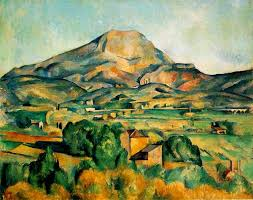
Mont Sainte-Victoire, Paul Cezanne, Post-Impressionism, 1890
Subject: wanted to fully see the truth of landscape, reveal underlying structure underneath all things - father of cubism, a landscape of a mountain with little farms and wildlife
Form: reduces the form to their simplest form, geometric and strips away visual irrelevancies, not a lot of detail with decorative elements, basic shapes and colors, color is building blocks - asserts structural forms, horizontal planes of color, lot of horizontal patches countered by vertical elements, interweaved parts to make a harmonious image - visual harmony, tree in the front exists right in front of the picture plane yet the branches sometimes appear close and far away, also follow the curvature of the mountains, lot of plein air technique of studying nature, aware of impact of warm colors verses cool colors, 3D houses, lot of texture but no detail in forms of greenery, houses are cubes (some chimneys and doorways), rectangles as trees, aqueduct in the back with round arches, very flat, warm colors go towards the viewer and cool goes away into the background
Function: signature work developed out of impressionist style but moved beyond collective aesthetic principles, rely heavily on color in their work, distinct means of putting paint on canvases and brushwork, allow their subjective feelings and beliefs to enter into the work, also didn’t identify as a collective group, not as sketchy,
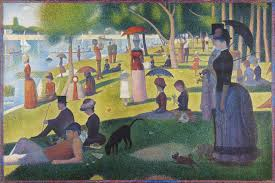
Georges Seurat, A Sunday Afternoon on the Island of La Grande Jatte, Post-Impressionism, 1890
Subject: scene is upper middle class enjoying a day of leisure, island in the middle of the Seine river, popular gathering place for these people, criticism of this class - achievement of this class is exploiting the working class
Form: characteristics of impressionism but not: scale is monumental, not painted in plein air, not as much of a moment captured, carefully placing figures across the foreground, carefully composed groups and objects, people look uptight and rigid/stiff, figures have unique identities, can’t sit in their clothes but they are fashionable for the time, tree leaves are very loose, pretentious and assume air of nobility, overly formal and not relaxed at all, lose sight of reality of enjoying what they have, people fishing, making music, strolling, boating - don’t feel joy or enjoyment, faces are deadpan or obscured - seeking to dehumanizing them, parasols, uses the technique of pointillism, man in the front is very relaxed and dressed casually, even the children are stiff and not looking happy - will grow up to be just as pretentious as their parents, little girl in the back does seem to be happy (no parents to corrupt her), woman with pet monkey and dogs - symbolism: mimicry and aping behavior of higher class, permanence: stuck in a pose, verticals and horizontals locking into place, uses pointillism, optical blending
Function: signature work developed out of impressionist style but moved beyond collective aesthetic principles, rely heavily on color in their work, distinct means of putting paint on canvases and brushwork, allow their subjective feelings and beliefs to enter into the work, also didn’t identify as a collective group, not as sketchy,
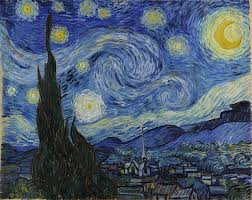
The Starry Night, Vincent van Gogh, Post-Impressionism, 1890
Subject: first expressionist artist - put the emotions and pain he was feeling into his art work, tormented individual, view from hospital room, impacted by emotions and love for nature - dreamed of painting his “starry sky”
Form: lot of swirling elements, uses color in an arbitrary way, will not let nature restrict him, color is expressive of emotion rather than realistic appearances, wonder and awe inspiring painting, oil on canvas, really thick impasto technique, embodies life, energy, and change, solid forms for nature, dynamic lines and shapes, lot of blues, whites, and yellows, rolling lines surrounding the town, pronounced quick brushstrokes, blue “waves” in the background are actually mountains - gives them energy and dynamism, curvilinear lines, bright blues are suggestive of water, massive sky that is full of energy and not static, short, angular, and intentional brushstrokes, wonderful swirl unfolding across the sky - wind, stars fill the sky - circular dots of color with little halos around them, moon is in the top right corner, uses greens, blues and whites to make stars, moon reflects light from the sun yet here it has a bright presence, Cyprus tree in the front: distorted and personal to artist (ideal form in nature), dark colors, greenish and rusty orange - emanates life and growth as it stretches up the canvas
Function: signature work developed out of impressionist style but moved beyond collective aesthetic principles, rely heavily on color in their work, distinct means of putting paint on canvases and brushwork, allow their subjective feelings and beliefs to enter into the work, also didn’t identify as a collective group, not as sketchy,
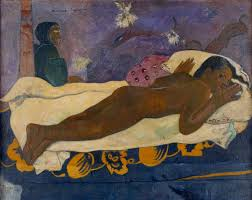
Manao Tupapau (Spirit of the Dead Watching), Paul Gauguin, Post-Impressionism, 1890
Subject: stockbroker who decided to become an artist, seeks to get away from Paris and to the truth/real way of life - primitive life at Tahiti, painted his idea of his “ideal Eden” creates a world from imagination, painting of his wife
Form: not ashamed of being naked, pure and adulterated, rooted in the simple and superstitious way of the culture, Tahitian women believed that if no lights were on at night, then spirits would come at night, monumental presence, painted frighted in bed at night where the spirits and ghosts are close to her, lot of purples, spirits are flashes of color, a spirit person dressed in dark clothes are staring at her - desire to turn away, spiritual realm existed that we did not see - inner realm, showing both realms side by side, wife is naked and flattened out, but detailed as a young nude female, bed is natural like, background is very abstract, some areas are painterly and loose while other parts are really harsh, bright yellow of the sheet suggests the lamp light and how she is comforted by it to turn away from the spirits, purple - terror, flat background and organic patterns, people got upset at this because she was brown, emphasize heavy legs, flat feet, strong shoulders - connected to the land, she is not idealized but is pure and natural - a woman!
Function: signature work developed out of impressionist style but moved beyond collective aesthetic principles, rely heavily on color in their work, distinct means of putting paint on canvases and brushwork, allow their subjective feelings and beliefs to enter into the work, also didn’t identify as a collective group, not as sketchy,
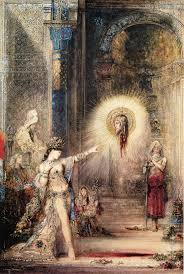
The Apparition, Gustave Moreau, Symbolism, 1883
Subject: biblical scene, dream like fantasy realm and very imaginative, story of John the Baptist - his demise, king Herod in background, wife hated him so she demanded he die (put his head on a silver platter), femme fetale - woman who uses her beauty to the downfall of man
Form: really dream like, lot of reds, blues, decorative elements everywhere in clothing and structure, engaging textures to pull you in, visual enticement of Herod, complexity of ornate forms, Herod’s in a sticky situation, unusual treatment of subject, hovering head staring at the figures, divine status and dripping blood, executioner in the background, blue sprinkling along the floor, scattered with flower petals - horrifying and beautiful, brings out a different aspect of the story, lot of architectural interesting forms
Function: portray an inner world, inspired by Freud thinking, unique ways to describe traditional subjects,
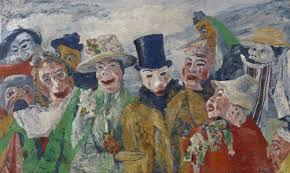
The Intrigue, James Ensor, Symbolism, 1883
Subject:
Form:
Function:
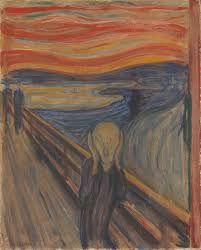
The Scream, Edvard Munch, Symbolism, 1883
Subject:
Form:
Function:
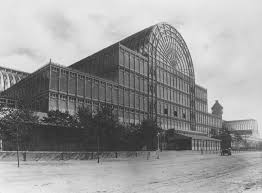
Crystal Palace, Joseph Paxton, London, 19th-century architecture, 1850
Subject:
Form:
Function:
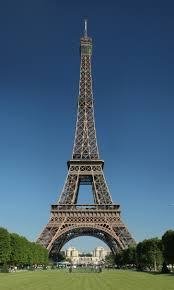
Eiffel Tower, Gustave Eiffel, 19th-century architecture, 1890
Subject:
Form:
Function:
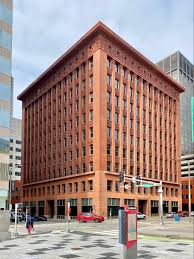
Wainwright Building, Louis Sullivan, St. Louis, MO, 19th-century architecture, 1890
Subject:
Form:
Function:

