1: Gas exchange
0.0(0)
 Studied by 0 people
 Call Kai
 Learn
Learn Practice Test
 Spaced Repetition
 Match
Match Flashcards
 Knowt Play
Card Sorting
1/21

There's no tags or description
Looks like no tags are added yet.
Last updated 7:45 PM on 2/7/26
Name | Mastery | Learn | Test | Matching | Spaced | Call with Kai |
|---|
No analytics yet
Send a link to your students to track their progress
22 Terms
1
New cards
gas exchange
The transfer of gases between an organism and its environment.
2
New cards
lungs
The organ in which gas exchange takes place.
3
New cards
ribs
Bones which surround the lungs to protect them and form the rib cage.
4
New cards
respiratory system
Organ system which replaces oxygen and removes carbon dioxide from the blood.
5
New cards
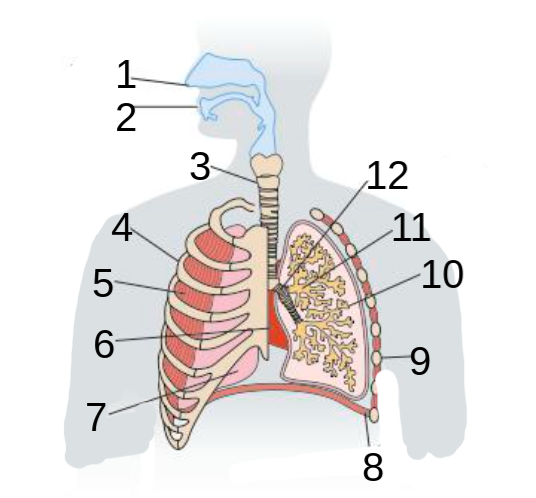
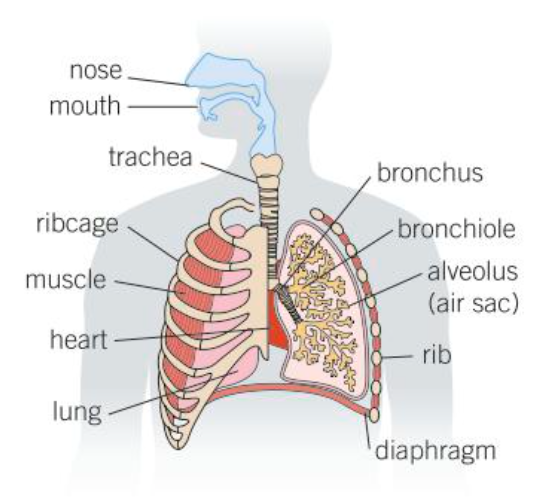
Label the diagram
nose, trachea, ribcage, muscle, heart, lung, bronchus, bronchiole, alveolus (air sac), rib, diaphragm
6
New cards
trachea
Tube which carries air from the mouth and nose to the lungs.
7
New cards
bronchus
One of the two tubes which carry air into the lungs.
8
New cards
bronchiole
Small tube in the lung.
9
New cards
alveoli
Small air sacs found at the end of each bronchiole where gas exchange takes place with the blood.
10
New cards
breathing
The movement of air in and out of the lungs.
11
New cards
inhale
Breathing in, to take in oxygen.
12
New cards
respiration
* Process that transfers energy in plants and animals
* Glucose reacts with oxygen to make carbon dioxide and water
* Glucose reacts with oxygen to make carbon dioxide and water
13
New cards
exhale
Breathing out, to remove carbon dioxide.
14
New cards
condense
The change of state from gas to liquid.
15
New cards
State the step by step process of respiration.
1. Air enters body through mouth and nose.
2. Air moves down trachea (windpipe) - a large tube.
3. Air moves down a bronchus - a smaller tube.
4. Air moves through a bronchiole - a tiny tube.
5. Air moves into alveolus - air sac.
6. Oxygen diffuses into blood.
16
New cards
Which specific features of the alveoli aid gas exchange? ie. their adaptations
* Millions of alveoli
* Create large surface area
* Thin walls - one cell thick
* Gas exchange can occur quickly and easily
* Create large surface area
* Thin walls - one cell thick
* Gas exchange can occur quickly and easily
17
New cards
Why do we breathe in and out?
* Breathing - movement of air in and out the lungs
* When we breathe, we inhale to take in oxygen
* Oxygen in used in respiration to transfer energy
* Respiration produces carbon dioxide, which must be removed from the body
* When we breathe out, we exhale to remove carbon dioxide
* When we breathe, we inhale to take in oxygen
* Oxygen in used in respiration to transfer energy
* Respiration produces carbon dioxide, which must be removed from the body
* When we breathe out, we exhale to remove carbon dioxide
18
New cards
What determines how fast you breathe?
Amount of oxygen required by body cells
19
New cards
How does exercise impact the amount of oxygen your body requires?
* More oxygen required during exercise
* Harder you exercise → faster breathing rate → greater volume of breathing
* Allows you to take in the oxygen you need to respire more
* Transfers more energy to muscle cells
* Harder you exercise → faster breathing rate → greater volume of breathing
* Allows you to take in the oxygen you need to respire more
* Transfers more energy to muscle cells
20
New cards
State how much nitrogen, oxygen, carbon dioxide and other gases are present in inhaled air.
* Nitrogen: 78%
* Oxygen: 20.96%
* Carbon dioxide: 0.04%
* Other gases: 1%
* Oxygen: 20.96%
* Carbon dioxide: 0.04%
* Other gases: 1%
21
New cards
State how much nitrogen, oxygen, carbon dioxide and other gases are present in exhaled air.
* Nitrogen: 78%
* Oxygen: 16%
* Carbon dioxide: 4%
* Other gases: 2%
* Oxygen: 16%
* Carbon dioxide: 4%
* Other gases: 2%
22
New cards
Why does a cold mirror steam up when you breathe on it?
* Water vapour in the air you breathe out condenses on the cold surface
 Note
Note  Flashcards (99)