bio 2 - animals: the invertebrates ch 31 (post)
 Call Kai
 Learn
Learn Practice Test
 Spaced Repetition
 Match
Match Flashcards
 Knowt Play
1/103

There's no tags or description
Looks like no tags are added yet.
Name | Mastery | Learn | Test | Matching | Spaced | Call with Kai |
|---|
No analytics yet
Send a link to your students to track their progress
104 Terms
what supergroup are animals in?
Opisthokonta in domain Eukarya
what are the two major animal groups?
invertebrates (no backbone) and vertebrates (have backbone)
what is an example of parazoa?
sponges (porifera)
spongin
most sponges have a skeleton composed of fibers of spongin, a soft protein
what is the major evolutionary split in animals?
parazoa (no true tissue) and eumetazoa (true tissue)
relationship between DNA similarity and relatedness - phylogeny
the more closely related two organisms are, the more similar their DNA sequences
what is the major split of eumetazoa
protostomes and deuterostomes
asymmetrical symmetry
No particular symmetry (e.g., sponges)
cnidarian (eumetazoa) organization of sac
Epidermis (outer)
Gastrodermis (inner) - gastrovascular cavity with digestive juices
Layers separated by mesoglea
the itchy phylum
what are the classes of arthropoda?
chilopoda - 1 pairs + 1 body seg
diplopoda - 2 pairs = 2 body seg
insecta - 3 pairs
arachnida - 4 pairs
crustacea - 5 pairs
three subphylum of chordata
urochordata
cephalochordata
vertebata chordata
radial symmetry
Circular organization where any longitudinal slice will produce mirror images
sessile (attached to a substrate) or free floating
bilateral symmetry
Definite right and left halves—only a longitudinal cut down midline produces mirror images
tend to be more active animals
often accompanied by cephalization (brain and sensory organs at anterior end)
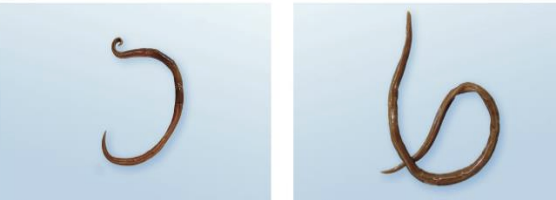
roundworm male v female difference
males have a curved, hooked posterior end, while females have a straight, blunt posterior end
nematocysts of cnidarians
toxin filled capsules with coiled thread
Discharged when cnidocyte is triggered
Used to capture prey
Prey is physically captured or paralyzed
spicules
compose internal skeleton of some sponges
ribbon worms - phylum nemertea
more complex than flatworms
complete digestive tract
regional specialization
closed circulatory system
blood cells with hemoglobin
proboscis to capture prey
general features of animals
locomotion
multicelular
life cycle in which adults are typically diploid
sexual reproductiono
heterotrophic
sponge reproduction
Asexual by budding, fragmentation, or gemmule formation (freshwater spore)
Sexual: most are hermaphroditic, but usually not self-fertilizing
•Sperm released through osculum and are drawn into other sponges for fertilization
•Zygote develops into a flagellated larva
class chilopoda
phylum arthropoda
1 pair of leg clas/body sec
class diplopoda
phylum arthropoda
2 pair of leg clas/body sec
class insecta
phylum arthropoda
3 pairs of legs
include female grasshopper - romalea
female grasshopper. romalea
phylum arthropoda
class insecta
digestive system for herbivore diet. they have an excretory, respiratory, and circulatory system metaphorphosis
class crustacean
phylum arthropoda
marine animals ie barnacles, shrimps, lobsters, and crabs. They are named for their hard shell
function of choanocytes
create water currents and capture food
difference between animals and fungi feeding
fungi: external digestion + absorption
Animals: ingest food and digest internally
which single celled protist is the closest ancestor of animals?
chanoanoflagellates
what is modern animal phylogeny based on?
morphological characters of living and fossil organisms
developmental homologies
molecular DNA characters
choanoflagellates
A single cell, 3–10 µm in diameter, with a flagellum surrounded by a collar of 30–40 microvilli
Movement of the flagellum creates water currents, which pull the protist along
As water moves through the microvilli, they engulf any bacteria and debris
Can form colonies
evolution of the animal body plan
The animal body plans seen today were present by the Cambrian period, 500 mya.
Two major groups of animals, divided by body plans: invertebrates and vertebrates
invertebrates
Lack an endoskeleton of bone or cartilage
Evolved first and far outnumber the vertebrates
vertebrates
Have an endoskeleton of bone or cartilage
what controls variation in animal body plans?
Different combinations that could have led to the great variety of animal forms
Slight shifts in DNA code and the expression of Hox (homeotic) genes
symmetry
asymmetrical
radial symmetry
bilateral symmetry
levels of animal organization
cellular, tissue, and organ levels
cellular level of organization
No true tissues
example: sponges (parazoa)
tissue level of animal organization
diploblastic - have two germ layers
example: Cnidarians like hydra (eumetazoans)
organ level of animal organization
triplobastic - have an ectoderm, endoderm, and mesoderm - bilateral animals
•Majority of animals (also eumetazoans)
allows for more specialization and abilities
what are the major events that differentiate protostomes or deuterostomes
animals with three tissue layers are differentiated by:
cleavage
fate of blastopore formed by blastula
coelom formation
cleavage - differenitation of animals as protostomes or deuterostomes
•Spiral and determinate in protostomes
•Radial and indeterminate in deuterostomes
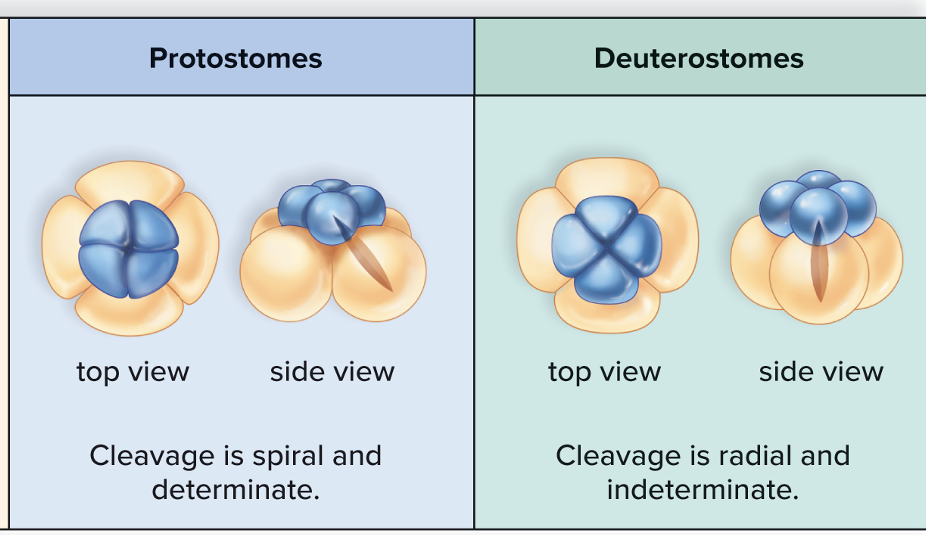
Fate of blastopore formed by blastula
Becomes the mouth in protostomes
Becomes the anus in deuterostomes
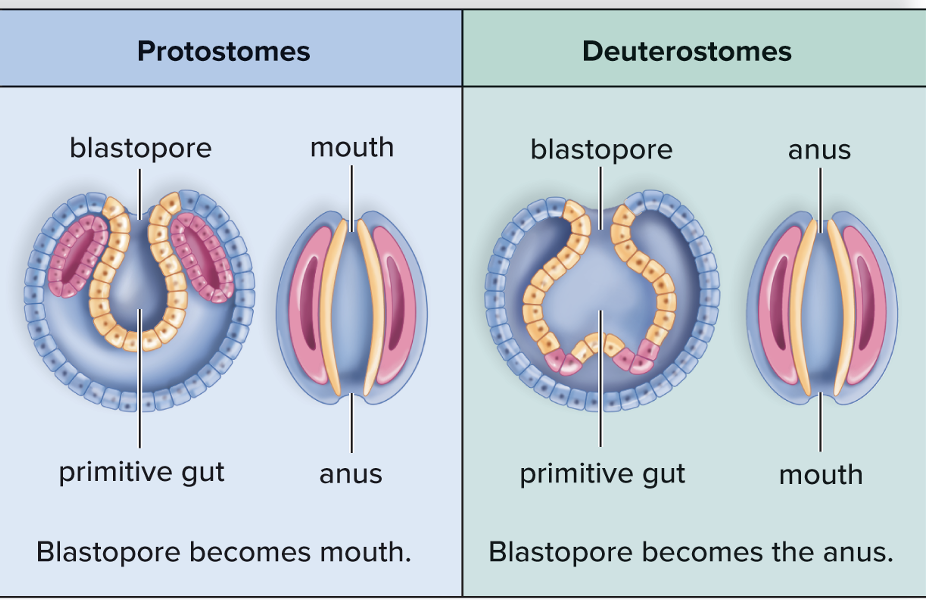
coelom formation - differenitation of animals as protostomes or deuterostomes
•Mesoderm splits in protostomes
•Mesodermal pouches from gut wall meet and fuse in deuterostomes
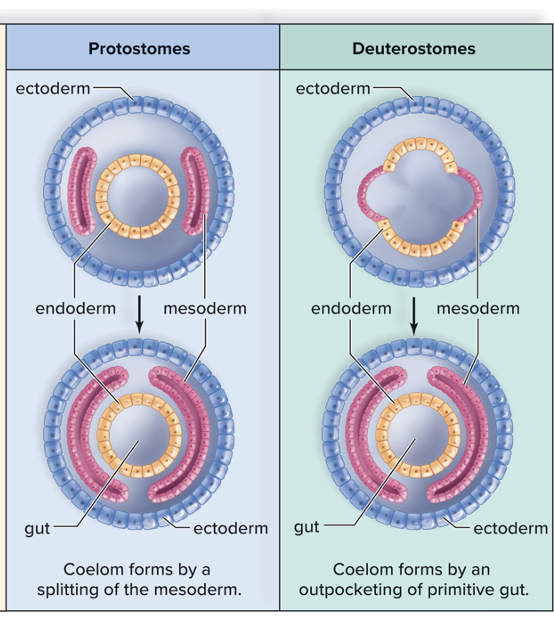
deuterostomes
domain eukarya
supergroup: opisthokonta
kingdom: animalia
phylum of eumetazoa
includes echinoderms and chordates
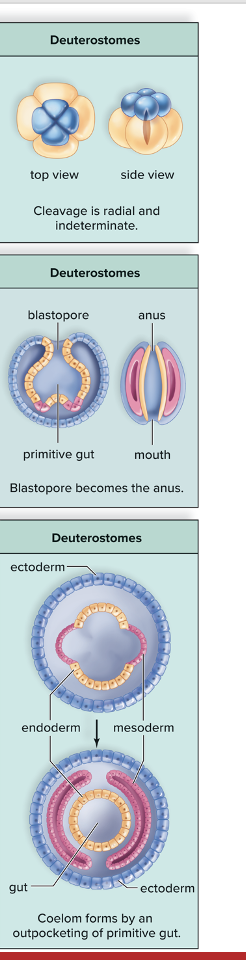
protostomes
domain: eukarya
supergroup: opisthokonta
phylum eumetazoa
divided into ecdysozoa and spiralia
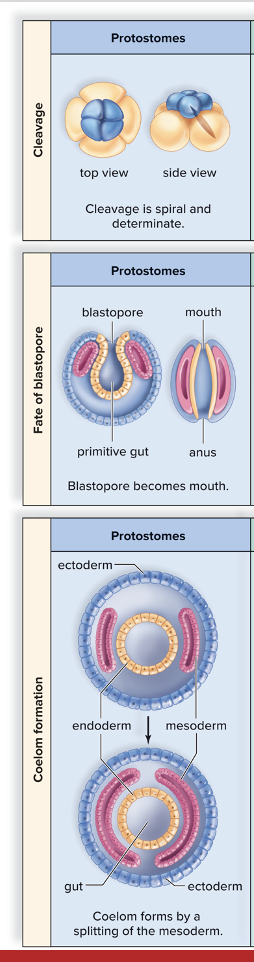
ecdysozoas - types of protostomes
domain eukarya
supergroup: opisthokonta
kingdom: animalia
have outer covering called a cuticle
eumetazoa
includes roundworms and arthropods
•Shed outer covering as they grow - molting
spiralia - type of protostomes
Lophophorans
platyzoans
Trochozoans
platyzoans - type of spiralia protostome
domain eukarya
supergroup: opisthokonta
kingdom: animalia
bilateral symmetry with no circulatory or respiratoy system
key traits of porifera - type of parazoa
sponge and filter feeders
classified based on their skeleton
saclike bodies with pores
lack nerve and muscle cells
cellular level of organization
choanocytes (collar cells)
base of evolutionary tree of animals
spicules
Chalk sponges have spicules made of calcium carbonate
Glass sponges have spicules that contain silica
spongin
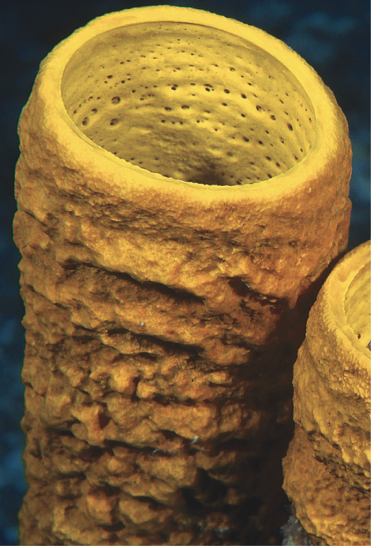
sponges: the parazoe porfera simple invebrates
Saclike body with many pores
Multicellular, but lack organized tissues
Outer body layer is flattened epidermal cells
Middle layer is semifluid matrix with wandering amoeboid cells
•Amoeboid cells digest food, transport nutrients from cell to cell, and produce sex cells and spicules
Inner layer is flagellated collar cells called choanocytes
•Beating flagella produce water currents that flow in through pores and out through the osculum
filter feeders: the parazoe porfera simple invebrates
filter water for food and engulf food particles by collar cells
•Food is digested or passed to amoeboid cells
Use asexual and sexual reproduction
the eumetazoa
tissue level of organization
radial animals (diploblastic) - cnidarians and ctenophores
Both groups have true tissues
Their embryos have ectoderm and endoderm germ layers
can reach in all directions for food
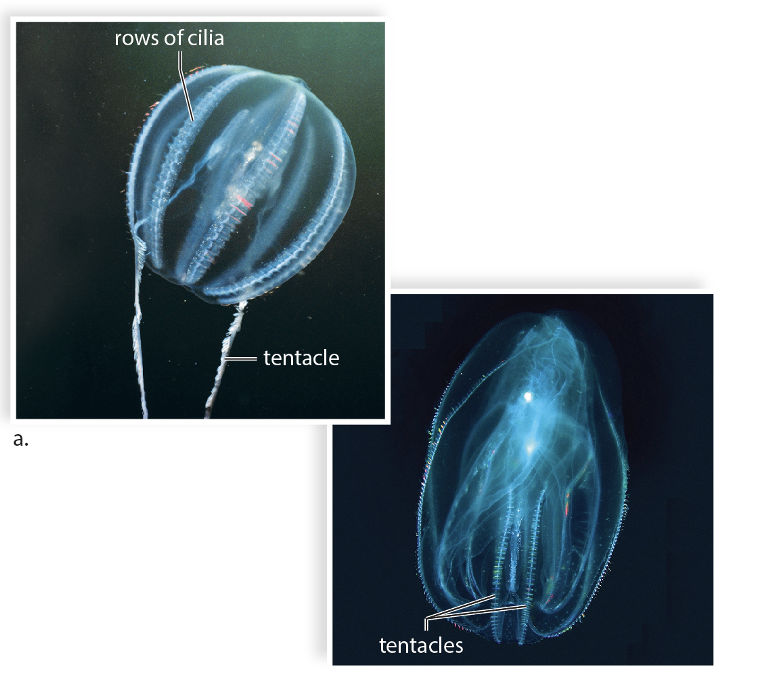
ctenophora - eumetazoe
comb jellies are members of phylum Ctenophora
Solitary, free-swimming marine animals
Movie via cilia
Body made up of mesoglea—transparent, jellylike substance
Use colloblasts (adhesive cells) to capture prey
some are bioluminescent
some have two tentacles
cnidarians - eumetazoe
phylum cnidaria
Tubular or bell-shaped animals
Radial symmetry
All aquatic, mostly shallow coastal waters
two basic body forms
polyps and jellyfish and medusa
Named for cnidocytes, specialized stinging cells that contain a nematocyst
two layer sac
the two basic body forms of cnidarians
polyp
the mouth and tentacles are directed upward
The sessile stage produces a medusa by budding
medusa
bell-shaped with mouth and tentacles directed downward
Has more mesoglea than polyp
Tentacles found on the margin of the bell
Motile form produces egg and sperm
one stage dominant in some species and even absent in others
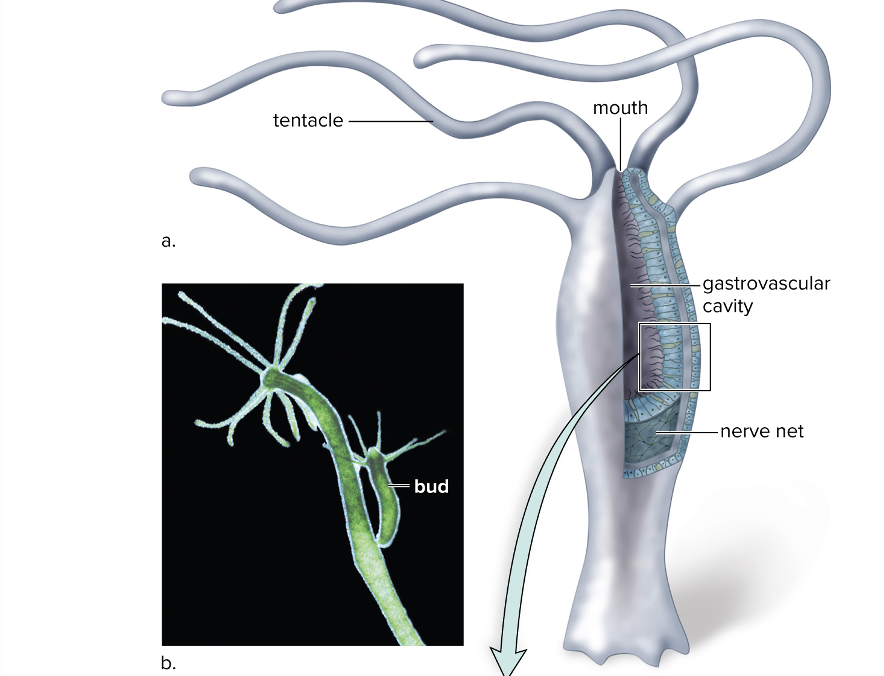
hydra
Attaches to rocks and plants in lakes or ponds
Takes form of a small, tubular polyp, saclike body plan with a single opening (mouth) surrounded by four to six tentacles
Longitudinal and circular muscle fibers
Diffuse nerve net below epidermis that communicates with sensory cells throughout the body
tentacle can reach out and grasp prey
Digestion begins in the gastrovascular cavity and is completed in the gastrodermal cells
nutrients pass to other cells by diffusion
Gastrovascular cavity also allows exchange of gases with watery medium
bodies exist only as polyps
reproduce sexually and asexually
sexual reproduction by developing an ovary or testis in body wall
asexual reproduction by budding
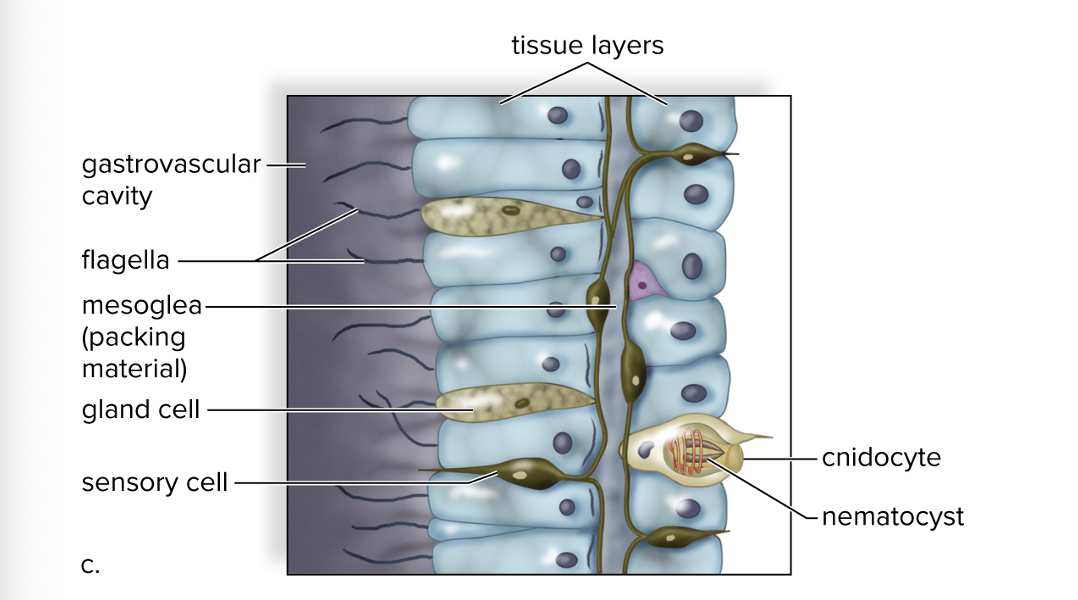
hydra layers
•Outer tissue layer: protective epidermis derived from ectoderm
•Inner layer: gastrodermis derived from endoderm
•Mesoglea: separates the two layers
sea anemones
cnidaria
sessile polyps attached to substrate under water
corals
cnidaria
polyps similar to anemones but encased in a calcium carbonate house
hydrozoans
cnidarian
have a dominant polyp stage
•Include hydra and the Portuguese man-of-war
jellyfish
cnidarian
medusa is the primary stage
•Depend on tides and currents for movement
lophotrochozoans
domain eukarya
supergroup: opisthokonta
kingdom: animalia
eumetazoa protostomia
spirilia
Bilaterally symmetrical in at least one stage of development
Triplobastic
some have a true coelom
includes: rotifers, flatworms, lophorates, annelids, and mollusks
lophophorans - types of lophotrochozoa
domain eukarya
supergroup: opisthokonta
kingdom: animalia
spiralia protostomes
have a mouth surrounded by ciliated tentacle-like structures
include: bryozoans, phoronids, brachiopods - aquatic; have lophophore mouth
trochozoans - types of lophotrochozoa
protostomes
all have trochophore as a larval stage; also includes flatworms and rotifers because they descended from an ancestor of a trochophore in the past
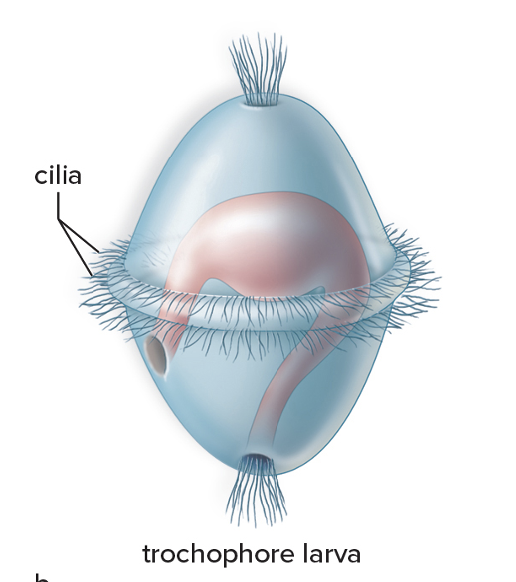
bryozoans - lophophorans
domain eukarya
supergroup: opisthokonta
kingdom: animalia
aquatic, colonial lophophorans
•Zooids are individuals in a colony and have protective exoskeletons; can specialize
brachiopods - pohpophorans
have two hinged shells
•Top and bottom shells; muscular pedicle affixes to hard surfaces
phoronids - lophophorans
live inside a long tube formed from their own chitinous secretions
mollusks - trochozoans inside of lophotrochozoans
phylum mollusca
domain eukarya
supergroup: opisthokonta
kingdom: animalia
Second most numerous animal phylum
Variety of environments: marine, freshwater, terrestrial
true coelom with bilateral symmetry
three germ layers
organ level of organizaiton
complete digestive tract
Chitons, limpets, slugs, snails, abalones, conchs, nudibranchs, clams, scallops, squid, and octopuses
unique characteristics of mollusks
Visceral mass: soft body mass that includes most organs
Foot: muscular portion used for locomotion
Mantle: membranous or muscular covering that almost encloses visceral mass
Mantle cavity—space between the two folds of mantle
Mantle may secrete a shell
Radula—rasping, tonguelike organ for feeding
flatworms - trochozoan lophotrochozoa - protostomes
phylum Platyhelminthes
Incomplete digestive tract (gastrovascular cavity) with one opening (mouth)
No body cavity—mesoderm fills spaces between organs
Lack respiratory and circulatory systems
free living planarians - •Have muscles, excretory, digestive, and nervous systems
Parasitic flukes and tapeworms
free living flatworms
freshwater planarians - Found in lakes, ponds, and streams
•Feed on small organisms such as worms and crustaceans by extending muscular pharynx
Possess an excretory system of canals and flame cells
Ladderlike nervous system exhibits cephalization (small brain, eyespots)
Reproduce both asexually and sexually
gastropods - mollusks
class gastropoda
Includes nudibranchs, conchs, and snails
Foot is flattened ventrally
Move by muscle contractions along the foot
Some herbivores; others carnivores
Existence of shells varies
Land snails hermaphroditic; cross-fertilize
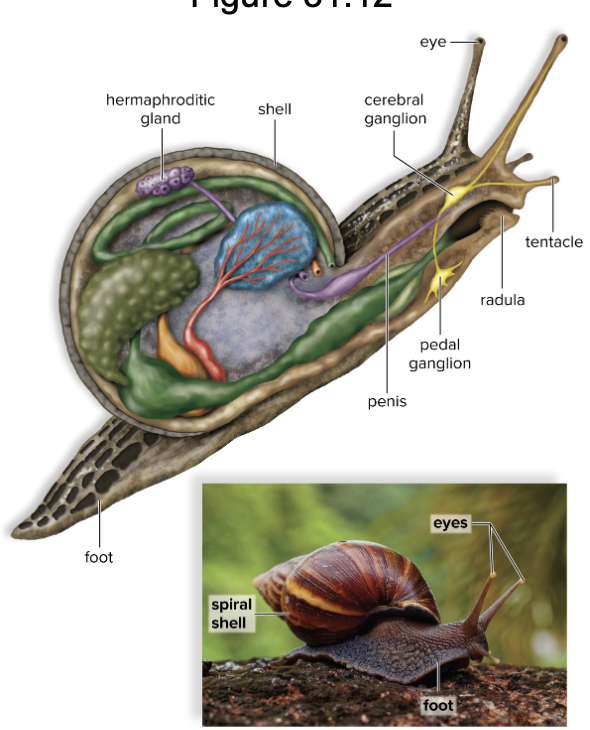
cephalopods - mollusks
class cephalopoda
Includes octopuses, squid, nautiluses
Foot has evolved into funnel or siphon
Powerful tentacles, beak, and radula used for feeding; ink defense
Cephalization
Octopuses have no shell; squid have reduced shell
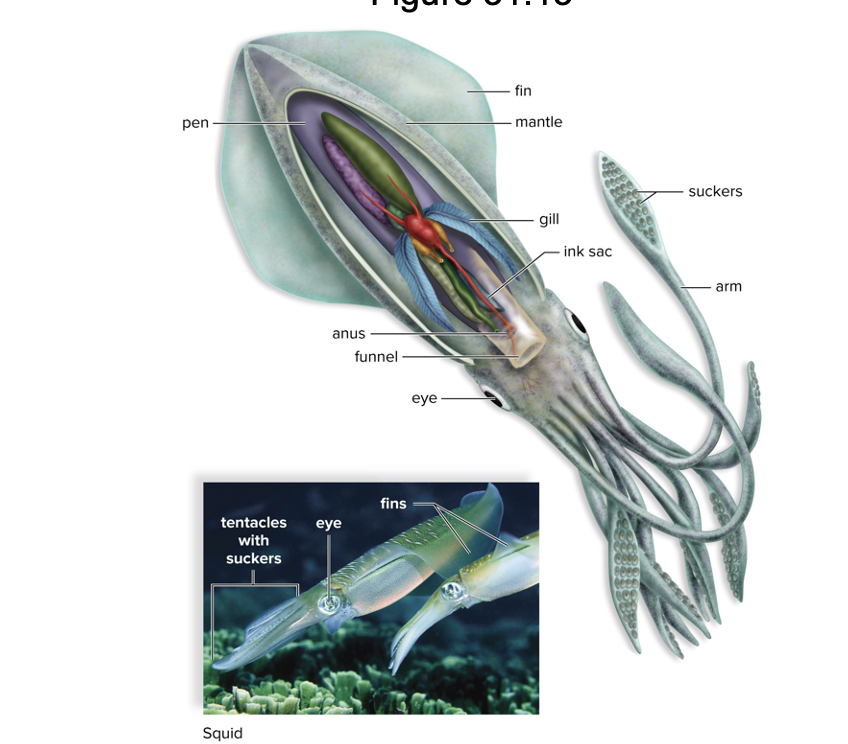
bivalves - mollusks
class bivalvia
Include clams, mussels, oysters, scallops
Two-part shells composed of protein and calcium carbonate are secreted by mantle
Gills located within the mantle cavity, used for gas exchange
Filter feeders: water enters through incurrent siphon
“Hatchet” foot can extend and move clam
visceral mass
The sexes are usually separate
Gonads (ovary or testis) are located around coils of intestine
All clams have some type of larval stage, and marine clams have a trochophore larva
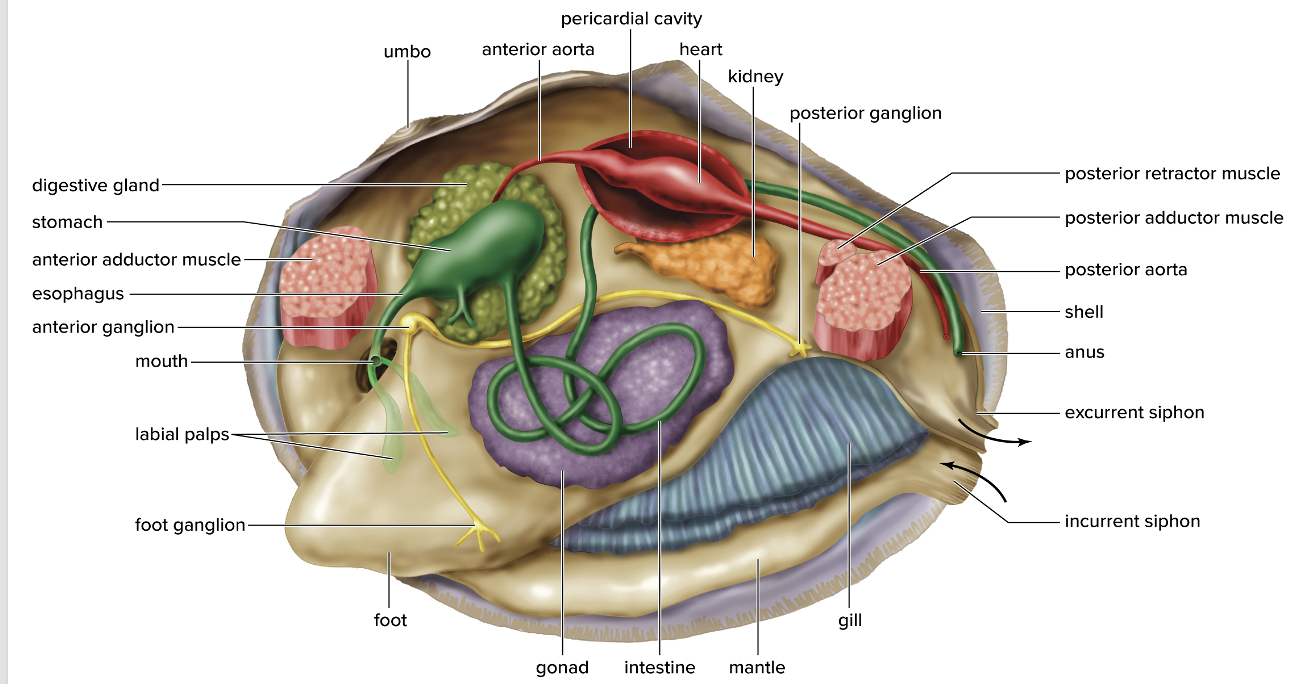
bivalves visceral mass - mollusks
The heart lies within the pericardial cavity, which is the only remains of the reduced coelom
The open circulatory system is so called because blood flows through sinuses in the organs
The nervous system is composed of three pairs of ganglia connected by nerves
clams lack cephalization
bivalves digestive system - mollusks
includes a mouth with labial palps, esophagus, stomach, and intestine.
Two excretory kidneys remove waste from the pericardial cavity
the two basic body forms of cnidarians
polyps have mouths directly up but for jellyfish and medusa they are directed down
medusa are bell shaped and have more mesoglea than a polyp and tentacles are concentrated on the margin of the bell
when both are present the animal is dimorphic: the sessile polyp stage produces a medusa by asexual budding and the motile medusa stage produces an egg and sperm - in some one stage is dominant and the other is reduced but in other species one form is absent all together
annelids
phylum annelida
segmented - rings on outside of body
developed coelom
septa separated segments
hydrostatic skeleton - fluid filled interior - muscle contraction and stretching
losed circulatory system
locomotion via contraction and expansion
specialization of digestive tract
closed circulation system
nervous system of nerve cord
nephridia tube for excretion
includes leaches and worms as well as marine animals
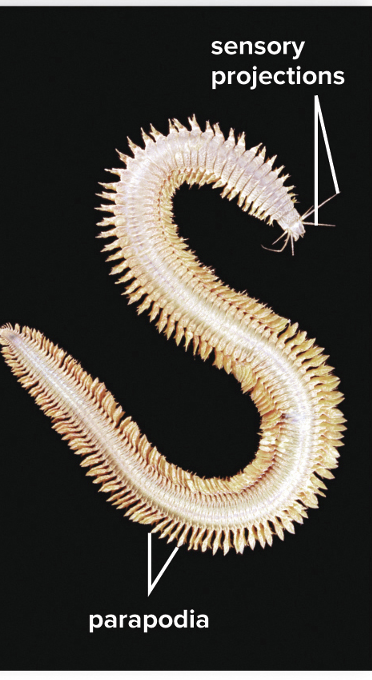
polychaetes
marine annelids
have many setae - bristles that anchor the wormm and help it to move
setae are on parapodia which are used for swimming and respiration
have head and sense organs
predator
2. sessile tube worms with tentacles to form fan
Cilia create water currents to direct trapped food toward the mouth
sex organs are functional only during breeding seasons
Zygote develops into a trochophore larva
oligochaetes
class oligochaeta
phylum annelida
includes earthworms
few setae
no well developed head or parapodia
locomotion via muscle contraction in segments
need moisture for gas exchange
scavengers
use muscular pharynx to eat
digestion through long intestine called typhlosole
•Long ventral nerve cord; brain
•Dorsal and ventral blood vessels; five pairs of connectives called “heart”
segmentation: body rings, nerves in each segments, coelom divided by septa
reproduction: hermaphroditic
leeches
class hirudinea
phylum annelida
mostly found in freshwater
same body plan as other annelids but no setae and body rings have grooves
two suckers - one around the mouth and one posterior one
fluid feeders at open woods or free living feeding on plants
hirudin in saliva prevents blood coagulation for those that feed on blood
free living flatworms reproduction
regeneration (asexual)
hermaphroditic cross fertilization (sexual)
the two types of parasitic flatworms
tapeworms - class cestoda
flukes - class trematoda
tapeworms - parasitic flatworms
class cestoda
internal parasites with specialized body covering resistant to digestive juices
excretory, muscular, and nervous systems similar to those of other flatworms
scolex - anterior region with hooks for attachment and suckers for feeding
proglottids - reproductive units - body segments
taenia solium - uses a human as a primary host and a pig as a secondary host
flukes - parasitic flatworms
class trematoda
endoparasites
Body is flattened, oval to elongated, with a nonciliated integument
Two suckers: one for feeding, one for attachment
Well-developed alimentary canal
Muscles and excretory system similar to free-living flatworms
Reduced nervous system (poorly developed senses)
Often hermaphroditic
Complex life cycle involving two intermediate hosts
Blood, liver, and lung versions
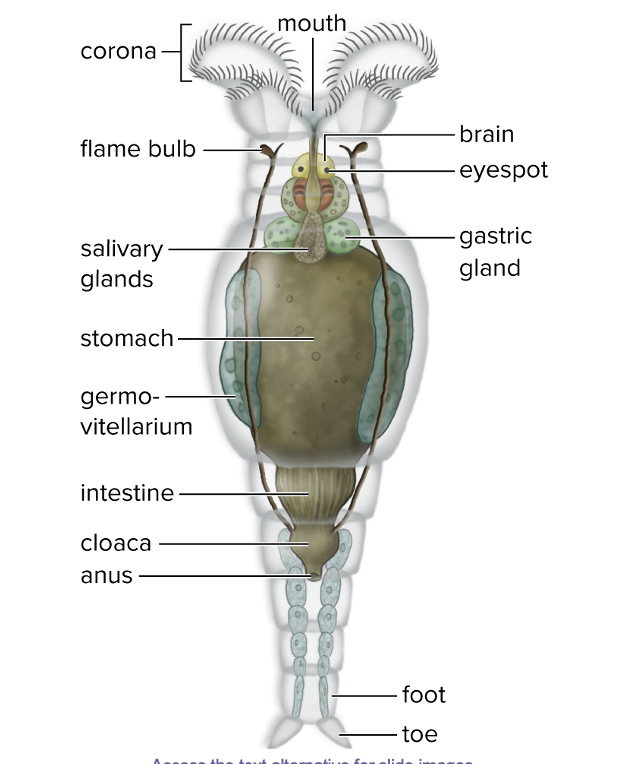
rotifer
phylum rotifera
trochozoans related to flatworms
crown of cilia - corona → used for locomotion and to move food to the mouth
many are transparent
can desiccate to survive harsh conditions and remain dormant for long times
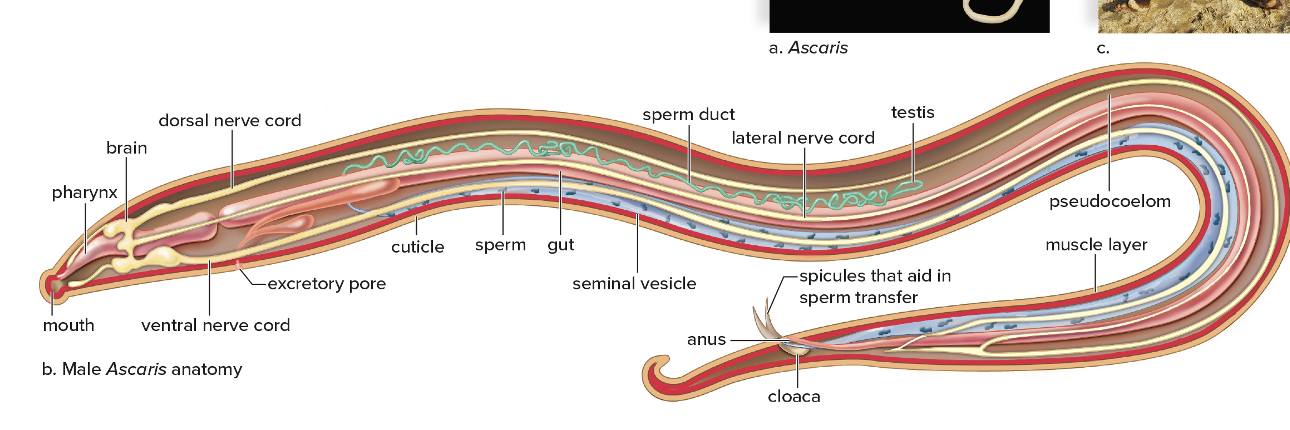
roundworms - phylum Nematoda
phylum Nematoda
Nonsegmented worms found in almost every environment
have a pseudocoelom—a fluid filled body cavity that is incompletely lined by mesoderm - substitute for circulatory system
nematodes (phylum) can be free-living or parasitic
scaris lumbricoides
females are longer and prolific
whiplike motion
Eggs enter host in uncooked vegetables or ingested fecal material
trichinosis from undercooked pork and resides in intestine after ingestion
lympathatic filariasis - caused by filarial worms which use mosquito as intermediate host and resides in lymphatic vessels and prevent lymph drainage
pinworms are common in US kids
arthropods
phylum Arthropoda
many species
characteristics:
segmentations - fused to form head, thorax, abdomen regions
jointed appendages
•Exoskeleton composed of chitin; must be shed (molting) to grow larger
well developed nervous system, sensory structures, simple and compound eyes
respiratory organs
metamorphosis
crustaceans - types of arthropods
(subphylum Crustacea)
largely marine arthropods such as barnacles, shrimp, lobster, and craps
freshwater: crayfish
terrestrial: sowbug
named for hard shell - calcified exoskeleton
head with eyes and have five pairs of appendages - firs two are antennae and others are feeding mouthparts
stomach with two parts - one for grinding and one for filtering
green glands in head excrete metabolic waste
coelom is reduced
nervous system similar to earthwroms
hemocoel - gives blue color to blood - open circulatory system
separate sexes
crayfish - crustaceans
Five pairs of walking legs on thorax
gills above the walking legs
Head and thorax fused to form cephalothorax - covered by carapace
Abdominal segments have swimmerets - paddlelike structures
Last two segments are the uropod and telson which make fan shaped tail
insects - types of arthropods
subphylum Uniramia
head with sensory antennae, compound or simple eyes, and mouthparts
abdomen
digestive system
extetory system - malpighian tubules
respiratory system - spiracle openings lead into tubules called tracheae that branch - air pumped via contraction and relaxation
circulatory: heart pumps hemolymph into aorta, leads to a hemocoel (no pigment here though)
thorax with three pairs of legs and zero to three pairs of wings
entomology
the study of insects
reproduction and developement of insects
Reproduction is adapted to life on land
Internal fertilization protects both gametes and zygote from desiccation
Sperm is released by a male from a penis, passed to the female, and stored in the seminal receptacle
Metamorphosis
Change in form and physiology that occurs as an immature stage, called larva, becomes an adult
grasshoppers go through gradual
caterpillar go through complete
comparison of crayfish and grasshoppers
Adaptations:
Grasshoppers → terrestrial life
Crayfish → aquatic life
Respiration:
Crayfish → gills + oxygen-carrying pigment
Grasshoppers → spiracles & tracheae (oxygen diffuses directly; no pigment needed)
Excretion:
Crayfish → ammonia (liquid waste)
Grasshoppers → uric acid (solid waste)
Movement:
Crayfish → swim using uropods
Grasshoppers → move with legs and wings
Sensory & Reproduction (Grasshoppers):
Tympanum for hearing
Males have penis (prevents sperm from drying out)
Females have ovipositor (lays eggs)
arachnids
(subphylum Chelicerata)
Scorpions, spiders, ticks, and mites
Cephalothorax has six pairs of appendages → Chelicerae, pedipalps, and four pairs of walking legs
abdomen has internal organs
scorpions - arachnids - arthropods
Pedipalps are large pinchers
Long abdomen ends with a venomous stinger
Widely distributed, tropics, subtropics, and temperate regions
spiders - arachnids - arthropods
Narrow waist separates cephalothorax from abdomen
•Chelicerae have fangs that deliver venom
•Book lungs are used for gas exchange
•Silk glands are used for web spinning
internal organs reflect adaptation
Malpighian tubules work in conjunction with rectal glands to reabsorb ions and water
A relatively dry nitrogenous waste (uric acid) is excreted
Invaginations of inner body wall form lamellae, which create the book lungs
invertebrate deuterostomes
Chordates are most closely related to echinoderms
second embryonic openin becomes mouth
coelom forms via outpocketing of primitive gut
echinoderms - invertebrate deuterostomes
Marine
Endoskeleton made of spine-bearing, calcium-rich plates
Spine sticking out of skin
Radial symmetry
•Larvae are bilateral free swimmers, which undergo metamorphosis into radially symmetrical adults
includes: sea lilies, motile feather stars, brittle stars, and sea cucumbers
sea stars - echinoderms - invertebrate deuterostomes
mouth on underside and anus on upperside
On the oral surface, each arm has a groove surrounded by tube feet
spines for protection
Pincerlike structures called pedicellariae that keep the body surface free of debris
Skin gills, extensions of skin, for gas exchange
feeding on clams, oysters, and other bivalve mollusks
partial digestion inside and out
NS: central nerve ring on each arm and eyespot at tip of each arm
locomotion: uses water vascular system
Water goes in → through tubes → into tiny feet
Water pressure makes the tube feet stretch out
The feet stick to surfaces (like suction cups)
Then they pull the animal forward
no respiratory, excretory, or circulatory systems exist
sexual and asexual reproduction
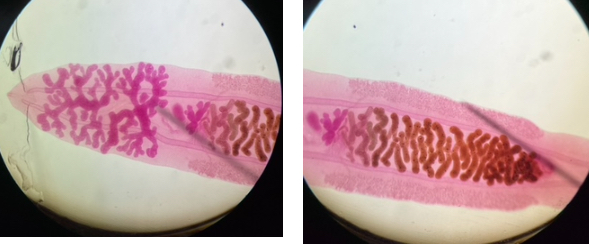
Clonorchis sinesis Microse pic