Ch. 10, 11, 12
 Call Kai
 Learn
Learn Practice Test
 Spaced Repetition
 Match
Match Flashcards
 Knowt Play
1/113

There's no tags or description
Looks like no tags are added yet.
Name | Mastery | Learn | Test | Matching | Spaced | Call with Kai |
|---|
No analytics yet
Send a link to your students to track their progress
114 Terms
Agreement
Mutual understanding between two or more parties about their rights and duties toward each other.
Contract
Legally enforceable agreement between two or more parties. All contracts are agreement, but not all agreements are contracts.
Three elements: offer, acceptance, and consideration.
Private Law
Form of contract.
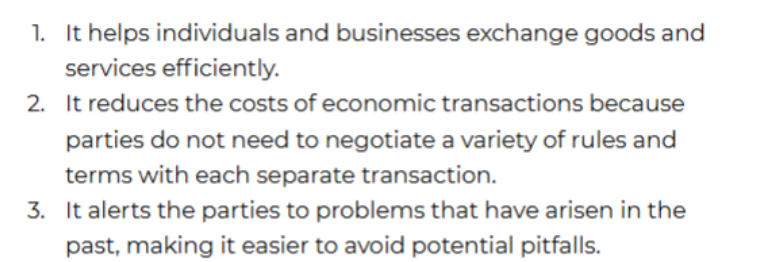
Contract law performs three significant economic functions
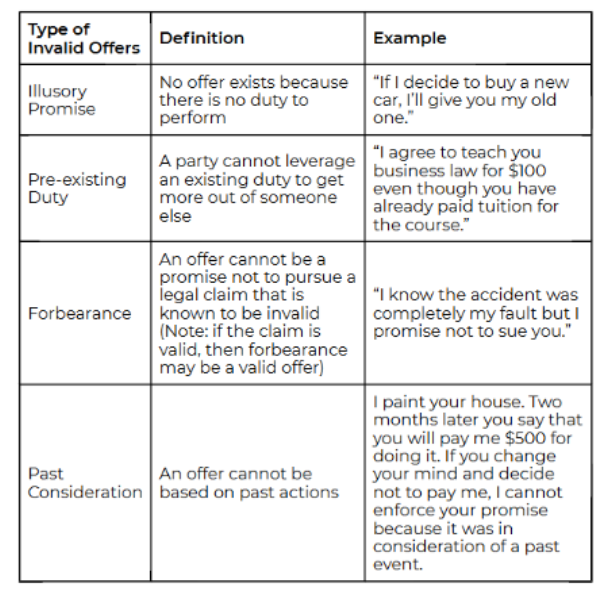
Offer
Conditional promise to do or refrain from doing something now or in the future.
Continue to exists until:
Rejected
Replaced by a counteroffer
Lapses to expires
Is revoked
Terminated by operation of law
Lapsed Offer
An offer that is no longer valid because a reasonable time to accept it has expired. Coupon.
Acceptance
Implied or express act that shows willingness to be bound by the terms of an offer. Can be express or implied.
Counter-offer
When an acceptance changes, adds, or modifies term to the offer.
Mutual Assent
Parties intention to enter into a binding contract on the terms they agreed upon.
Consideration
Is the bargained-for exchanged of something of value that shows the parties intend to be bound by the contract.
2 elements to consider
Something of value
Is exchanged between the parties
Legal Detriment
Giving up a legal or property right.
Promissory Estoppel
is the principle that a promise made without consideration may nonetheless be enforced to prevent injustice if the promisor should have reasonably expected the promisee to rely on the promise, and the promisee actually relied on the promise to his or her detriment. P
Bilateral Contract
Both parties make a promise of performance. Also called mutual or reciprocal contracts.
Unilateral Contract
On the other hand, is a contract where one party makes a promise that the other party can accept only by doing something.
Express Contract
Is a contract in words (orally or in writing) in which the terms are spelled out directly.
Implied Contract
A contract that is inferred from the parties’ actions. No discussion of term took place, an implied contract exists if it is clear from the conduct of the parties that they have an agreement.
Quasi-contract
Is an obligation imposed by law to avoid unjust enrichment of one person at the expense of another.
Valid
A contract that is fully enforceable and reflects the parties’ intent is valid.
Unenforceable Contract
Is a contract where the parties intend to form a valid bargain but the court declares that it cannot be enforced for legal reasons.
Void
When an agreement is lacking one of the legal elements of a contract is void because it never was a contract.
Voidable Contract
Is a contract that can be annulled. A contract that is unenforceable by one party but enforceable by the other.
Ratify
The contract-that is, agree to be bound by it.
Disaffirm
The contract-that is, disavow or avoid it.
Executory Contract
Contract that has yet to be completed. Most are enforceable.
Partially Executed
When part, but not all of the term of the contract have been performed.
Executed Contract
A contract that has been completed.
Performance
Means undertaking the legal duties imposed by the terms of the contract.
Complete Performance
A contract was formed, the parties performed their obligations under it (known as complete performance), and they are subsequently discharged from further duties arising under the contract.
Breach of Contract
When a party fails to perform under the terms of the contract without a legally justifiable reason.
Substantial Performance
In a service contract, the standard used to judge performance.
Material Breach
In a service contract occurs when a party has not substantially performed under the terms of the contract.
Minor Breach
Occurs when the party has substantially performed but has not strictly performed.
Personal Satisfaction
Can be enforced if the contract expressly requires it. Contract performance is evaluated subjectively, either by one party to the contract or by a third-party beneficiary specified in the contract.
Condition
Is an act or event (other than the lapse of time) that must occur before performance under a contract becomes due.
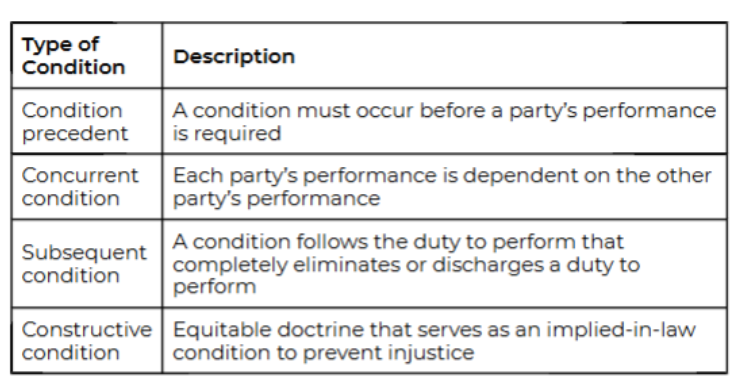
Condition Precedent
Is an act or event that must occur before a duty of immediate performance of a promise arises.
Concurrent Condition
Occurs when mutually dependent conditions must be performed at the same time by the parties.
Subsequent Condition
An event that discharges a duty of performance that becomes absolute. Ex: insurance company may require notice within 30 days of a claim.
Constructive Condition
Is a conditioned in an essential contractual term that, though omitted by the parties from their agreement, a court has supplied as being reasonable in the circumstances.
Breaching
Not performing a contract.
Illegality
Statutory Violations and violations of public policy.
Capacity
Is the mental state of mind sufficient to understand that a contract is made and its legal consequences.
Undue Influence
Occurs when one party overpowers the free will of another by use of superior power or influence. Unfair persuasion.
Duress
Occurs when there is a threat to a person, family, or property.
Unconscionability
Occurs when the contract contains markedly unfair terms against the party with less bargaining power or sophistication than the party who created the terms and induced the other party to sign it.
Statute of Frauds
Requires certain contracts to be in writing and signed to be enforceable.
Real property interests;
2. Marriage;
3. Payment of another’s debt;
4. Contracts that cannot be completely performed within
one year;
5. Contracts for the sale of goods of five hundred dollars or
more; and
6. Acting as another’s executor/administrator.
Statute of Limitations
An affirmative defense that can be raised by a defendant to argue that a lawsuit is being brought too late.
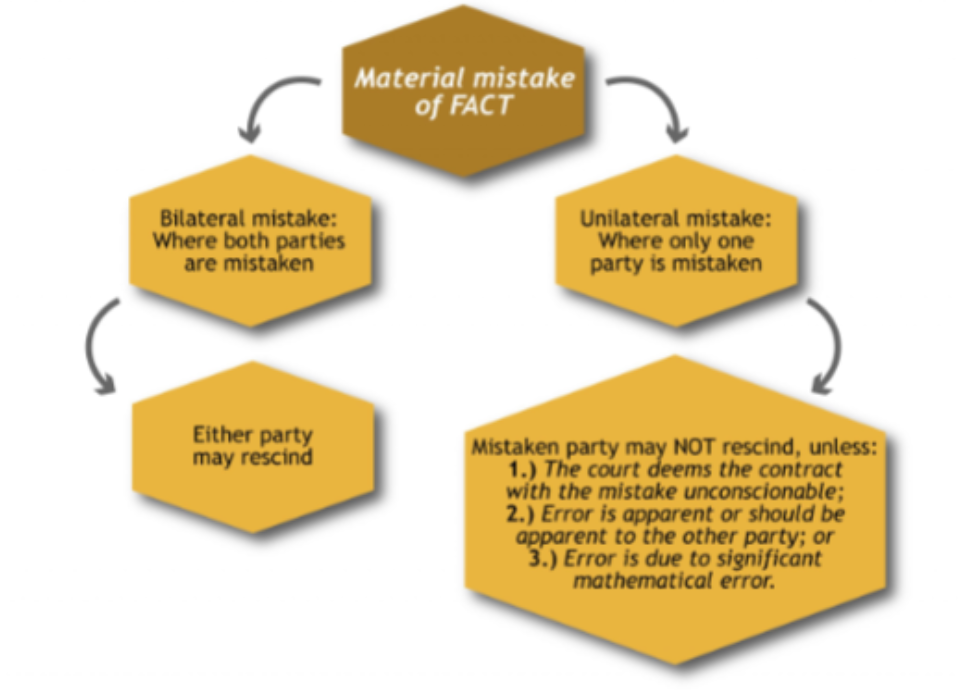
Mistake
Is the situation in which the parties did not mean the same thing or when one or both parties formed untrue conclusions about the subject matter of the contract.
Mutual Mistake
Refers to something that is a mistake by both parties that relates to an essential term of the contract.
Unilateral Mistake
Occurs when only one party is laboring under a mistake.
Misrepresentation
Is when a party makes a false statement that induces the other party to enter into the contract.
Fraud
Is a closely related concept, and it simply means that one party has used deception to acquire money or property.
Commercial Impracticability
Is a defense that can be used when fulfilling a contract has become extraordinarily difficult or unfair for one party. Also called frustration of purpose or impossibility.
Bankruptcy
The bankruptcy court will determine which debts the bankrupt party must pay and which are dischargeable.
Assignment
The rights conveyed by the contract may be transferred to another party by assignment, unless an express restriction on assignment exists within the contract, or unless an assignment violates public policy.
Delegation
Duties imposed on a party may be transferred to another party by delegation, unless the contract expressly restricts delegation, there is a substantial interest in personal performance by the original party to the contract, or if delegation would violate public policy.
Novation
Is essentially a new contract that transfers all rights and duties to a new party to the contract and releases the previous party from any further obligation.
Third Party Beneficiary
Is someone who is not a party to the contract but stands to benefit from it.
Intended Beneficiary
Is someone who the parties intend to receive the benefit of the contract.
Beneficiary
Does not need to know about the contract to have his or her rights vest.
Incidental Beneficiary
Is someone who benefits from a contract but was not intended by the parties to benefit.
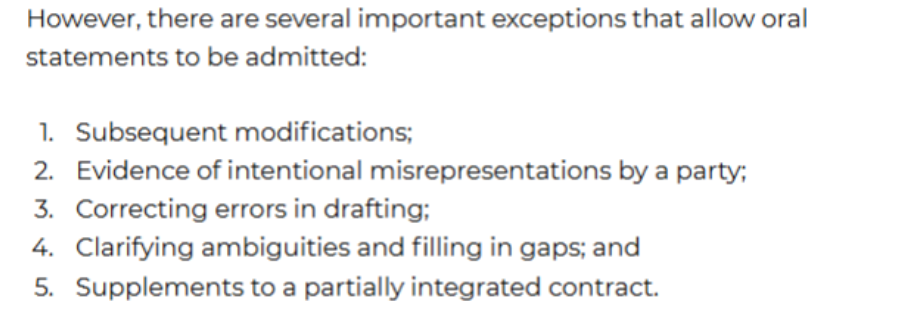
The Parol Evidence Rule
Is the principle that a writing intended by the parties to be a final embodiment of their agreement cannot be modified by evidence that adds to, varies, or contradicts the writing.
Damages
Are the money paid by one party to another to discharge a legal liability.
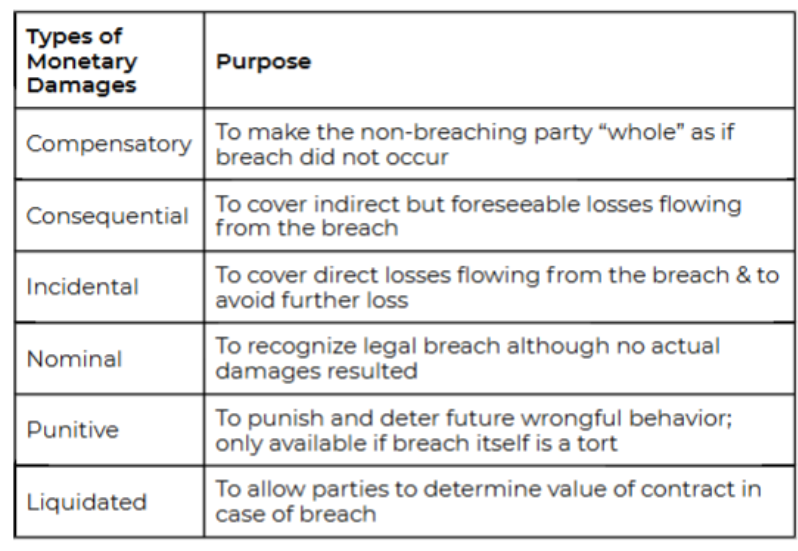
Compensatory Damages
Are paid to compensate the non-breaching party for the loss suffered as a result of the breach.
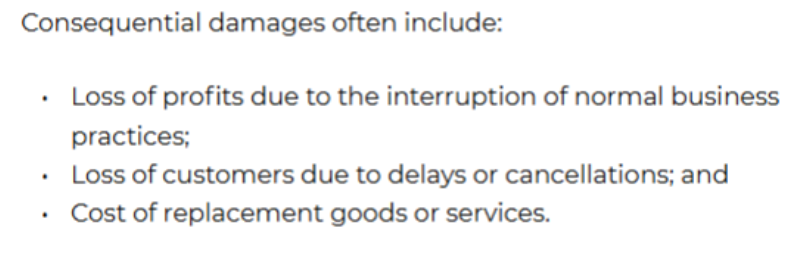
Consequential Damages
Are damages that flow as a foreseeable but indirect result of the breach of contract.
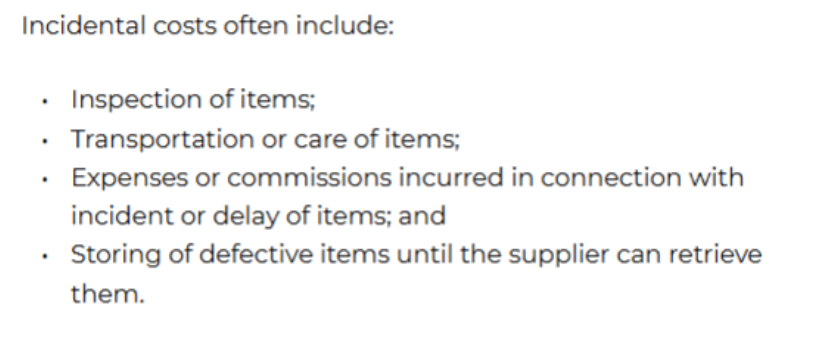
Incidental Damages
Are damages that are paid to the non-breaching party in an attempt to avoid further loss on account of the breach.
Nominal Damages
Are a token amount of money paid when the breach has caused no actual loss.
Punitive Damages
Are awarded to a non-breaching party in excess of any loss suffered to punish the breaching party.
Liquidated Damages
Are damages agreed upon by parties to a contract to be paid in the event of a breach.
Equitable Remedies
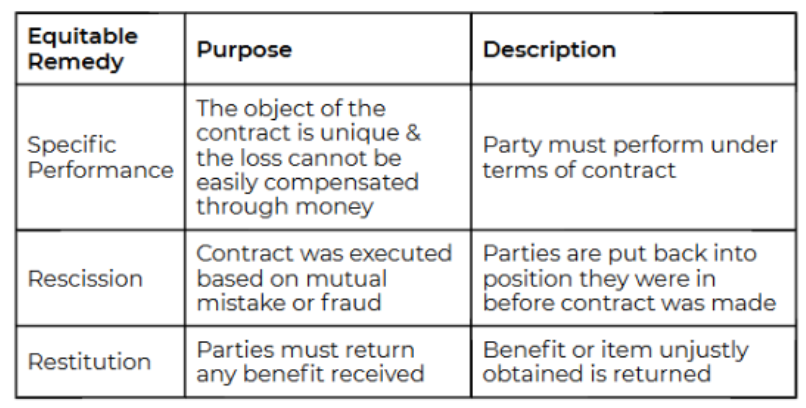
Specific Performance
Is a judicial order directing a party to deliver the exact property (real or personal) under the terms of a contract.
Recission
Occurs when one party seeks to undo a contract and return to the position it was in before the contract was made.
Restitution
Is restoring property to the original owners. Parties must return any benefit received under the contract.
Uniform Commercial Code (UCC)
Is a proposed set of laws developed by legal experts and business leaders to govern commercial transactions, including sale of goods, secured transactions, and negotiable instuments.
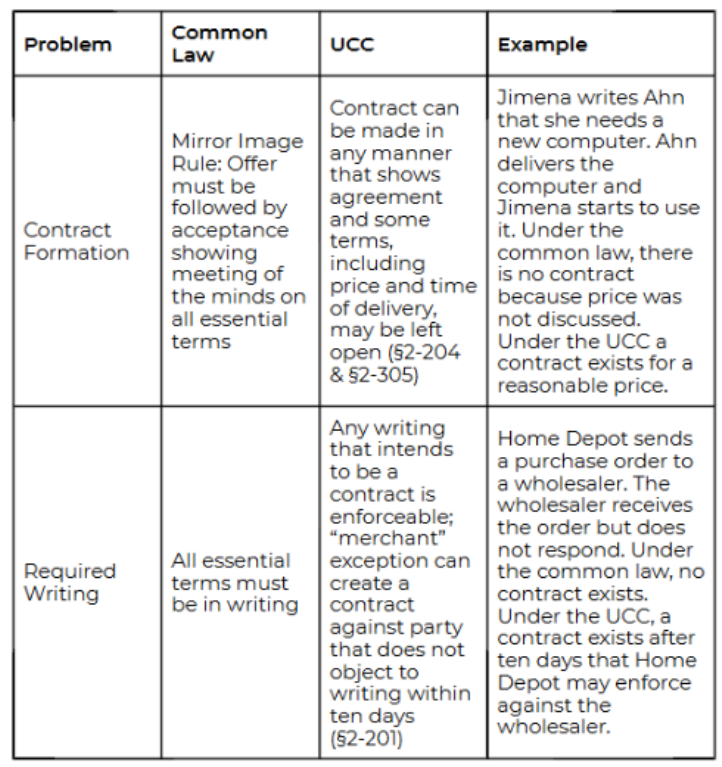
Common Law Problems
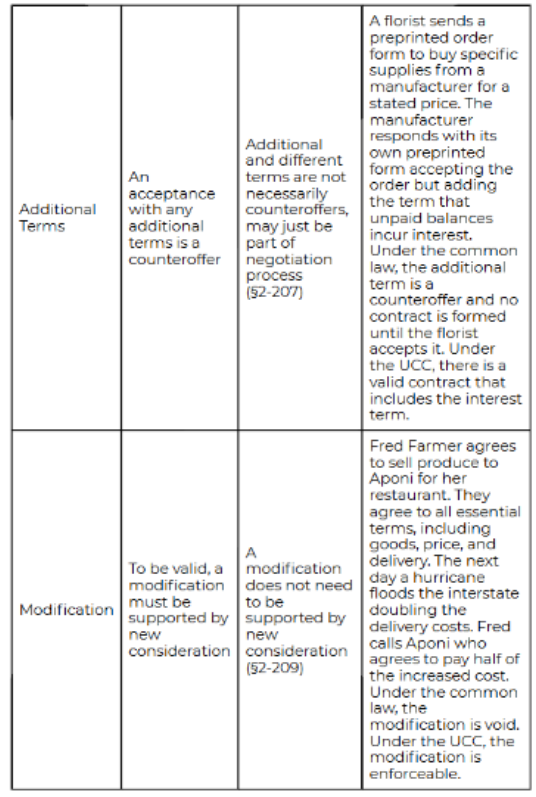
Goods
Which the Code defines as any moveable physical object except for money and securities.
Mixed Contracts
Are for both the sale of goods and services.
Merchant
Is someone who routinely deals in the goods involved in the transaction or who, by his or her occupation, holds himself or herself out as having special knowledge with respect to the goods. Suppliers of services are not merchants.
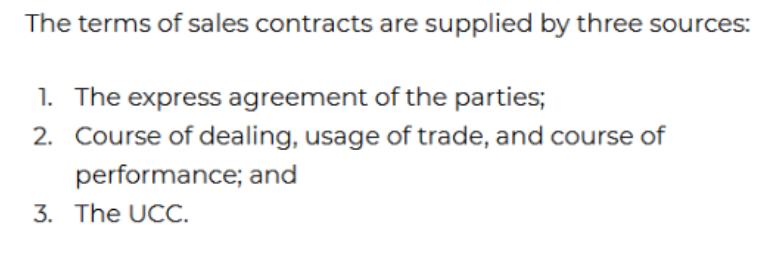
Terms of Sales
Course of Dealing
Is an established pattern of prior conduct between the parties to a particular transaction.
Course of Performance
Relates to the conduct of the parties under the contract in question after its formation. It occurs when a contract involves repeated performance and looks at how the parties have acted when performing this particular contract, not contracts in the past.
Usage of Trade
Is a practice or custom in a particular trade used so frequently that it justifies the expectation that it will be followed in the current transaction.
Additional Term
Is a proposed contract term that addresses issues not included in the offer.
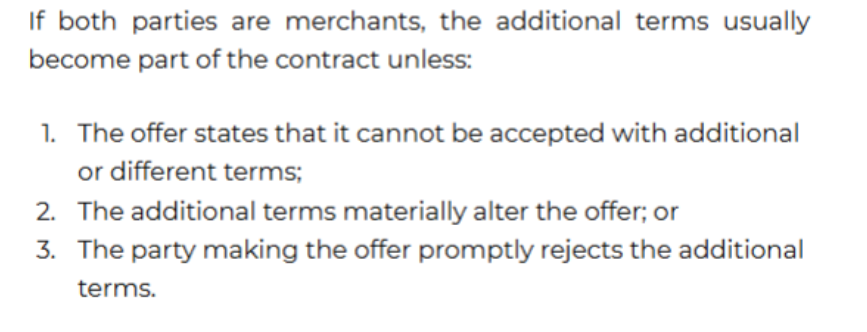
Different Term
Is a proposed contract term that contradicts the terms in the offer. Under the UCC, different terms cancel each other out.
Conforming Goods
Meet contractual specifications and satisfy performance requirements.
Non-conforming Goods
Are goods that fail to meet contractual specifications, allowing the buyer to reject the goods or to revoke acceptance.
Right to Cure
Which is the right to deliver conforming goods before the contract deadline.
Cover
Is obtaining reasonable substitute goods because another party failed to perform under a contract.
Warranty
Is a contractual assurance that goods will meet a certain standard.
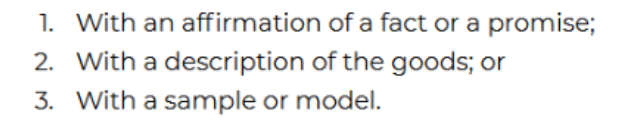
Express Warranty
Is a guarantee, created by the words or actions of the seller, that goods will meet certain standards. Under the UCC, a seller may create an express warranty in three ways.
Implied Warranty
Is a guarantee created by the UCC and imposed on the seller of goods. Two implied warranties: merchantability and fitness for a particular purpose.
Implied Warranty of Merchantability
Is a warranty that the goods are git for the ordinary purposes for which they are used.
Implied Warranty of Fitness for a Particular Purpose
Is a warranty that the property is suitable for the buyers special purpose.
Bold
Bold and underlining, work better than italics alone for capturing the reader’s eye.
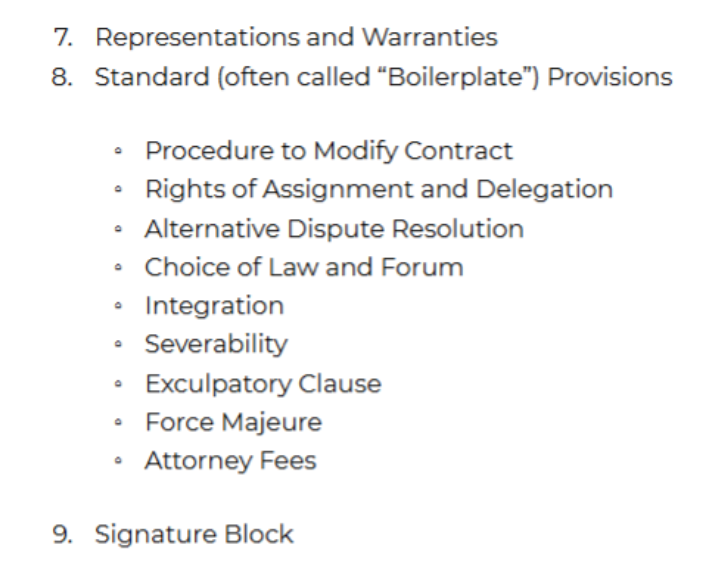
Covenant
If a formal promise to perform.
Conditions
Are things that must occur before performance is due.
Material Breach
Is a substantial breach of contract that excuses aggrieved parties from further performance and affords them the right to sue for damages.
Acceleration Clause
Makes all future payments due immediately under the contract.
Liquidated Damages Clause
Allows parties to determine the amount of damages in the event of a material breach.
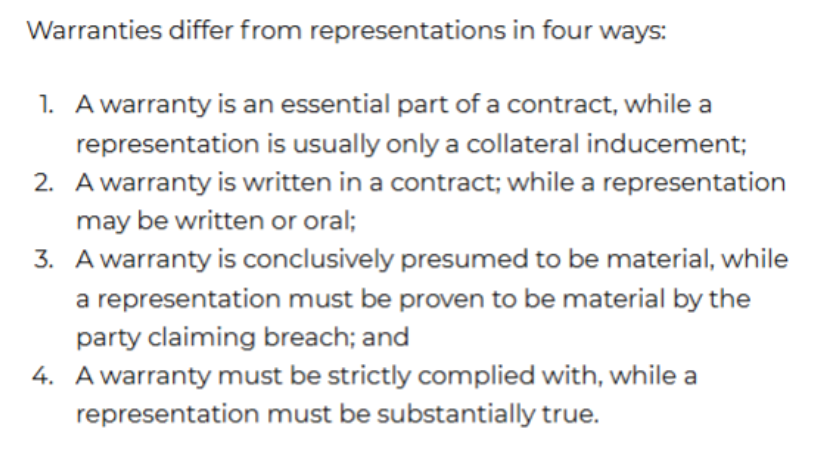
Representations
Are statements of fact made to induce someone to enter into a contract. Common representations by businesses include.
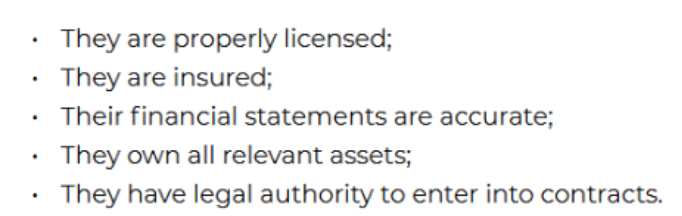
Warranties
In a contract are express promises that guarantee something in furtherance of the contract by one of the parties.