Introduction to Technical Theatre Final
 Studied by 0 people
 Call Kai
 Learn
Learn Practice Test
 Spaced Repetition
 Match
Match Flashcards
 Knowt Play
1/113

There's no tags or description
Looks like no tags are added yet.
Name | Mastery | Learn | Test | Matching | Spaced | Call with Kai |
|---|
No analytics yet
Send a link to your students to track their progress
114 Terms
What is lights primary purpose?
To illuminate the playing space
What are the controllable qualities of light?
Intensity, 2. Color, 3. Angle, 4. Distribution, 5. Movement
What is the 1st controllable property of light?
Intensity
What is the 2nd controllable property of light?
Color
What is the 3rd controllable property of light?
Angle
What is the 4th controllable property of light?
Distribution
What is the 5th controllable property of light?
Movement
What is intensity?
is the controlling the relative brightness on stage. We
the controlling of relative brightness on stage.
What is HIGH intensity associated with?
We associate “bright” or _____ intensity with feelings of happiness or focus.
What is LOW intensity associated with?
Low intensity or “dim” lighting can bring about feelings of isolation or
foreboding. It also allows the LD to highlight actors or objects to make
We associate “dim” or _____ intensity with feelings of isolation or foreboding. Can also highlight actors and objects.
What is color?
______ can be used in a variety of ways, such as establishing warmth/cold, celebration/music/dance, feeling/mood
What is angle?
An artistic choice that can be either realistic or not.
Where does realistic lighting come from?
From above to create natural highlights and shadows.
Where do angles usually come from in dance?
From the sides to highlight the whole bodies range of motion and shadows on their faces.
Where do angles usually come from for unnatural lighting?
From below to create shadows and highlights that are not _______ and can be creepy.
What is an even distribution of light called?
A wash, typically just general lighting to cover the whole playing space.
What is the opposite of a wash?
Isolating individual areas, generally used to focus on key areas.
What is movement?
A physical or cued up shift of light to allude to movement.
What are the FOUR FUNCTIONS of light?
Visibility, 2. Selective Focus, 3. Modeling,4. Mood
What is the first function of light?
Visibility
What is the second function of light?
Selective focus
What is the third function of light?
Modeling
What is the fourth function of light?
Mood
What is visibility?
A combination of intensity and distribution.
What is selective focus?
Another factor of visibility, by reducing intensity of most of the stage and concentrating on what we want to highlight
What is modeling?
Emphasizing the use of highlight and shadow to add dimension to objects. Usually a combo of angle, intensity, and distribution.
How does electricity work?
Electricity is the flow of electrons
Some elements have “free electrons” which can break off of one atom to join another
If this happens enough and is organized, you have electricity
What does AC stand for?
Alternating Current
What is AC current?
A common household electrical current, the standard because it is easier to transmit over long distances and voltage could be easily increased/decreased
Who created AC current?
Nikola Tesla
What does DC stand for?
Direct Current
What is DC current?
Used for households commonly in the 19th century, now primarily used to operate phones, laptops, cars, etc.
Who created DC current?
Thomas Edison
How does DC current work?
One way flow. Electricity flows from a negative charge (where the electrons are) to a positive charge (where there are none).
How does AC current work?
Flow changes directions. Electricity will change directions at least 60 times a second in NA.
Most common batteries are _______
1.5 VDC, intended for small circuits.
The typical household current in the US is a _______.
Nominal 120 VAC.
What does Voltage =?
Electrical Potential
What does Amperage aka Amps =?
Electrical Current
What is electrical current based on?
The size of the conductor and the needs to the device it wants to power.
What does Ohms (Ω) =?
Electrical Resistance
What are some examples of conductors?
Copper, gold, water.
What are some examples of insulators?
Wood, plastic, air.
What does Wattage (W) =?
Electrical Power
A higher wattage bulb burns _____ than a lower wattage bulb.
Brighter
Motors can be rated either in watts or ________.
Horsepower (hp)
What three parts does a simple electrical circuit need to work?
A Source, A Conductor, A Load
What is an example of a source for electrical curcuits?
Something which provides the electrical current
What is an example of a conductor for electrical circuits?
Something which allows the electricity to flow from point A to point B
What is an example of a load for electrical circuits?
Something like a lightbulb or motor to do the work
In a series circuit, what happens?
Two or more loads are in line with the flow of electricity (ex. Christmas tree lights)
In a parallel circuit, what happens?
Two lamps independently are powered by one battery so if one lamp burs out, it will still continue to work.
What does Ohm’s law describe?
How in an electrical circuit, there is the current supplied by the source,
and resistance to the electrical current provided by the load. ______ describes this relationship and provides us with a formula for analyzing circuits.
What is Ohm’s 1st law?
Voltage is equal to Resistance multiplied by Current flow or V=A*Ω.
This formula is used to help design smaller or low voltage circuits
What is Ohm’s 2nd law?
Power (Wattage) is equal to Voltage multiplied by Current flow or W=V*A.
For us this formula is most often used to gauge if a circuit can safely handle the
amount of current flowing through it.
What formula would you use to answer “how many amps would this circuit draw?”
W = VA, Ohm’s 2nd law
Energy can be neither ______ or destroyed. It only can change states.
Created
What size wires are most common in lighting equipment?
12 to 14 gauge wire.
Black wires = _____?
“Hot”
White wires = _____?
“Neutral”
Green wires = _____?
“Ground”
How many pins do modern plugs have?
Three pins: two pins to carry the current, and the third as a ground.
What are the three most common electrical plugs?
Edison connector, stage pin connector, twist lok connector
What is the term for the measurement of electrical current?
ampere or amps.
What is considered to be the type and nominal amount of voltage found in common
household outlets?
A U.S nominal 120 VAC (WS)
What is the maximum number of amps a 16 ga. wire can conduct?
10 amps
Which Ohm’s law would you use to answer the following question: “what is the maximum number of watts you can run on a standard U.S. nominal voltage (120),15 amp circuit?”
Ohm’s 2nd law, W = VA
What are the two main categories for lighting fixtures?
Conventional and Intelligent
What are conventional fixtures?
Basic instruments which use a traditional incandescent lamp (bulb)
What are examples of conventional fixtures?
Fresnels, Ellipsoidal Reflector Spotlights (ERS or Lekos), PARs
What are some features that all conventional fixtures have in common?
The C Clamp (attach the batten), 2. The Stem (bolt connects c clamp to yoke), 3. The Yoke (U shape, supports(, 4. The Pan Nut (swing left or right), 5. The Pig Tail (cable which powers), The Body, The Stage Pin (connector for pig tail), The Lens, The Saftey Cable
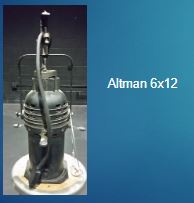
What is 1 example of an ellipsoidal reflector spotlight?
The Altman 6×12
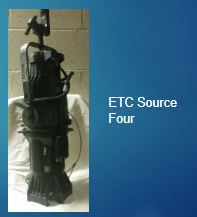
What is 2 example of an ellipsoidal reflector spotlight?
ETC Source Four
What can ERS’s be used for?
Long or short throw distances
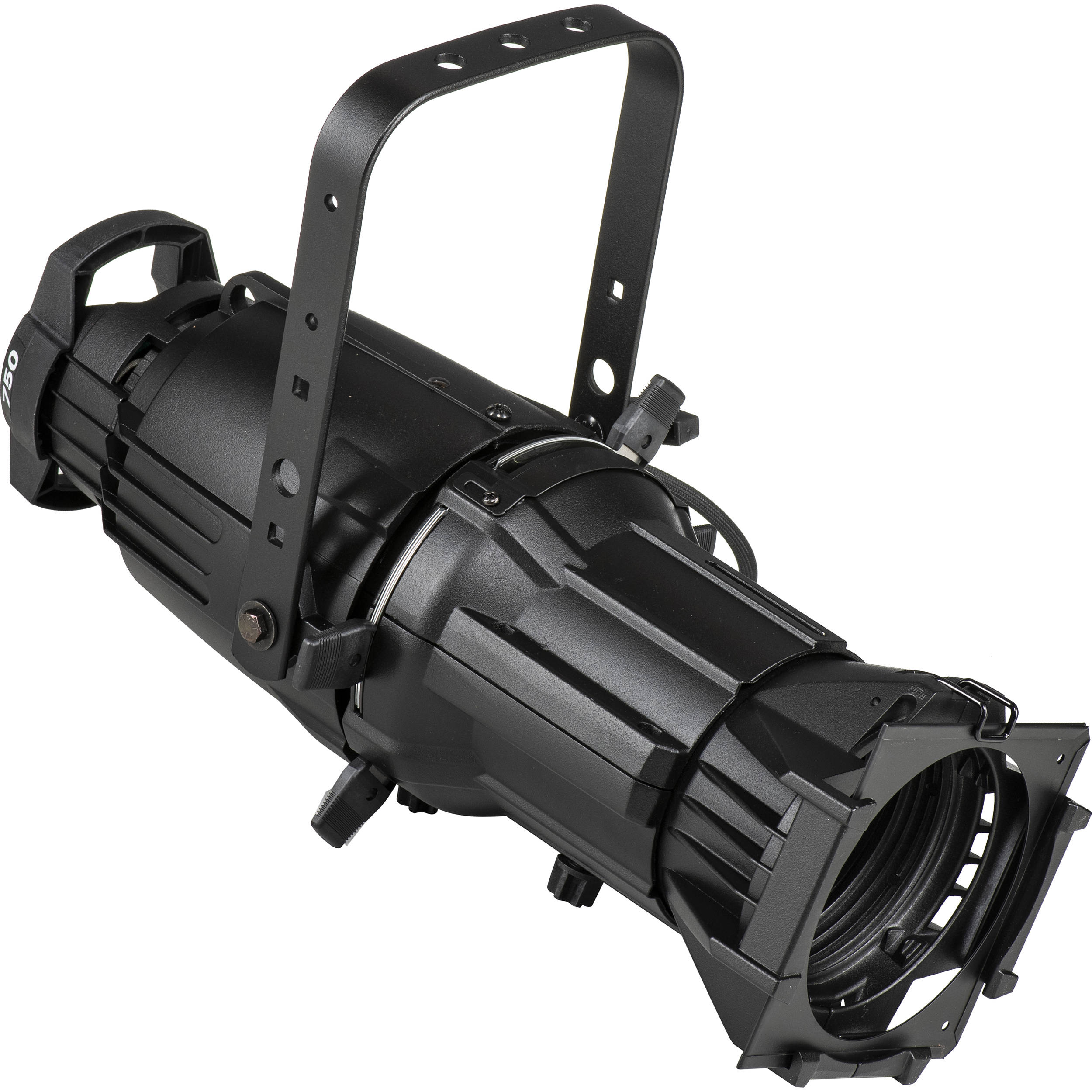
What lighting instrument is this?
ETC Source Four
What is an ETC Source Four?
an Ellipsoidal Reflector Spotlight (aka a Leko, an ERS, or an Ellipsoidal). Has interchangeable lens tubes which will change the beam angle degrees into either 19, 26, 36, or 50. This is a hard focused instrument capable of being used in short (50 degree), medium (26 degree) and long (19 degree) throw distance positions. It has an accessory slot for gobos (templates), irises and other add-on accessories.
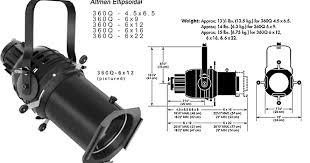
What lighting instrument is this?
Altman 360q
What is an Altman 360q?
another ERS fixture. Unlike the Source Four, ______have a fixed set of lenses and focal points. The ones we have are 6x12s which means it has a 6" diameter lens and a 12" focal length. This makes the field angle similar to a 26 degree Source Four ERS and makes it work well for short to medium throw distances.
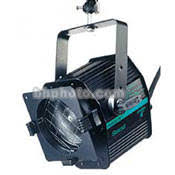
What is this lighting instrument?
A Strand Fresnel
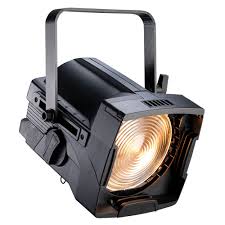
What is this lighting instrument?
ETC Source Four Fresnel
What are Fresnel Style instruments?
soft focused instruments, good of short throw distances., known as "wash" instruments because the produce a large, even pool of light which can be varied in size (from flood to spot) by turning the focus wheel.
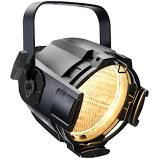
What is this lighting instrument?
ETC Source Four PAR
What is an ETC Source Four PAR?
a soft focused short throw instrument that produces an oval pool of light. The direction of the oval can be changed by rotating the lens. This instrument uses interchangeable lenses to produce different sized pool of light typically known as either; Wide Flood (WFL), Medium Flood (MFL), Narrow Spot (NSP) or Very Narrow Spot (VNSP)
What are circuits?
The physical receptacle which supplies power to conventional instruments
What are dimmers?
Things that control the flow of electricity to circuits.
What is a SCR?
Silicon Controlled Rectifiers, controlled by the light board
What does the term “dimmer per circuit” mean?
A system where every circuit has a corresponding dimmer assigned to it
What are channels?
A means of connecting the commands of the light board to the dimmers or devices being controlled
What are addresses?
A term sometimes used instead of channels, a networking protocol devices are connected to
What is patching?
A means of assigning or grouping vastly different circuits or dimmer numbers to manageable channel numbers
Connecting channels with drummers in the computer is known as _______.
Soft Patching
What light boards do we have at UMD?
Two different ETC (electronic theater control) boards from the Eos family.
Name several digital accessories for lighting:
Color scrollers, I-Cue, DMX Iris, Auto Yoke
What is a hue?
The quality that differentiates one color from another
What is saturation (chroma)?
The amount or percentage of a particular hue in a color mixture
What is value?
The relative lightness or darkness of a hue
What is tint?
A color mixed with white to give a high value.
What is shade?
A color mixed with black with a low value.
What is tone?
Colors of a middle value.
What does RBG stand for?
Red, blue, green
 Note
Note  Flashcards (96)