W9 - Hemispheric laterality
 Call Kai
 Learn
Learn Practice Test
 Spaced Repetition
 Match
Match Flashcards
 Knowt Play
1/23

There's no tags or description
Looks like no tags are added yet.
Name | Mastery | Learn | Test | Matching | Spaced | Call with Kai |
|---|
No analytics yet
Send a link to your students to track their progress
24 Terms
lateralisation of function
unequal representation of various psychological functions in the 2 hemispheres of the brain
have 2 of pretty much everything
how is lateralisation studied
split-brain patients
cortical localisation of functions through:
wada test
imaging methods (fMRI)
dichotic listening test (DLT)
early evidence for cortical localisation of functions - aphasia
deficit in language comprehension or production due to brain damage
usually on the left
Broca’s area
left inferior prefrontal cortex
damage leads to expressive aphasia
early evidence for cortical localisation of functions - apraxia
difficulty performing movements when asked to so out of context
also a consequence of damage on the left
primary motor cortex (Liepmann, 1900)
led to the theory of hemispheric dominance
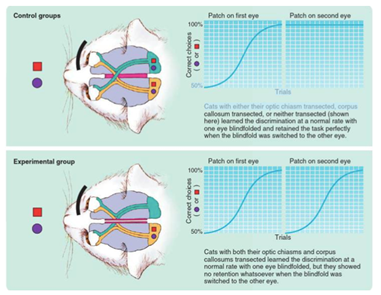
split brains in cats
Myers and Sperry (1953)
studied function of the corpus callosum
they cut the corpus callosum and optic chiasm in one group of cats
these are the two routes through which information from each eye crosses over the opposite hemisphere
catts were trained on a visual discrimination task when one eye was blindfolded
all cats (in the experimental and control group) first showed learning of the task and the same level
the blindfold was then transferred to the second eye
control cats performed the task at the same level, but the experimental group cats had to relearn the task
because of no transfer of information between hemispheres for experimental cats
shows the role of the corpus callosum in transferring information between the 2 hemispheres
left hemisphere
receives sensory input from right visual field and right hand
controls right hand movements
language
right hemisphere
receives sensory input from left visual field left hand
controls left hand movements
cannot speak
split brain in humans
replicated cat study with humans
person stares at fixation cross
word flashes on screen - visual acuity
for tenth of a second so no time to move eyes
objects out of sight - comprehension
brains already split, but optic chiasm intact as that can create blindness
something on right side of screen encoded in left hemisphere = language, so they say what they saw
controls right hand movements too so identify what was seen in right visual field
something on left side of screen encoded in right hemisphere, which cannot speak, so say they saw nothing
its the left side of brain answering which hasn’t seen anything in right visual field
controls left hand movements, so can identify the object
testing cerebral lateralisation - wada test
sodium amytal test
lateralisation of language
sodium amytal is inserted into the carotid artery on one side of the neck
anesthetize one hemisphere and check for a specific function (e.g., language) in the other
when the left hemisphere is anesthetized, production of speech is affected and when the ability returns this is associated with errors.
testing cerebral lateralisation - functional brain imaging methods
fMRI/PET can be used to see which half is more active when doing a language-related activity eg. reading
expensive and not everyone can go in one
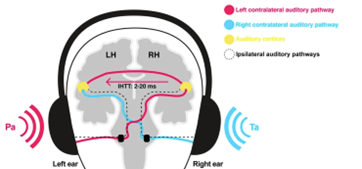
testing cerebral lateralisation - dichotic listening test (DLT)
involves the simultaneous presentation of two different acoustic signals to the right and left ears
participants better at reporting stimuli presented to the right ear if more left hemisphere dominant (Kimura, 1967; 2011)
because when both ears are simultaneously stimulated, uncrossed pathways are suppressed
right ear input directly reaches LH
but left ear input travels via RH
wada vs fMRI - Bauer et al. (2014)
conducted a meta-analysis and systematic review of studies comparing the Wada test with fMRI
81% of patients were correctly classified
of the 19% of patients where technique disagreed, most had atypical lateralization
of those correctly classified:
94% of patients were typical (left-hemispheric lateralization)
51% of patients were atypical language lateralization (right side)
wada vs DLT - Staruss et al. (1987)
epileptic patients whose speech dominance was ascertained using the Wada test were tested using a DLT
patients with typical LH speech dominance showed greater right-ear-advantage
laterality index score +37%, p < .05
no advantage towards either ear was seen for patients RH/atypical speech dominance
LI = -12%, ns
fMRI vs DLT - Hund-Georgiadis et al. (2001)
assessed language lateralisation using DLT and fMRI
the two methods showed very strong agreement (97.1%)
the lateralisation indices differed by more than 40% in 11/34 participants
greater variability in lateralisation in LH participants
conclusions of ways to test lateralisation
wada test = most valid and reliable
but most invasive
fMRI = non-invasive alternative
with lower validity and reliability than Wada
DLT = simple to administer with good convergent validity
fMRI and DLT more accurate in diagnosing typical language lateralisation
functional differences between the hemispheres
vision
left = words, letters
right = faces, geometric patterns, emotional expressions
audition
left = language sounds
right = music
touch
right = tactile patterns, braille
movement
left = complex and ipsilateral movements
right = movements in spatial patterns
memory
left = verbal memory
right = perceptual aspects in memory
language
left = speech, reading, writing
right = emotional content
spatial ability
right = mental rotation of shapes, direction, distance
where functional differences do exist, they tend to be slightly biased in favour of one hemisphere - not absolute differences
for example - language lateralisation is far from being absolute
language related activity also takes place in the right hemisphere of the brain
the right ear advantage in individuals with left language dominance is only 55%
anything other than language is very small
hemisphere functional differences
left hemisphere
plays superior role in controlling ipsilateral movements
damage to the left hemisphere can influence production or fine motor movements of the left compared to the right hand
right hemisphere
plays superior role in controlling spatial tasks/abilities (eg. hemispatial neglect) and emotions
how should we interpret functional laterization?
all cognitive processes associated with a broad functional category might not be lateralised to the same hemisphere
eg. speech perception and understanding word meaning involves the right hemisphere
anatomical asymmetries of the brain
the link between the anatomical and functional asymmetries of the brain is mixed
these language structures are different in the hemispheres:
frontal operculum
Heschi’s gyrus
Planum temporale
due to more recent evolution and adaptation to language
theories of cerebral asymmetry / evolution of lateralisation
analytic-synthetic theory
motor theory
linguistic theory
analytic-synthetic theory
2 modes of thinking:
analytic (left)
solves problems
synthetic (right)
creativity
vague and essentially untestable
motor theory
left hemisphere controls fine movements
speech is just a category of movement
does not explain why motor function would have become lateralised
linguistic theory
primary role of left hemisphere is language
damage to left hemisphere affects American sign language speakers’ language
but not charade gestures/movements
oversimplification

