Fish Buoyancy Control and Locomotion final
 Studied by 0 people
 View linked note
 Call Kai
 Learn
Learn Practice Test
 Spaced Repetition
 Match
Match Flashcards
 Knowt Play
1/37

Earn XP
Description and Tags
These flashcards contain key terms and definitions related to fish buoyancy control and locomotion to aid in exam preparation.
Name | Mastery | Learn | Test | Matching | Spaced | Call with Kai |
|---|
No analytics yet
Send a link to your students to track their progress
38 Terms
What is the primary function of the gas bladder in fish?
Helps w/ buoyancy control
allowing them to stay at a certain depth without much effort.
In some fish, it also aids in breathing.
General form of Gas bladders
gas-filled sac derived from anterior portion of the alimentary tract
Monopneumonan = 1 gas bladder
dipneuman = 2
Which orders have 2 gas bladders
Lepidosireniforms → Lepidosiren (South American lungfish) and
Polypteriformes → (bichirs and reedfish)
What is a Monopneumonan Gas Bladder?
monopneumonan gas bladder
single-chambered gas bladder found in many advanced bony fish (teleosts).
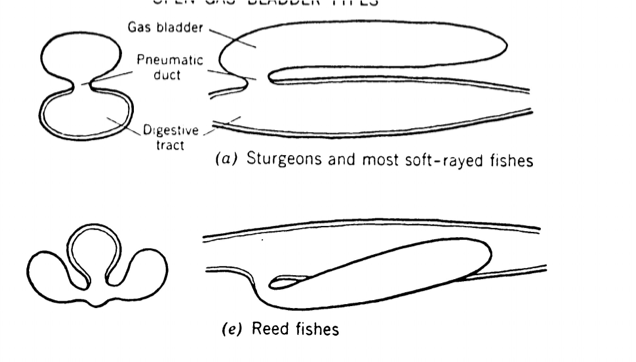
2 Gas bladder conditions
Physostomous Condition:
Has pneumatic duct
duct allows air to move directly between the digestive system and the gas bladder
More basal/primitive condition
ex: sturgeons and many soft rayed fishes
Physoclistous Condition
No pneumatic duct; connection to the esophagus has been lost
Instead, gas exchange occurs internally
more derived condition
ex: reed fishes
physostomous is the ancestral and physoclistous is a later-evolved condition in bony fishes.
What is a Physostomous Gas Bladder?
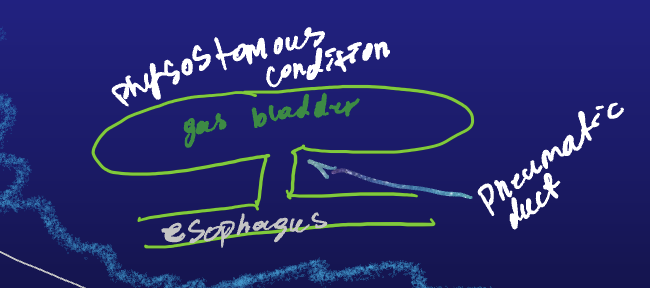
physostomous gas bladder:
Has a tube (a pneumatic duct) connecting to the esophagus.
Allows fish to gulp air to add gas or burp air to release gas.
Adjusts buoyancy (e.g., minnows, eels).
more primitive or basal condition
duct allows air to move directly between the digestive system and the gas bladder
Ex: sturgeons and many soft-rayed fishes
What is the function of the pneumatic duct?
The pneumatic duct connects the gas bladder to the esophagus in physostomous fish, enabling them to swallow or burp air to control buoyancy.
What is the function of the Gas Gland in fish buoyancy control?
The gas gland secretes lactic acid and carbon dioxide (CO_{2}), lowering blood pH to force gases into the gas bladder.
What is the Rete Mirabile and its function?
The rete mirabile is a network of tiny blood vessels (capillaries) that:
Operates as a countercurrent exchange system.
Traps gases, creating a high concentration (e.g., oxygen) near the gas gland.
Helps fill the gas bladder with gas.
What is the role of the Oval in the gas bladder?
The oval is a specialized, richly vascularized area of the gas bladder lining. It helps reabsorb gases from the bladder into the blood, allowing the fish to sink.
Where is the gas bladder typically found in fish?
Absent: In some bottom-dwelling or fast-swimming fish (e.g., tunas, flatfish, some sharks).
Present: In most bony fishes; thought to have evolved from primitive lungs.
What type of gas bladder is considered more primitive?
Physostomous bladders (with a pneumatic duct) are more primitive.
Physoclistous bladders (without a pneumatic duct, advanced secretion/reabsorption) are more evolutionarily advanced.
What starts the gas secretion process into the gas bladder?
The gas gland initiates gas secretion by releasing lactic acid and carbon dioxide (CO_{2}) into the rete mirabile's blood capillaries.
How does lactic acid affect blood in the gas bladder system?
Lactic acid lowers blood pH, causing hemoglobin to release oxygen (Bohr effect) and reducing its oxygen-carrying capacity (Root effect), thus pushing oxygen into the gas bladder.
What is the 'salting out' effect in gas secretion?
The 'salting out' effect occurs when concentrated acid and CO_{2} reduce gas solubility in the blood, forcing more gas into the gas bladder.
How does the rete mirabile's countercurrent system help gas secretion?
The rete mirabile's countercurrent system traps released gases, building high pressure (especially oxygen) that drives gases into the gas bladder.
What is the mechanism of gas reabsorption from the gas bladder?
Gas reabsorption occurs via the oval. When its muscle relaxes, a blood-rich area is exposed, allowing gases to diffuse from the bladder back into the blood.
Describe the basic mechanism of whole-body locomotion in fish.
Fish move by:
Rhythmic, wave-like contractions of body muscles (myotomes) from head to tail.
Pushing against water for propulsion.
The tail providing most of the thrust.
What are Epaxial Myotomes?
Epaxial myotomes are muscle segments located dorsal (above the spine) that help bend the fish's back and tail.
What are Hypaxial Myotomes?
Hypaxial myotomes are muscle segments located ventral (below the spine) that also contribute to body bending and tail propulsion.
How are fish myotomes arranged?
Fish myotomes are arranged in a W or V-shape pattern, providing leverage and efficiently transmitting force to the spine and skin for movement.
What are myosepta and their role in fish locomotion?
Myosepta are connective tissue sheets that:
Separate individual muscle segments (myotomes).
Act as attachment points for muscle fibers.
Transmit muscle contraction force to the skeleton and skin, aiding movement.
What is the Vertical Myoseptum?
The vertical myoseptum is a key connective tissue sheet dividing the epaxial (dorsal) and hypaxial (ventral) muscle groups in fish.
What is Anguilliform locomotion?
Anguilliform locomotion is when over half of the fish's body forms a wave (e.g., eels). It allows navigation in complex spaces but creates high drag.
What is Carangiform locomotion?
Carangiform locomotion involves undulations mainly in the posterior (rear) half or third of the body, with a stiff main body and strong tail fin beats (e.g., mackerel). It's efficient for fast swimming with less drag.
What is attached flow in fish hydrodynamics?
Attached flow is when water flows smoothly over the fish's body with minimal turbulence, reducing drag (seen in streamlined fish at moderate speeds).
What is separated flow in fish hydrodynamics?
Separated flow is when water detaches from the fish's body, creating turbulent swirls (eddies) that greatly increase drag (occurs with blunt shapes or sharp body angles).
What is Pressure Drag (Form Drag) in fish locomotion?
Pressure Drag (Form Drag) is a resistance force caused by water pressure differences around a moving fish. Streamlined shapes minimize it.
What is Friction Drag (Viscous Drag) in fish locomotion?
Friction Drag (Viscous Drag) is resistance from the rubbing force between water and the fish's body surface. A smooth surface and small surface area reduce it.
What is Lift in fish locomotion?
Lift is a force perpendicular to a fish's motion, generated by fin movements (like an airplane wing), aiding in maneuvering or depth control.
What is Balistiform locomotion?
Balistiform locomotion is fish movement by rhythmically waving their dorsal (top) and anal (bottom) fins (e.g., triggerfish).
What is Rajiform locomotion?
Rajiform locomotion is characterized by wave-like movements of large, paddle-like pectoral fins (e.g., rays, skates).
What is Amiiform locomotion?
Amiiform locomotion involves only the wavy movements of the dorsal fin (e.g., bowfin).
What is Labriform locomotion?
Labriform locomotion describes movement generated by the oar-like or rowing motions of the pectoral fins (e.g., wrasses, parrotfish).
What do Erector Muscles do in fish fins?
Erector muscles are responsible for lifting or extending a fish's fins.
What do Depressor Muscles do in fish fins?
Depressor muscles are responsible for lowering or retracting a fish's fins.
What do Inclinator Muscles do in fish fins?
Inclinator muscles adjust the angle or tilt of the fins, allowing for precise control and steering.
Why is the physoclistous condition considered more evolutionarily advanced?
The physoclistous condition is more advanced because it allows fish to achieve precise, internal control of buoyancy without needing to surface. This is crucial for maintaining depth in diverse aquatic environments and relies entirely on specialized internal mechanisms like the gas gland, rete mirabile, and oval for gas regulation.
 Flashcards (77)