AP Government: The Bureaucracy
 Call Kai
 Learn
Learn Practice Test
 Spaced Repetition
 Match
Match Flashcards
 Knowt Play
1/30

There's no tags or description
Looks like no tags are added yet.
Name | Mastery | Learn | Test | Matching | Spaced | Call with Kai |
|---|
No analytics yet
Send a link to your students to track their progress
31 Terms
Cabinet
persons appointed by a head of state to head executive departments of government and act as official advisers
Executive (Cabinet) Departments
1. The 15 cabinet departments
2. Each department specialized to enforce laws/policies in a particular area and is made up of agencies to do so
3. Each cabinet is supervised by a secretary who is a presidential appointee that has been approved by the Senate
4. Cabinet Department Hierarchy:
President--> Department Secretary --> Deputy Secretary --> Under Secretary
Independent Regulatory Commissions
1. In charge of making, enforcing and regulating rules to protect the public interest in certain areas of the economy
2. Benefit: Independence increases each agency's ability to focus on its mission
Cost: Independence also weakens its willingness to cooperate
3. Examples: Federal Communications Commission (FCC), Food and Drug Administration (FDA), Federal reserve board (FRB)
Executive Orders
Formal orders issued by the president to direct action by the bureaucracy.
Bureaucracy
system of managing government through departments run by appointed officials
Patronage
(politics) granting favors or giving contracts or making appointments to office in return for political support
Spoils System
The practice of rewarding supporters with government jobs. Jackson made this practice famous for the way he did it on a wide scale.
Pendleton Act
created a federal civil service so that hiring and promotion would be based on merit
Discretionary Authority
the extent to which appointed bureaucrats can choose courses of action and make policies that are not spelled out in advance by laws
Merit System
hiring people into government jobs on the basis of their qualifications, rather than patronage.
Hatch Act
Limits political activities of civil service employees
(running partisan elections, making or soliciting political contributions, influencing elections, running for office as a member of a political party, etc...)
Appropriations
the amounts of money approved by Congress in statutes (bills) that each unit or agency of government can spend
Red Tape
Complex bureaucratic rules and procedures that must be followed to get something done
2 Ways Federal Bureaucracy Hires Employees
1. Civil service system
2. Presidential recruitment and appointment
Government Corporations
1. Are intended to act more like businesses
2. Make money by charging for services
3. Example:
a) US Postal Services sells stamps and charges for mail delivery
b) Amtrak sells railroad tickets and charges shipping costs.
Executive Agencies
1. Small bureaucracies that serve a specific group of Americans or work on specific problems
2. Independence increases each agency's ability to focus on its mission
3. Leaders generally appointed by the president and may have partisan motivations
4. Examples: Environmental Protection Agency (EPA), Central Intelligence Agency (CIA), National Aeronautical and Space Agency (NASA)
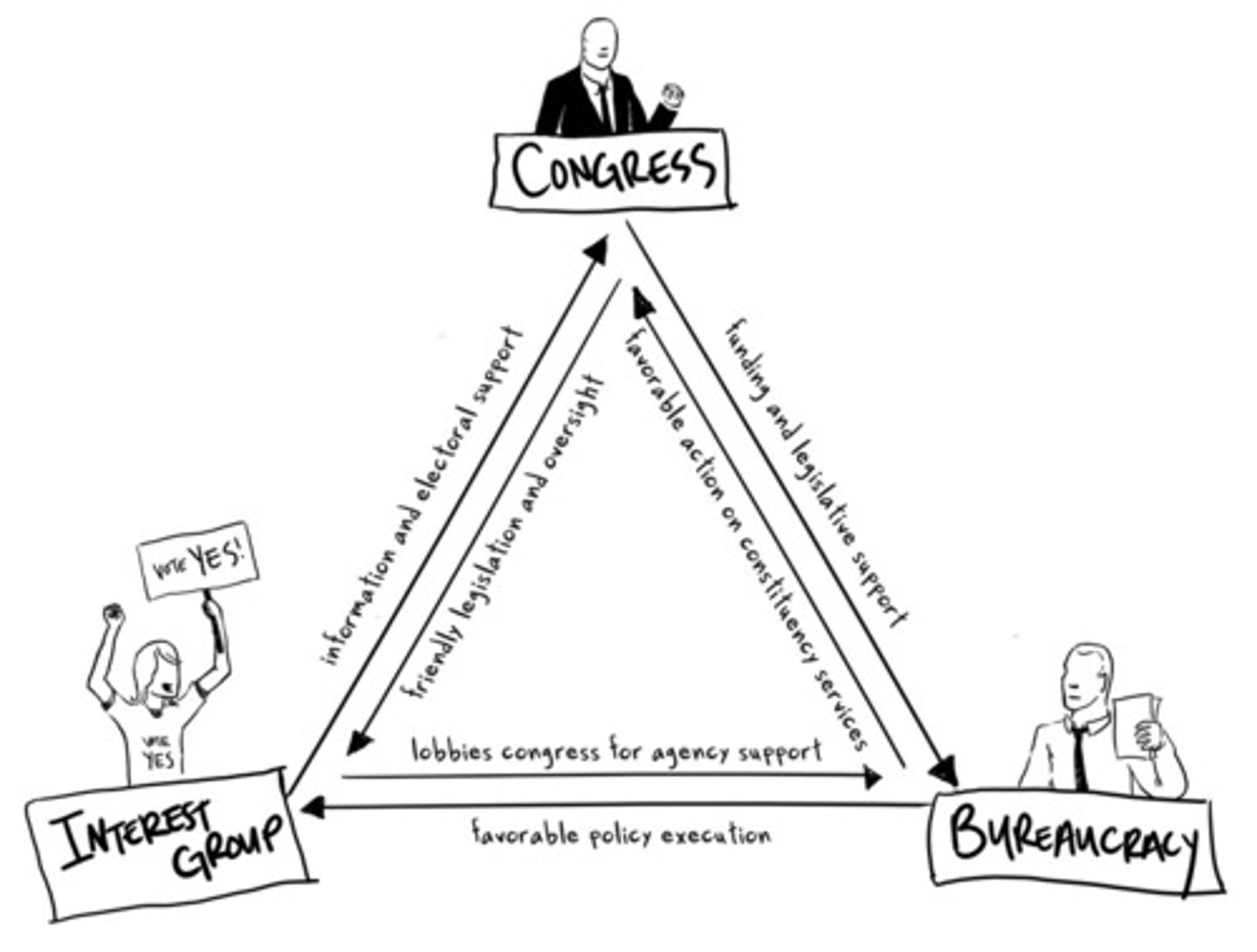
Iron Triangle
1. Interest group advocates a policy
2. Congressional committee writes/handles that policy
3. bureaucratic agency in charge of enforcing that policy
issue network
A network that includes policy experts, media pundits, congressional staff members, and interest groups who regularly debate an issue.
Department of Homeland Security
US federal agency created in 2002 to coordinate national efforts against terrorism
Department of Transportation
Manages the nations highways, railroads, airlines, and sea traffic
Department of Veterans Affairs
Directs services for armed forces veterans
Department of Education (1979)
administers federal aid programs to schools, engages in educational research
Enviromental Protection Agency (EPA)
an independent federal agency established to coordinate programs aimed at reducing pollution and protecting the environment
Securities and Exchange Commission (SEC)
monitors the stock market and enforces laws regulating the sale of stocks and bonds
Congressional Oversight
a committee's investigation of the executive and of government agencies to ensure they are acting as Congress intends
agency capture
process whereby regulatory agencies come to be protective of and influenced by the industries they were established to regulate
bureaucratic adjudicating
Determining the rights and duties of particular parties within the scope of an agency's rules or regulations
bureaucratic regulations
a set of rules that guide employees of an agency in carrying out a program or service.
bureaucratic discretion
bureaucrats' use of their own judgement in interpreting and carrying out the laws of Congress
Implementation
the process by which a law or policy is put into operation
career civil servants
Employees within the executive departments who are hired rather than appointed for their position

