Tissues of the skeletal system
 Call Kai
 Learn
Learn Practice Test
 Spaced Repetition
 Match
Match Flashcards
 Knowt Play
1/17

There's no tags or description
Looks like no tags are added yet.
Name | Mastery | Learn | Test | Matching | Spaced | Call with Kai |
|---|
No analytics yet
Send a link to your students to track their progress
18 Terms
why do we need both skeleton and muscle
movement requires both msucle and incompresible skeleton bcs muscles will only produce effective movement if they pull on a structure that doesnt shorten or bend
what is a bone
the strong, calcium-rich tissue which is the main component of the vertebrae skeleton
bone structure
Made of bone cells which are fixed firmly in a matrix of collagen and calcium salts
Bone needs to be light to reduce weight we carry, compact bone is dense and heavy. This is the long bones of your body
Spongy bones have a much more open structure to much lighter
what is cartilage
hard but flexible skeletal tissue that often acts as a shock absorber and prevents wear in joints
cartilage structure
made up of cells called chondrocytes within an organic matrix which consists of varying amounts of collagen fibres
Cartilage is elastic and able to withstand compressive forces
what are the two main types of cartilage?
Hyaline cartilage is found at the ends of bones ( and in the nose, air passageways and parts of ear)
White fibrous cartilage has bundles of densely packed collagen in the matrix. It has great tensile strength but is less flexible than the other forms of cartilage. It forms the discs between your vertebrae and is found between the boens in the joints
what are tendons
strong connective tissues which connect muscles to bones
structure of tendons
made up almost entirely of white fibrous tissue. This consists of bundles of collagen fibres,
One end of tendon is attached to muscles and other end directly to bone or to a fibrous cover of bone
property of tendons
They are flexible but do not stretch when a muscle is contracting and pulling on a bone
There are a few muscles with very long tendons and also a few that are directly attached to the bone
what are ligaments
Ligaments are also lengths of strong connective tissue but they connect bones to other bones, which keep the skeleton intact
structure of ligaments
they form a capsule around the joint and hold the boens together inside the joint itself
elastic so bones of joint can move
Made of yellow elastic tissue which gives an ideal combination of strength with elasticity
what are the different types of joints
shoulder-ball and socket joint
elbow-pivot joint
wrist-saddle joint
finger joint
knee-hinge joint
joint between ankle bones
what is synovial fluid
joint lined with a replaceable layer of rubbery cartilage to articulate smooth movement and to prevent ends from becoming weaker and thinner by rubbing together
The most mobile joints also have liquid lubricant called synovial fluid
It fills the joint cavity and ensures easy friction-free movement
how muscles mover
Muscles are only capable of contracting or pulling, they cannot push
As a result of this limitation muscles generally operate in pairs
Each skeletal muscles is attached by tendons to two diferent bones,e xtending across atleast one joint
A muscle pulls in one direction at a joint and the other muscle pulls in the opposite direction
This is described as antagonistic muscle action
what are extensors
muscles that extend (stretch or open) a joint
what are flexors
muscles that flex (close or bend) a joint
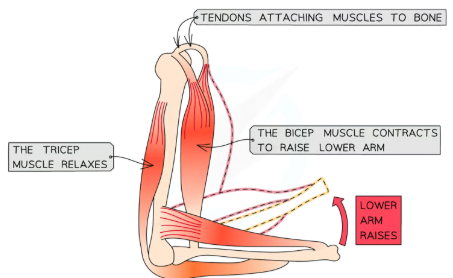
process of raising lower arm
The bicep contracts and the tricep relaxes
As the bone can't be stretched the arm flexes around the joint
A muscle that bends a joint during contraction is known as a flexor (the bicep in this case)
This brings the tricep into its full length so that it can contract again
process to lower the lower arm
The tricep contracts and bicep relaxes
As the bone can't be stretched the arm flexes around the joint
A muscle that straightens a joint during contraction is known as an extensor (the tricep in this case)

