Mechanics of Materials reminder stuff
 Call Kai
 Learn
Learn Practice Test
 Spaced Repetition
 Match
Match Flashcards
 Knowt Play
1/39

There's no tags or description
Looks like no tags are added yet.
Name | Mastery | Learn | Test | Matching | Spaced | Call with Kai |
|---|
No analytics yet
Send a link to your students to track their progress
40 Terms
Which way is tension and which is compression?
Tension = ← [object] → (think like a string)
Compression = → [obj] ←
Unit for stress?
Pascal (Pa)
What are the units of a Pa
N/m² = kg/(m*s²)
Factor of Safety? F.S.
permitted stress/actual stress
permitted stress = theoretical load. The amount that would cause our part to break
actual stress = actual load. The amount that we calculate/have rn.
What is a kip
1000 lb
What does negative stress mean in normal stress?
The part is under compression (compressive stress)
Positive stress number suggests tensile stress
Normal Stress
σ = P/A
σ = Normal stress, P = axial force, A = cross sectional area
Shearing Stress
T = P / A
T = shearing stress (supposed to be tau not t), P = shearing force, A = cross sectional area
Double shear?
When shear occurs in two spots. You multiply the area by 2 lol, but the force stays constant
Strain
ε = δ / L
ε = Strain, δ = deformation, L = initial length
Bearing Stress
σ = P/A
σ = Bearing stress, P = load force, A = projected area
What is young’s mod also called
Elastic modulus
Young’s mod
E = σ / ε
E = young’s mod, σ = stress, ε = strain
Deformation
δ = PL / (AE)
δ = deformation, P = force, L = Length, A = cross section area, E = young’s mod
Total deormation?
Sum of all section deformations
Poisson’s ratio
V = - lateral strain / axial strain
The V represents nu letter
ranges from 0.0 (cork) to 0.5 (rubber)
How will a cube deform under shearing stress?
Will deform into a rhomboid
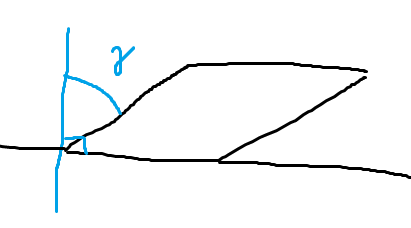
Shear strain of a cube
T = GY
T = tau = shearing strain (tau is also used for shearing stress for like bolts and stuff idk why)
G = Modulus of rigidity or shear modulus
Y = gamma = angle (demonstrated in pic)
Modulus of rigidity?
G = E/2(1+V)
G = modulus of rigidity (shear mod), E = young’s mod, V = poisson’s ratio
Stress concentration factor?
K = σmax / σavg
Shearing strain (for torsion) (for cylinder)?
Y = ρ Φ / L
Y = gamma = shearing strain, ρ = distance of point from axis (largest is r), Φ = angle of deformation (looking at the cross section), L = length
Second polar moment of area of circle?
J = π r4 / 2
What is second polar moment of area also called
second moment of inertia
Second polar moment of area of a hollow circle
J outer - J inner
Shear stress for elastic torsion
T1 = T ρ / J
T1 = tau = shear stress, T = torsion, ρ = distance from center of axis (max is r), J is second polar moment of area
called torsion stress on formula sheet
How do ductile materials generally fail in torsion
Shear
How do brittle materials generally fail in torsion
Tension
Hooke’s law
σ = E ε
σ = stress, E = youngs mod, ε = strain
(i assume this is axial stress)
What is it called when something fails after repeated loadings?
Fatigue. Usually fails in a brittle nature.
Endurance limit
Stress for which failure doesn’t occur over an indefinitely large number of cycles
Fatigue limit
Stress corresponding to failure after a specified number of loading cycles
Deformation of a non homogeneous rod
δ = (integral from 0 to L) P dx / (A E)
δ = deformation, P = axial force, dx = integral thing, A = cross sectional area, E = young’s mod.
Angle of twist for an object in torsion
Φ = T L / (G J)
Φ = angle (looking at cross section), T = torsion, L = length, G = shear mod, J = 2nd polar moment of area
Power?
P = T ω
P = power, T = torque, ω = angular speed (rad/sec)
Units for power?
SI = N m / sec.
American = ft lb / sec
Horsepower?
550 ft lb / sec
Horsepower to watts
1 hp = 745.7 watts
Linear thermal expansion
δ = α (ΔT) L
δ = expansion amount (not final length), α = thermal expansion coefficient, ΔT = change in temp (in C unless α is in F units), L = length
Thermal strain
ε = α (ΔT)
ε = thermal strain, α = thermal expansion coefficient, ΔT = change in temp (in C unless α is in F units).
Gear ratio information
Large gear / smaller gear = ratio
Smaller gear spins ratio times faster
Bigger gear spins with ratio amount more torque.

