Genetics and society unit 1
 Studied by 0 people
 Call Kai
 Learn
Learn Practice Test
 Spaced Repetition
 Match
Match Flashcards
 Knowt Play
1/42

There's no tags or description
Looks like no tags are added yet.
Name | Mastery | Learn | Test | Matching | Spaced | Call with Kai |
|---|
No analytics yet
Send a link to your students to track their progress
43 Terms
Genetics
Started as a field of study inheritance of traits
People observed that like gave rise to like
Organisms produced offspring of the same type of organism
Offspring often had specific traits that resembled parents
Something was passing from parent to offspring
The basic type of experiment that Mendel used
Controlled matings:self fertilization or cross fertilization of pea plants
found a 3-1 ratio of dominant to recessive
Law of Segregation
Each individual possesses two alleles for a particular trait (e.g.,
Aa 𝐴𝑎), which separate (segregate) during the formation of gametes (egg/sperm), ensuring each gamete carries only one allele. This means an offspring receives one allele from each parent, allowing for the re-emergence of recessive traits in later generations.
Law of Independent Assortment (Second Law)
: Genes for different traits (such as seed color and seed texture) are sorted into gametes independently of one another. This principle explains how traits can appear in new, diverse combinations, such as a plant having green, wrinkled seeds, even if neither parent possessed that exact combination.
Principles of Dominance
: Mendel observed that for a specific trait, one allele might mask the presence of another (the recessive allele), determining the organism's visible appearance (phenotype).
Masking
Masking- Dominate (Purple -
Phenotype
How the trait played out. If the plant was purple it had the dominant phenotype
Genotype
Combination of allele
Allele
different versions of a gene for the same trait. (Colors of the pea).
Monohybrid crosses-looking at a single trait
True breeding line that will always produce offspring identical to the parents
Involve a single pair of contrasting traits
P1 generation: original parents
F1 generation:offspring
F2 generation: offspring of f1 generation crossed (self fertilizing: “selfing”)
For the experiment- P Generation crosses purple flowers and white flowers
The f1 generation resulted in only purple flowers
The f2 produced 705 purple flowered plants and 224 white flowered plants (Approx 3-1 ratio of purple to white)
Homozygus dominant-
- PP- Genotypes that have two of the same phenotype that are dominant
Mendle Ratio?
Mendle Ratio- 100% F1 dominant and 3:1 f2 dominant to recessive
At certain times the chromosomes condense-Chromosome condensation
They get shorter and fatter
Only see the chromosomes when they are in mitosis and condensed
first in prophase
chromosome structure
DNA-negative charge
Histone proteins-cylindrical proteins that dna wraps around
Have positive charges on their surface that attracts dna
P arm- top
Centromere
Q arm- bottom
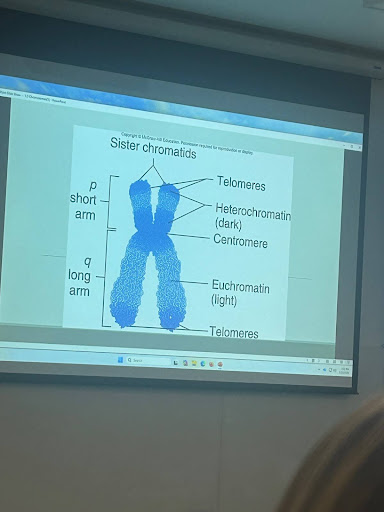
Replicated vrs unreplicated chromosomes
replicated form an X unreplicated just I
replicated have sister chromatids
Morgan’s work and how it showed genes were located on chromosomes
he noticed that the inheritance pattern of eye color was linked to sex. The white-eye trait appeared mostly in males, which led Morgan to conclude that the gene for eye color was located on the X chromosome.
What is meant by linked genes and their pattern of inheritance
Linked genes are genes that are located close together on the same chromosome. Because of their physical proximity, they tend to be inherited together during meiosis rather than assorting independently.
Pattern of inheritance:
Linked genes do not follow Mendel’s law of independent assortment.
They are usually passed on as a group from parent to offspring.
The closer the genes are on the chromosome, the less likely they are to be separated by crossing over.
Occasionally, crossing over during meiosis can separate linked genes, creating new combinations, but this happens less often than with genes on different chromosomes.
how recombination separates linked genes
During meiosis I, matching chromosomes line up next to each other.
Portions of DNA are exchanged between the chromosomes (this is recombination).
If this exchange happens between two linked genes, the genes end up on different chromosome pieces.
As a result, new combinations of traits appear in the offspring.
The farther apart the genes are on a chromosome, the more likely recombination will separate them. Genes that are very close together usually stay linked.
How the mechanism of meiosis explains the findings of both Mendel and Morgan
For Mendel, meiosis explains his laws of inheritance. During meiosis I, homologous chromosomes separate, which explains the law of segregation—each gamete receives only one allele of a gene. The random orientation of chromosome pairs during meiosis explains the law of independent assortment, where genes on different chromosomes are inherited independently.
For Morgan, meiosis explains why some genes do not assort independently. Morgan discovered linked genes, which are genes located on the same chromosome. During meiosis, these genes tend to stay together. However, crossing overduring meiosis can separate linked genes, explaining the recombinant offspring Morgan observed in fruit flies.
What type of cells are produced by meiosis
Meiosis produces haploid sex cells, also called gametes.
haploid,
The genetic condition of having only one copy of each chromosome
diploid,
The genetic condition of having pairs of homologous chromosomes
Most cells are diploid
somatic cell,
Somatic cells are body cells that make up most of an organism’s tissues and organs.
They are not involved in reproduction
They are diploid, meaning they contain two sets of chromosomes (one from each parent)
Examples include skin cells, muscle cells, and nerve cells
gamete
sperm or eggs for humans
What does meiosis do
Meosis- Process by which gametes are formed
Phases of Meiosis 1
Prophase I – Chromosomes pair up, crossing over occurs, and genetic material is exchanged
Metaphase I – Homologous chromosome pairs line up at the center of the cell
Anaphase I – Homologous chromosomes separate
Telophase I – Two haploid cells form
phases of meiosis 2
Meiosis II
(Similar to mitosis)
Prophase II – Chromosomes condense again
Metaphase II – Chromosomes line up at the center
Anaphase II – Sister chromatids separate
Telophase II – Four genetically different haploid cells are produced
These phases explain how meiosis creates genetically diverse gametes.
Spermatogenesis
Sperm cell production
Meiosis occurs as described with equal separation of cytoplasm and cell material
After meiosis 2 you have four haploid spermatids
These need to be modified to produced sperm cells
This process is called differentiation
Each spermatid loses unneeded cell material to streamline them
Each gets a flexible flagellum for swimming
The mitochondria of each cells moves to the collar of the cell
Mitochondria produce energy so these power the flagellum
Ends with four similar spermatozoa
Oogenesis
Oogenesis is the process by which female gametes (eggs or ova) are produced in the ovaries.
Oogenesis is distinct because during telophase 1 and 2 the cells are not divided evenly
One cell gets much more cytoplasm and cell material (Oocyte)
One cell gets much less amd is smaller as a result (polar body)
Only the oocyte from meiosis 1 goes to meiosis 2
This produces an ootid and secondary polar body
Neither polar body will become an egg (ovum
Only the ootid differentiates to become an ovum
Ova are much larger and contain more cell material than spermatozoa
You inherit all of your mitochondria from your mother
When human males and females perform their respective gametogenesis reactions
Males: Gametogenesis is continuous after puberty.
Females: Gametogenesis is cyclical and limited, starting before birth and completing meiosis only after fertilization.
The phases of the cell cycle and what is happening in each phase
G1 phase- cell grows in size
G0 Phase-The rest cycle
S phase -Replicates DNA and forms sister chromatids
G2 Phase-cells grow more and check for repairs
M Phase -Mitosis occurs
The phases of mitosis and what is happening in each
Interphase- Cell grows
Prophase- Chromosomes condense and become visible.
Spindle fibers start to form from the centrosomes.
The nuclear envelope breaks down.
Metaphase -Chromosomes line up at the center of the cell (metaphase plate).
Spindle fibers attach to the centromeres of each chromosome.
Anaphase-Sister chromatids are pulled apart by the spindle fibers.
Chromatids move to opposite poles of the cell.
Telophase -Chromatids reach the poles and begin to uncoil into chromatin.
Nuclear envelopes reform around each set of chromosomes.
The spindle fibers disassemble.
The mechanism of chromosomal separation (molecular roles of the kinetochore)
The kinetochore acts as both a sensor and a mechanochemical engine—it attaches chromosomes to microtubules, monitors correct orientation, and harnesses microtubule dynamics and motor proteins to physically pull chromatids apart.
The mechanisms of cytokinesis in plant and animal cells
Animal cytokinesis: Contractile ring constricts the membrane, pinching the cell in two.
Plant cytokinesis: Vesicles form a new cell plate that grows outward to divide the cell.
How cell cycle control and cancer are related
the checkpoints in the development of the cell fail, it leads to the cell replicating that failed part uncontrollably
Mendel’s rule does not apply when
One gene encodes one trait
Two possible alleles per gene
One allele will be dominant over the other
Genotype produces predictable phenotype
Complete dominance
Complete dominance- masks affect of recessive gene-MENDELS
Incomplete dominance
Incomplete dominance-intermediate phenotype half way between two parents
Red x White= Pink
Codominance
Codominance-Both genes express slightly different, but not exclusive traits
RedxWHite= White marbled with red
The genetics of human ABO blood typing
Complex system with 3 possible alleles and codominant relationship
Antigen- a molecule recognized by the immune system
Gene encodes antigens on red blood cells
3 alleles- A encodes A antigen, b encodes B antigen, O encodes no antigen
Phenotypes are blood types
6 different genotypes
AA and AO produce A phenotype (42% of population
BB and BO produces B phenotype (10% of pop
OO produces ) phenotype (44% of ppp
AB produces AB phenotype (4% of pop
How traits encoded by multiple genes are often expressed as a normal distribution
When a trait is influenced by many genes, each adding a small effect, and environmental factors also contribute, the combined effect produces a continuous range of phenotypes. Most individuals cluster around the average, while extremes are rare, giving the familiar normal (bell-shaped) distribution.
Think the skin color melanin example
Examples of how environmental factors affect phenotypes
Nutrition
Light exposure
Temperature
 Note
Note  Flashcards (25)