UCF Anatomy Block 4 Study Guide
 Call Kai
 Learn
Learn Practice Test
 Spaced Repetition
 Match
Match Flashcards
 Knowt Play
1/168

There's no tags or description
Looks like no tags are added yet.
Name | Mastery | Learn | Test | Matching | Spaced | Call with Kai |
|---|
No analytics yet
Send a link to your students to track their progress
169 Terms
What is the clinical significance of fractures of the humerus?
Fracture of the surgical neck, middle of the shaft, distal end of humerus, or medial epicondyle
Traumatic separation of the proximal epiphysis under 18-20 years
Dislocation of the shoulder joint
What is injured when the surgical neck of the humerus is fractured?
Axillary nerve
What is injured when the middle of the humerus shaft is fractured?
Radial nerve = wrist drop
What is injured when the distal end of the humerus is fractured?
Median nerve
What is injured when the medial epicondyle of the humerus is fractured?
Ulnar nerve
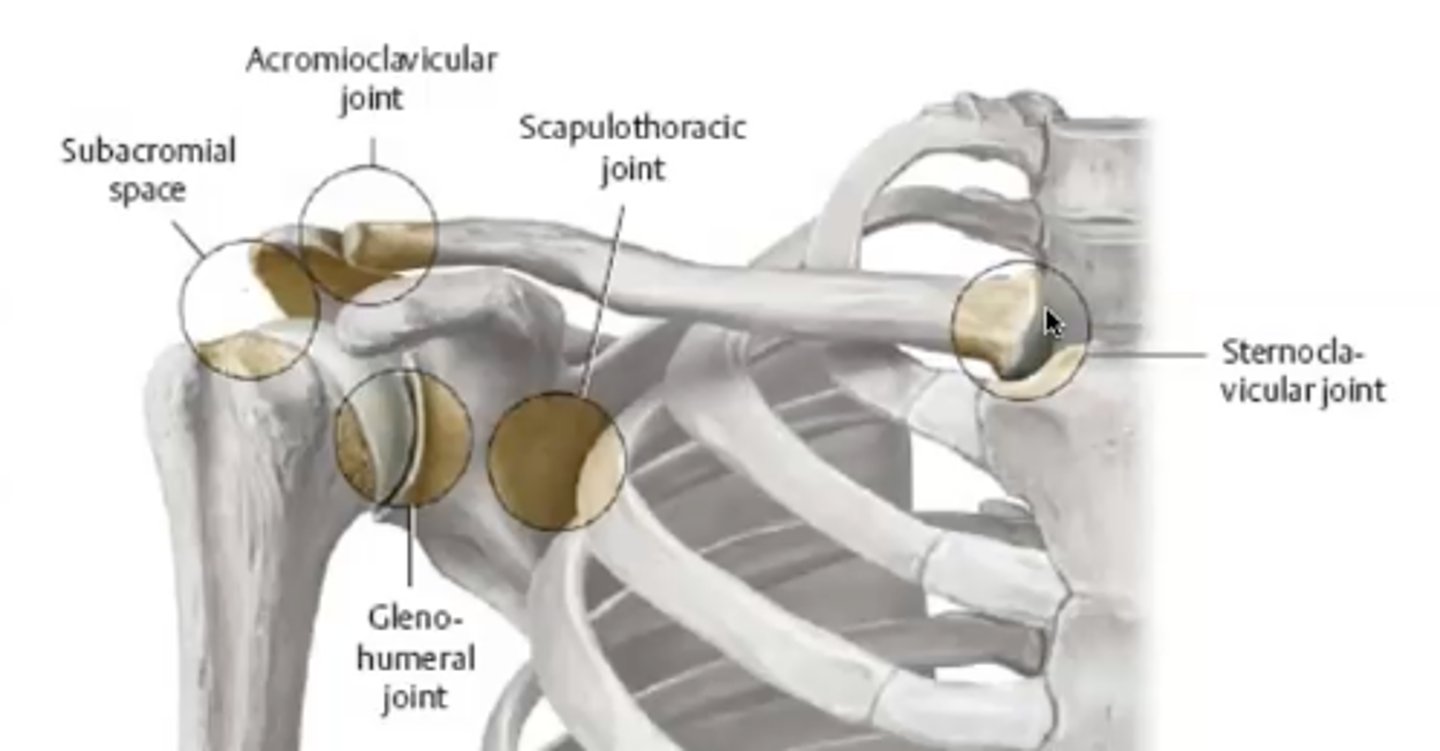
What are the four joints of the shoulder and where are each located?
What is the innervation of the trapezius?
Accessory n. (CN XI); cervical plexus (C3-C4)
What is the location of the trapezius?
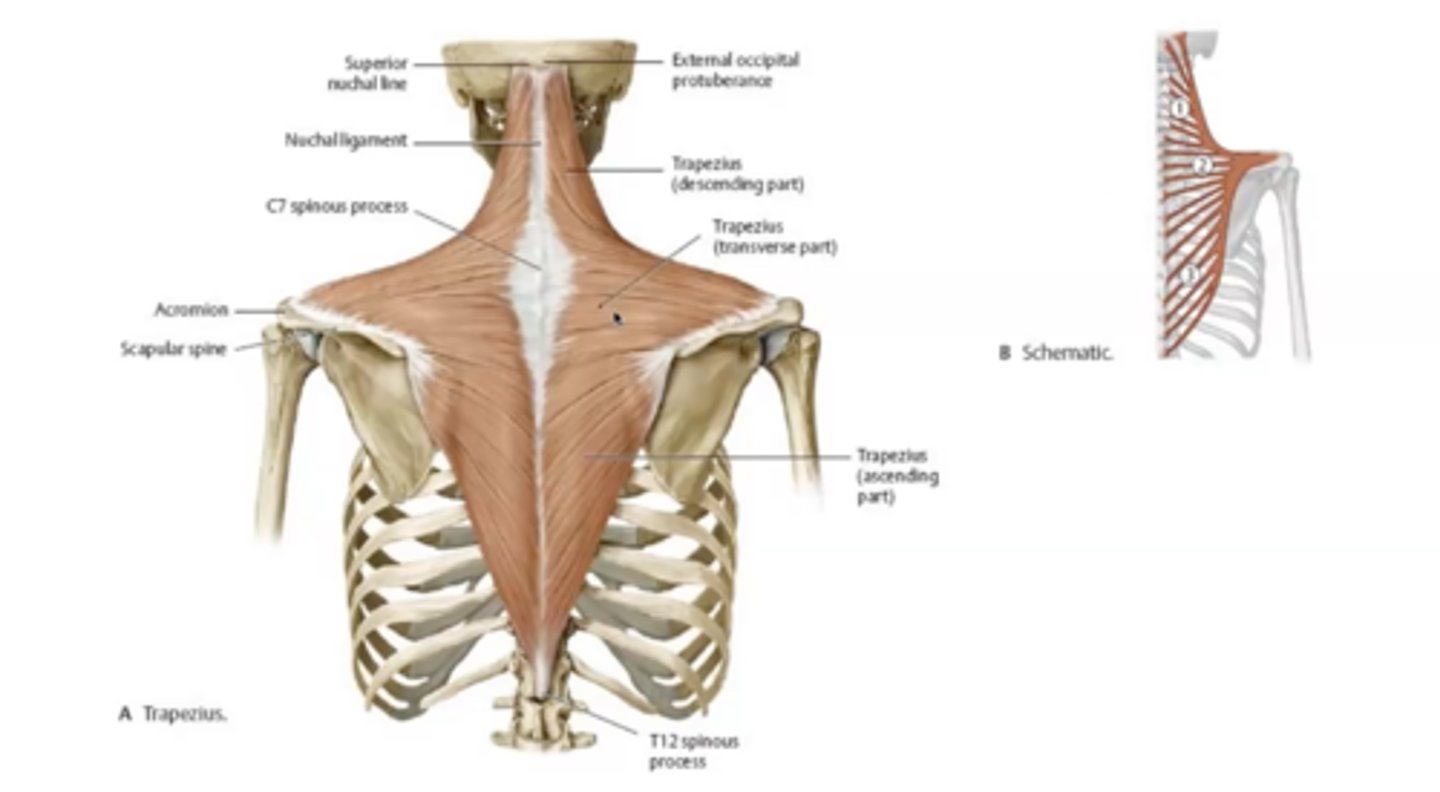
What is the function of the descending part of the trapezius?
Draws scapula obliquely upward; rotates glenoid cavity superiorly; tilts head to same side and rotates it to opposite
What is the function of the transverse part of the trapezius?
Draws scapula medially
What is the function of the ascending part of the trapezius?
Draws scapula medially downward
What is the function of the trapezius?
Steadies scapula on thorax
What is the innervation of the latissimus dorsi?
Thoracodorsal n. (C6-C8)
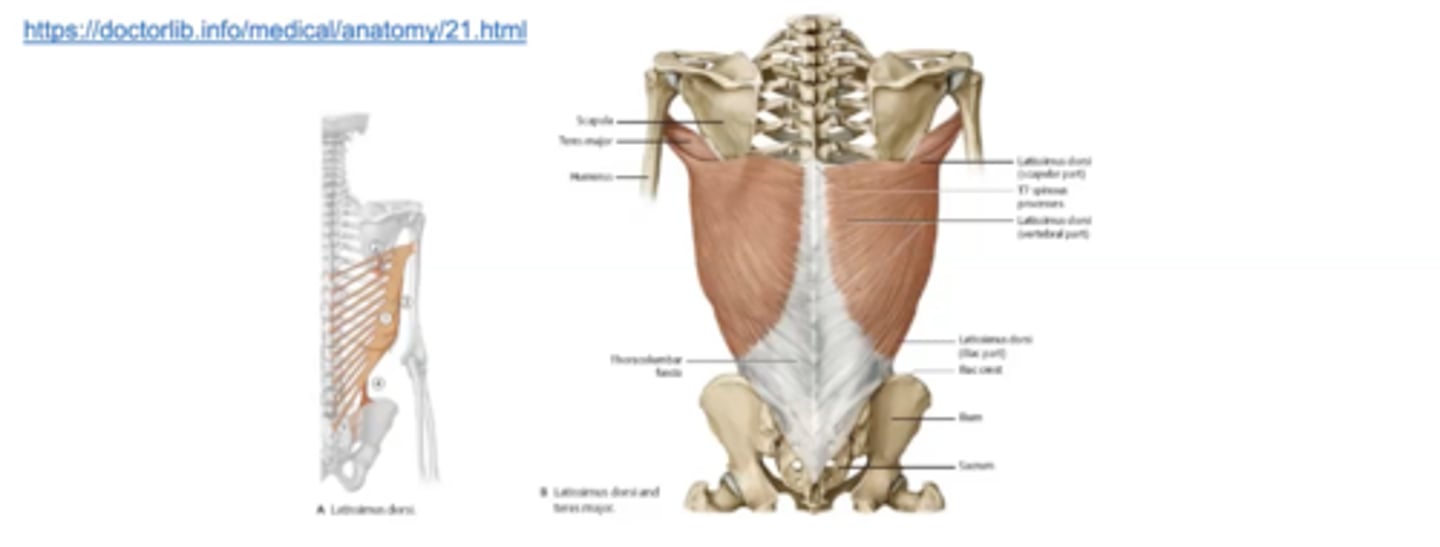
What is the function of the latissimus dorsi?
Internal rotation, adduction, extension, respiration ("cough muscle")
What is the location of the latissimus dorsi?
What is the innervation of the teres major?
Lower subscapular n. (C5-C7)
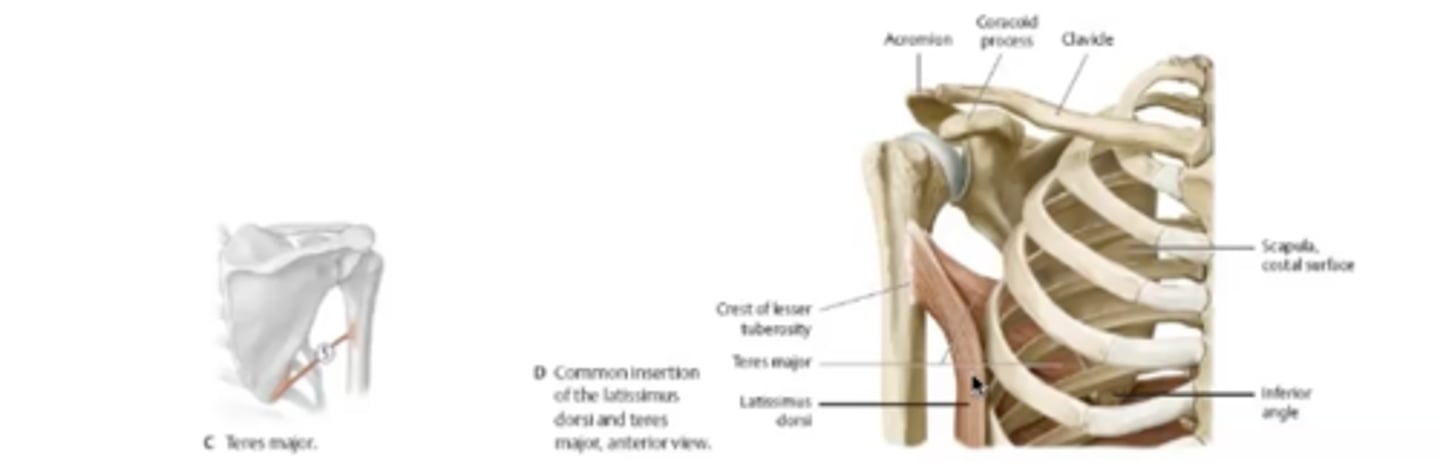
What is the function of the teres major?
Internal rotation, adduction, extension
What is the location of the teres major?
Is the teres major a rotator cuff muscle?
HE-HELL NAW
What is the innervation of the levator scapulae?
Dorsal scapular n. (C4-C5)
What is the function of the levator scapulae?
Draws scapula medially upward while moving inferior angle medially; inclines neck to same side
What is the innervation of the rhomboid major and minor?
Dorsal scapular n. (C4-C5)
What is the function of the rhomboid major and minor?
Steadies scapula; draws scapula medially upward
What are the locations of the levator scapulae and rhomboid major/minor?
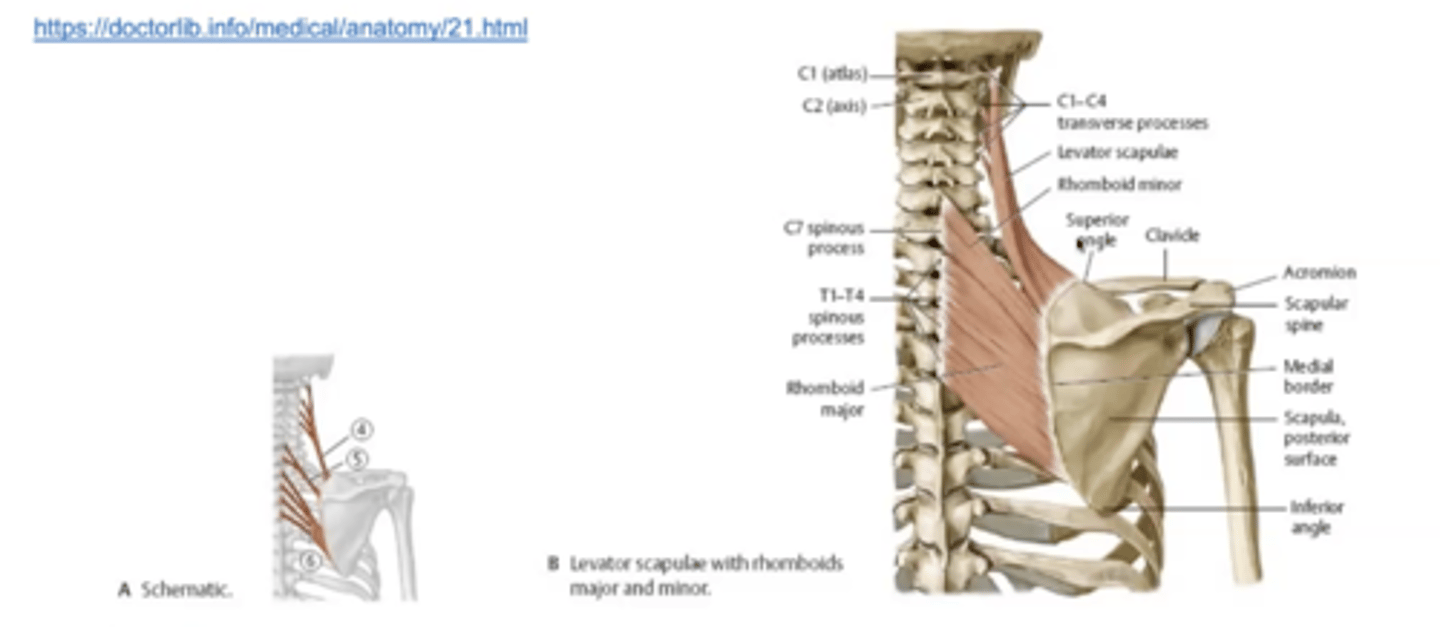
What is the clinical significance of a winged scapula? How are two ways this could happen, i.e., what muscles and corresponding nerves would be damaged? How would you determine which muscles are compromised?
Paralysis: Lifting the arm beyond 90° is not possible
Differential diagnosis: Rhomboid muscle injury, winged scapula with normal arm elevation
Due to a loss of innervation. Three muscles involved: rhomboids (innervated by dorsal scapular n.), serratus anterior (innervated by long thoracic n.). If those don't work, we get a winged scapula. The easiest way to find out which muscles/innervations are damaged is to have them watch you and put your arm out, then lift it up. If they can lift their arm up, it's a rhomboid issue (dorsal scapular n). Their only function is to hold the scapula in place. If this innervation is lost, the scapula pops. The serratus anterior helps lift the arm above the head 90° and lower it down. If the patient can't lift their arm up, the serratus anterior (long thoracic nerve) is damaged. This can happen from a radical mastectomy when the long thoracic nerve is damaged. The rhomboids can be damaged from a traumatic injury, car accident, motorcycle accident, etc.
What are the rotator cuff muscles?
Supra- and infraspinatus, teres minor, subscapularis
What is the function of the supraspinatus?
Abductor of the arm
What is the innervation of the supraspinatus?
Suprascapular nerve (C4-C6)
What is the function of the infraspinatus?
Lateral rotator of the arm
What is the innervation of the infraspinatus?
Suprascapular nerve (C5-C6)
What is the function of the teres minor?
Lateral rotator of the arm
What is the innervation of the teres minor?
Axillary (circumflex) nerve (C5-C6)
What is the function of the subscapularis?
Arm adduction and medial rotation
What is the innervation of the subscapularis?
Upper and lower subscapular nerve (C5, C6, C7)
What are the locations of the rotator cuff muscles?
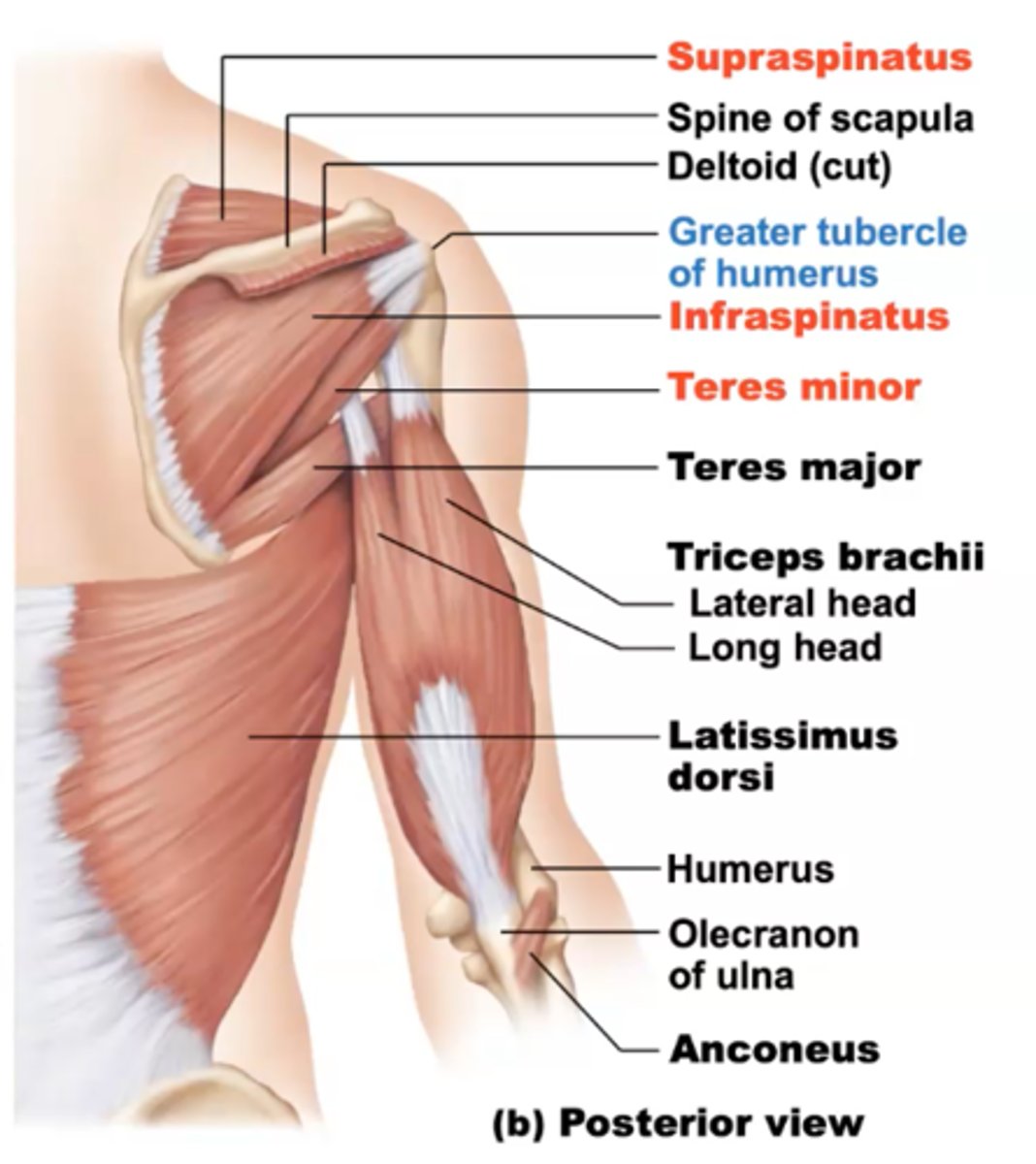
What is the function of all the rotator cuff muscles?
Stabilize the glenoid humeral joints; also help with lateral rotation or abduction with the supraspinatus
What is the function of the deltoid?
Most important abductor of the arm up to 90 degree
What is the innervation of the deltoid?
Axillary nerve (C5-C6)
What is the function of the anterior deltoid?
Flexes (anteversion) the arm + medial rotation of the arm
What is the function of the middle deltoid?
Abducts the arm
What is the function of the posterior deltoid?
Extends (retroversion) + lateral rotation
What is the location of the deltoid?
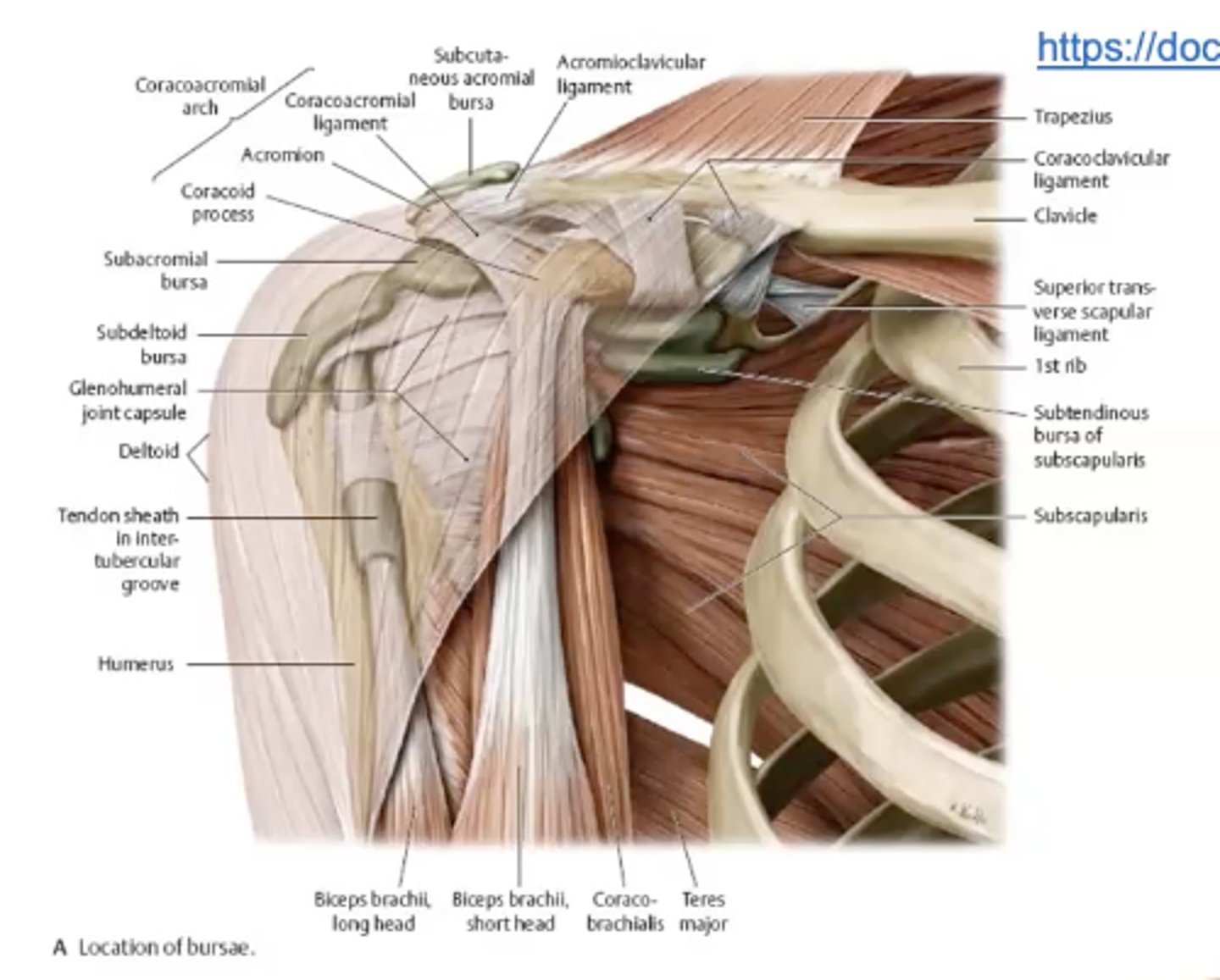
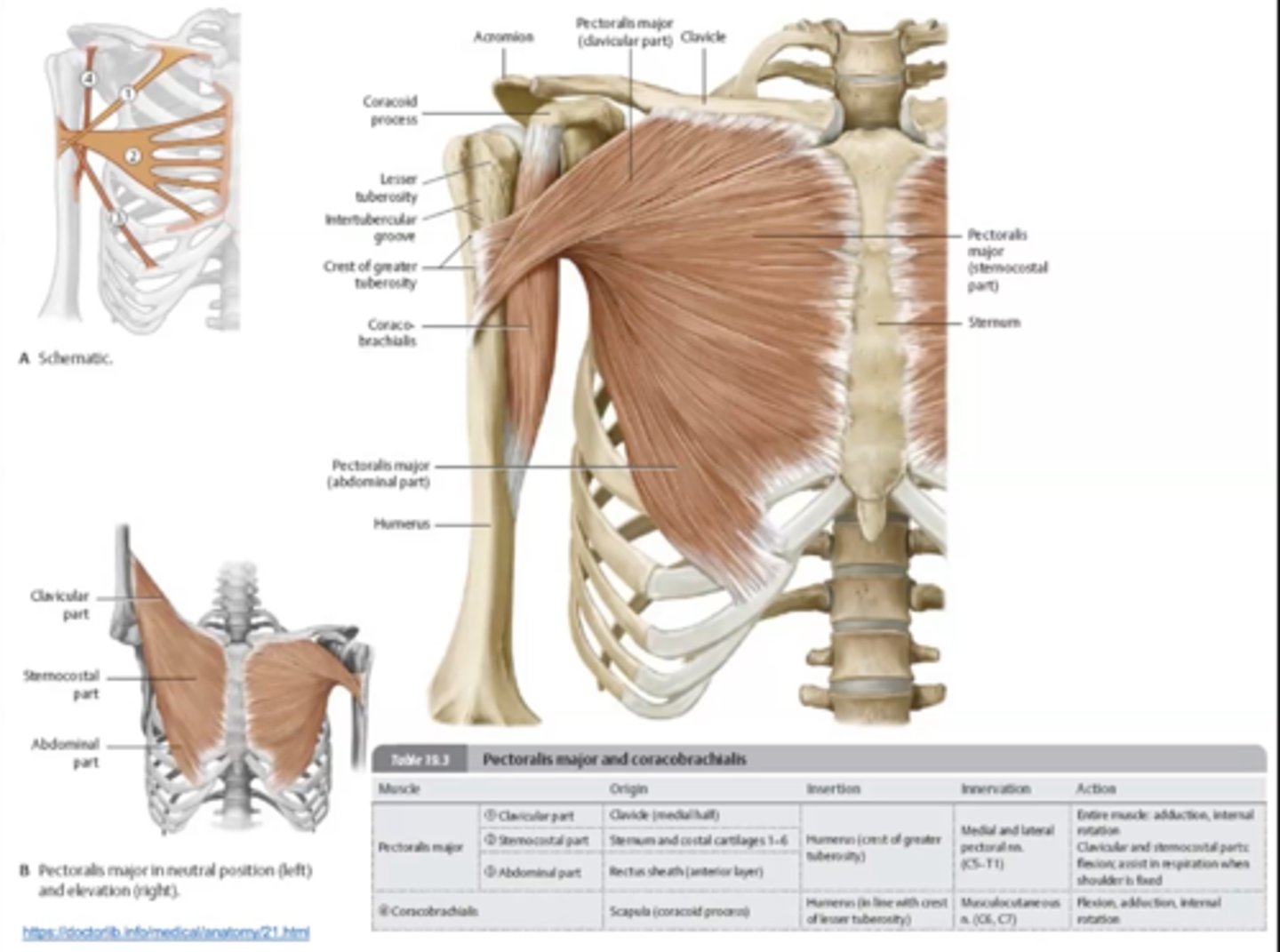
What is the insertion of the pectoralis major?
Humerus (crest of greater tuberosity)
What is the innervation of the pectoralis major?
Medial and lateral pectoral nn. (C5-T1)
What is the function of the pectoralis major?
Entire muscle: adduction, internal rotation
Clavicular and sternocostal parts: flexion; assist in respiration when shoulder is fixed
What are the origin and insertion of the coracobracialis?
Origin: Scapula (coracoid process)
Insertion: Humerus (in line with crest of lesser tuberosity)
What is the innervation of the coracobrachialis?
Musculocutaneous n. (C6, C7)
What is the function of the coracobrachialis?
Flexion, adduction, internal rotation
What are the locations of the pectoralis major and coracobrachialis?
What is the innervation of the pectoralis minor?
Medial and lateral pectoral nn. (C6-T1)
What is the function of the pectoralis minor?
Draws scapula downward, causing inferior angle to move posteromedially; rotates glenoid inferiorly; assists in respiration
What is the location of the pectoralis minor?
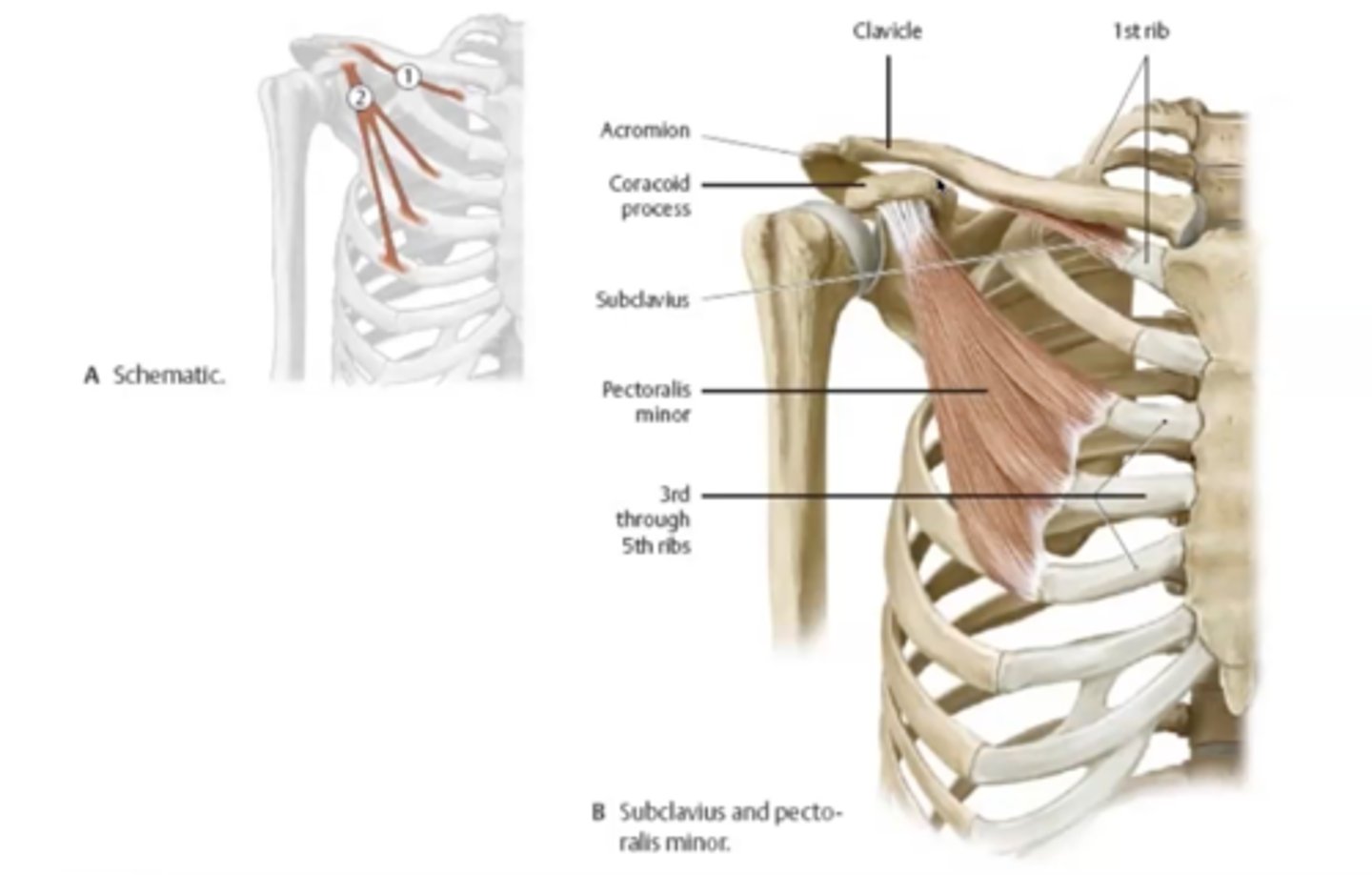
What is the innervation of the serratus anterior?
Long thoracic n. (C5-C7)
What is the function of the superior serratus anterior?
Lowers the raised arm
What is the function of the entire serratus anterior?
Draws scapula laterally forward; elevates ribs when shoulder is fixed
What is the function of the inferior serratus anterior?
Rotates scapula laterally
What is the location of the serratus anterior?
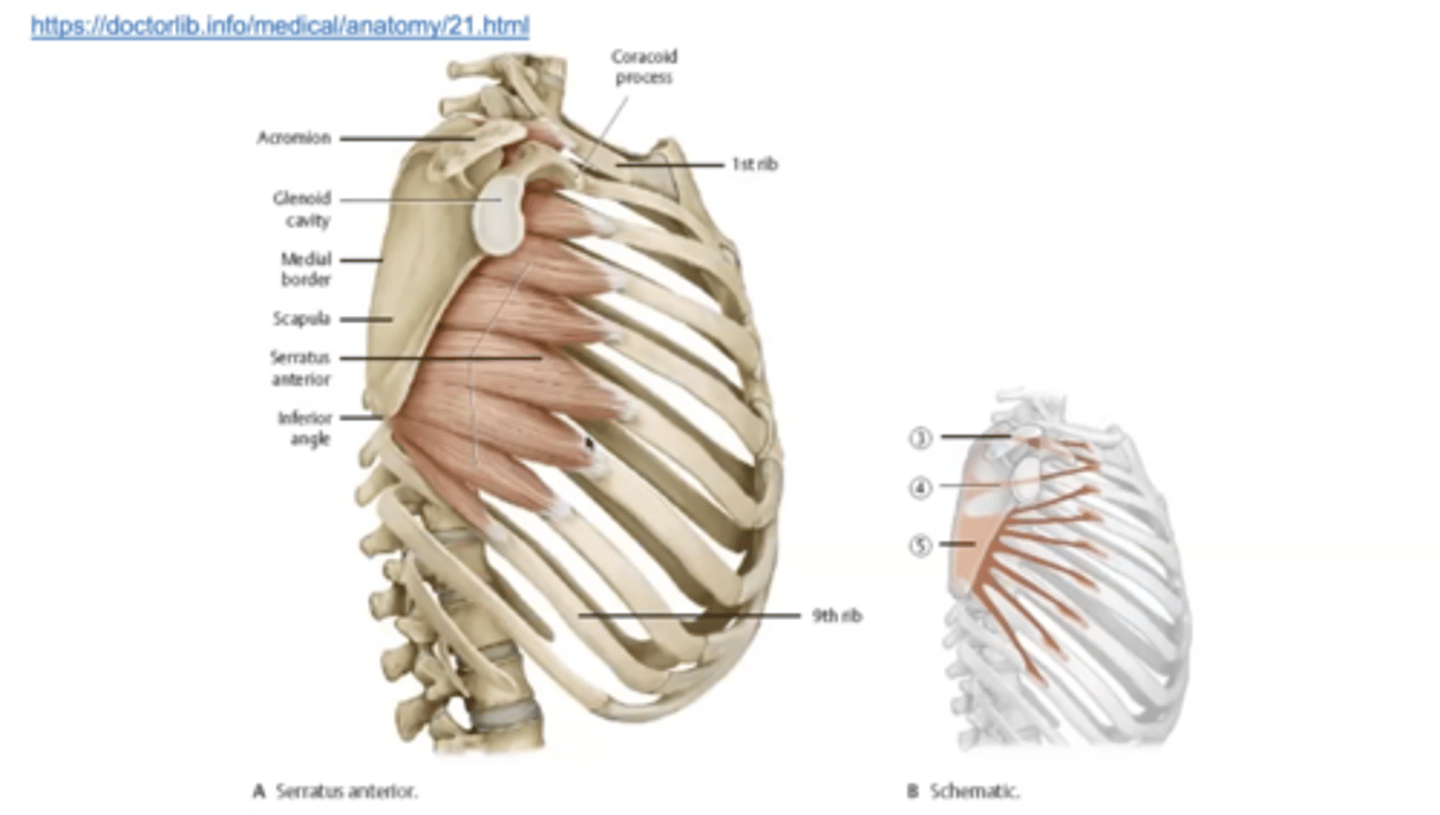
What is the innervation of the biceps brachii?
Musculocutaneous n. (C5-C6)
What is the function of the biceps brachii?
Elbow joint: flexion; supination
Shoulder joint: flexion; stabilization of humeral head during deltoid contraction; abduction and internal rotation of the humerus
*Note: When the elbow is flexed, the biceps brachii acts as a powerful supinator because the lever arm is almost perpendicular to the axis of pronation/supination.
What are the origin and insertion of the brachialis?
Origin: Humerus (distal half of anterior surface)
Insertion: Ulnar tuberosity
What is the innervation of the brachialis?
Musculocutaneous n. (C5-C6) and radial n. (C7, minor)
What is the function of the brachialis?
Flexion at the elbow joint
What are the locations of the biceps brachii and brachialis?
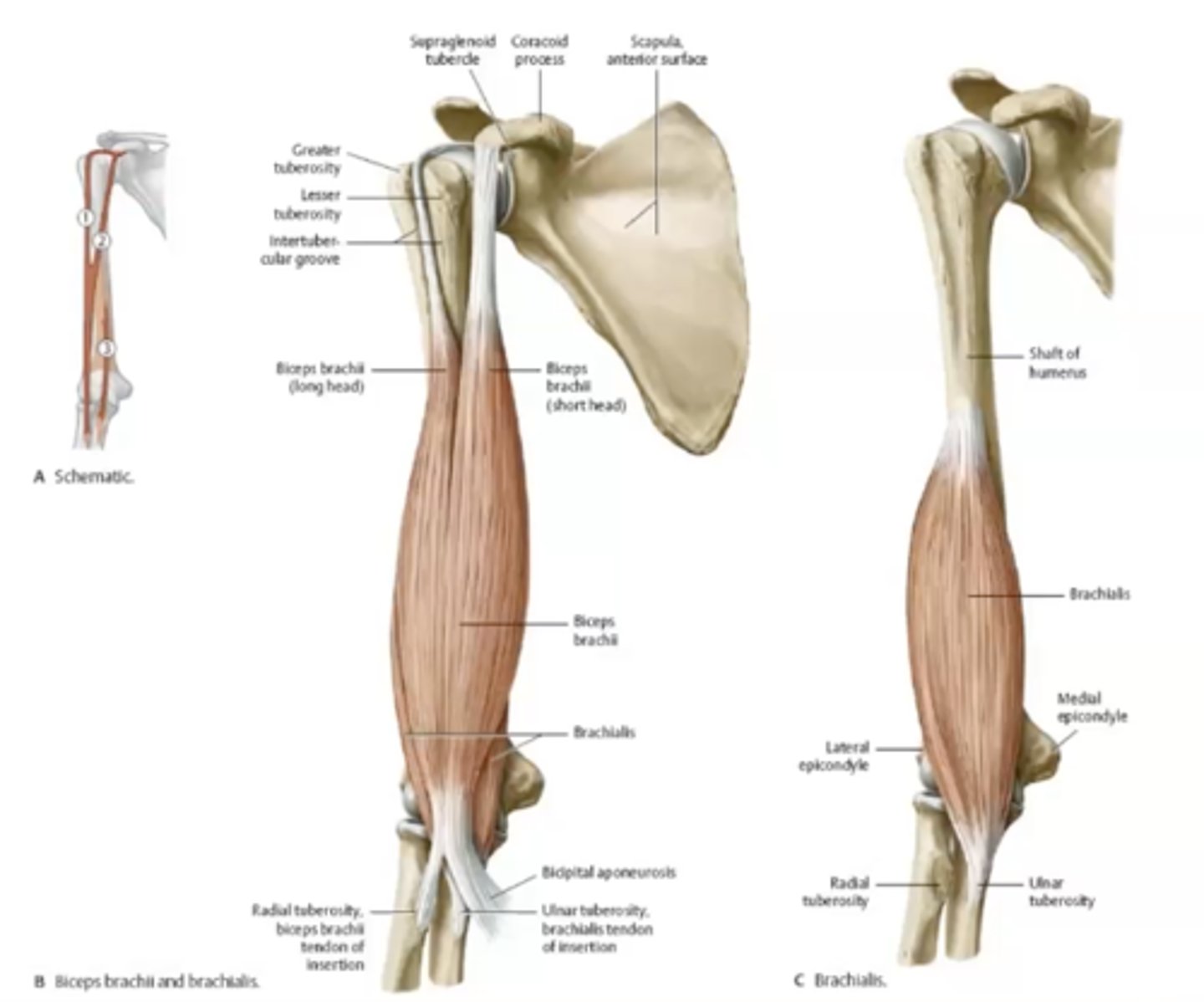
What is the innervation of the triceps brachii?
Radial n. (C6-C8)
What is the function of the triceps brachii?
Elbow joint: extension
Shoulder joint: long head extension and adduction
What is the innervation of the anconeus?
Radial n. (C6-C8)
What is the function of the anconeus?
Extends the elbow and tightens its joint
What are the locations of the triceps brachii and anconeus?
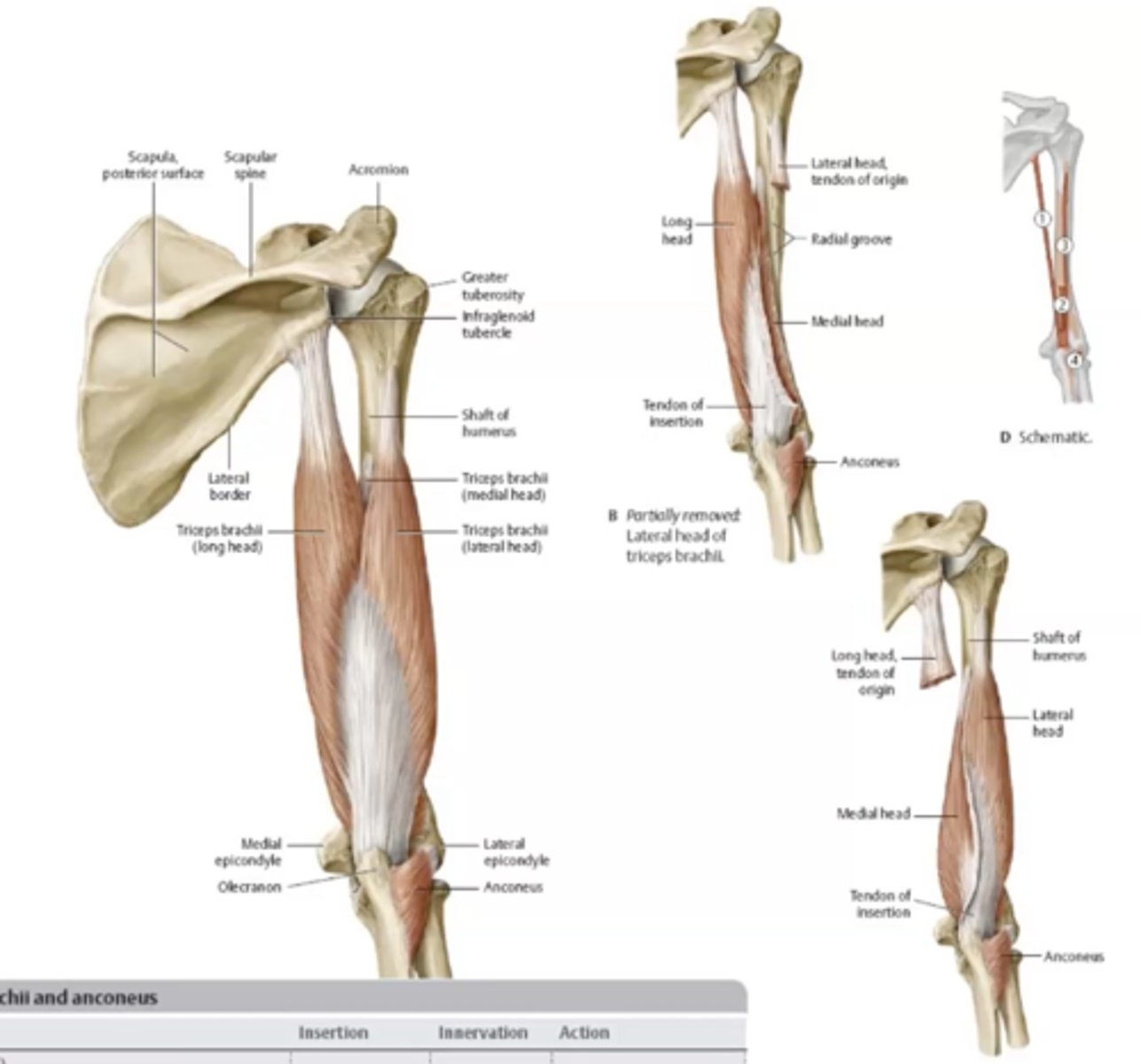
Which vein is not found in the arm?
Median cubital v. (situated in the proximal region of the forearm)
Which veins are utilized during a venipuncture, and why?
The veins of the cubital fossa (medial cubital vein) are frequently used when drawing blood. In preparation, a tourhiquet is applied. This allows arterial blood to flow but blocks the return of venous blood. The resulting swelling makes the veins more visible and palpable.
What are the nerves of the brachial plexus?
Main nerves:
Musculocutaneous nerve
Axillary nerve
Median nerve
Radial nerve
Ulnar nerve
Other nerves:
Dorsal scapular
Suprascapular
Subclavius
Lateral/medial pectoral
Upper subscapular (USS)
Thoracodorsal (TD)
Lower subscapular (LSS)
Medial brachial cutaneous (MBC)
Medial antebrachial cutaneous (MABC)
Long thoracic
What are the roots of the musculocutaneous nerve?
C5-C7; flexion at both the shoulder and elbow
What are the roots of the axillary nerve?
C5 and C6; helps with shoulder rotation and enables the arm abduction
What are the roots of the median nerve?
C6-T1; movement in the forearm and parts of the hand
What are the roots of the radial nerve?
C5-T1; movements in the arm, elbow, forearm and hand
What are the roots of the ulnar nerve?
C8-T1; fine motor control of the fingers
What is the clinical significance of a brachial plexus neuropraxia (stretch)?
Root compression usually by rotation of the head; commonly seen in older individuals
Nerve traction is a result of a downward pull; common among adolescents and young adults
Both characterized as "burners" or "stingers" depending on the sensation felt with each injury
What is the clinical significance of a brachial plexus rupture?
A forceful stretch resulting in the partial or complete tear of a nerve
Associated with muscle weakness and pain, severity depends on location and extent of injury
Often require surgery to repair
What is the clinical significance of a brachial plexus neuroma?
Commonly occurs when a nerve is cut during surgery
Scar tissue forms a painful knot on the nerve, preventing it from healing itself
Surgery often required to remove scar tissue
What is the clinical significance of a brachial plexus avulsion?
Nerve root is completely separated from spinal cord
Common injury during childbirth (2/1000 births), among athletes, and blunt trauma
Two types depending on nerves involved
Treatment depends on severity
What are the lymph nodes of the axillary region?
Pectoral, lateral, apical, central, posterior
What is the drainage of the lymph nodes of the axillary region?
Subclavian lymphatic trunk to right lymphatic duct to right venous angle
How are the lymph nodes of the axillary region involved in lymph drainage of the breast and upper limb?
Breast cancers may transport metastasis to the axillary lymph node (75% of breast's lymphatics drain here)
Removal of the lymph nodes may be necessary
Mastectomy: removal of the breast
Lymphangitis
What is the clinical significance of Colle's fracture?
Fracture of the radial styloid process; posterior displacement forces the process into the shaft
Falling on hand with extended arm
May be accompanied by avulsion of the ulnar styloid process
What are the locations of the pronator teres, flexor carpi radialis, palmaris longus, flexor carpi ulnaris, and flexor digitorum superficialis?
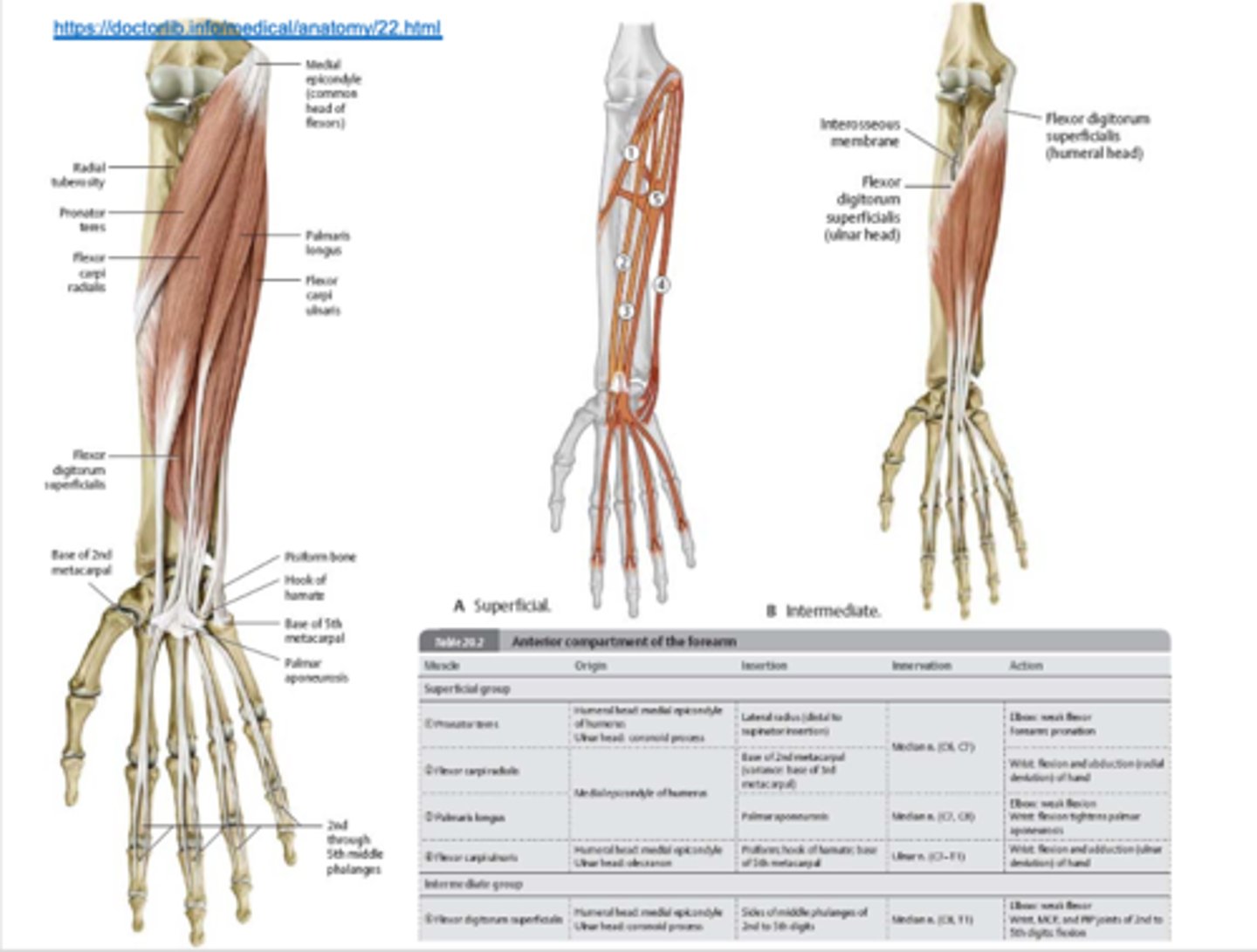
What are the origin and insertion of the pronator teres?
Origin:
Humeral head: Medial epicondyle of humerus
Ulnar head: Coronoid process
Insertion: Lateral radius (distal to supinator insertion)
What is the innervation of the pronator teres and flexor carpi raidalis?
Medial n. (C6, C7)
What is the function of the pronator teres?
Elbow: Weak flexor
Forearm: Pronation
What is the origin of the flexor carpi radialis and palmaris longus?
Medial epicondyle of humerus
What is the insertion of the flexor carpi radialis?
Base of 2nd metacarpal (variance: base of 3rd metacarpal)
What is the function of the flexor carpi radialis?
Wrist: flexion and abduction (radial deviation) of hand
What is the insertion of the palmaris longus?
Palmar aponeurosis
What is the innervation of the palmaris longus?
Median n. (C7, C8)
What is the function of the palmaris longus?
Elbow: Weak flexion
Wrist: Flexion tightens palmar aponeurosis
What are the origin and insertion of the flexor carpi ulnaris?
Origin:
Humeral head: Medial epicondyle
Ulnar head: Olecranon
Insertion: Pisiform; hook of hamate; base of 5th metacarpal
What is the innervation of the flexor carpi ulnaris?
Ulnar n. (C7-T1)
What is the function of the flexor carpi ulnaris?
Wrist: Flexion and adduction (ulnar deviation) of hand
What are the origin and insertion of the flexor digitorum superficialis?
Origin:
Humeral head: Medial epicondyle
Ulnar head: Coronoid process
Insertion:
Sides of middle phalanges of 2nd to 5th digits
What is the innervation of the flexor digitorum superficialis?
Medial n. (C8, T1)
What is the function of the flexor digitorum superficialis?
Elbow: Weak flexor
Wrist, MCP (metacarpophalangeal), and PIP (proximal interphalangeal) joints of 2nd to 5th digits: Flexion

