Purposes
 Studied by 0 people
 Call with Kai
 Learn
Learn Practice Test
 Spaced Repetition
 Match
Match Flashcards
 Knowt Play
1/45

There's no tags or description
Looks like no tags are added yet.
Name | Mastery | Learn | Test | Matching | Spaced | Call with Kai |
|---|
No study sessions yet.
46 Terms
Formality - General OUtline
Planned, rehearsed, edited,
Carefully construction of purposes
Is lexcially dense - more precise and has clarity - is easily understood by a wider audience
Occasionally requries expertise to understand (using jargon) - has a large social distance (not familiar with one another that much)
The setting and matter (thing being talked about) determines the language used within formality - context affects the level of formality, and what language is used
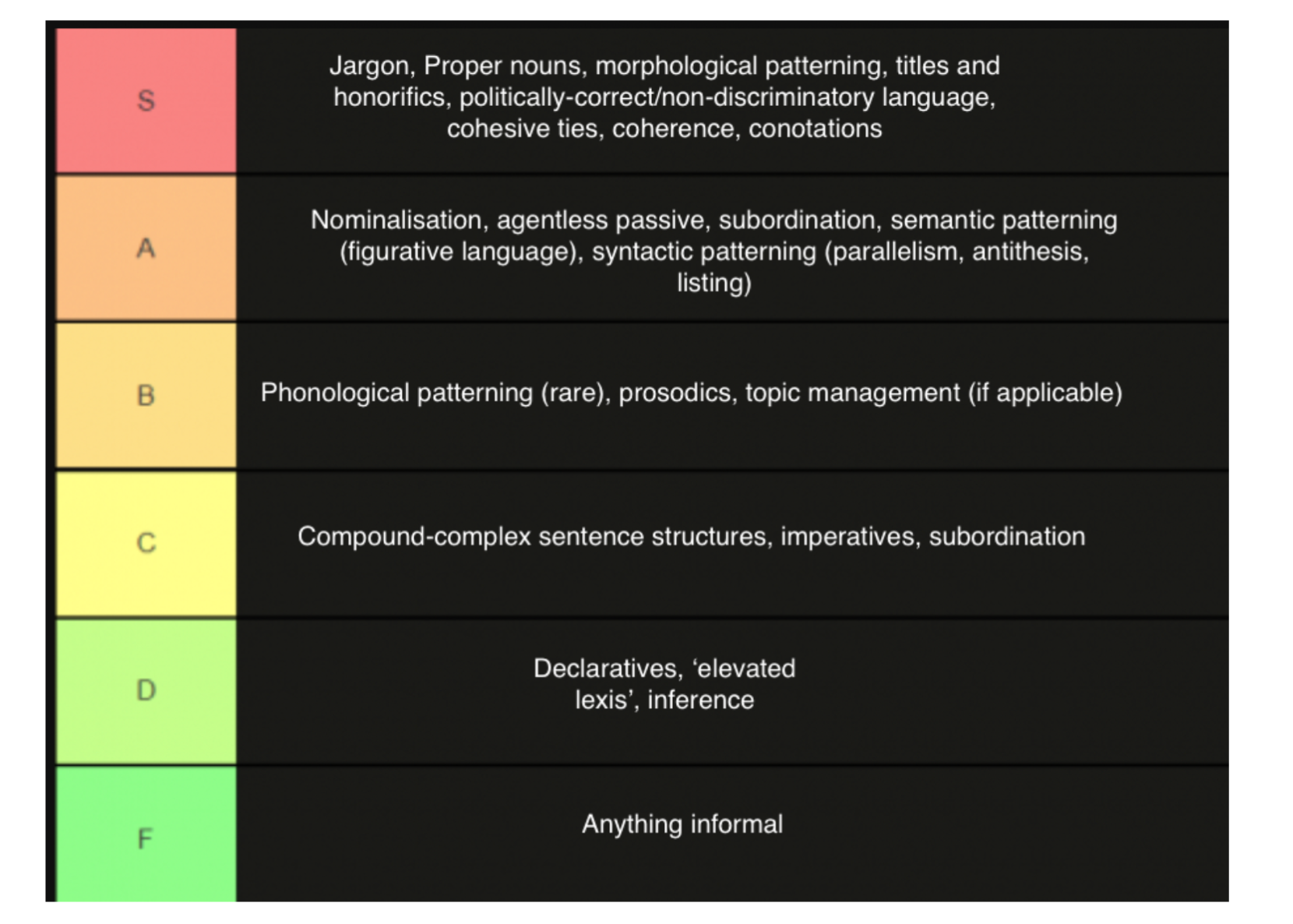
Things that indicate formality being used in tiers
Purposes
Asserting authority or reinforcing social distance
Establishing Expertise
Establishing social harmony, building rapport and negotiating taboo
Face Needs & Politeness
Obfuscation
Manipulation
Clarity
Asserting Authority or reinforcing social distance (Large Social Distance) - (Purpose)
Formal language is more broad and inclusive (avoids slang or any language that people may not know about - can exclude) - also avoids social taboo or offensive terms
Is a reflection of a large social distance
Salient Language features of having a large social distance
Euphemisms (negotiating around taboo topics)
Hedging (avoids threatening or challenging those of a higher power hierarchy)
Asserting Authority (Purpose)
Reinforces existing power hierarchies between groups or people
Used to validate position of higher ranking individuals - used portray them as trustworthy and of high status especially in times of crisis
Salient Language features of asserting authority
Deferential language (honorifics, titles)
Nominalization and depersonalizing language (shifts focus to action/rule - making it unquestionable or unopposable)
Passive voice and agentless (if there is blame - it takes out the responsibility of the person) passive - depersonalize texts
(Unhedged) Imperatives - by superiors to subordinates (direct command - indicates the power)
High modality verbs (must, should, will - reinforces the power present)
Establishing Expertise (Purpose)
Showing that a person is very knowledgeable and adept within a field - differentiates those who are not particularly knowledgeable in the field.
e.g. Rocket scientist vs layman
Language use demonstrates a complex and sophisticated understanding of the matter
Purpose of establishing expertise
Can enhance a speaker’s ethos (trustworthiness or credibility) to create gain trust from audience - elevates their ability to persuade
Conative (persuade) + referential (inform)
Can actually attend to one’s own positive face needs as it makes them more respected, trustworthy; also attends to negative face needs as it validates what they are saying and gives them more credibility and authority.
Salient language feature so establishing expertise
Jargon, Patterning, Nominalization, Complex-compound structures, Honorifics, Cohesive Devices
Jargon
Specific terminology associated with a specific field
Can confuse, obfuscate people - used for manipulation
Or even establish in-group membership amongst those who know what the term means
Can communicate efficiently, precisely, clearly and efficiently - economy of expression
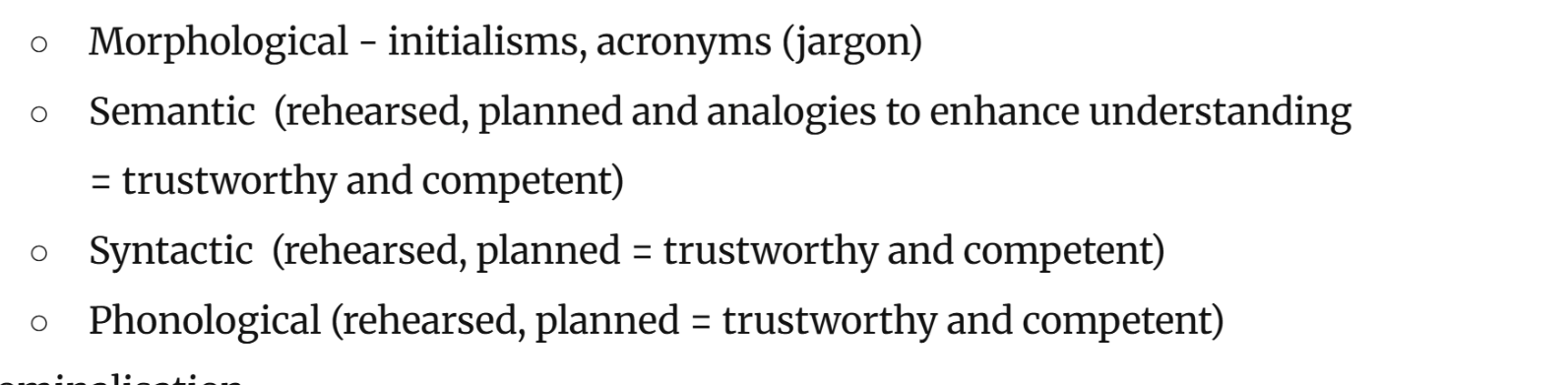
Patterning
Nominalisation
Highlights concepts and actions over agents (people doing it)
Creates an academic and authoritative tone - may come across as being sophisticated
Impersonal and objective presentation - can strengthening the expertise of the indivdiual
Compound complex structures
Shows full understanding of scenario
Can come across as being more academic and sophisticated
Honorifics
Mr, Dr, Mrs, Master - indicate their expertise within the field and the associated level of understanding they have
Cohesive Devices
Structuring arguments clearly (logic and reasoning).
Linking ideas across complex sentences (clarity and flow).
Demonstrating command of technical vocabulary and precise language.
Guiding the reader through the writer’s thought process (authority and professionalism).
Establishing Social Harmony, Building Rapport & Negotiating Taboo
A strong inclination to ensure a peaceful, inclusive and comfortable environment for all participants, accentuated in formal contexts when social distances are large and speakers/writers don’t know their audience too well.
Social Harmony (Purpose)
Breakdown of social barriers between people and promotion of inclusion and tolerance.
Using language in a way that keeps people happy, polite, and avoids conflict.
Basically, it’s about getting along well when talking or writing.
Can be done to exemplify the author/speaker’s moral character and perception of social values - displaying ethos (moral value/character)
Salient Features of Social Harmony
Non-discriminatory language (NDL)
Euphemisms
Politeness strategies (hedging, softening, indirect requests)
Inclusive language
Lexical ambiguity and semantic patterning
Ethnolects, AbE (this is unit 4), code-switching
NDL
Language that does not unfairly exclude, stereotype, or offend people based on things like:
Gender
Race / ethnicity
Age
Religion
Disability
Sexual orientation
Basically, it’s inclusive and respectful language.
To broaden audience and to not label any group or individual (can employ lexical ambiguity)
Pros Of NDL
Encourages positive thinking about minority groups. (doesn’t explicitly state “LGBTQ” people or label people)
Reduces prejudice and unconscious bias (reducing overgeneralization)
Promotes social harmony and inclusivity.
Cons of NDL
Can feel like it limits free speech.
Changing language may not change attitudes.
Risk of tokenism or focusing on words instead of real issues.
May provoke backlash if seen as “thought policing.” - pushing people to use certain language can create backlash and people may fight against it - e.g. using gender neutral pronouns - infringe speech
Tokensim
Showing something to be fair and equal on the surface however, doesn’t really make a change - can be symbolic of a change through language, but doesn’t create a change itself
Link back to cultural context (template)
Link with: The role of cultural context in shaping any social barriers and values that are acceptable in today’s society.
Negotiating Taboo (Purpose)
Avoiding topics or concepts that may be discomforting to the audience
Consider role of cultural context - e.g. In a room full of people with financial problems - talking about money is considered taboo
What Taboo can look like
Can be more ambiguous language choices, or more technical (and hence, confusing to the general populace).
Being deliberately vague and confusing can alleviate the strictness of a taboo topic - deliberate and strategic vagueness (negotiating taboo)
Salient Features
Non-discriminatory language (NDL)
Euphemisms
Nominalisation
Jargon
How does Jargon negotiate taboo
Softens sensitive topics → makes them less direct or shocking.
Example: “The patient expired” instead of “The patient died.”
Creates professional distance → reduces emotional impact.
Example: “Excretion” instead of “poo.”
Allows precise communication within specialist groups → discusses taboo topics safely.
Example: Lawyers use “sexual harassment claims” instead of crude language.
Maintains social and cultural acceptability → polite and formal way to handle delicate subjects.
Link negotiating taboo towards
The role of cultural context, and what is shaping the taboo
Consider if the speaker/writer is working within the cultural context and social expectations of formality.
What social harmony can slso do to minority groups
Uses polite, inclusive language → shows respect.
Avoids stereotypes or offensive terms → protects self-esteem.
Promotes belonging and acceptance → makes groups feel valued.
Encourages cooperation and trust → strengthens relationships.
Building Rapport Salient Features (Purpose)
Salient features
Hedging
Politeness markers
Inclusive language
What Is Building Rapport
Building rapport = making someone feel comfortable, respected, and connected through your words and behavior.
Politeness Markers
Hedging / softening: perhaps, maybe, I think
Indirect requests: Could you…, Would you mind…
Formal titles / honorifics: Sir, Madam, Professor
Apologetic phrases: I’m sorry to bother you, Excuse me…
Inclusive / respectful language: Chairperson, people with disabilities
Politeness & Face Needs (Refer to Informal Language)
Is increased in formal scenarios
Deferential Language
Language showing power, prestige, social status, age, expertise
Obfuscation (Purpose)
Intentionally using language to mislead or to confuse the audience - making it hard for them to interpret
Lets the author/speaker mask the true meaning or outcome of an event or action (especially in political contexts)
What is it used for
To negotiate social taboo, making unpleasant truths more acceptable (we are downsizing positions -we are firing 50 people - makes it more acceptable)
Makes people (sometimes) feel better about socially sensitive topics and hence maintains positive face needs (passed away - died)
Avoid blame and responsibility (Mistakes were made - doesnt say who or what)
Cover up damning information and protect oneself - hide embarrasing details or wrongdoings
Salient Features
Weasel Words
Overly complicated, seemingly sophisticated words that sound like something meaningful but really just make a vague claim.
Rhetoric
Jargon
Doublespeak
Nominalisation
Patterning (semantic - ambiguous; morphological - abbreviations)
Agentless passive
Euphemisms
Weasel Words
Avoid commitment or accountability
Example: “Many people say…” instead of naming exactly who.
Make claims sound more impressive than they are
Example: “Experts agree that…” → vague, could refer to one or many “experts.”
Softens statements
Example: “Some studies suggest…” → makes it less direct or less certain.
Can manipulate or mislead
Often used in advertising, politics, or PR to create positive impressions without giving hard facts.
Rhetoric (S-tier)
Persuasive language of all sorts; positioning readers/listeners to act/believe a particular way convincingly:
Salient features
Subsystem patterning (especially syntactic) - more sonorous and rhythmic
Prosodics - amplifies the point made
Repetition
Euphemism
Modal verbs (high modality)
Connotations
Emotive function
Manipulation (Review)
Leads the audience to think about one thing, and draw attention away from another part
Can be positive or negative
Salient Features Of Manipulation
Information flow (front/end focus, clefting)
Prosodics
Patterning
Paralinguistics and vocal effects
Clarity
Anything that is clear and easily understandable
Is crucial in certain contexts - such as in a crisis - need to warn everyone
Why must there be clarity (purpose)
Clear and easy-to-read language meets readers’ negative face needs → doesn’t impose on them.
Public texts (e.g., in Australia) require high clarity to be understandable by everyone.
Clear texts are more likely to achieve their purpose and function effectively.
Salient Features of Clarity
Modifiers (intense use of adjectives, adverbs)
Subordinate clauses
Jargon
Cohesion
Coherence (formatting, logical ordering, conventions)
Prosodics
Listing
Simple sentence structures
How do modifiers create clarity
They specify and add extra detail to the noun - giving greater clarity and in turn much better understanding about the matter
 Note
Note  Flashcards (87)