Ecology Exam 2
 Call Kai
 Learn
Learn Practice Test
 Spaced Repetition
 Match
Match Flashcards
 Knowt Play
1/37

There's no tags or description
Looks like no tags are added yet.
Name | Mastery | Learn | Test | Matching | Spaced | Call with Kai |
|---|
No analytics yet
Send a link to your students to track their progress
38 Terms
What are population range dynamics and what causes them?
It describes how species ranges are not fixed, they shift, contract and expand due to changing environmental factors and colonization.
It often accompanies exponential growth
Describe what the following equations means: Nt+1 = Nt + (B + I) – (D+E)
It shows the size of the population at a future time is equal to
the current population, plus those added, minus those removed
what does a per capita value give us
It shows a change per unit of population to proportion different population sizes
Why do we use life tables?
To extract more information about a population and how/why it grows or doesn’t grow through time. It is a method to study demography
it show age specific birth and death rates
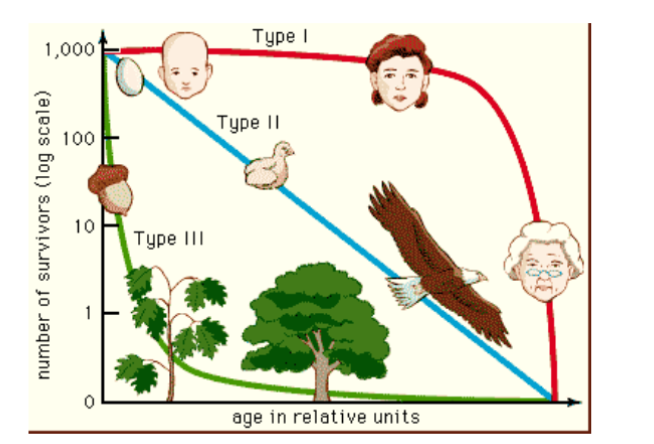
Survivorship curves and types
shows how different classes of ages survive through time due to differences in mortality.
Type I - higher young survivorship and mortality in older ages
Type II - constant survivorship across ages; equal chance that organism dies throughout their entire life cycle
Type III - High mortality of young but have lower rates or mortality at older ages
R0
The net reproductive rate per individual
=Sum of (lxmx)
for non-overlapping generations, it is the amount of female offspring produced per female during their lifetime
lx = proportion surviving to day x
mx = Average number females offspring produced per female
value over 1 means population is growing
value under 1 means population is declining
geometric rate of increase
Nt+1/N1
the ration of the population size at two time points; how many times bigger the population gets at distinct times
same value as R0 for non-overlapping generations
Steps for overlapping generations
first calculate generation time
then calculate r (per capita rate of increase)
T = (∑xlxmx)/ R0
r = [ln(R0)]/T
if r is negative, population is declining; if positive population is growing
Population Growth
refers to the change in population size or density over time. growth can be positive or negative
population changes are determined by both the organism’s growth potential and the environment
Types of population growth
Geometric growth - often describes non-overlapping generations; no constraints, rapid growth
Exponential Growth - often describes overlapping generations; no constraints, rapid growth
Logistic growth - environmental constraints, limited growth
Characteristics of populations without limiting factors
introduced to a new environment
populations rebounding from a catastrophe
low population densities and favorable environments
cannot be sustained indefinitely
Limits to population growth
density-dependent factors - proportional effects depend on population size; proportion of population dying because some factor increases with population size
ex. disease, competition for resources (mostly biotic)
Density independent factors - proportional effects do not depend on population size; probability of individual dying is not related to population
Carrying Capacity
(K) the maximum number of individuals of a population the environment can support
at K, birth rates must equal death rates and population growth is 0
Logistic Population Growth
dN/dt = rmaxN(1-N/K)
when population density is low, growth rate is nearly exponential
when population density is high, growth rate gets smaller
when population reaches carrying capacity, growth rate is 0
r vs k selection
r-selection favors rapid population growth and colonizing ability; favors presence is disturbed habitats; far below carrying capacity
k-selection favors efficient use of resources and competitive ability; favors presence in stable habitats
reproductive strategies for k and r selection
k-selected: late reproduction, few offspring, invest a lot in raising offspring
r-selected: early reproduction, many offspring, little parental care
characteristics of k and r selected species
r: high rmax , rapid development, early reproduction, small body size, many offspring, one reproduction event
k: low rmax , high competitive ability, slow development, late reproduction, large body size, repeated reproduction events, fewer offspring
phenology
the timing of life history events or ecological events
often in relation to climate or weather
long term records are often used
community ecology
includes interactions between just two species, interactions among all species present and everything in between
competition
negative interaction between organisms resulting from a shared requirement for a resource that is in limited supply
reduces the fitness of both but one may have more reduced fitness than the other
competition for water, nutrients, food, light, space
usually between individuals but can have population level consequences
can occur between individuals of same or different species
effects of competition
decreased contribution to the next generation
decreased survival or fecundity
individuals involved obtain fewer resources, growly slower, have fewer offspring and have lower chances of survival
effects of competition are density dependent
Types of competition (who)
intraspecific competition: competition among individuals of the same species
interspecific competition: competition among individuals of different species
mechanisms of competition
exploitative competition: competing individuals do not interact directly with each other, but instead depress abundance of a resource
interference competition: direct interaction between individuals
both types can occur between intra and inter specific competition
Niche
all factors that influence growth, survival and reproduction of a species
fundamental niche: defined only by abiotic factors
realized niche: defined by abiotic plus biotic factors
Principle of competitive Exclusion
two species with identical niches cannot coexist indefinitely, one species will be a better competitor and exclude the other.
species with similar niches will compete more with each other than species with very different niches
Fecundity definition
the biological capacity or potential reproductive rate of an organism to produce an offspring
types of exploitative interactions
predators-prey, herbivory, parasitism, parasitoids
parasites vs parasitoids
parasites- consume live tissue of other organisms but usually don’t kill the host
parasitoids- insects whose larvae consume their hosts and kills it, functionally equivalent to predation, not parasitism
predatory adaptions
keen hearing
larger eyes to see in the dark
jaws/teeth/beaks for ripping and tearing
camouflage and other stealth methods
Anti-predatory defenses
morphological: spines, armor, camouflage, coloration, large size
behavioral differences: aggressive behavior, increasing apparent size
chemical defenses: toxins, digestion-reducing compounds, warning coloration
safety in numbers (predator satiation - synchronous reproducing)
Parasitism
a parasite refers to an animal or protist while pathogens are viruses, bacteria or fungi
infected hosts may exhibit altered behavior which may increase the likelihood of infecting another host or being eaten
Host-parasitoid interactions
parasitoid are insects that parasitize other insects
adult female parasitoids lay eggs on their insect host; parasitoid larvae hatch and slowly consume the host
parasitoids often specialize on a narrow range of host species
Predator prey interactions
predator removal studies reveal that prey populations depend on predator populations; if predator populations go down, prey populations go up
Time series analysis of predator prey cycles
population cycles of predator-prey species occur about every 10 years in hares and lynx
similar cycles occur in other small mammal populations
food and predator numbers are main factors on prey populations
predator dynamics lags slightly behind prey dynamics
functional response (curves)
relationship between availability vs. consumption rate
type 1: linear increase then levels off; food intake proportional to prey abundance then levels off
type 2: slope of line continually decreasing then levels off;
type 3: s-shaped curve
Mutralism
individuals of both species benefit from the association but still involve some costs; interactions between individuals of different species which results in increased fitness of both partners
benefits must outweigh costs for association to continue
Types of mutralism
facultative mutualism- species benefit from a mutualistic partner but can survive and reproduce without them
obligate mutualism- species cannot survive or reproduce without partner
important examples of mutualism
mycorrhizae and nutrient uptake by plants
plants and bacteria
coral reefs and zooxanthellae
pollination
seed dispersal by animals
ants and plants

