Lecture 20: factorial design (part 2)
 Studied by 0 people
 Call with Kai
 Learn
Learn Practice Test
 Spaced Repetition
 Match
Match Flashcards
 Knowt Play
1/31

There's no tags or description
Looks like no tags are added yet.
Name | Mastery | Learn | Test | Matching | Spaced | Call with Kai |
|---|
No analytics yet
Send a link to your students to track their progress
32 Terms
what’s the difference between a control variable and a control condition?
variable: variable that is held constant across all levels of the IV (something that could influence your results but that you don’t want to measure, ex: light, time)
condition: one level of the IV that doesn’t receive the treatment (ex: not receiving a vaccine)
why would you have control variables?
to make sure that the IV explains the changes in the DV (internal validity)
*control variable: variable that is held constant across all levels of the IV (ex: lighting, time of day)
why would you have a control condition?
to compare the participants who received the treatment and participants who didn’t
*control condition: one level of the IV that doesn’t receive the treatment
true or false: a control condition can be a control variable (and vice-versa)
false: a control condition applies to one level of the IV (varies with the IV) while a control variable is kept constant
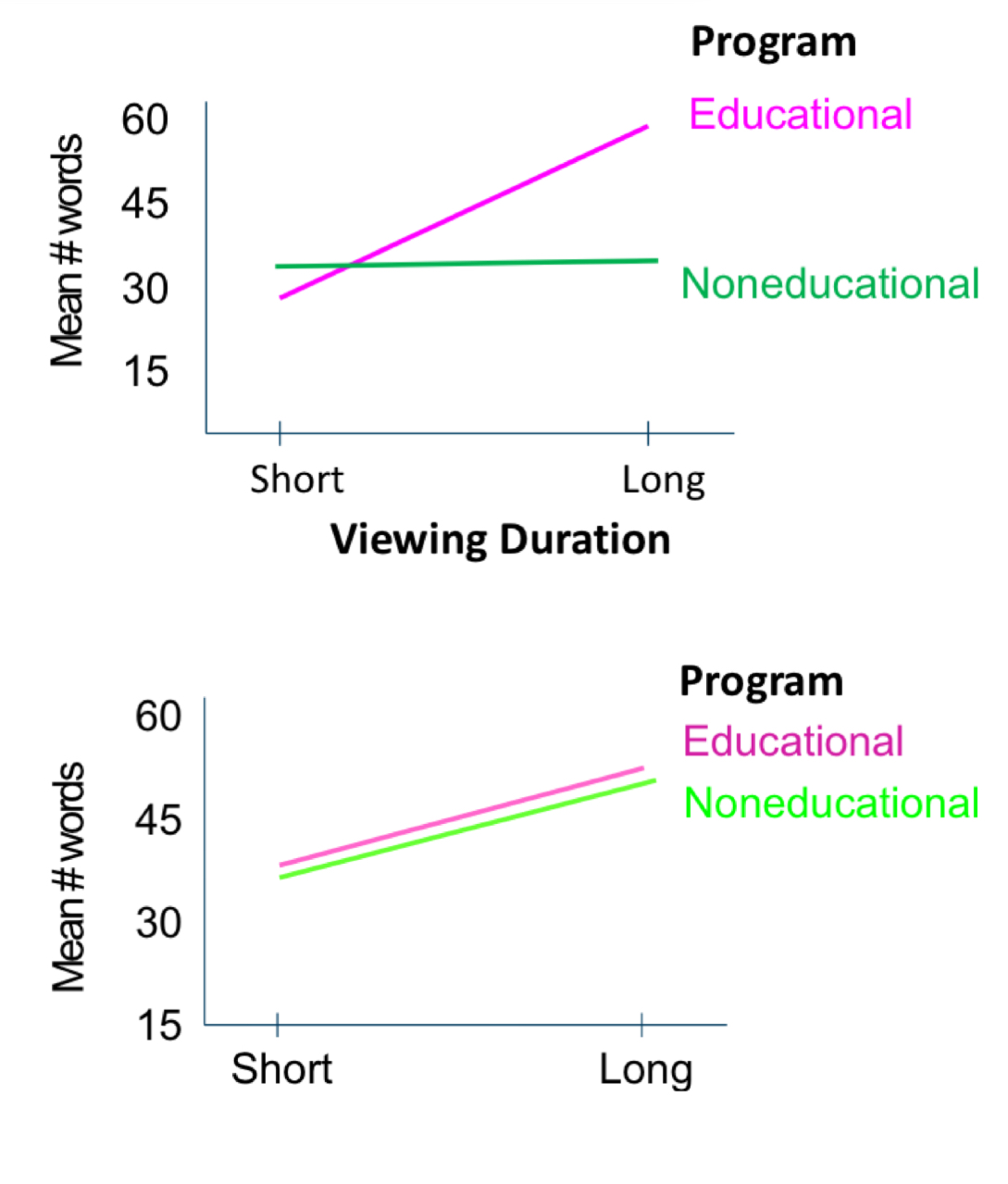
explain the difference between these two graphs knowing that
factor A: TV viewing duration
factor B: TV program
DV: toddler’s vocabulary
top graph: viewing duration (factor A, x-axis) impacts the number of world learned (DV, y-axis) depending on the program (factor B, lines)
interaction because the lines aren’t parallel
bottom graph: TV viewing duration (factor A, x-axis) will increase the number of words learned (DV) regardless the TV program (factor B, y-axis)
no interaction: lines are parallel
what are the types of factorial designs? (3)
pure (between-subjects) factors
within-subjects factors
mixed designs (between + within-subjects factors)
define “higher order factorial designs”
factorial designs with 3 or more factors
define “pure factorial designs”
AKA between-subjects factorial design
all factors are being manipulated across participants
different groups of participants are randomly assigned to each condition (one participant goes in one condition)
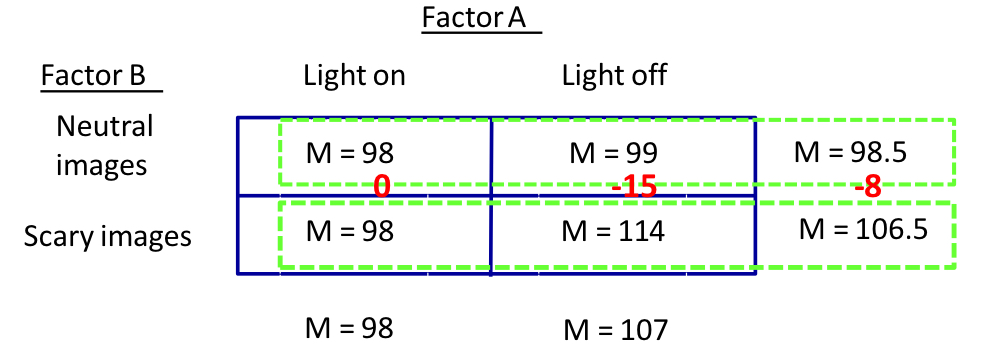
in this pure factorial design, is there a main effect of A, a main effect of B and an A x B interaction?
main effect of A: 98 ≠ 107
main effect of B: 98.5 ≠ 106.5
interaction: 0 ≠ -15 ≠ -8
what’a the advantage (1) and the disadvantages (2) of pure factorial designs?
advantage:
no order effect problem (because each participant only experiences the condition once)
disadvantages:
between-subjects, so could require a lot of participants
individual differences can become a confounding variable
when should you choose a pure factorial design? (3)
a lot of participants are available
individual differences are small
order effects won’t be a problem
define “within-subjects factorial designs”
one group of participants goes through all condition
when you change the size of a factorial design (ex: go from 2×2 to 3×3), the number of participants will be affected in a [between/within] subjects factorial design
between only: participant in one condition only
what are the advantages (2) and disadvantages (2) of within-subjects factorial designs?
advantages:
fewer participants needed
reduces individual differences
disadvantages
more factors = participants go through more condition
time consuming, higher chances of attrition (lose participants)
when should you use a within-subjects factorial designs? (2)
a lot of individual differences
order effects aren’t a problem
define “mixed design”
factorial design that combines one between-group and one within-group design
when should you used mixed factorial designs?
when you want the advantages of a between-subjects design for one factor, but also the advantages of a within-subjects design for the other factor
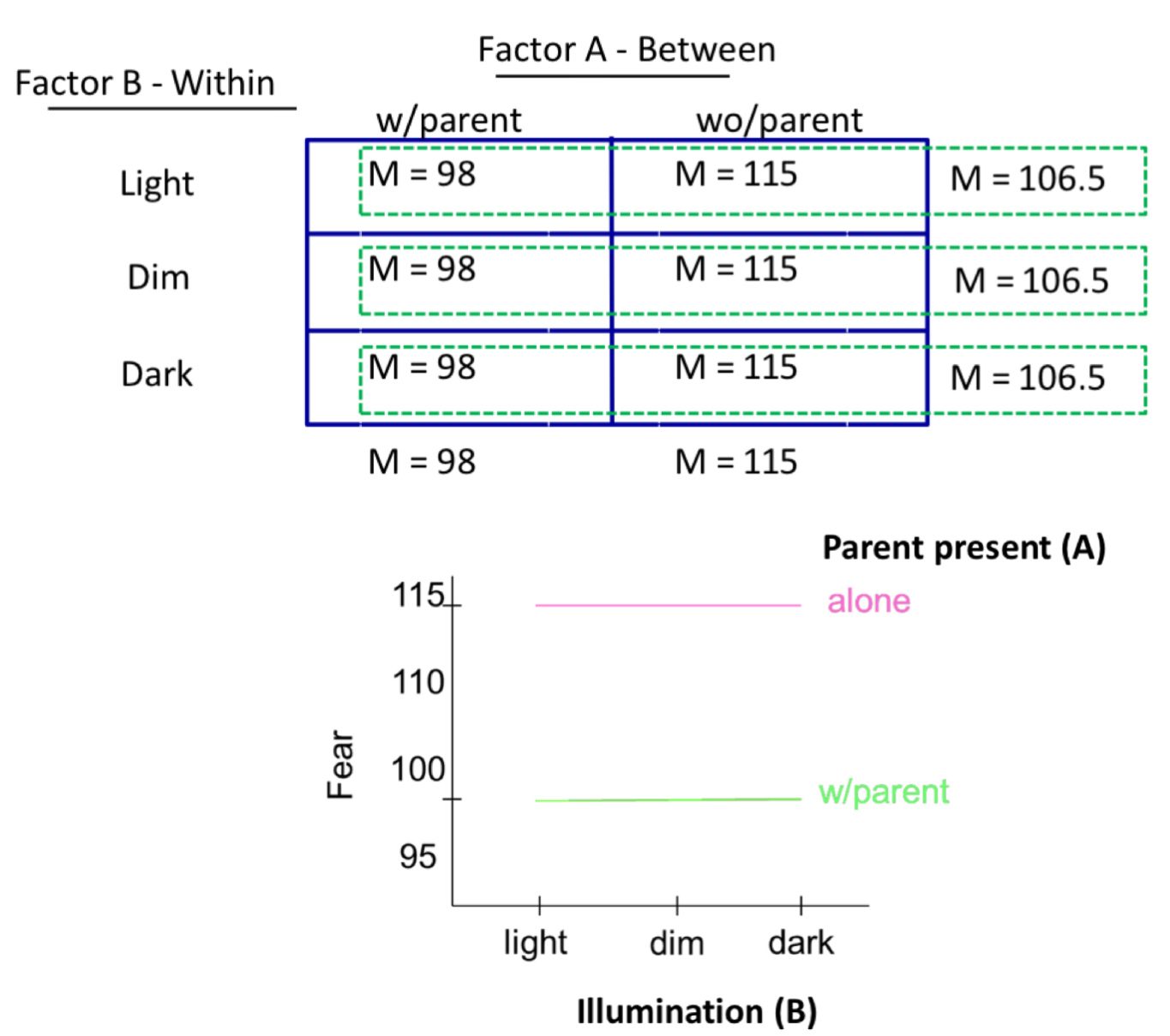
in this mixed factorial design, is there a main effect of A, a main effect of B an an interaction?
main effect of A: 98 ≠ 115
no main effect of B: 106.5 = 106.5 = 106.5
no interaction: lines are parallel
when you have pretest and posttest groups, you’re doing a [between-within]-subjects factor
within: pretest before treatment and posttest after treatment
in a three-factor design, how many main effects and interactions are you measuring?
main effect: 3 (A, B, C)
interactions: 4 (A×B, B×C, A×C, A×B×C)
in this four-factor design where we measure the correctly recalled items, you have these factors. which are between-group and which are within-group:
gender: male/female/non-binary
age: older adult/middle adult/young adult
time of day: morning/afternoon/evening
types of word: concrete/abstract
gender: between-group (you can’t be in multiple gender groups)
age: between-group (you can’t be in multiple age groups)
time of day: within-group (counterbalance so that we measure participants at multiple day times)
types of words: within-group (we can present both types of words to the participant)
true or false: higher order interactions can become complex
true: especially if you have more than 3 factors, you will have a hard time predicting interactions
consider a 3 (gender) x 3 (age) x 2 (word type) x 2 (morning/evening) design. determine the number of factors (x-way) present in the findings: “females in the middle adult and young adult groups remembered abstract words better than concrete words in the evening”
4-way:
“females”: difference, no male or non-binary
“middle and young adult”: difference, no old adult
“abstract better than concrete”: difference, abstract VS complex
“evening”: difference, no afternoon or evening
consider a 3 (gender) x 3 (age) x 2 (word type) x 2 (morning/evening) design. determine the number of factors (x-way) present in the findings: “males in the older and middle adult groups remembered both abstract & concrete words well in the morning“
3-way
“males”: difference, no females or non-binary
“older and middle adults”: difference, no younger adults
“both abstract and concrete”: NO difference
“morning”: difference, no afternoon or evening
what are the advantages of a factorial design? (3)
efficient and allows you to study multiple things
instead of reducing individual differences by holding factors constant, it can add that difference as a factor
higher external validity: measure multiple variables and people differ from multiple variables
what does a factorial design allows us to study? (3)
effects of many factors at the same time
interactions of factors
replication and expansion of an existing study: you can replicate and add another variable
what are the disadvantages of a factorial design? (4)
more chances of having confounds and control for them
if the factors aren’t manipulated, interpretations aren’t better than correlational studies
too many factors are confusing to interpret
might require higher alpha levels due to multiple statistical tests
what do we do in a statistical analysis of a factorial design? (2)
compute the means for each treatment condition (cell)
use ANOVA to evaluate the statistical significance of the mean differences
what are some other uses of factorial designs? (3)
replication: repeating a previous study and add new factor
expanding: add a factor in the form of a participant characteristic to reduce variance (for between-subjects only according to book)
use order of treatments as an additional factor to reduce variance (for within-subjects only)
what’s the difference between replication and expansion?
replication: do again and add a new factor
expansion: do again, but add a participant characteristic factor to reduce variance
when you add order of treatments as an additional factor, what are the possible outcomes? (3)
no order effect: no order effect existing
symmetrical order effects: same order effects across other factors (A-B = B-A → A influence B like B influence A)
asymmetrical order effects: order interacts with other factors (A-B ≠ B-A)
how does adding the order of treatments as an additional factor reduce variance? (2)
randomization of participants to conditions doesn’t not reduce bias from extraneous variables (different order does reduce bias)
it’s not always possible to randomize all conditions orders when there are many conditions
 Note
Note  Flashcards (114)