Civil Materials Exam#2 (4-6)
 Call Kai
 Learn
Learn Practice Test
 Spaced Repetition
 Match
Match Flashcards
 Knowt Play
1/48

Earn XP
Name | Mastery | Learn | Test | Matching | Spaced | Call with Kai |
|---|
No analytics yet
Send a link to your students to track their progress
49 Terms
Which reaction product provides strength?
Calcium Silicate Hydrate, C-S-H
Which reaction product increases the pH of concrete?
Calcium hydroxide, CH
What is the most critical micro structural component that influences concrete durability in the following situation?
(Exposure to high sulfate levels?)
Permeability and Mono sulfate, and to a much lesser extent, C-S-H
What is the most critical micro structural component that influences concrete durability in the following situation?
(Exposure to Deicing salts?)
Permeability
What is the most critical micro structural component that influences concrete durability in the following situation?
(Exposure to frequent freezing and thawing?)
Entrained air content and Spacing
What is the most critical micro structural component that influences concrete durability in the following situation?
(Use of aggregates containing reactive silica?)
Alkali content and moisture
What contributes to late age strength?
C2S
What liberates a high/large amount of heat?
C3S
What are the two products of C3S and C2S hydration?
C-S-H and CH
What are the two products of C3A hydraiton?
ettringite and mono sulfate
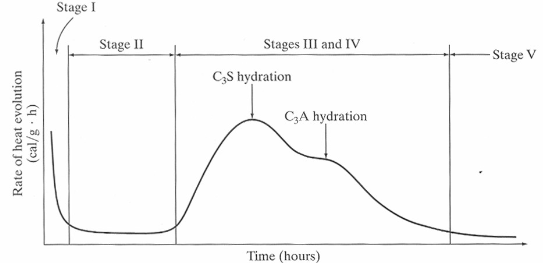
Stage I represents?
Initial Dissolution of Ions
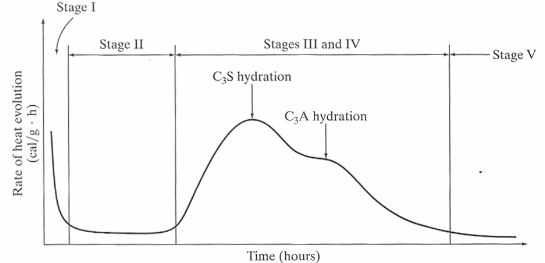
Stage II represents?
Induction period
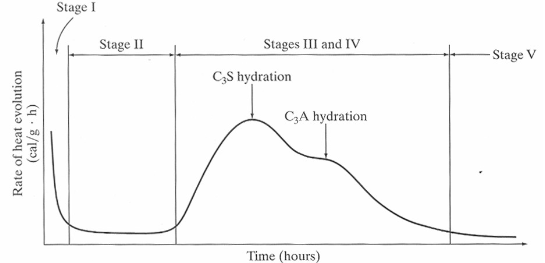
Stage III & IV represents?
Acceleration & Deceleration
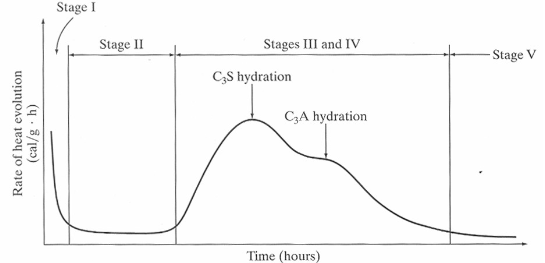
Stage V represents?
Steady State
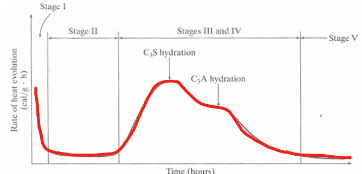
Draw the curve
Be able to draw the curve
Is it normal to see etrinite at later ages in the micro structure?
No, it converts to mono sulfate
Whats the ITZ?
High periodicity one sided growth, weakest point because of voids
Whats the most commonly used SCM?
Fly Ash
What type of fly Ash do we prefer / what do we have
We want C we have F
Latent hydraulic or Pozzolanic which uses calcium hydroxide?
Pozzolanic uses Calcium hydroxide
Air entraining admixtures are added to concrete for?
freeze-thaw resistance.
Water reducing admixtures can be used to increase _________ the water-to-cement ratio.?
slump or reduce
What is a typical replacement percentage of silica fume used?
5-10%
What is the maximum fly ash content allowed by TDOT?
25%
All SCMs reduce ______, which significantly improves durability.
permeability
Which SCM would be used to reduce concrete heat?
fly ash or slag
What is tertiary blend?
2 or more SCMs blended together
Micro - filler effect
Increased packing of cementitious particles
Increased C-S-H
Replacing porous CH with C-S-H
The Wall effect
Densifying the ITZ
Pore Blocking
combination of these factors
Micro - filler effect, increased C-S-H, Wall Effect, and Pre Blocking provide what effects?
These effects refine the pore structure and reduce the permeability of concrete thereby making it more resistant to the penetration of deleterious agents
Most SCMs Reduce?
Overall heat of hydration and rate of heat liberation ( Eliminates the need of Type IV cement)
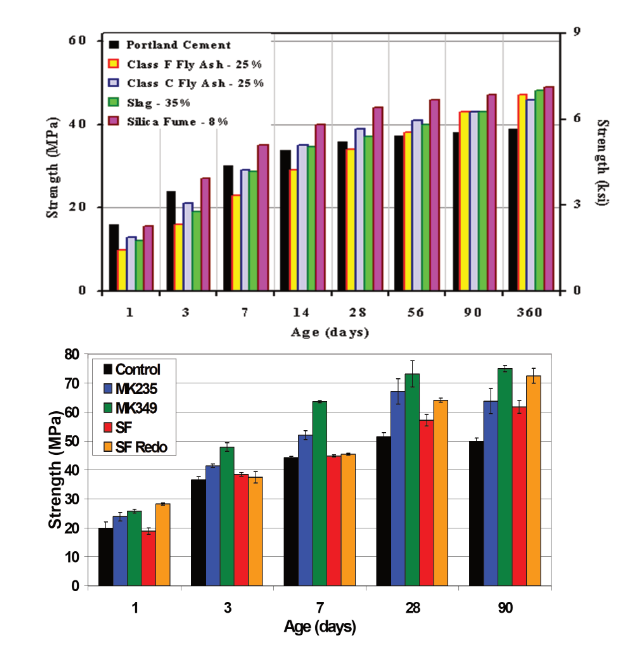
Which SCMs react really fast?
Silica Fumes (Typically improve early age strength)
Typical replacement precent of Fly Ash?
25% Fly ASH
Typical replacement precent of Slag?
<70% Slag
Typical replacement precent of Silica Fumes?
<10% Silica Fume
Typical replacement precent of Metakaolin?
<10% Metakaolin
Which SCM is not in Tennessee?
Slag
Set Accelerators?
Speeds up early Hydration
Cold weather concreting
Higher early strength
contain chloride salts
Set Retarders?
Slows down early hydration
hot weather concreting
avoid cold joints
does not eliminate slump loss
Given the following applications, which SCMs and chemical admixtures are most
appropriate? Give reason(s) for your choices.
a. Two foot thick foundation mat for a high-rise building
Fly ash or slag – to reduce heat
Retarder – to slow reaction and reduce heat
Air entrainer – F/T resistance
Given the following applications, which SCMs and chemical admixtures are most
appropriate? Give reason(s) for your choices.
a. Construction of a concrete foundation in late fall
Fly ash or slag – reduce cost; but if colder temps, then may reduce heat too much
Accelerator – to offset any lower temps
Air entrainer – F/T resistance
Given the following applications, which SCMs and chemical admixtures are most
appropriate? Give reason(s) for your choices.
a. Slip-forming of a highway pavement
Fly ash or slag – reduce cost, but be careful with fly ash to not increase slump
Air entrainer – F/T resistance
Given the following applications, which SCMs and chemical admixtures are most
appropriate? Give reason(s) for your choices.
a. Construction of a sea wall on the Gulf Coast
Any – to reduce permeability
Water reducer – reduce permeability
1. What are the typical replacement percentages of portland cement for each of the following?
a. Class C fly ash – 25%
b. Class F fly ash – 25%
c. Slag – 35-50%
d. Metakaolin – 5-10%
e. Silica fume – 5-10%
What problems are associated with using calcium chloride as an accelerating admixture?
Introduce chlorides that may induce and/or accelerate corrosion
You notice that the amount of air entrainer needed for a normally reliable air-entrained concrete is much greater than typically necessary for this mix, which contains 25% Class F fly ash. What do you suspect is the problem?
Large amount of unburnt carbon (high LOI) that acts to absorb the admixture, rendering it less effective.
You, a pool contractor, specify 2500 psi concrete, giving no further details to the batch plant. The pool owner complains that the concrete looks greenish in color. What do you tell the owner?
Probably due to high slag content; can be fixed by letting concrete be exposed to oxygen

