C9 : Chemistry of the Atmosphere
 Call Kai
 Learn
Learn Practice Test
 Spaced Repetition
 Match
Match Flashcards
 Knowt Play
1/38

Earn XP
Description and Tags
Name | Mastery | Learn | Test | Matching | Spaced | Call with Kai | Chat |
|---|
No analytics yet
Send a link to your students to track their progress
39 Terms
How old is the Earth?
4.6 billion years old
What are the proportions of gases are there in the atmosphere today?
Approximately 78% nitrogen
Approximately 21% oxygen
Small amounts of other gases ~ carbon dioxide, water vapour and noble gases (less than 1%)
How long have the gases in the atmosphere stayed constant for?
200 million years
What was the early atmosphere mostly made up of?
Carbon dioxide
The Earth’s early atmosphere can be compared to which planets today?
Mars + Venus
In the first billion years what was the Earths surface mostly covered in?
Covered in volcanoes
What did intense volcanic activity produce in the early atmosphere? (5)
Nitrogen
Water vapour
Methane
Ammonia
Carbon Dioxide
How were oceans formed?
As the earth cooled, the water vapour released by the volcanoes condensed to form oceans
Explain how the amount of oxygen in the atmosphere increased
Algae and plants produced the oxygen that is now in the atmosphere by photosynthesis
How long ago did algae produce oxygen?
2.7 billion years ago
What did the build up of oxygen lead to?
Complex life such as animals to evolve
How was the percentage of carbon dioxide reduced in the atmosphere? (4)
Carbon dioxide dissolving in water
Photosynthesis of algae
Formation of fossil fuels
Sedimentary rocks
Explain how was the percentage of carbon dioxide reduced in the atmosphere when carbon dioxide dissolved in water
Carbon dioxide was dissolved in water and carbonates were precipitated producing carbonate sediments on the sea bed.
Explain how the percentage of carbon dioxide reduced in the atmosphere as a result of photosynthesis
Plants and algae needed carbon dioxide to photosynthesise
Explain how dead plants reduced the carbon dioxide in the atmosphere (3)
Plants took in carbon dioxide because of photosynthesis
When they died they were buried by layers of sediment
Over millions of years they became compressed and formed the sedimentary rocks/fossil fuel - trapping carbon dioxide and reducing it from the atmosphere
Define plankton
Organisms that can be moved by ocean currents
Explain how crude oil and natural gas are formed
Formed from deposits of plankton over millions of years by being exposed to high temperatures + pressures
Explain how coal is formed
Formed from thick deposits of dead plant material over millions of years by being exposed to high temperatures + pressures
What is limestone?
A sedimentary rock
Explain how limestone is formed
Mainly formed from calcium carbonate deposits from the shells and skeletons of marine organisms
What is the job of greenhouse gases?
Create an insulating layer in the Earths atmosphere which maintains temperatures
Why are greenhouse gases important?
Allows the Earth to be warm enough to support life
What are the 3 main greenhouse gases?
Water vapour
Carbon dioxide
Methane
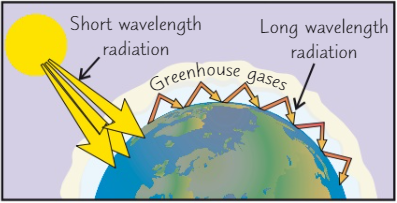
Explain the greenhouse effect in terms of the interaction of short and long wavelength radiation (7)
Energy from the sun travels to the Earth as short wavelength radiation (e.g. ultra violet and visible light)
The energy of the radiation is absorbed when it reaches the surface of the Earth
The surface of the Earth then re-emits the energy as long wavelength radiation (e.g. infra-red)
Some of the long wavelength radiation reflects back into space
But some of the long wavelength radiation interacts with the greenhouse gas molecules in the atmosphere and the energy in the long wavelength radiation is absorbed
The greenhouse gases then re-emit the thermal radiation in all direction including towards the earth
Because the energy is trapped in the atmosphere this causes the temperature to increase
What are the 2 ways humans increase the amount of carbon dioxide in the atmosphere?
Deforestation → leads to less trees photosynthesising which leads to less carbon dioxide being absorbed
Burning fossil fuels → releases carbon dioxide
What are the 2 ways humans increase the amount of methane in the atmosphere?
Agriculture → farm animals produce more methane through their digestive processes (farting)
Decomposition of landfills → releases methane
What is the importance of peer review?
Makes information reliable
Why is there speculation on the causes of global warming?
Simplified models, speculation and opinions presented in the media that may be based on only parts of the evidence and which may be biased
What are the consequences of climate change? (4)
Melting of polar ice caps, causing a rise in sea levels, increased flooding in costal areas and costal erosion
Increase in extreme weather (droughts, hurricanes floods)
Changes in rainfall patterns and increase in temperatures will lead to species not being adapted to their new environments and crops not having the correct conditions to grow
Tropical diseases such as malaria would be more common in areas that aren’t tropical such as the UK
What is a carbon footprint?
The total amount of carbon dioxide and other greenhouse gases emitted over the full life cycle of a product, service or event.
How could carbon footprints be reduced? (8)
Use renewable energy sources instead of fossil fuels
Be efficient processes to reduce waste which reduces emissions of methane
Governments can tax people on the amount of greenhouses gases they emit
Governments can put a cap (limit) on emissions of all greenhouse gases that companies make
Invest in technology that captures carbon dioxide
Walk instead of driving
Become a vegetarian
Improve home insulation
Why is it difficult for people to reduce their carbon footprints? (4)
Governments are worried that if they prioritise the environment it will impact economic growth of communities
Hard to makes international agreements to reduce emissions because countries don’t want to sacrifice their economic development if others won’t do the same
Individuals don’t want to change their lifestyles
Too expensive
What are released when fossil fuels are burned? (6)
Carbon dioxide
Carbon monoxide
Water vapour
Sulfur dioxide
Oxides of nitrogen
Particulates
When is carbon dioxide released + what are its effects?
Released → complete combustion of fossil fuels with an excess of oxygen
Effects → a greenhouse gas which causes global warming
When is carbon monoxide released + what are its effects?
Released → incomplete combustion of carbon fuels with a lack of oxygen
Effects → Colourless, odourless and very hard to detect
→ dangerous as it binds with the haemoglobin and reduces the amount of oxygen in the blood as a result
→ lack of oxygen causes fainting, a coma or death
When is water vapour released + what are its effects?
Released → complete/incomplete combustion of fossil fuels
Effects → a greenhouse gas which causes global warming
When is sulfur dioxide released + what are its effects?
Released → when coal is burned, sulfur atoms are oxidised
Effects → causes acid rain which kills plants and damages buildings and statues, also makes metal corrode
→ also causes respiratory problems if breathed in
When are oxides of nitrogen released + what are their effects?
Released → a reaction between nitrogen and oxygen in the air caused by the heat of burning at high temperatures (happens mainly in the internal combustion engines of cars)
Effects → causes acid rain which kills plants and damages buildings and statues, also makes metal corrode
→ also causes respiratory problems if breathed in
When are particulates released + what are their effects?
Released → unburned particles of hydrocarbons
Effects → cause respiratory problems if inhaled as they get stuck in lungs and cause problems
→ also reflect sunlight back into space leading to less light reaching the Earth and causing global dimming