FNR 240 Final Exam
 Studied by 0 people
 Call with Kai
 Learn
Learn Practice Test
 Spaced Repetition
 Match
Match Flashcards
 Knowt Play
1/306

There's no tags or description
Looks like no tags are added yet.
Name | Mastery | Learn | Test | Matching | Spaced | Call with Kai |
|---|
No study sessions yet.
307 Terms
List the seven levels of taxonomic classification in order from broadest to most specific.
Kingdom, Phylum, Class, Order, Family, Genus, Species.
What mnemonic is provided to remember the order of taxonomic classification?
King Phillip Came Over For Good Soup.
In taxonomy, what classification level is between Phylum and Order?
Class.
In taxonomy, what classification level is between Family and Species?
Genus.
What is the scientific name for the snowshoe hare?
Lepus americanus.
What is the scientific name for the eastern cottontail?
Sylvilagus floridanus.
Based on their genus, which two of the following are most closely related: Mule deer (*Odocoileus hemionus*), White-tailed deer (*Odocoileus virginianus*), or Elk (*Cervus elaphus*)?
Mule deer and White-tailed deer.
Deer, elk, moose, and caribou all belong to the family _____.
Cervidae.
Approximately how many mammal species exist globally?
Around 6,500 species.
Approximately how many mammal species are found in North America?
Around 643 species.
How many mammal species are found in Indiana?
60 species.
What is a key distinguishing feature of mammals regarding how they feed their young?
They produce milk.
Mammals are warm-blooded, which is also known as being _____.
Endotherms.
What are the three primary groups of mammals, defined by their breeding mechanisms?
Monotremes, marsupials, and placental mammals.
Which group of mammals is characterized by laying eggs?
Monotremes.
Name the two examples of living monotremes.
Platypus and echidna.
Which group of mammals is characterized by having a pouch where young complete their development after a short gestation period?
Marsupials.
Name two examples of marsupials.
Kangaroo, koala, or opossum.
Which group of mammals is the largest, containing 95% of species, and is characterized by a placenta and live birth of well-developed young?
Placental mammals.
Indiana's 60 mammal species are organized into how many Orders and Families?
8 Orders and 19 Families.
What is the single species of the family Didelphidae (opossums) found in Indiana?
Virginia Opossum.
How many species of the family Soricidae (shrews) are found in Indiana?
Six species.
How many species of the family Talpidae (moles) are found in Indiana?
Two species: Star-nosed mole.
The family Vespertilionidae, which includes the Indiana bat, consists of how many species in Indiana?
Thirteen species.
What is one of the thirteen species listed in the family Vespertilionidae?
Any one of: Eastern small-footed bat, Southeastern bat, Gray bat, Little brown bat, Northern long-eared bat, Indiana bat, SIlver-haired bat, Tri-colored bat, Big brown bat, Evening bat, Red bat, Hoary bat, and Rafinesque’s big-eared bat.
What is the single species of the family Dasypodidae found in Indiana?
Nine-banded armadillo.
True/False: The Nine-banded armadillo is moving northward into Indiana.
True.
How many species of the family Leporidae (rabbits and hares) are found in Indiana?
Two species.
How many species of the family Sciuridae (squirrels) are found in Indiana?
Eight species.
What is one of the species listed in the family Sciuridae?
Any one of: Eastern chipmunk, Woodchuck, Thirteen-lined ground squirrel, Franklin’s ground squirrel, Gray squirrel, Fox squirrel, Red squirrel, Southern flying squirrel.
The Eastern chipmunk, Woodchuck, and Southern flying squirrel all belong to the family _____.
Sciuridae.
What is the single species of the family Geomyidae (pocket gophers) found in Indiana?
Plains pocket gopher.
What is the single species of the family Castoridae found in Indiana?
Beaver.
How many species of the family Cricetidae (New World rats, mice, and voles) are found in Indiana?
Nine species.
The Muskrat, Prairie deer mouse, and Meadow vole all belong to the family _____.
Cricetidae.
What is one of the species in the family Cricetidae?
Any one of: Western harvest mouse, Prairie deer mouse, White-footed mouse, Allegheny woodrat, Meadow vole, Prairie vole, Woodland vole, Muskrat, Southern bog lemming.
How many species of the family Muridae (Old World rats and mice) are found in Indiana?
Two species: Norway rat, House mouse.
What is the single species of the family Dipodidae (jumping mice) found in Indiana?
Meadow jumping mouse.
How many species of the family Canidae (coyotes, dogs, and foxes) are found in Indiana?
Three species.
What are the three species of the family Canidae found in Indiana?
Coyote, Red Fox, and Gray Fox.
What is the single species of the family Ursidae (bears) found in Indiana?
American black bear.
What is the single species of the family Procyonidae found in Indiana?
Raccoon.
How many species of the family Mustelidae (weasels, badgers, and otters) are found in Indiana?
Five species.
The River otter and the American mink belong to the family _____.
Mustelidae.
What is the single species of the family Mephitidae (skunks) found in Indiana?
Striped skunk.
What is the single species of the family Felidae (cats) found in Indiana?
Bobcat.
What is the single species of the family Cervidae (deer) found in Indiana?
White-tailed deer.
According to the Grimaldi & Engel 2005 data, approximately how many species of insects have been described?
925,000.
Insects represent about _____ of individual multicellular life forms on Earth.
90%
What is the Kingdom, Phylum, and Class, that insects belong in?
Insects belong to Kingdom Animalia, Phylum Arthropoda, and Class Insecta.
What are the three distinct body segments that characterize an insect?
The three body segments are the head, thorax, and abdomen.
How many pairs of jointed legs do insects have?
Insects have three pairs of jointed legs.
What sensory structures are typically found on an insect's head?
A pair of compound eyes and a pair of antennae are typically found on an insect's head.
How many pairs of wings do insects usually have in their adult stage?
Insects usually have two pairs of wings in their adult stage.
The order Coleoptera refers to what group of insects?
Beetles.
The order Hymenoptera includes which three major groups of insects?
Bees, Wasps, and Ants.
The order Diptera, or 'True Flies', includes common insects such as the fruit fly and _____.
Mosquitos.
The order Hemiptera, known as 'Bugs', includes which three examples mentioned in the lecture?
Hemiptera includes cicadas, bedbugs, and stinkbugs.
The order Lepidoptera refers to what two groups of insects?
Lepidoptera refers to butterflies and moths.
A 2017 PLOS ONE study found what percentage of decline in total flying insect biomass over 27 years in protected areas?
The study found more than a 75 percent decline.
According to a 2014 study in Science by Dirzo, global monitoring data for 452 species showed what percentage of decline in invertebrate populations over the past 40 years?
The data showed a 45 percent decline in invertebrate populations.
What are the five main conservation issues threatening insect populations?
Climate change, habitat loss, invasive species, disease, and the synergy among these factors.
How does climate change specifically impact insects?
Climate change affects plant phenology and nutrition, which in turn impacts insects.
Habitat loss is a particularly significant threat to which type of insect species?
Specialist insect species.
What is an example of a disease-related conservation issue mentioned for insects?
Colony collapse disorder (in bees) is an example of a disease-related issue.
The infographic 'DEATH BY A THOUSAND CUTS' illustrates multiple global threats to insects, including pollution, urbanization, and _____.
Agricultural intensification or deforestation or insecticides (and others).
What are three critical ecosystem roles that insects perform?
Insects serve as trophic links, pollinators, and waste disposers.
What percentage of terrestrial birds in North America rely on insects and other arthropods to raise their young?
96% of terrestrial birds in North America rely on insects to rear their young.
Which specific type of insect is described as 'the bread and butter of the food webs'?
Caterpillars.
Name two specific bird species in Indiana that rely on small insects for sustenance.
Henslow’s Sparrows and Cerulean Warblers.
What percentage of the world's wild plants depend on insect pollinators for seed production?
80%.
What percentage of the world's food crops are dependent on pollinators?
75%.
Since 1970, animal and insect pollination has led to a _____ increase in the volume of agricultural production.
300%
What is one of the most powerful actions an individual can take at home to support insect conservation?
Reducing the size of their lawn and converting it to native habitat.
Approximately how many acres of North America are covered in lawns?
Up to 40 million acres.
List two ecological functions that lawns do not perform.
Lawns do not sequester carbon, support the food web, manage the watershed, or support pollinators.
Which native trees are particularly important for supporting caterpillars?
Native Oaks, Native Willows, and Native Cherries.
Which bird species aids in the dispersal of acorns from Native Oaks?
Blue Jays.
Which native plant is essential for Monarch butterfly caterpillars?
Milkweed.
Name two native plants recommended to support pollinators.
Native sunflower (such as Jerusalem artichoke) and Goldenrod.
How many insect species are listed as Threatened & Endangered (T&E) under the Endangered Species Act (ESA)?
There are currently 93 T&E insects under the ESA.
What was the first wild bee species to be placed on the federal endangered species list in the U.S.?
The Rusty-patched Bumble Bee.
The endangered Rusty-patched Bumble Bee is native to what region of the United States?
This bee is native to Indiana and can be found throughout the northeastern United States.
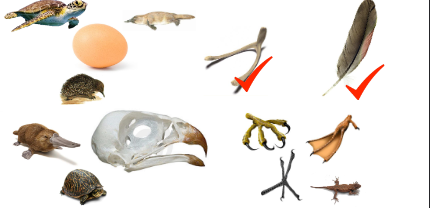
What features are unique to birds?
The presence of a beak AND a wishbone/furcula, feathers, egg-laying, and specialized feet.
What types of feathers do birds possess?
Tail, wings, semiplume, contour, down, filoplume, and bristle.
Compared to mammals or reptiles, how does the number of bones in a bird skeleton differ?
There are many fewer bones in a bird skeleton, due to fusion and reduction of bones.
Approximately how many bones are in a typical bird skeleton?
112.
How does the number of bones in a bird's distal wing (carpometacarpus and digits) compare to a human hand?
A bird has about 10 bones in this area, while a human has around 30.
What is the primary function of the furcula in a bird's skeleton?
The furcula's primary function is to strengthen the thoracic skeleton to withstand the rigors of flight.
What is the common name for the furcula?
The wishbone.
Most birds have a _____-shaped sternum, which creates more surface area for the attachment of flight muscles.
Keel.
What is the function of having a keeled sternum in birds?
It creates a larger surface area for the attachment of powerful flight muscles.
How might the sternum of a flightless bird, like an emu, differ from that of a strong flier?
Flightless birds typically have a flat or reduced keel on their sternum, as they lack large flight muscles.
What is the uncinate process in a bird's skeleton?
A system of small bones where each rib is connected to the adjoining ribs for additional support.
The _____ process is a system unique to birds where each rib is connected to the adjoining ribs, providing additional support to the rib cage.
Uncinate.
What does it mean for a bird's bones to be 'pneumatic'?
It means the bones are hollow and include spaces filled with air, which keeps their weight to a minimum.
What is a key characteristic of all modern bird bills or beaks regarding dentition?
They are all toothless.
In the avian digestive system, what is the function of the crop?
The crop is an expandable pouch that holds food before it moves to the stomach.
Since birds lack teeth, how do they mechanically break down food?
They use the gizzard, a muscular part of the stomach, to pulverize and grind food.
How does the proportion of body volume dedicated to the respiratory system compare between birds and mammals?
Birds devote approximately 1/5th of their body volume to the respiratory system, while mammals only devote about 1/12th.
 Note
Note  Flashcards (91)