CapMar Lec4
 Studied by 6 people
 Call Kai
 Learn
Learn Practice Test
 Spaced Repetition
 Match
Match Flashcards
 Knowt Play
1/23

Earn XP
Description and Tags
IM Lesson 4 Credit Ratings affecting Bond Market
Name | Mastery | Learn | Test | Matching | Spaced | Call with Kai |
|---|
No analytics yet
Send a link to your students to track their progress
24 Terms
Credit Ratings
assessments of creditworthiness of issuers of debt (corporations, municipalities, governments) & debt instruments they issue
provides a measure of credit risk associated with various debt instruments
these ratings help investors make informed decisions & play a crucial role in determining borrowing costs for issuers
these ratings indicate the likelihood that the issuer will be able to meet its debt obligations (interest payments & principal repayment)
According to Corporate Finance Institute (CFI), a credit rating is?
an opinion of a particular credit agency regarding the ability & willingness an entity (government, business, individual) to fulfill its financial obligations in completeness & within the established due dates
Type of Credit Ratings
Investment Grade
Speculative-Grade or Junk
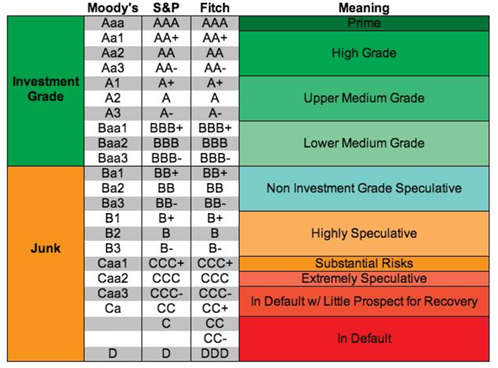
Investment Grade Ratings
low to moderate risk of default
ratings are typically categorized as
AAA: Highest credit quality
AA, A, BBB: Lower grades within investment-grade categories
Speculative-Grade or Junk Ratings
higher risk of default
ratings are typically categorized as
BB, B, CCC, CC, C, D: increasingly speculative & higher risk
Major Credit Rating Agencies
responsible for assigning credit ratings to issuers & their debt instruments
each uses its own methodologies & criteria to assess credit risk, but all consider similar factors including financial stability, economic environment, & issuer-specific conditions
Standard & Poor’s (S&P)
Moody’s Investors Services
Fitch Ratings
Standard & Poor’s (S&P)
one of the most prominent credit rating agencies, known for its broad range of ratings & indices
Moody’s Investors Service
provides credit ratings & research on debt instruments & issuers
Fitch Ratings
offers ratings & analysis across a wide array of financial instruments
Significance of Credit Ratings
Impact on Issuers
Impact on Investors
Impact on Issuers
Cost of Borrowing
higher credit ratings generally lead to lower borrowing costs for issuers
lower-rated issuers typically face higher interest rates to compensate for increased risk
Access to Capital
investment-grade ratings allow issuers to access a broader range of investors, including those restricted to investment-grade assets
Impact on Investors
Risk Assessment
ratings provide a standardized measure of credit risk, helping investors assess the risk associated with specific debt instruments
Portfolio Management
investors use credit ratings to diversify portfolios & align investments with their risk tolerance
How Credit Ratings are Determined
Financial Analysis
Economic & Industry Analysis
Qualitative Factors
Financial Analysis
Financial Statements - agencies analyze financial statements (balance sheets, income statements, cash flow statements)
Financial Ratios - key ratios are evaluated (debt-to-equity, interest coverage, liquidity ratios)
Economic & Industry Analysis
Economic Conditions - broader economic conditions & trends are considered
Industry Conditions - health & prospects of the industry in which the issuer operates are assessed
Qualitative Factors
Management Quality - track record & expertise of the issuer’s management team are considered
Operational Risks - operational challenges & business risks are evaluated
Limitations & Criticisms
credit ratings play crucial role by providing a standardized measure of credit risk
they offer valuable insights for investors & issuers, but need to understand their limitation & factors influencing ratings for informed decision-making
Potential Conflicts of Interest
Lagging Indicators
Impact of Rating Changes
Potential Conflicts of Interest
Issuer Pays Model: agencies are paid by issuers for ratings, which may lead to conflicts of interest & potential biases
Lagging Indicators
Historical Data: ratings may be based on historical data & may not be always reflect current conditions or future risks
Impact of Rating Changes
Market Reactions: changes in ratings can lead to significant market reactions, affecting bond prices & investor sentiments
Enron Scandal of 2001 & its Credit Ratings
Enron Corporation
american energy, commodities, & services company
based in Houston, Texas
infamous for one of the largest corporate frauds
founded in 1985 by Kenneth Lay
rapidly grew to become a major player in the energy sector & was renowned for its innovative trading strategies & aggressive business expansion
one of the largest companies in US with reported revenues of over $100 billion in 2000
Enron Scandal
their spectacular rise was fueled by fraudulent accounting practices designed to hide the company’s true financial condition
used complex financial structures, including special purpose entities (SPEs) to keep large amounts of debt off its balance sheet & inflate its earnings
executives (CEO Jeffrey Skilling & CFO Andrew Fastow) manipulated financial statements to present a misleadingly strong performance, which misled investors, regulators, & the public
scandal began to unravel in October 2001 when Enron announced a massive third-quarter loss & a significant reduction in shareholder equity due to hidden debts
disclosure led to a loss of investor confidence & rapid decline in the company’s stock price
filed for bankruptcy on December 2, 2001 which was the largest bankruptcy in US history at the time, resulting in the loss of thousands of jobs & billions of dollars investments
Credit Ratings of Enron After the Scandal Emerged
credit rating agencies responded by downgrading Enron’s multiple times in a short period
November 28, 2001: S&P, Moody’s, & Fitch downgraded Enron’s credit rating to junk status (non-investment grade)
S&P: downgraded Enron to BB+, below the investment-grade threshold, considered speculative & indicates a higher risk of default
Moody’s: downgraded Enron to Ba1, a non-investment grade, indicating substantial credit risk
Fitch: downgraded Enron to BB+
November 29, 2001: S&P downgraded Enron again to B-
December 2001: before Enron’s bankruptcy filing, ratings had fallen to D by S&P (default status)
rapid downgrade from investment-grade to junk status within days of the company’s bankruptcy filing was a key element of the Enron scandal, exposing the failure of credit rating agencies to detect the financial instability & fraud earlier
Impact of the Scandal & Failure of Credit Ratings Agencies
highlighted major flaws in the credit rating system
raised concerns about conflicts of interest, as rating agencies were paid by the companies they rated, potentially compromising their objectivity
delayed downgrade significantly contributed to the scale of the financial losses suffered by investors & creditors
scandal led to regulatory changes (Sarbanes-Oxley Act of 2002) which aimed to enhance corporate governance, financial disclosures, & accountability of credit rating agencies & auditors
 Note
Note  Flashcards (32)