Summative Assessment Part 1
 Studied by 2 people
 Call Kai
 Learn
Learn Practice Test
 Spaced Repetition
 Match
Match Flashcards
 Knowt Play
1/145

There's no tags or description
Looks like no tags are added yet.
Name | Mastery | Learn | Test | Matching | Spaced | Call with Kai |
|---|
No analytics yet
Send a link to your students to track their progress
146 Terms
Language
-socially shared code or conventional system for representing concepts using arbitrary symbols and rule-governed combination of those symbols
-the principal method of human communication, consisting of words used in a structural and conventional way and conveyed by speech, writing, or gestures
-complex and dynamic system of conventional symbols that is used in various modes for thought and communication
Contemporary views of language hold that
• language evolves within specific historical, social, and cultural contexts
• language, as rule-governed behavior, is described by at least five parameters
• language learning and use are determined by the interaction of biological, cognitive, psychosocial, and environmental factors
• effective use of language for communication requires a broad understanding of human interaction including such associated factors as nonverbal cues, motivation, and sociocultural roles
speech
Neuromuscular activity that turns language into an oral sound signal and transmits it to an aural receiver
Why does language not = speech
speech is referring to the physical and verbal execution of transmitting and receiving sounds, which is a component of some languages. However, there is more to language than speech. Language is a complex and dynamic system of conventional symbols that is used in various modes for thought and communication. Some languages, such as ASL, do not use speech at all.
communication
a process of information exchange between a sender and receiver through a common system of symbols, signs, or behaviour; it is unique and similar within humans
Examples of animal communication
Waggle dance of bees, pheromones of cats
Why does language not equal communication?
you can communicate without using language, language is just a specific communication tool. Language focuses more on words, signs, or symbols, while communication focuses on the message.
What are the 3 specific characteristics that human language as (that forms of communication may not)
productivity, semanticity/symbolism, possibility of displacement
Productivity
Speakers can make new utterances and recombine the forms they have
learned
semanticity/symbolism
representation of objects, events and ideas symbolically
possibility of displacement
Messages do not need to be tied to the immediate context
what are the 3 domains of language
form, content, use
what are the subtypes of language form
phonology, morphology, syntax
what is the subtype of language content
semantics
what is the subtype of language use
pragmatics
phonology
Study of the sound system of a language, the sounds the language uses and the rules for their combination
phoneme
smallest unit of sound
morphology
rules that govern the use of morphemes in a language that are concerned with the internal organization of words
morpheme
smallest unit of meaning
syntax
rules by which sentences are made; how to combine words into acceptable phrases
semantics
the study of the meaning of language; vocabulary
pragmatics
the rules for when and how to use language to be an effective communicator in a particular culture/society
Children appear to reach developmental milestones ________, regardless of culture or language
in the same order
according to Keller, what are the 2 prototypical cultural models of parenting
interdependence and autonomy
Interdependence Model
-Child is a member of the community
-Children don't sleep alone, are in constant contact with caregiver, and are talked to less
Autonomy model
child is an independent agent who is talked to a lot. There is a desire for independence and sleeping alone
What are the 2 examples of early communicative skills observed in children from different cultures
Example 1: Lieven & Stoll (2013)
· Looked at the communication of two different groups and recorded them
· Village in eastern Nepal (Chintang) vs rural area in western Germany
· Found that there was a similar onset of emerging communicative skills (ex. pointing, showing, attention-getting, etc.) in both cultures
· However, the skills developed at a somewhat different rate
o German children tended to point more (probably give one-on-one interaction with adults)
Example 2: Callahan et al. (2011)
· Development of children in two rural communities (India and Peru) and in a university town in eastern Canada
· 8-month-olds and 3.5 year-olds
Children reached developmental milestones at similar ages - some variation as children got older
Nativist Theories (nature)
-people are born knowing all they need to acquire language, as they biologically develop, so does their language
-insist that language is too complex and is acquired too rapidly to have been learned through any known methods (e.g., imitation), so some critical aspects of the language system must be innate
Empiricist theories (nurture)
-focus on the influence of the environment and the nature of the interactive language contexts within which the child is immersed.
-language input and exposure are the most important
Structuralism
analyzing the form of the utterance from observable data; do they know how English works?
functionalism
focused more on the pragmatic side of the interaction; utterance is followed by observing an action/getting a response for the utterance
competence
-individuals knowledge of language
performance
-actual instances of language use
what is associated with structuralism
competence
what is associated with functionalism
performance
what are the classic theories of language acquisition
behavioural and linguistic
what are the interactionist theories of language acquisition
cognitive, social, usage/gestural
interactionist theories (meaning)
these say that multiple factors after development interact with each other
main points of behavioural approaches
-focus on measurable aspects of language as a behaviour
-emphasize performance over competence, in that intentions and implicit knowledge of grammatical rules are avoided
-child is viewed as a passive recipient of stimuli
how is language acquired according to behavioural theories?
-Classical and operant conditioning
-Productive speech is the result of reinforcements and punishments supplied by environmental agents
-Language development is determined by training, not maturation
-Imitation is an important factor for language learning
main points of linguistic approaches
-language is innate and has a structure independent of language use
-developed by Chomsky who believed in the language faculty
-children have a universal grammar built into their brains
-children also have an innate biological language component specializes in processing, called the language acquisition device
-favours competence over performance
-believes in a critical period for language acquisition
universal grammar
Noam Chomsky's theory that all the world's languages share a similar underlying system of principles, conditions, and rules and that it is considered to be innate
language acquisition device
Chomsky's concept of an innate, prewired mechanism in the brain that allows children to acquire and process language naturally
language faculty
the hypothetical component of the brain devoted to language
what are the 2 components that the language faculty must have
cognitive system and performance system
critical period for language acquisition
between 2 years and puberty; certain timeframe children have where they can be exposed to language and adequately learn it
what are the 2 cognitive approaches for language acquisition
Piaget's Theory and information processing model
Main Points of Piaget's Theory
-Language is not a separate innate characteristic, but rather an ability that results from cognitive development
-The sequence of cognitive development determines the sequence of language development
-Complex structures of language are neither innate nor learned
-Children
need to complete the sensorimotor period before using language
main point of information processing models
-Children are novice information processors (little computers)
what are the 2 information processing models
competition model and parallel-distributed processors
competition model
-Various cues in the language environment compete with one another and are processed
-As the mind is processing a sentence or phrase, it is rapidly computing these different probabilities, often based on past experiences with similar sentence constructions and the grammatical rules taught for a given language
-Serial processing: Operations performed one at a time
-Parallel processing: Multiple operations occur simultaneously
parallel distributed processing
-Consist of a series of processing units called activation nodes which are connected to other
nodes by pathways that vary in the strength of the connection-Language comprehension and production involve parallel processing-Multilayered networks of connections: Interpret linguistic input and generate speech
-Eg. If you are using the word dog a lot, then the node continues to get activated and then gets learned. The more times info is given, the more the node is activated and the easier it's acquired
main points of social interaction approach
· Speech directed to children (motherese or infant-directed speech) facilitates language development
· Language emerges from interplay between children’s linguistic and cognitive capacities and social environment
· Non-linguistic aspects of interaction are key: turn- taking, mutual gaze, joint attention, and cultural conventions
-Cognitive development results from interaction between children’s innate skills (nativist/linguistic) and social experiences (empiricist/behavioural)
-Social interactive language learning: Interactions between caregivers and children are the basis for future conversational patterns
-zone of proximal development
Social interactive language learning
· Interactions between caregivers and children are the basis for future conversational patterns
Zone of proximal development
Area between what a child can accomplish independently (actual developmental level) and what he can accomplish with another person who has greater knowledge or skills (level of potential development)
Main points of gestural and usage-based approach
· Language acquisition is the product of cognitive and social processes
· Human language roots consist of communicative pointing and iconic gestures
-mirror neurons are support for this
-signs (including ASL) can convey the same information as a spoken sentence without mastering syntactic rules
-pattern finding (a cognitive skill), joint attention, and interactions with caregivers are important for emergence of grammar
mirror neurons
a neuron that fires both when performing an action and when observing the same action performed by another person
joint attention
a process in which social partners intentionally focus on a common referent in the external environment
Infants can ____ different speech sounds before they ____ them
distinguish; produce
word segmentation
the process of discovering where words begin and end in fluent speech
when is speech segmentation acquired
8 months
Early babbling sounds are similar across languages, but this changes towards the end of the____
first year
what are the 5 criteria for deciding if an infant is engaging with intentional communication
1. Child makes eye contact with the partner while gesturing or vocalizing (alternate gaze between object and partner)
2. Some gestures become consistent (opening and closing hand when the baby wants something)
3. Some vocalizations become consistent (producing "eh eh" when the baby wants something)
4. After a gesture or vocalization the child pauses to wait for a response from the partner
5. The child persists in attempting to communicate if he/she is not understood (can modify behaviour)
When do the first signs of intentional communication tend to emerge
8-10 months
What are 4 ways that infants can communicate with their caregivers
-Show an object to the caregiver while vocalizing
-Give an object to the caregiver
-Point to direct attention to an object (around 6 to 10 months)
-Look towards an object indicated by a caregiver (around 9 to 12 months)
when does joint attention emerge
around 12 months
protowords
Vocalizations with consistent sound patterns used across situations but unique to the child
what are the two main aspects of a caregiver's speech when communicating with infants
child directed speech and the conversational nature
child directed speech (motherese)
Speech directed to infants that contains specific characteristics
what are 5 characteristics of child directed speech
-Higher pitch
-Slower rate of speech
-Variable pitch (greater pitch variation)
-Exaggerated stress
-Simplified sentence structure
why is the conversational nature of caregiver's speech important for language development? and what does this mean?
Caregivers comment on various nonverbal and verbal behaviours exhibited by the infant; as infants grow up caregivers change in what they accept as a turn in a conversation. Important because the quantity of adult-to-child speech is important for rate of language development
When do children start putting words together?
age 2
What is timing of first word combinations related to
timing of first words, time that they understand around 50 words, mother's responsiveness to child communication at age 1
what are 6 methods of assessing early comprehension of syntax
-diary studies
-act-out tasks
-direction tasks
-picture-choice tasks
-preferential looking paradigm
-ERP's
Diary studies
document conditions under which the child can or cannot understand
Act-out tasks
the experimenter asks the child to act out a sentence such as Make the girl kiss the duck using toys)
direction tasks
child is asked to carry out a direction, such as Tickle the duck, or answer questions
Picture-choice tasks
child must select the picture that best represents the linguistic form being tested
Preferential looking paradigm
Experimental method used with prelinguistic infants that tracks eye movement
-ex. reading a sentence and seeing if the children reliably spend longer looking at a correct depiction of the scene
ERP and syntax
2-year-olds showed different brain responses to grammatical vs. ungrammatical sentences
when do children produce single-word utterances
12-24 months
when do children produce two-word utterances
18-24 months
when do children produce longer multi-word utterances
24-30 months
One-word stage
■ Comprehension is ahead of production
■ One-word utterances express sentence-like meaning
Two-word stage
■ Most of the child utterances are two words-long
■ Child's language is creative (no imitation of adult sentences)
■ Sentences are simple
in the two word stage, what are early sentences mostly composed of?
content words such as nouns, verbs, and adjectives
in the two word stage, what are early sentences mostly lacking?
function words such as prepositions, conjunctions, and articles
telegraphic speech
Speech that consists of content words without function words; kitty go home
what is the average age of syntactic growth
18 months
at what age do most children produce word combinations
2 years
_____ is a good indicator of syntactic development
Sentence length
Stage 1 (browns stages of early syntactic growth)
MLU= 1.0-2.0, age= 12-26 mo.
Stage 2 (browns stages of early syntactic growth)
MLU= 2.0-2.5, age= 27-30 mo.
Stage 3 (browns stages of early syntactic growth)
MLU=2.5-3.0, age=31-34 mo.
Stage 4 (browns stages of early syntactic growth)
MLU=3.0-3.5, age= 35-40
Stage 5 (browns stages of early syntactic growth)
MLU=3.5-4.0, age=41-46
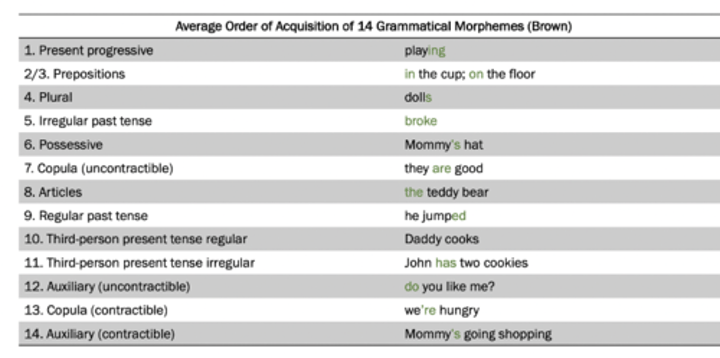
what does predict the order of morpheme acquisition? what doesn't?
complexity; frequency of parent's usage
Average order of acquisition of grammatical morphemes
what are the first 3 pronouns acquired
I, it, you
when are subjective and objective pronouns acquired?
by age 3
 Note
Note  Flashcards (20)