Lecture 13: Photosynthesis and Carbon Fixation
 Call Kai
 Learn
Learn Practice Test
 Spaced Repetition
 Match
Match Flashcards
 Knowt Play
1/56

There's no tags or description
Looks like no tags are added yet.
Name | Mastery | Learn | Test | Matching | Spaced | Call with Kai |
|---|
No analytics yet
Send a link to your students to track their progress
57 Terms
autotrophs
self feeders
heterotrophs
other-feeders
oxygenic photosynthesis generates
O2 in the atmosphere
photosynthesis converts what energy into what energy
light energy into chemical energy
What to the plants take in and what the they produce and release
Take in CO2 and water, produce carbohydrates, and release O2
photosynthesis equation
6CO2 + 6H2O -> C6H12O6 + 6O2
photosynthesis location
chloroplast
What happens if a molecule absorbs a photon?
thermal dissipation, fluorescence, energy transfer, electron transfer
Excited electrons properties
increased potential energy, transfer energy (excitons), easier to transfer (oxidation)
pigments
molecules that absorb specific wavelengths of light
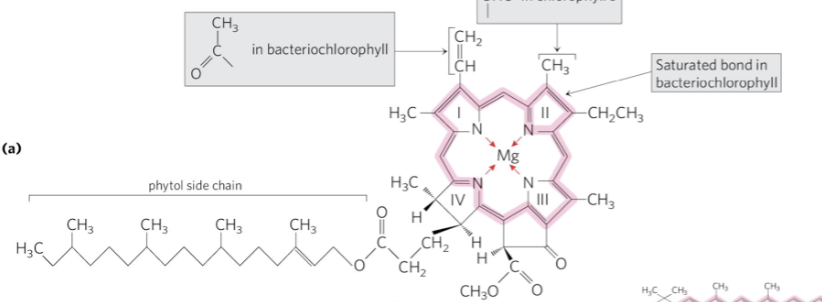
Chlorophylls structure
porphyrin head (porphyrin ring with conjugated double bonds) and a phytol tail
chlorophyll function
absorb photons within the visible spectrum, minimize energy loss through thermal vibration (de-excitation)
accessory pigments
used to extend the range of light absorption
absorption spectra correlate with
photosynthetic activity (absorbed wavelengths power photosynthesis)
pigments are bound to the _____ ____ ____ within the ____ _____
light harvesting complexes; thylakoid membrane
reaction center
pigments where absorbed light energy drives electron transfer
antenna complex
provides a network of pigment molecules to capture and transfer energy
reaction center chlorophyll enables efficient
redox reaction
photosystems
energy hasvesting proyteins that faciliate transfer of excited electrons
energy is funneled to the _____ ____ ____ in the reaction center
chlorophyll special pair
excitation causes a _______ ____ ______ in the reaction center and initiates a ____ ___
separation of charges; redox chain
oxygen evolving complex
splits water to produce O2, electrons, and H+ in photosystem II
In the Oxygen Evolving Complex, water reduces what to produce O2 in a single step
Mn
Problem in cytochrom b6f complex
plastohydroquinone (PQH2) transports two e-, but plastocyanin (PC) can only transport one e- at a time
cytochrome b6f overall
remove 2H+ from the stroma, pump 4 total H+ into the thylakoid lumen, move both electrons from QH2
Ferradoxin (Fd)
shuttles e- NADP reductase to produce NADPH, shuttles e- to cyt b6 f complex to produce ATP
photosystem I
accepts e- from PC, excite e-, transfer e- to ferredoxin
track electrons through carriers in a
z scheme
photophosphorylation
light generates a proton gradient that drives ATP synthase
how many H drive a full rotation of CF0 subunit
12 H+
Two systems of electron transport
noncyclic and cyclic
noncyclic electron transport
ps I and psII required, produce NADPH and ATP
cyclic electron transport
PS I, produce ATP NOT NADPH
plants use cyclic and noncyclic to maintain what ra
3:2 ATP: NADPH for carbon fixation
cyclic electron transport recycles
electrons to generate additional ATP
Appressed thylakoids
stacked tight, packed with PSII and LHC to optimize light capture, LHC mediates connection between membranes
nonappressed thylakoids
unstacked regions with access to stroma (ferradoxin, NADP+, ADP), PSI and ATP synthase
how does thylakoid stacking work and change
dynamic in response to light
LHC mediates
connection between membranes
LHC (movement and job)
mobile, can help funnel energy to PSI when PSII is more active
CO2 assimilates into …
biomass in plants
carbon fixation aka the calvin cycle occurs where
stroma
calvin cycle: stage 1
CO2 fixation to 3-phosphoglycerate
Ribulose 1,5 bisphosphate carboxylase/oxygenase (RuBisCO)
very slow: large amounts are needed to achieve high carbon fixation rates
RuBisCO represents around what percent of soluble protein in chloroplast
50%
RuBisCO in the presence of oxygen forms
alternative products
Carboxylase activity of rubisco: problem
once it is primed for attack, cannot discriminate between CO2 and O2
Carboxylase activity of rubisco: solution
plants have evolved different mechanisms to increase [CO2] in leaf tissue
calvin cycle stage 2
reduce 3-PG to G-3-P
we need ___ G3P to regenerate RuBP
5
calvin cycle: stage 3
regeneration of ribulose 1,5 bisphosphate
Calvin cycle stage 3 problem
RuBP is pentose (5C), but G3P and DHAP are 3C
Triose phosphates interconvert to form
pentose phosphates
Calvin Cycle overall summary
for every 3 CO2 fixed, 9 ATP and 6 NADPH are consumed, 1 G3P is produced
enzymes in calvin cycle are ____ ___ by light
indirectly activated
when chloroplasts are illuminated
stromal [Mg2+] increases, stromal pH increases
fructose 1,6 bisphosphatase
stage 3, pH dependent, requires Mg2+, increase in light conditions

