SAS 11: PART II
 Call Kai
 Learn
Learn Practice Test
 Spaced Repetition
 Match
Match Flashcards
 Knowt Play
1/34

There's no tags or description
Looks like no tags are added yet.
Name | Mastery | Learn | Test | Matching | Spaced | Call with Kai |
|---|
No analytics yet
Send a link to your students to track their progress
35 Terms
axis location
can be determined using a kinematic face-bow or arbitrary hinge-bow
3 classification of jaw relations
orientation relations
vertical relations
horizontal relations
orientation relations
necessary to do before carrying out other jaw relation
this relation gives the angulation of the maxilla in relation to the base of the skull
jaw relation that orients the mandible to the cranium allowing rotation in the sagittal plane around the transverse axis in its most posterior position
vertical relations
represents the length of the face
jaw relation that establishes the amount of jaw separation allowable for dentures
horizontal relations
jaw relation that establishes the front-to-back and side-to-side relationship of one jaw to the other
three-dimensional movement of mandible
vertical axis → lateral rotation
horizontal / hinge axis → opening/closing
sagittal axis → orbiting condyle movement during lateral excursions
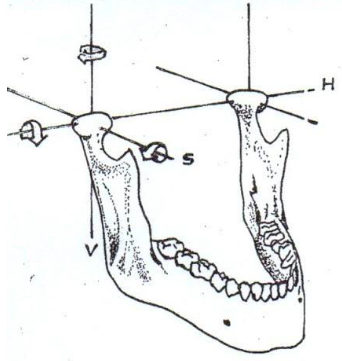
rotation around the horizontal (hinge) axis
produces opening and closing movements of the mandible
can occur in any degree of protrusion as well as in centric relation
rotation around the vertical axis of one condyle
produces lateral rotation of the mandible in the horizontal plane
results in lateral excursion toward the side of the rotating condyle
[ rotating (working) condyle → the condyle around which rotation occurs ]
lateral excursions of the mandible
the orbiting condyle travels downward and forward
produces rotation around a second horizontal axis called the sagittal axis → intersects the rotating condyle
[ orbiting (non-working) condyle → the opposite condyle ]
2 types of vertical jaw relations
vertical relation of occlusion (VRO/VDO)
vertical relation of rest position (VRP/VDR)
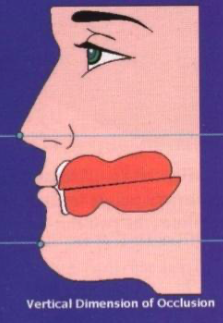
vertical relation of occlusion (VRO/VDO)
length of the face when the teeth are in contact
used as a guide to restore lost vertical relation of occlusion
establishment:
natural teeth → by the teeth in occlusion
dentures → by the vertical height of the two dentures when teeth are in contact
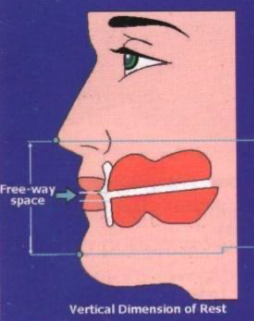
vertical relation of rest position (VRP/VDR)
longer than the VDO
length of the face when the lower jaw is relaxed
determined by muscles and gravity, not teeth
physiologic rest position
all muscles that open the jaws are in minimal tonic contraction sufficient to maintain posture
difference between VRO and VRP
interocclusal distance or freeway space
interocclusal distance (freeway space)
essential for health of periodontal tissues
distance or gap between upper and lower teeth when mandible is at physiologic rest
absence of freeway space may cause:
clicking during speech
soreness of basal seat tissues
rapid destruction of residual alveolar ridges
normal distance of freeway space (interocclusal)
2-4mm vertically → observed at 1st premolars
centric relation (centric jaw relation)
basic horizontal relationship
most posterior position of the mandible to the maxillae at the established vertical relation
eccentric relations
other horizontal relations
deviations from centric relation in a horizontal plane
protruded relation
right, left lateral relations
intermediate relations
movements of the mandible
complex, varies among individuals and within the same individual
occurs during:
mastication, speech
swallowing, respiration
facial expression
parafunctional movements:
bruxism, clenching → may cause pain or pathosis
factors that regulate jaw motion
influence of the TMJ
axes of mandibular rotation
influence of opposing tooth contacts
muscular involvement in jaw motion
neuromuscular regulation of mandibular motion
influence of opposing tooth contacts
occlusion of opposing teeth guides movements
condylar movement is not limited solely by TMJ anatomy
teeth should meet evenly on both sides in centric and eccentric positions
prevents:
deflection of mandible from normal path
displacement of dentures from residual ridges
muscular involvement in jaw motion
temporal and lateral pterygoid muscles
are primarily involved
clinically significant for establishing jaw relations
influence of the TMJ
each TMJ has two compartments separated by the articular disk:
upper compartment → primarily translation
lower compartment → primarily rotation
3 axes of mandibular rotation
vertical
sagittal
transverse
[ axes move constantly during normal function ]
neuromuscular regulation of mandibular motion
muscles that move, hold, or stabilize the mandible receive impulses from the central nervous system
jaws slightly opened
hinge → rotation
hinge action predominates
jaws widely opened
gliding → translation
hinge and gliding actions combined
face-bows
it orients casts in the same relationship to the opening axis of the articulator
a caliper-like device that records and transfers the jaw relationship to the TMJs
enables mounting of the maxillary cast on the upper member of the articulator in the same relationship as the maxilla to the glenoid fossa
use of face-bows
helps prevent errors in denture occlusion
records the relationship of the maxilla to the glenoid fossa
orients the casts on the articulator in the same relationship as the patient’s jaws
2 types of face-bows
arbitrary face-bow
kinematic (hinge) face-bow
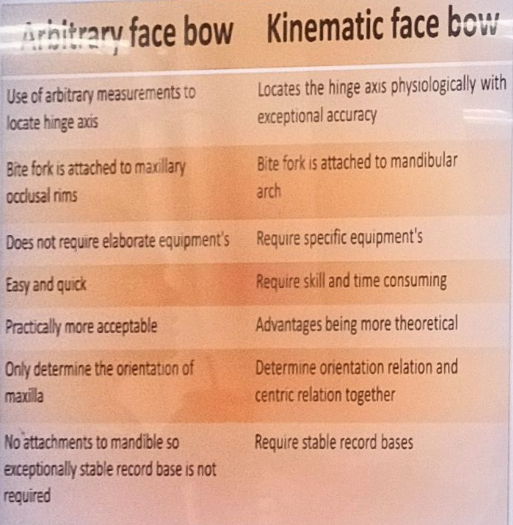
arbitrary face-bow
fork is attached to the maxillary occlusion rim
condyle rods placed approximately over the condyles
widely used type of facebow and are sufficient for fabrication
uses approximate points on the face as the posterior points and condylar rods are positioned on the points
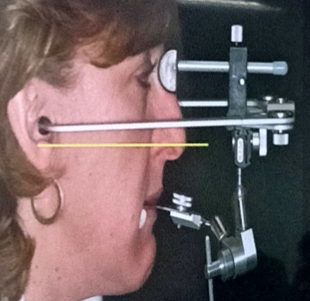
facia type facebow
this facebow takes it name from the fact that it rests upon the face like the kinematic bow
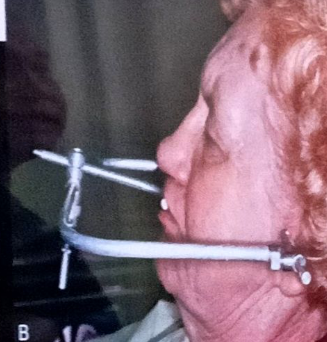
earpiece type facebow
this type of facebow uses the external auditory meatus as an arbitrary reference point which is aligned with ear pieces
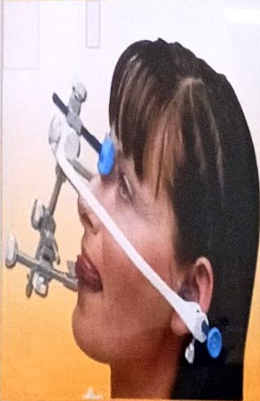
kinematic (hinge) face-bow
fork is attached to the mandibular occlusion rim
opening axis of mandible can be located more accurately
allows for the precise determination of the patient’s hinge axis (terminal hinge axis)

