Algebra 1
 Call Kai
 Learn
Learn Practice Test
 Spaced Repetition
 Match
Match Flashcards
 Knowt Play
1/96

Earn XP
Description and Tags
Name | Mastery | Learn | Test | Matching | Spaced | Call with Kai |
|---|
No analytics yet
Send a link to your students to track their progress
97 Terms
Algebra
It is branch of mathematics which deals with the study of formal manipulations of equations involving numbers and numerals (signs or symbols for graphic representation of numbers).
Al-jabr - Restoration
The word Algebra is taken from the Arabic word "___", which means _____.
Algebra
One of the earliest mathematical concepts was to represent a number by a symbol and to represent rules for manipulating numbers in symbolic form as equations.
Algebra
Science of restoration, completion, reduction, or balancing.
Number
It is an entity describing the quantity or position of a mathematical object or extensions of these concepts.
Number
An item that describes magnitude and position.
Cardinal and Ordinal Numbers
Two distinct type of numbers.
Cardinal Numbers
It refers to the magnitude (size) and quantity.
Ordinal Numbers
It refers to the position relative to an ordering.
Numerals
Signs or symbols for graphic representation of numbers.
Roman Numerals
Consist of seven symbols written in Latin Alphabet.
Number System
It is a simple tree diagram showing the classifications of numbers.
Positive Numbers
Natural or counting numbers
Integers
Negative, zero, and positive numbers
Rational Numbers
Integers and non-integers
Rational Number
Any number that can be expressed in the ratio of 2 integers a to b or (a/b).
Non-Integers
Fractions, non-repeating and terminating decimal, repeating and non-terminating decimal
Real Numbers
Irrational and rational
Axiom
Theorems
The properties of real numbers are simply the rules where many of which are ____ (assumptions), and ____ (consequences of these assumptions) that are to be followed in working with mathematical expressions or equations.
Transcendental Numbers
Other term for irrational numbers
Irrational or Transcendeantal Numbers
Constants like pi and e
√2
What is the first known irrational number?
Christian Kramp
Who introduced the factorial sign “!”?
Robert Recorde
Who introduced the equal sign “=”?
Neither
Is one (1) a composite number or prime number?
Twin Prime
A prime number that is either 2 less or 2 more than another prime number. For example, (41, 43) or (11, 13).
Emirp
A prime number that results in a different prime when its decimal digits are reversed.
Palindromic Prime (Pal Prime)
Both prime numbers that reads the same forwards and backwards that only divisible by 1 and itself.
Surd
It is under irrational numbers; represents with the radical symbol like √3, 1+√6, √3+√6
Complex Numbers
Real and Imaginary numbers
Gaussian Integer (Number Theory)
The complex numbers are generally called?
Argand Diagram
Complex Numbers are plotted in _____.
Complex Numbers
It is in the form of a+bi (i.e. 1+6i)
Leonhard Euler
Who introduced the i with the value of √-1?
Composite Numbers
Numbers with more than 2 factors (i.e. 4, 6, 9, 12)
Prime Numbers
Numbers having only 2 factors (unity and itself)
2216091-1
What is the highest known prime?
2
What is the only prime even number?
Because it only has 1 factor
Why does 1 is not a prime number?
Complex Number
The sum of real and imaginary number.
a = real part
b = imaginary part
i = √-1
What are a, b, and i in complex numbers?
Pure Imaginary
In a+bi, when a=0, the number is called?
Real
In a+bi, when b=0, the number is called?
Irrational Numbers
Numbers that cannot be expressed as a ratio of two integers.
Happy Number
A number which will yield 1 when it is replaced by the sum of the square of its digits repeatedly.
3 = index
1 = radicand
√ = radical
Parts of ∛1
n√am = (n√a)m
n√a * n√b = n√ab
(n√a)n = a
n√a/n√b = n√a/b
m√(n√a) = mn√a
Laws of Radicals (5)
Common Factor
A ____ of two or more counting numbers which is a factor of each of the given number. The set of _____ of the two numbers is the instersection of these two sets.
Greatest Common Factor (GCF)
The largest counting number which is a factor of each of the given number.
Greatest Common Factor (GCF)
The product of the smallest prime factors common to both.
Multiple
The _____ of a number is the product that the number gives when multiplied by a counting or natural number.
Least Common Multiple (LCM)
The smallest counting number which is a multiple of each of the given number.
Least Common Multiple (LCM)
The product of the prime factors with the highest power in the fatorization.
Lucky Number
The number that is generated by a certain “sieve”.
Perfect Number
A number that is equal to the sum of its proper divisors.
Proper Divisors
Positive factors of a number other than the number itself.
Proper Divisors
6 = 1 × 6
6 = 2 × 3
6 = (1, 2, 3)
1 + 2 + 3 = 6
Abundant Number
A number for which that sum of its proper divisors is greater than the number itself.
Abundant Number
12 = (1, 2, 3, 4, 6)
1 + 2 + 3 + 4 + 6 = 16
Abundance Value
The diffenrence of the sum of its proper divisor to the original number.
Untouchable Number
A number that cannot be expressed as the sum of all the proper divisors of any positive integer including the number itself.
5
What is the only known odd untouchable number?
Most Beautiful Number
The value of the golden ratio.
Amicable Numbers
Two different numbers related in such a way that the sum of the proper divisors of each is equal to the other number.
Amicable Numbers
220 = (1, 2, 4, 5, 10, 11, 20, 22, 44, 55, 110)
1+2+4+5+10+11+20+22+44+55+110 = 284
284 = (1, 2, 4, 71, 142)
1+2+4+71+142 = 220
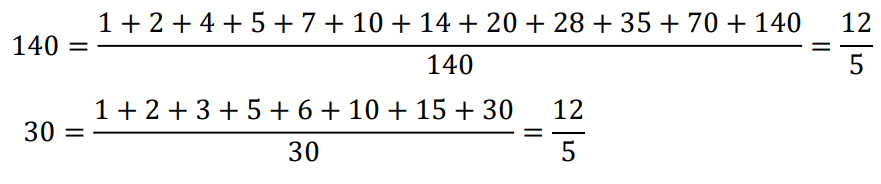
Friendly Numbers
Two or more numbers with a common abundancy index, the ratio between the sum of divisors and the number itself.
Friendly Numbers
Two numbers with the same “abundany” form a friendly pair: (140, 30)
Algebraic Expression
It is made up of variabes and constants along with algebraic operation and made up of terms.
Algebraic Equation
It is indicated by the sign “=”.
3 = numerical coefficient
x2 = term
- = algebraic operation
x = variable
9 = constant
3x2 - x + 9
a (x + y) = ax + ay
(x + y)2 = x2 + 2xy + y2
(x +y) (x - y) = x2 - y2
(x - y)2 = x2 - 2xy + y2
(x + y)3 = x3 + 3x2y + 3xy2 + y3
x3 + y3 = (x + y) (x2 - xy + y2)
x3 - y3 = (x - y) (x2 + xy + y2)
Special Products (7)
aman = am+n
am/an = am-n
(am)n = amn
(ab)m = ambm
(a/b)m = am/bm
a0 = 1
a-1 = 1/an
Exponential Properties (7)
Exponential Notation
An easier way to write a number as a product of many factors.
Logarithm
The inverse function of exponentiation.
Brigssian Logarithm or Common Logarithm
A logarithm with base equal to 10.
Ex.: log10(x) = 4 → log(x) = 4
Naperian Logarithm or Natural Logarithm
A logarithm with base equal to e.
Ex.: loge(x) = 4 → ln(x) = 4
Logus
Arithmus
Logarithm was derived from the word _____ (ratio) and _____ (number).
John Napier
Who introduced logarithm?
Henry Briggs
Who is the mathematician notable for changing the original logarithms into common logarithms.
Antilogarithm or Antilog
The inverse function of logarithm, used to find the original number (x) from a given logarithm value (y).
loga(AB) = logaA + logaB
loga(A/B) = logaA - logaB
loga(Ac) = clogaA
logbx = logax/logab
logx = 0.4343lnx
logx = log10x
lnx = logex
lne = 1
elnx = x
lnx = 2.302logx
Properties of Logarithm (10)
Characteristics
The integral part (whole number) of a common logarithm.
Mantissa
The non-negative decimal part.
Logarithm of a Number
Characterisitics + Mantissa
colog (x) = log (1/x) = -log x
Cologarithm
Fundamental Theorem of Algebra
States that every nonzero, single variable, degree n polynomial with complex coeffients has, counted with multiplicity, exactly n complex roots.
Quadratic Equation
Any equation that can be rearrange in the standard form.
Ax2 + Bx + C = 0, where A is not equal to 0.
x1x2 = C/A
Products of Roots formula
x1 + x2 = - B/A
Sum of Roots formula
Quadratic Formula
The mathematical formula in solving the zeros.
x = (-B ∓ √B2-4AC)/2A
Quadratic Formula
Discriminant
A parameter of an object or system calculated as an aid to its classification or solution.
Real and Equal Roots
If the discriminant is B2-4AC = 0?
Real and Distinct Roots
If the discriminant is B2-4AC > 0?
Imaginary Roots
If the discriminant is B2-4AC < 0?
Descartes’ Rule of Signs
A technique for determining an upper bound (maximum value) on the number of positive or negative real roots of a polynomial. It is not a compete criterion, because it does not provide the exact number of positive or negative roots (approximate).
Descartes’ Rule of Signs
The rule is applied by counting the number of sign changes in the sequence formed by the polynomial’s coefficients.

