The central nervous system
 Call Kai
 Learn
Learn Practice Test
 Spaced Repetition
 Match
Match Flashcards
 Knowt Play
1/14

There's no tags or description
Looks like no tags are added yet.
Name | Mastery | Learn | Test | Matching | Spaced | Call with Kai |
|---|
No analytics yet
Send a link to your students to track their progress
15 Terms
what does CNS include?
The brain: processes information about external and internal stimuli and co-ordinates the body's responses
The spinal cord connects the brain to the rest of the nervous system by carring nerve fibres into and out of brain as well as coordinating some reflex responses.
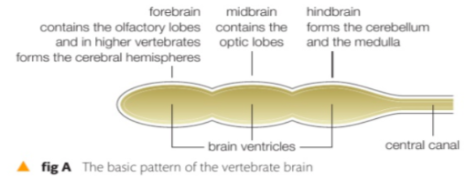
Formation of the brain
In veertebrates the brian forms as a swelling in the hollow neural tube at the anterior (front) end of a vertebrae embryo and folds back on itself
Three main areas, forebrain, midbrain and hindbrain.
compelxity of brain
Some vertebrates have simple brains which have simpler functions such as sight and smell.
Other vertebrate are more complex like humans.
The three areas of the brain are difficult to see as the cerebrum, made of two cerebral hemispheres is folded over the entire brain.
what is grey matter
the cell bodies of neurones in the CNS
What is white matter
the nerve fibres of neurones in the CNS
Structure of cerebrum
The cerebrum is divided into two halves known as the
cerebral hemispheres. Cerebrum is biggest and most
highly developed parts of the brain.
The hemispheres are joined together by a band of nerve fibres known as the corpus callosum
The right hemisphere controls the left side of the body and the left one controls the right side
Thin outer later called cerebral cortex
what is cerebral cortex
The cerebrum has a thin outer layer known as the cerebral cortex or 'grey matter'
The cerebral cortex consists of the cell bodies of neurones
It is highly folded, which increases its surface area and allows it to contain a greater number of neurones
With more neurones in the brain, more neurone connections can be made
This is important, as the more connections between neurones in the brain, the greater the ability of the brain to carry out more complex behaviours
what is beneath cerebral cortex
Beneath the cerebral cortex or grey matter layer is the 'white matter'
The white matter consists of the myelinated axons of neurones
fucntion of cerebrum
The cerebrum is the largest part of the brain in humans, accounting for about 80% of the total mass of the brain
It carries out a large variety of functions
involved with conscious activities, including:
Vision
Hearing
Speech
Thinking
Memory
what does hypothalamus monitor
The hypothalamus monitors the blood as it flows through the brain and, in response, releases hormones or stimulates the neighbouring pituitary gland to release hormones
The hypothalamus plays an important role in some homeostatic mechanisms and coordinates the autonomic nervous system
Functions of hypothalamus
Regulating body temperature
The hypothalamus monitors blood temperature and initiates a homeostatic response if this temperature gets too high or too low
Osmoregulation
Cells in the hypothalamus monitor the water balance of the blood and releases the hormone ADH if the blood becomes too concentrated
ADH increases absorption of water in the kidneys
Regulating digestive activity
The hypothalamus regulates the hormones that control appetite as well as the secretion of digestive enzymes
Controlling endocrine functions
The hypothalamus causes the pituitary gland to release hormones that control a variety of processes e.g. metabolism, growth and development, puberty, sexual functions, sleep, and mood
what is cerebellum?
Coordinates smooth movement
Uses information from the muscles and the ears and eyes to control balance and maintain posture
what is the medulla oblongata
Also known as the medulla
The medulla contains co-ordination centres that control different unconscious functions e.g.
The cardiac centre controls heart rate
The respiratory centre controls breathing rate
The medulla controls functions that are able to maintain life even if other parts of the brain are damaged. Controls reflex actions eg coughing, sneezing, swallowing, paristalsis and saliva production
job of pituitary gland
Its role is to produce a range of hormones
Some of these directly influence and regulate processes in the body while some stimulate the release of further hormones from other endocrine glands
pituitary gland structure
The pituitary gland is located below the hypothalamus
The pituitary gland is divided into two sections; the anterior pituitary and posterior pituitary
The anterior pituitary produces and releases hormones
The posterior pituitary stores and releases hormones produced by the hypothalamus e.g. ADH and oxytocin

