NSCI 2001 Midterm 3
 Call Kai
 Learn
Learn Practice Test
 Spaced Repetition
 Match
Match Flashcards
 Knowt Play
1/340

Earn XP
Description and Tags
University of Minnesota (UMN) NSCI 2001 Human Neuroanatomy midterm 3. Set your settings so that it's answer with definition only or you'll cry :(
Name | Mastery | Learn | Test | Matching | Spaced | Call with Kai |
|---|
No analytics yet
Send a link to your students to track their progress
341 Terms
p type ganglion cells
small dendritic arbor
few bipolar cells
color and form perception
m type ganglion cells
large dendritic arbor
many bipolar cells
motion perception
fovea
high acuity vision
only cones (no rods)
no blood vessels
optic chiasm
where the optic nerve attaches to the brain. retinal axons from nasal side of retina cross in the chiasm
binocular zone
center of visual field where both eyes see
monocular zone
peripheral vision which goes to only one eye
axons of the nasal side of retina _______ in the optic chiasm and goes on the ______ side to the visual cortex
cross; contralateral
axons of the temporal side of retina _______ in the optic chiasm and goes on the ______ side to the visual cortex
do not cross; ipsilateral
the right visual hemifield from both eyes goes to the ____ side of the brain
left
lateral geniculate nucleus
area in thalamus that processes vision
primary visual cortex (V1)
located on either side of calcarine sulcus
receives information from lateral geniculate nucleus (LGN)
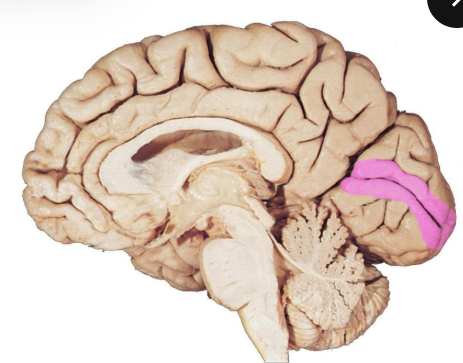
suprachismatic nucelus
hypothalamus
regulates circadian rhythms
pretectal nucleus
midbrain
pupillary light reflex
superior colliculus
midbrain
oculomotor control
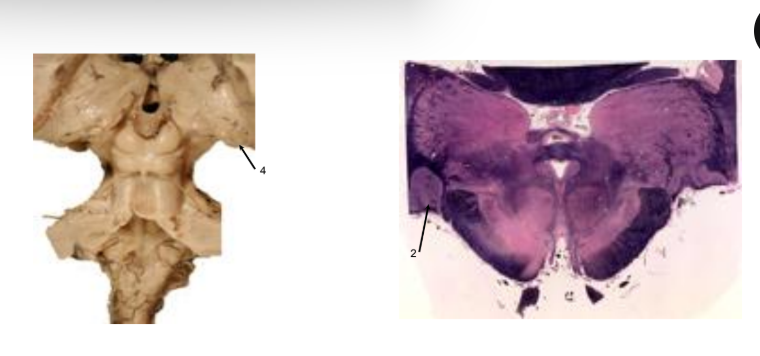
area 2/4
lateral geniculate nucleus
lateral geniculate nucleus has X cell layers
six
cells from M type ganglion cells synapse here
Layers 1 and 2 of the LGN
cells from p type ganglion cells synapse here
layers 3-6 of LGN
lateral geniculate has this type of organization
retinotopic
meyer’s loop processes fibers from ______ in the ___ lobe, _____ to the calcarine fissure
inferior retina/superior visual field; temporal; inferior
fibers representing the ________ are processed in the ______ lobe, ______ to the the calcarine fissure
superior retina/inferior visual field; parietal; superior
inputs from thalamus synapse in what layer of neocortex
layer 4 of neocortex
layer 4 neurons send axons to
layers 2 and 3 of neocortex
primary visual cortex has three types of columns
orientation
ocular dominance
color
how does the layout of visual information in the columns change during development
begin overlapped but eventually segregate completely
dorsal stream
motion
location
“where pathway”
ventral stream
color
object recognition
“what pathway”
where do visual areas of the cortex from two hemispheres communicate?
corpus callosum
labyrinth/inner ear
cochlea
vestibule (utricle and saccule)
semicircular canals.
cochlea
organ that transduces sound into nerve impulses
semicircular canals
angular acceleration into nerve impulses on x y and z axis
vestibule
utricle and saccule, linear acceleration
utricle
horizontal acceleration
saccule
acceleration in saggital plane (front/back, up/down)
tympanic membrane
ear drum, moves with vibration
external ear
collects sound
ossicles
maleus (hammer)
incus (anvil)
stapes (stirrup)
what cochlea shape ?
tube folded in half and then wound into 2.5 spiral
oval window
movement of stapes causes pressure wave to move down cochlea
round window
where the pressure wave of sound exits the cochlea
basilar membrane
where hair cells sit between the two limbs of tube
hair cells
detect sound and movement with different heights of hairs that get closer or further apart from each other
spiral ganglion
primary afferent neurons for hearing
the basilar membrane is thickest at the _________ and thinnest at the ________
base; apex
highest frequencies are located
closest to the beginning of basilar membrane
lowest frequencies are detected at the?
apex of cochlea
tonographic organization is _____
logarithmic
depolarization hair cell hearing causes
excitation, when hairs get further apart on cell (towards longest hair)
hyperpolarization hair cell hearing causes
inhibition, moves towards shortest hair, closer together
cochlear nuclei
sound localization and identification: medulla
superior olivary nuclei
sound localization and volume control: pons
inferior colliculus
identification of and reflexive responses to sounds: midbrain
medial geniculate nucleus
thalamic relay nucleus for hearing
auditory cortex
tonotropic organization, sound identification
conduction deafness
bone issues or earwax that causes hearing loss
sensorineural deafness
most common form
exposure to loud noises or age related
treated with hearing aids
flocculonodular lobe
where vestibular apparatus projects axons
projections to nuclei innervating extraocular muscles
track objects while turning your head
vestibular ocular reflex
projections to spinal cord and cerebellum are responsible for (in balance)
coordinating eye movements with head and neck. coordinate vestibular input with “anti-gravity” muscles
three inputs that tell us how body is oriented
proprioception
vestibular system
vision
Vertigo
sensation of turning in absence of motion
nystagmus
repetitive tracking eye movements in absence of movement
what are the chemical senses?
taste (gustation)
smell (olfactory)
olfactory epithelium
roof of nasal cavity where smell receptors sit
anterior cribriform plate
small holes where thin axons travel from the nose to the olfactory bulb
olfactory bulb
where axons from the olfactory sensory neurons synapse
____ type of odorant receptors are present per olfactory neurons
1
how long is the lifespan of an olfactory neuron
1-2 months
receptors for smells are similar to ____ neurotransmitter receptors
g-protein coupled
how many odorant receptor types do humans have? how many do mice have ?
350, 1000
how do different specific smells get encoded in the odorant receptors?
odorants are recognized by different combinations of odorant receptors
glomeruli
where different inputs are relayed and modulated in the olfactory bulb, specific to different odors
olfactory cortex
located in rostral telencephalon
where the olfactory bulb projects
orbitofrontal cortex
just above eyes
allows for odor discrimination
where scent is processed to involve appetite
lateral hypothalamus
pheromones
in animals (not humans)
modulate reproductive hormones
aggression
often found in urine or glandular secretions
anosmia
inability to smell
can be caused by traumatic injury, genetics, and infection
what are the five tastes
sweet
umami,
salt,
sour,
bitter
which tastes are innately attractive to humans?
sweet
umami
which tastes are innately aversive to humans
sour
bitter
taste
results from activation of five receptors
flavor
taste combined with smell and somatosensation
taste is sensed by which cranial nerves?
facial CN7,
glossopharyngeal CN9,
vagus CN10
which CN innervates front 2/3 of tongue?
cn7 facial
which CN innervates back third of tongue
CN9 glossopharyngeal
which CN innervates throat and very back of tongue
CN10 vagus
papillae
bumps on tongue where most taste buds live
taste cells release an ____________ neurotransmitter onto the terminals of gustatory afferent nerves
excitatory
which taste receptors are simple ion channels
salt
sour
which taste receptors are g protein coupled
bitter,
sweet,
umami
what is the taste associated with T1 receptors
sweet
umami
what is the taste associated with T2 receptors
bitter
ageusia
loss of sense of taste
dysgeusia
constant unpleasant metallic taste in mouth resulting from damage to facial nerve
somatomotor system
controls striated skeletal muscles
autonomic motor system
sympathetic and parasympathetic control of heart, blood vessels, and digestive tract
upper motor neurons (UMNs)
start in cortex and target lower motor neurons
lower motor neurons (LMNs)
start in brainstem (as cranial nerves) or spinal cord (as spinal nerves) and directly target muscles
where do somas of the lower motor neurons sit
ventral horn of spinal cord
neuromuscular junction
motor neuron-muscle connection

